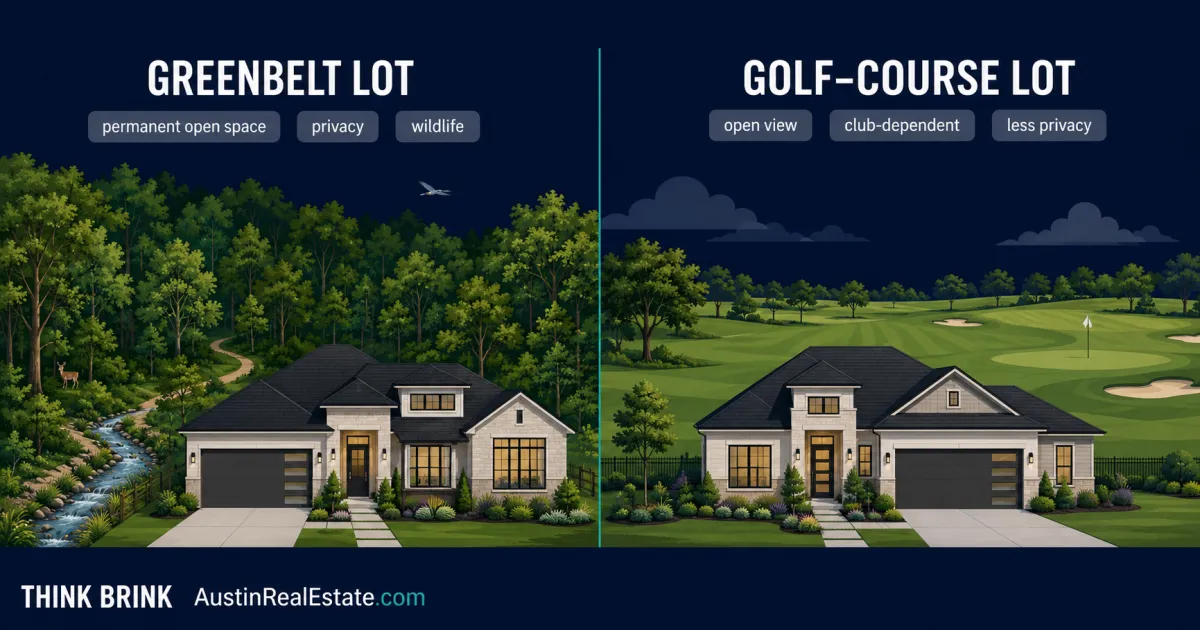
Northwest Austin Greenbelt and Golf-Course Lots: What the Premium Actually Buys You
The lot premium buyers pay, and rarely stop to price out
In Northwest Austin, two of the most reliable ways to add a large number to a home's price have nothing to do with the house. They are the lot behind it. A home that backs to protected greenbelt, or one that sits on a golf-course fairway, will almost always carry a premium over an otherwise identical home on an interior lot. Buyers feel the appeal instantly at the showing. The back of the house opens onto trees or fairway instead of a neighbor's fence, and it sells itself.
What buyers do less often is stop and ask what, specifically, the extra money is buying, whether that specific premium holds its value, and what the tradeoffs are that nobody brings up while you are standing on the back patio watching the sunset. Those questions matter, because greenbelt and golf lots are not one category. They range from genuinely irreplaceable, permanently protected land that will command a premium forever, to a strip of drainage easement that a good listing photo made look like a nature preserve. The gap between those two is the difference between a smart purchase and an overpay.
This post breaks down what a greenbelt lot and a golf-course lot each actually deliver in this market, where the premium is real and durable, where it is soft, and the tradeoffs that come attached to both. If you want the broader framing on how lots are priced across the area, I go deeper on that in the Great Hills hillside and view lots guide.
What actually counts as a greenbelt lot in Northwest Austin
The word greenbelt gets used loosely, and the looseness is where buyers get hurt. In the strongest sense, a greenbelt lot backs to permanently protected public open space: city parkland, a preserve, or a protected creek corridor that cannot be developed. Northwest Austin has genuine examples of this. The Bull Creek greenbelt system winds along the Loop 360 corridor between Spicewood Springs and RM 2222, and homes that back to that protected drainage look out over land that is not going to become anything else. Canyon Creek in 78726 sits against a headwater tributary of Bull Creek on its eastern edge, which is part of why the neighborhood has the wooded backdrop it does. I cover that neighborhood in detail in the Canyon Creek buyer guide.
That is the version worth paying for. Permanently protected land behind your home means privacy that cannot be taken away, a treed view that will not be replaced by a two-story house looking into your bedroom, and in many cases direct or near-direct access to trails. That combination is genuinely scarce, and scarcity is what makes a premium durable.
Then there is the weaker version, which also gets marketed as greenbelt. A lot might back to a drainage easement, a detention pond, a utility corridor, or a thin buffer of trees on land that is not actually protected from future development. It can look identical in a listing photo. It is not the same asset. A drainage easement can be cleared, a utility corridor can be accessed and torn up for maintenance, and unprotected adjacent land can change. Before you pay a greenbelt premium, you need to know which version you are buying, and that means confirming what the land behind the fence actually is and who controls it.
How to tell the difference before you pay for it
The verification is not complicated, but it has to be done. Pull the plat and the survey and look at what the adjacent parcel actually is. Protected parkland or preserve is owned and designated as such and will show up that way in county and city records. A drainage or utility easement is a different animal and will be labeled as one. Ask specifically whether the land behind the lot is publicly owned protected open space or privately owned land that merely happens to be undeveloped today. The answer determines whether the view and the privacy are permanent or borrowed. This is the single most important check on any greenbelt lot, and it is exactly the kind of thing a good buyer's agent runs down before you write the offer.
What a greenbelt lot actually buys you
When it is the real thing, a greenbelt lot delivers a specific and defensible set of benefits. Privacy is the first and biggest. No rear neighbor, no fence line staring back at you, and no risk of a new build changing your view. In a market where lots on both sides are increasingly built out, permanent open space behind the house is a real luxury.
The view and the natural setting are the second. Central Texas greenbelt land means oaks, cedar, creek drainage, and wildlife, and that backdrop changes how the house lives day to day. Buyers relocating from denser metros often describe it as the thing that made a house feel like Texas rather than like the suburb they left. Trail access is the third benefit where it exists. Backing to a system like Bull Creek can mean you walk out your back gate onto trails, which is a lifestyle amenity that a treadmill in the garage does not replace.
There is also a resale argument. Because protected greenbelt is finite and cannot be manufactured, homes with a true protected-greenbelt backdrop tend to hold their premium through market cycles better than homes whose only differentiator is an interior upgrade that the next owner may not value. The land does the work, and the land does not go out of style.
The greenbelt tradeoffs nobody mentions at the showing
Backing to protected wild land is not all upside, and an honest broker tells you the rest of it before you fall for the view. Wildlife is the first tradeoff. Greenbelt means deer, and in Northwest Austin the deer are numerous and they are hungry. If you were planning a garden, plan on fencing it or feeding the herd. It also means the occasional less-welcome visitor, from raccoons to snakes, because you have chosen to live at the edge of their habitat rather than in the middle of a subdivision.
Fire and brush management is the second. Land that backs to a creek corridor or preserve carries a wildland interface, and buyers should understand the defensible-space and insurance implications of that before they commit, especially in dry years. This is a reasonable thing to discuss with your insurance agent for the specific property, because it can affect both premiums and what maintenance you are responsible for.
Drainage and topography are the third. Many of the best greenbelt lots sit above a creek drainage, which means slope, and slope means you need to understand where water goes in a heavy rain and whether any part of the lot sits in or near a floodplain. A lot that backs to a creek is wonderful ninety-five percent of the time and something you need to have diligenced the other five percent. Confirm the floodplain status and drainage for the specific lot. None of these tradeoffs should scare a buyer off a great greenbelt lot. They should simply be known and priced in rather than discovered after closing.
What a golf-course lot actually buys you
Golf-course lots are the other classic Northwest Austin premium, and this geography has real golf frontage to offer. The Balcones Country Club, off Research Boulevard at Balcones Club Drive in 78750, operates two courses, the private Balcones Course and the semi-private Spicewood Course, and the homes built around them in the Balcones Village and Spicewood Estates area are the archetype of the Northwest Austin golf-course lot. For the neighborhood context around that area, see the Spicewood Estates buyer guide.
What a golf-course lot buys, at its best, is an open, manicured, green view that will not be built on, combined with an established, mature-tree setting because these courses and the neighborhoods around them have been in place for decades. The Balcones courses date to the mid-twentieth century, so the trees are grown and the streetscape is settled in a way new development cannot replicate. For a certain buyer, particularly one who plays or who simply wants the expansive green outlook, a fairway view is exactly the thing.
The premium on a golf lot is real, but it behaves differently than a greenbelt premium, and understanding that difference is the key to not overpaying.
The golf-course tradeoffs that change the math
The first and most important difference: a golf course is a private business, and its future is not guaranteed the way public parkland is. Golf has been through real contraction as a sport over the past two decades, and courses around the country have closed and been redeveloped. When you buy a greenbelt lot backing to protected parkland, the open space is permanent. When you buy a golf-course lot, your view depends on the course continuing to operate as a course. That is usually a safe bet with an established, well-supported club, but it is a risk that simply does not exist on protected public land, and it belongs in your analysis.
The second tradeoff is the day-to-day reality of living on a course. Errant golf balls are a genuine thing on fairway-adjacent lots, and depending on the hole and the lot position, they can mean the occasional ball in the yard or against the window. Course maintenance means early-morning mowers and irrigation. And you have less privacy on a golf lot than the marketing implies, because there are golfers on the course during playing hours with a clear sightline to the back of your home. A greenbelt lot gives you privacy and seclusion. A golf lot gives you an open view and a steady stream of people enjoying it alongside you.
The third is access and membership. Backing to a golf course does not automatically grant you play or club access, and the club's membership structure, initiation, and dues are separate from the home. Buyers sometimes assume the fairway behind the house comes with a tee time. It does not. If club access matters to you, price and confirm it separately.
How the two premiums hold value, side by side
Put simply: a true protected-greenbelt premium is the more durable of the two, because it rests on land that is permanently off-limits to development and therefore permanently scarce. A golf-course premium is real and can be substantial, but it carries a dependency on a private operator that a greenbelt lot does not, which is why I treat the two differently when advising a buyer on how much premium is defensible.
That does not make golf lots a worse buy. For the buyer who values the open manicured view, who is in an established club community with a healthy membership base, and who has priced the tradeoffs honestly, a golf lot can be a wonderful long-term home. It simply means the reasons the premium exists are different, and a smart buyer prices each lot on its own merits rather than lumping greenbelt and golf into a single vague idea of a premium view.
The worst outcome in either category is paying a protected-land premium for land that is not protected. That is the drainage-easement-marketed-as-greenbelt problem, and it is the golf-lot-on-a-struggling-course problem. Both are avoidable with the diligence described above, and both are expensive if you skip it.
How to decide what premium is worth paying
Start by naming what you actually want from the lot. If it is privacy and permanence, a true protected-greenbelt lot is your target and you should be willing to pay for the real thing and reject the imitation. If it is an open, green, manicured outlook and you like the idea of living in an established club community, a golf lot may fit better, and your diligence shifts toward the health and stability of the club.
Then verify before you value. Confirm exactly what the adjacent land is, who owns it, and whether it is protected or merely undeveloped. Check floodplain and drainage on any creek-adjacent lot. Understand the wildlife, brush, and insurance realities of a wildland edge, or the ball-strike, maintenance, and privacy realities of a fairway. Confirm what, if anything, the lot grants in terms of trail or club access. Only after all of that do you have the information to judge whether the asking premium is fair.
Finally, weigh resale. A premium lot in this market is usually a resale asset, not a liability, because the pool of buyers who want that outlook is deep in Northwest Austin. But the durability of that resale advantage tracks the durability of the thing creating it. Permanent protected land holds. A private operator's fairway holds as long as the operator does. Price accordingly. For how lot premiums fit into the wider pricing picture across these zip codes, see living in 78750 and 78759.
Frequently asked questions
Is a greenbelt lot in Northwest Austin worth the extra money?
If it backs to genuinely protected public open space, such as a park, preserve, or protected creek corridor, the premium is usually worth it because the privacy and view are permanent and cannot be built out. If the lot only backs to a drainage easement, utility corridor, or unprotected undeveloped land, the premium is much harder to justify because that land can change. The value depends entirely on whether the open space is protected, so verify that before you pay.
What is the difference between a greenbelt lot and a lot that just backs to trees?
A true greenbelt lot backs to land that is publicly owned and permanently protected from development. A lot that backs to trees may simply back to a drainage easement or privately owned undeveloped land that looks wooded today but is not protected. They can look identical in a listing photo. Pull the plat and survey and confirm what the adjacent parcel actually is and who controls it.
Do golf-course lots hold their value in Northwest Austin?
They generally do when the club is established and well supported, and this area has long-standing courses like the Balcones Country Club courses in 78750. The caveat is that a golf course is a private business, so the view depends on the course continuing to operate. That dependency does not exist on protected parkland, which is why a golf premium carries a risk a true greenbelt premium does not. Factor the health of the specific club into the decision.
What are the downsides of living on a golf course?
The main ones are errant golf balls on fairway-adjacent lots, early-morning course maintenance noise, less privacy than the marketing suggests because golfers have a sightline to the back of the home, and the fact that backing to a course does not grant club or play access. None of these are dealbreakers for the right buyer, but they should be understood and priced in before you pay a fairway premium.
Does backing to a greenbelt mean I will have wildlife and drainage issues?
Backing to a Central Texas greenbelt means deer, occasional other wildlife, and a wildland edge with brush-management and insurance considerations. Creek-adjacent lots also involve slope and drainage, so you should confirm floodplain status and how water moves across the specific lot. These are manageable realities rather than reasons to avoid greenbelt lots, but they should be diligenced rather than discovered after closing.
Does a golf-course lot come with a membership to the club?
No. Owning a home that backs to a golf course does not automatically grant play rights or club access. Membership, initiation, and dues are handled separately by the club and are independent of the home purchase. If club access is part of what you want, confirm and price it separately rather than assuming the fairway behind the house includes a tee time.
How can I tell if a lot marketed as greenbelt is actually protected land?
Look at the plat and survey and identify the adjacent parcel, then confirm through county and city records whether it is designated protected open space or an easement or private land. Protected parkland and preserves are owned and designated as such, while drainage and utility easements are labeled as easements. If you cannot confirm the land is protected, treat the greenbelt claim as a view that could change rather than a permanent one.
Which is the better buy, a greenbelt lot or a golf-course lot?
Neither is universally better; they suit different priorities. A protected-greenbelt lot delivers privacy and permanence and tends to hold its premium most durably. A golf-course lot delivers an open, manicured, established-community outlook that a certain buyer values highly, with a dependency on the club's continued operation. Decide what you want from the lot, verify the specifics, and price each on its own merits.
The honest summary
Greenbelt and golf-course lots are two of the most consistent premiums in Northwest Austin, and both can be excellent buys, but they are not the same purchase and they should not be evaluated the same way. A true protected-greenbelt lot buys permanent privacy, an unbuildable natural view, and often trail access, with tradeoffs around wildlife, brush, and drainage that are real but manageable. A golf-course lot buys an open, manicured, established-community outlook with tradeoffs around ball strikes, maintenance, privacy, and the fact that its view depends on a private business staying in business.
The premium is defensible when the thing creating it is durable and clearly understood, and it is a trap when it rests on land that is not actually protected or a course that is not actually stable. The buyers who do well here are the ones who name what they want from the lot, verify exactly what they are buying behind the fence, and price the tradeoffs honestly rather than paying for a listing photo. Do that, and a premium lot in Northwest Austin is one of the more satisfying purchases you can make. Skip it, and you may pay protected-land money for a borrowed view.
