What Makes a Great Hills Lot Worth the Premium - and How to Know If You're Paying for the Right One
If you've been searching Great Hills for more than a few weeks, you've probably noticed something that the listing data doesn't explain well: two homes with similar square footage, similar bedroom counts, and similar construction years can be priced $200,000 to $400,000 apart. Sometimes more. The house itself isn't what's driving that spread. The lot is.
Great Hills is one of the most terrain-driven neighborhoods in Northwest Austin. The Hill Country topography that makes the neighborhood distinctive also creates a clear value hierarchy among lots - and buyers who understand that hierarchy before they start making offers make meaningfully better decisions than buyers who discover it after they've already fallen in love with a specific house.
This post is specifically for buyers who already know they want Great Hills and are now trying to navigate the upper tier - the lots that command a premium and why they're worth it, what to look for when you're evaluating a specific property, and what the premium actually costs versus what the market would have you believe.
What Buyers Should Know About Great Hills Before Making an Offer
The Four Lot Types That Drive Great Hills Premium Pricing
Not all premium lots in Great Hills are the same. There are four distinct lot configurations that consistently produce the highest prices in the neighborhood, and each delivers a different combination of what buyers are actually paying for.
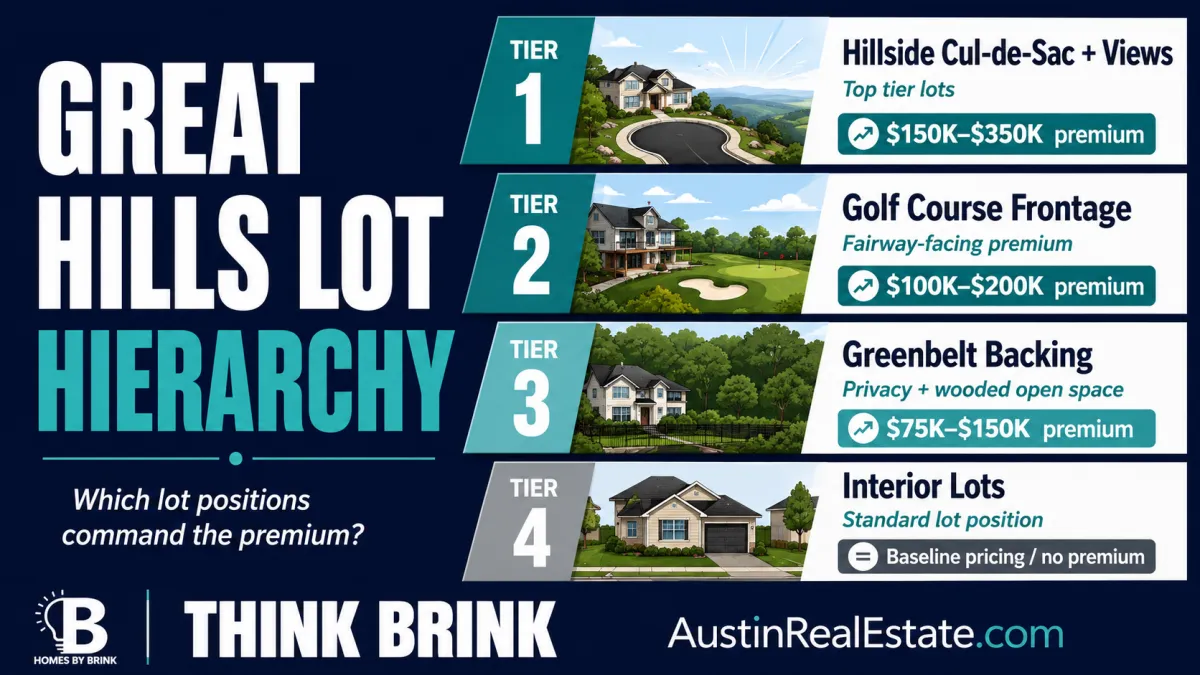
Hillside cul-de-sac lots with valley or Hill Country views are the most sought-after lots in the neighborhood and command the highest premiums. These are homes on dead-end streets or cul-de-sacs positioned on ridgelines or hillside elevations with westward or southwestward exposure that opens up to unobstructed views of the Hill Country terrain. The combination of minimal through-traffic from the dead-end positioning and the view out the back creates a daily living experience that is genuinely different from a suburban lot. Listing language for these homes consistently uses phrases like "perched above the treetops," "panoramic Hill Country views," and "sunset views from the deck" - and when that language is accurate rather than aspirational, it's reflecting a lot position that buyers are willing to pay a real premium for.
What makes these lots valuable beyond the obvious view is permanence. The terrain behind a hillside lot in Great Hills isn't going to be developed - it's either creek corridor, greenbelt, or Hill Country geography that doesn't support dense construction. The view you're buying today is the view you'll have in twenty years. That permanence is part of what the premium reflects.
Greenbelt-backing lots on wooded dead-end streets are the second tier of Great Hills premium lots. These homes back to the creek corridors, wooded slopes, and natural areas that lace through the neighborhood - particularly the Bull Creek watershed tributaries that run through the western portions of Great Hills. The backing is permanent open space in most cases, the privacy is genuine rather than manufactured by a fence line, and the mature tree canopy on these lots is often the most established in the neighborhood given how long the adjacent natural areas have been undisturbed.
The "plethora of cul-de-sacs and dead-end roads" that Great Hills is known for means these lots are more available here than in neighborhoods with a more conventional grid layout. But they're still meaningfully less common than interior lots, and when a well-positioned greenbelt-backing cul-de-sac home comes available in Good condition, it moves.
Golf course frontage lots in Fairway at Great Hills are a distinct premium category that attracts a specific buyer. These homes sit directly on the Great Hills Golf Course, primarily in the Fairway at Great Hills sub-section, with fairway views that in some cases include long sightlines down multiple holes. The view is different from a Hill Country view - more manicured, more social, more active - but it's a permanent and maintained open space backdrop that commands a consistent premium over interior lots. Homes perched above a quiet cul-de-sac backing to the 16th hole represent the overlap between the cul-de-sac premium and the golf course premium, and those specific positions sit at the top of the Fairway section's pricing.
Elevated lots with multi-level living and balcony access are the fourth premium category - homes that take advantage of the terrain by building down the hillside rather than flat, creating lower-level living spaces and multiple deck levels that capture the view from different elevations. Listing language for these homes often describes them as "exceptional three-level homes" or "multi-level retreats," and the architecture is specifically designed to maximize the terrain advantage. These tend to be larger, more custom builds from the 1990s and 2000s that were specifically positioned and oriented for the lot.
What Is Your 78750 or 78759 Home Worth Right Now?
What the Premium Actually Looks Like in Dollars
The honest pricing picture for Great Hills hillside premium lots versus interior lots requires nuance, because the spread varies by size, condition, and specific position. But the patterns are consistent enough to give buyers a reliable framework.
A well-positioned hillside cul-de-sac lot with genuine Hill Country views in Great Hills will typically trade at a premium of $150,000 to $350,000 over a comparable-square-footage home on an interior street without those views, assuming similar condition. The premium compresses toward the lower end when the view is partial or when the hill position is less dramatic. It expands toward the upper end for the most exceptional positions - ridgeline lots with 180-degree westward views, or lots where the terrain drop behind the house creates a sense of genuine privacy and altitude.
Golf course frontage in Fairway at Great Hills commands a premium of roughly $100,000 to $200,000 over comparable interior lots in the same section, reflecting both the permanent open space and the specific golf course lifestyle appeal.
Greenbelt-backing lots on wooded dead-end streets carry premiums in the $75,000 to $150,000 range over comparable interior lots, depending on how established the tree canopy is and how permanent the open space backing appears to be.
These ranges are approximate and condition-dependent. A hillside view lot with original 1985 finishes is not worth the same premium as a hillside view lot that has been comprehensively renovated. The lot premium and the condition premium are additive but also interact - a buyer who is willing to renovate can sometimes acquire the lot position at a reduced premium because other buyers are filtering out the renovation work.
How to Actually Evaluate a Specific Lot Before You Offer
This is where buyers consistently underinvest time relative to the financial stakes. A $200,000 lot premium is a significant component of a purchase decision and it deserves proportional evaluation.
Visit the lot at multiple times of day. The view from a hillside Great Hills lot at 10am on a sunny Saturday is not the same as the view at 7am on a weekday morning, or at sunset, or during a rainstorm. The canopy coverage, the light quality, and the sense of the space are all different at different times. If the view and the outdoor experience are part of why you're paying the premium, spend enough time at the property to actually understand what you're buying.
Walk the backyard and understand the slope. Hillside lots in Great Hills vary significantly in how usable the outdoor space actually is. Some hillside lots have a combination of usable flat areas and dramatic sloped terrain that creates an appealing layered landscape. Others are almost entirely steeply sloped, which means the view is real but the backyard isn't functional for much beyond the view itself. Know which you're buying before you make an offer.
Understand what's actually behind the property. Not all "greenbelt backing" in Great Hills is equal. Some lots back to managed natural areas that will remain undeveloped permanently. Others back to private lots that currently happen to be undeveloped or heavily wooded but carry no permanent open space protection. The difference between a city-owned greenbelt or creek corridor and a privately owned wooded lot that hasn't been developed yet is significant for long-term value. Your agent should be able to help you identify what the specific backing actually is.
Evaluate the access and the driveway. Hillside lots in Great Hills sometimes have steep driveway grades that are less obvious in listing photos. A driveway that requires careful navigation on a flat dry day becomes genuinely challenging on an icy morning or in heavy rain. Walk the driveway at your actual car, and think about what it means for daily life - multiple cars, teenagers learning to drive, package delivery, guests visiting.
Stand at the view point and look both ways. The view out the back is what the listing emphasizes. But also look at what's visible from the street facing the house, what the neighbor relationships look like from the perspective of privacy, and whether the lot position creates any noise exposure from 360 or 183 that isn't apparent from inside.
Check the foundation history specifically. Hillside lots in Central Texas clay soil are more susceptible to foundation movement than flat lots. The combination of slope, varying moisture levels across the lot, and decades of weather cycles creates more movement potential. Any hillside Great Hills home should have foundation inspection as a specific item in due diligence, ideally with an engineer rather than just a general inspector's observation.
What It Actually Costs to Own a Home in 78750 or 78759 Right Now
What the Premium Lots Tend to Have in Common Beyond the View
Buyers who have successfully navigated the Great Hills hillside premium tier consistently describe a set of characteristics that go beyond the listing description's headline features.
The street character matters as much as the lot itself. Homes on genuine cul-de-sacs or dead-end streets in Great Hills have a fundamentally different daily experience from homes on through-streets. The traffic, the noise, the number of cars passing, the sense of who belongs on the street - all of this shifts dramatically. Buyers who tour a cul-de-sac home and then tour a through-street home with similar views often find the cul-de-sac version much more appealing when they actually experience both rather than evaluating from photos.
The established trees on premium lots are often irreplaceable. A mature live oak that has been growing for 50 years on a hillside lot in Great Hills cannot be replicated by planting a new tree. The canopy coverage, the root system's influence on the microclimate, the visual character of the lot - these take decades to develop. Buyers who value this should factor it into their evaluation of specific lots rather than treating all "wooded" descriptions as equivalent.
The orientation matters. Westward-facing lots get the Hill Country sunset views but also get direct afternoon western sun, which affects cooling costs and outdoor comfort during Texas summers. East-facing lots get morning light and protected afternoon shade. Neither is wrong, but understanding which you're getting matters for both daily enjoyment and energy costs.
The Traps: What Looks Like Premium Isn't Always
Not everything marketed as a view lot or premium position in Great Hills actually delivers what buyers are paying for, and the gap between listing description and reality is wide enough to warrant specific caution.
"Treetop views" that depend on the absence of leaves. Some homes in Great Hills have views in winter when the deciduous trees have dropped their leaves, but essentially no view the rest of the year when the canopy fills in. A listing photographed in January can look like a premium view home that becomes a standard wooded lot experience by April. Visit at a time of year when the trees are fully leafed and verify what the view actually is.
"Privacy" that depends on adjacent lots staying undeveloped. The wooded privacy behind some Great Hills lots is a function of adjacent private property that currently has no structure on it. That private wooded lot can be developed, cleared, or built on at any time. True privacy in Great Hills comes from creek corridors, city greenbelts, or terrain that physically cannot be built on - not from a neighbor's undeveloped acreage.
Partial views from secondary areas only. Some homes are marketed with view language but the view is only accessible from one upstairs bedroom or a secondary balcony, not from the primary living spaces. If the view is a significant part of the premium, confirm where in the house it's actually visible from and whether that matches how you actually live day to day.
Steep hillside with no usable outdoor space. As mentioned earlier, some hillside lots in Great Hills are beautiful to look at and essentially impossible to use for outdoor living. If you're paying a hillside premium expecting a functional deck, backyard, or outdoor entertaining space, verify that the specific lot actually accommodates that before you're under contract.
Should You Sell Your 78750 or 78759 Home Before You Downsize?
The Buyer Who Belongs on a Great Hills Premium Lot
The hillside premium lots in Great Hills are genuinely the right purchase for a specific buyer. That buyer values permanence of view and natural setting over square footage maximization. They use outdoor living spaces - decks, terraces, covered patios with views - as a real part of their daily life rather than as an occasional weekend amenity. They are comfortable with the maintenance realities of a hillside property: steeper driveways, more complex foundation monitoring, landscaping that requires more management on a slope. They understand they're paying for something that cannot be replicated at this distance from downtown Austin.
The buyer who shouldn't pay the hillside premium is the one who values the view in theory but would realistically spend most of their time inside, would find the driveway and slope maintenance more stressful than scenic, and would be equally happy in a well-maintained interior lot home at $200,000 less. Both choices are legitimate. The key is being honest with yourself about which one you are before you're under contract on a hillside home that tested well on a sunny Saturday afternoon tour.
What Sellers in 78750 and 78759 Should Know About the Market Right Now
Frequently Asked Questions
How much more do hillside view lots in Great Hills cost compared to interior lots?
The premium varies by specific position, view quality, and condition of the home. Well-positioned hillside cul-de-sac lots with genuine Hill Country views typically command $150,000 to $350,000 over comparable interior lots. Golf course frontage in Fairway at Great Hills runs $100,000 to $200,000 over comparable interior lots in that section. Greenbelt-backing wooded lots on dead-end streets carry premiums of approximately $75,000 to $150,000.
How do I know if a "greenbelt" behind a Great Hills home is permanent?
You need to identify what the specific backing actually is - whether it's city-owned or county-managed open space, a creek corridor with permanent conservation status, or a privately owned undeveloped lot. Your agent should be able to help you pull the property records for adjacent parcels. Private undeveloped land provides privacy today but carries no guarantee of permanence.
Are hillside lots in Great Hills harder to insure or finance?
Not inherently, but foundation monitoring is more important on hillside lots in Central Texas clay soil, and some lenders will order a specific foundation report as part of the appraisal process on steeply sloped lots. Get a foundation inspection from a structural engineer as part of due diligence on any hillside lot rather than relying solely on a general inspector's observation.
Do view lots in Great Hills hold their value better than interior lots?
Premium lot positions in Great Hills have historically demonstrated stronger value retention through market cycles than interior lots, because the lot attributes are permanent and inimitable. The spread between premium and interior lots can compress slightly in slower markets and expand in competitive ones, but the premium lot category hasn't traded down to interior lot values in any recent market cycle.
What is the best way to evaluate a view lot before making an offer?
Visit at multiple times of day including early morning and evening. Walk the backyard and understand the slope and usability. Verify what's behind the property and whether it carries permanent open space status. Confirm where the view is actually visible from within the house. Drive the driveway in your actual vehicle. Check the foundation history specifically with an engineer rather than a general inspector. These steps take time but are proportional to the premium you're considering paying.
Is a hill view lot in Great Hills worth paying a premium for if the home needs significant updates?
It can be, but you need to run the math honestly. A hillside view lot with original 1988 finishes where the premium is $250,000 over comparable interior lots, and the renovation to bring it to buyer-ready standard costs another $150,000 to $200,000, produces a total investment that needs to be supported by comparable renovated hillside sales. Your agent should pull those specific comparables before you commit rather than after.
