What Relocating Buyers Should Know About Texas Homestead Exemptions and Property Tax Caps
Almost every buyer relocating to Northwest Austin from California, the Pacific Northwest, or out of state arrives with the same two-part impression of Texas property taxes: no state income tax, which they love, and eye-watering property tax rates, which they do not. Both halves are true. What most of them do not understand when they land is that Texas has a set of homestead protections that dramatically change the real number you pay, and that these protections do not apply automatically. You have to claim them, and if you do not, you will overpay, sometimes by thousands of dollars a year, for no reason other than not knowing the rules.
This is the post I end up recapping in person for nearly every relocating client. In 2026 the homestead rules got meaningfully more generous, so even buyers who did their homework a year ago are working from stale numbers. Here is how the Texas homestead exemption, the appraisal cap, and the over-65 freeze actually work, why they matter more than the sticker rate, and what you have to do to lock them in.
One important note before the details: I am a real estate broker, not a CPA or a tax attorney. This is general information to help you understand the landscape and ask the right questions. For how these rules apply to your specific situation, confirm current amounts with the county appraisal district and consult a CPA or tax attorney before you rely on anything here for a financial decision.
First, why the sticker rate misleads you
When a relocating buyer sees a combined Texas property tax rate that can run somewhere around 2 percent of value in this area and mentally compares it to the lower rate they paid in California, they often conclude Texas is punishing homeowners. But the comparison is broken in two ways.
First, California pairs a low property tax rate with a state income tax that can take a large bite of a tech salary. Texas has no state income tax at all. For a dual-income household earning well into six figures, which describes a large share of the buyers moving into the 78750, 78759, and 78726 corridor for Apple, the Domain, and the broader tech corridor, the income tax savings frequently dwarf the higher property tax. The total tax picture is what matters, not one line of it. I go deeper on this in my guide for California and Pacific Northwest buyers moving to Northwest Austin.
Second, and this is the part that gets missed, the headline rate is applied to a taxable value that the homestead exemption and the appraisal cap can hold well below market value. The rate is only half the equation. The base it applies to is the other half, and Texas gives homeowners real tools to shrink that base.
The residence homestead exemption: what changed in 2026
The homestead exemption reduces the taxable value of your primary residence. It applies only to the home you actually own and live in as your principal residence, not to a rental, a second home, or an investment property. When you claim it, a chunk of your home's value is carved out before the tax rate is applied.
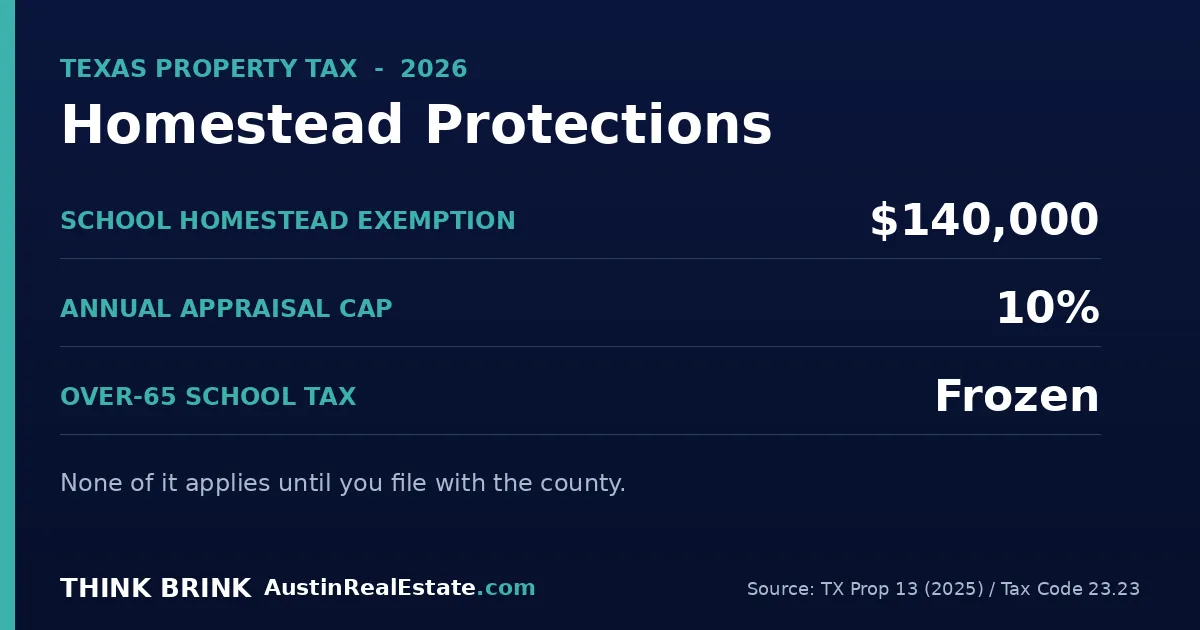
The most important piece is the school district portion, because school taxes are the largest slice of most Texas tax bills. As of 2026, the mandatory school district residence homestead exemption is 140,000 dollars. That figure was raised from 100,000 dollars by a constitutional amendment, Proposition 13, that Texas voters approved in November 2025 and that took effect January 1, 2026. For context on how fast this has moved, that same school exemption was only 40,000 dollars before 2023. It has more than tripled in three years.
What that means in plain terms: on the school district portion of your bill, the first 140,000 dollars of your home's value is not taxed at all. On a home valued at 500,000 dollars, your school taxes are calculated as if the home were worth 360,000 dollars. At typical school rates, that exemption alone saves a homeowner well over a thousand dollars a year, and often closer to two thousand.
Seniors and disabled homeowners get more
Homeowners who are 65 or older, or who are disabled, qualify for an additional school district homestead exemption on top of the general one. As of 2026 that additional amount was increased to 60,000 dollars, which stacks with the 140,000 dollar general exemption for a combined 200,000 dollars off the school-taxable value of the home. That increase came from a companion measure passed alongside Proposition 13 in the same November 2025 election. For a senior downsizing within Northwest Austin or relocating here in retirement, this is a substantial reduction, and it is one of the reasons the math on staying in Texas through retirement often works out well.
Local exemptions on top
Beyond the school exemption, counties, cities, and other local taxing units can offer their own optional homestead exemptions, frequently as a percentage of value. These vary by jurisdiction, so the exact stack depends on where in the area you buy. The county appraisal district can tell you which exemptions apply to a specific address. The point is that the school exemption is the floor, not the ceiling, of what you may be able to claim.
The 10 percent appraisal cap: the protection that compounds
The exemption lowers your starting taxable value. The appraisal cap controls how fast that value can climb. For me, this is the single most underappreciated homeowner protection in Texas, because its value grows every year you own the home.
Under Texas Tax Code Section 23.23, once you have a homestead exemption in place, the appraised value used to calculate your taxes cannot increase by more than 10 percent per year, no matter how much the market value of your home actually rises. If your neighborhood appreciates 20 or 30 percent in a hot year, and Northwest Austin has had those years, the market value on the appraisal roll can jump, but the capped value the county can actually tax you on can only step up 10 percent annually.
Over time, in an appreciating market, this creates a growing gap between what your home is worth and what you are taxed on. Longtime owners in established Northwest Austin neighborhoods often have capped values sitting well below true market value precisely because the cap has been throttling their taxable increases year after year. It is a slow-compounding benefit that rewards staying put.
The relocating buyer's trap
Here is the catch that catches transplants specifically. The cap only kicks in after you have owned the home and had the homestead exemption for a full year. In your first year of ownership, there is no cap protection yet, and the home is often reassessed at or near your purchase price, which itself may be a fresh, high market number. So your second-year tax bill can jump more than you expected, because you went from an uncapped first year to a capped value that reset at your purchase. Budget for a first-to-second-year increase, and do not assume the low tax figure a longtime seller was paying is what you will pay. Their capped value reflects years of the cap working in their favor. Yours resets when you buy. I cover this dynamic and the broader cost picture in my post on what it actually costs to own a home in 78750 or 78759 right now.
The over-65 school tax ceiling: the freeze
There is a third protection that matters enormously for older buyers and for anyone planning to age in place. When a homeowner turns 65 and has a homestead exemption, the school district portion of their property tax is frozen, or ceilinged, at the dollar amount they paid in the year they qualified. Even if rates rise and values rise for decades afterward, the school tax dollar amount on that home does not go above that ceiling, though it can go down.
This is the school-tax freeze, and it is a major reason retirees do well staying in their Texas homes long term. City and county taxes are not automatically frozen the same way, so it is not a total freeze, but the school portion is the biggest slice, so the effect is significant. The ceiling also has a portability feature: a qualifying homeowner who moves to another Texas home can generally transfer the percentage benefit of their ceiling to the new home. For seniors weighing a downsize within the area, this is a meaningful part of the calculation, and it is worth having a CPA or the appraisal district confirm how the transfer would work for your specific move.
The part relocating buyers get wrong: none of this is automatic
Here is the sentence I most want every transplant to absorb: the homestead exemption does not apply until you file for it. Buying the home does not trigger it. Closing does not trigger it. You have to file a homestead exemption application with the county appraisal district for the county your home is in.
The good news is that it is free, it is a one-time application for as long as you occupy the home, and Texas has made the timing forgiving. You generally qualify for the exemption for a tax year if you own and occupy the home as your principal residence as of January 1 of that year, and recent rule changes have made it possible to qualify in the year you purchase in many cases. You typically want the application in by the spring deadline, around the end of April, for full-year treatment, and Texas even allows late filing for a couple of years back with a potential refund if you missed it. But do not lean on the grace period. File it as soon as you close and occupy.
The number of relocating buyers who close, get busy, and simply never file is genuinely surprising, and every one of them overpays until they fix it. If you do one administrative thing after buying a home in Texas, make it filing your homestead exemption.
Watch out for the exemption-filing scams
One practical warning, because it targets new buyers specifically. Shortly after closing, many Texas homeowners receive official-looking letters offering to file the homestead exemption for them for a fee, often 50 or 75 dollars. Do not pay them. Filing the homestead exemption is free and you can do it yourself directly with the county appraisal district in a few minutes. These solicitations prey on transplants who do not yet know the process costs nothing.
How this fits into a relocation budget
Put the pieces together and the Texas property tax story is more nuanced than the scary sticker rate suggests. Yes, the rate is high relative to what you may be used to. But the homestead exemption carves 140,000 dollars off your school-taxable value, the 10 percent cap throttles how fast that value can climb once you have owned a year, the over-65 freeze eventually locks in the school portion for good, and there is no state income tax quietly draining your paycheck the way there may have been where you came from.
For the tech professionals I work with moving into the Apple and Domain corridors, the total tax picture usually lands far more favorably than they feared, provided they file their exemption and budget for that first-to-second-year bump. If you want to see how this interacts with the commute and price tradeoffs specific to where you are looking, my guides for Apple employees buying near the Parmer campus and for Northwest Austin property taxes and exemptions go deeper on the local specifics.
Frequently asked questions
How much is the Texas homestead exemption in 2026?
As of 2026, the mandatory school district residence homestead exemption is 140,000 dollars, raised from 100,000 dollars by Proposition 13, which Texas voters approved in November 2025 and which took effect January 1, 2026. Homeowners who are 65 or older or disabled qualify for an additional 60,000 dollars off the school-taxable value, for a combined 200,000 dollars. Counties and cities may add their own optional exemptions on top.
Do I have to apply for the homestead exemption or is it automatic?
You have to apply. It is not automatic and buying or closing on the home does not trigger it. You file a homestead exemption application with the county appraisal district where the home is located. It is free, it is generally a one-time filing for as long as you occupy the home, and you should do it as soon as you close and move in.
What is the 10 percent homestead cap in Texas?
Under Texas Tax Code Section 23.23, once you have a homestead exemption, the appraised value used to calculate your property taxes cannot rise more than 10 percent per year, regardless of how much your home's market value increases. The protection begins after you have owned the home and held the exemption for a full year, so your first year is uncapped and your second-year bill can step up.
Why did my property tax go up so much in my second year in Texas?
Because the 10 percent appraisal cap does not protect your first year of ownership. Homes are often reassessed at or near the purchase price when they sell, and the cap only starts limiting increases after you have held the homestead exemption for a full year. The jump from an uncapped first year to a capped-but-reset second year is normal, and relocating buyers should budget for it rather than assuming the prior owner's low bill.
Does Texas freeze property taxes for seniors?
Texas freezes the school district portion of property taxes for homeowners who are 65 or older with a homestead exemption. The school tax is ceilinged at the dollar amount paid in the year the owner qualified and cannot rise above it even as rates and values climb, though it can fall. City and county taxes are not automatically frozen the same way. The ceiling benefit can generally be transferred on a percentage basis if the homeowner moves to another Texas home.
Can I get the homestead exemption on a second home or rental?
No. The residence homestead exemption applies only to the home you own and occupy as your principal residence. Second homes, vacation homes, and rental or investment properties do not qualify. You can only have one homestead at a time.
Should I pay a company to file my homestead exemption for me?
No. Filing the homestead exemption is free and you can do it yourself directly with the county appraisal district in a few minutes. New Texas homeowners often receive official-looking letters offering to file for a fee. These are solicitations, not government notices, and there is no reason to pay them.
Does the higher homestead exemption help if I am relocating from out of state?
Yes, as soon as the home is your principal residence and you file. The exemption applies to your primary residence regardless of where you moved from, so a relocating buyer who closes and occupies the home gets the same 140,000 dollar school exemption and cap protections as a longtime Texan. The key is filing the application promptly rather than assuming it happens automatically.
The honest summary
Texas property taxes are high on paper and far more manageable in practice once you understand the homestead system. The 2026 rules are the most generous they have been in years: a 140,000 dollar school exemption, up from 40,000 just three years ago, 200,000 for seniors and disabled homeowners, a 10 percent cap that compounds in your favor the longer you stay, and a school-tax freeze at 65. Pair that with no state income tax and the total picture for a relocating tech household usually beats what they left behind. But the whole thing hinges on one unglamorous step: filing your homestead exemption with the county appraisal district after you close. Do that, budget for the second-year bump, and you will pay what Texas actually intends you to pay rather than the inflated number that scares people off.
This is general information, not tax or legal advice, and the amounts and rules can change, so confirm current figures with the county appraisal district and consult a CPA or tax attorney for your specific situation. If you are relocating to Northwest Austin and want a realistic picture of the all-in tax and carrying cost on the homes you are considering, that is exactly the kind of thing I help buyers work through. Reach out and we will run the real numbers together.
