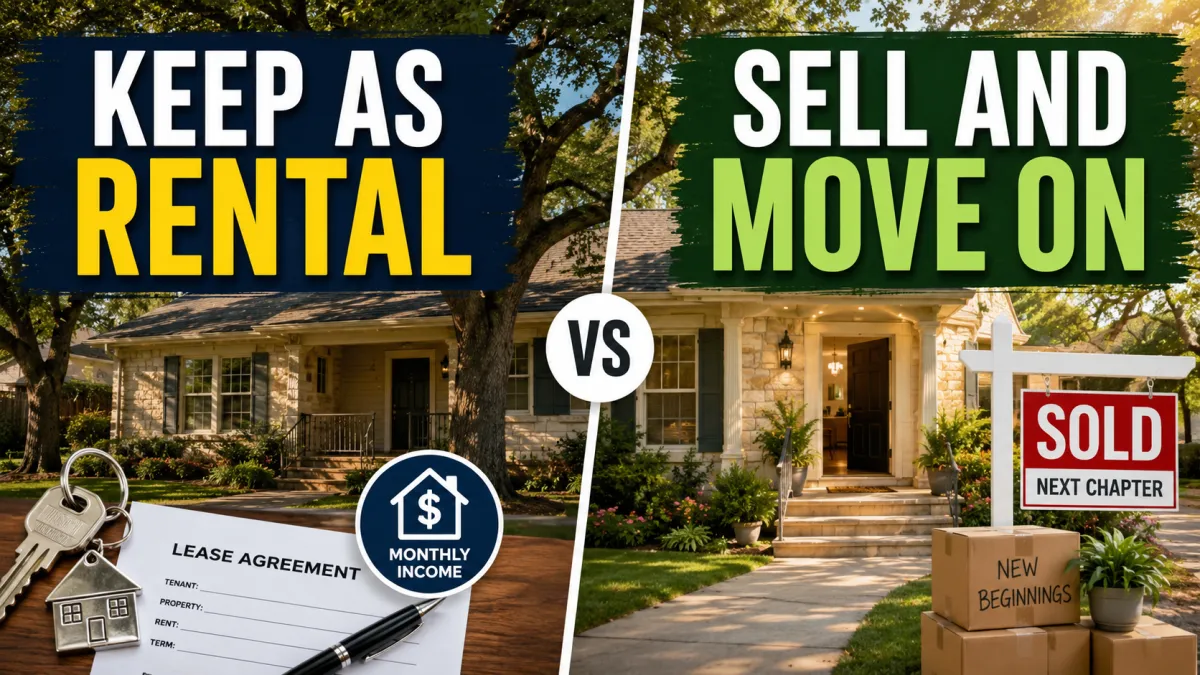
Should You Keep the Family Home as a Rental or Sell It?
If you own a longtime family home in Austin, especially in an established area like Northwest Austin, it can be tempting to ask:
Should we keep this house as a rental instead of selling it?
On paper, the idea may sound smart.
The home may have a lot of equity. Rents may be strong. The neighborhood may still be desirable. You may like the idea of keeping the property in the family. You may not feel ready to let go emotionally. And if the home is paid off or close to it, turning it into a rental can feel like an easy way to create income.
But keeping the family home as a rental is not automatically the best financial move.
It is also not automatically the best emotional move.
The better question is:
Does becoming a landlord actually support the next chapter, or does it keep you tied to a house you were trying to simplify away from?
How to Sell a Parent’s Home in Austin Without Overwhelming the Family
Why this question comes up so often
Longtime homeowners often consider keeping the home because the property still feels valuable in more ways than one.
It may represent:
family history
long-term appreciation
a desirable location
a possible income stream
a future inheritance asset
a home adult children might want someday
emotional hesitation about selling
fear of making a permanent decision
That is understandable.
But turning a family home into a rental changes the relationship with the property.
It is no longer simply “the family home.”
It becomes an investment property.
And investment properties need to be evaluated differently.
The first question: are you keeping it for financial reasons or emotional reasons?
This is the most important starting point.
Some owners say they want to keep the home as a rental because it is a good investment.
Sometimes that is true.
But sometimes the real reason is:
“I’m not ready to let go.”
“The kids grew up here.”
“Maybe someone in the family will want it later.”
“It feels wrong to sell it.”
“We worked so hard for this home.”
“What if prices go up?”
Those feelings are real.
But they are not the same as a rental strategy.
If the home is being kept mainly because the sale feels emotional, that does not make it wrong. It just means you should be honest about the reason.
A house can be meaningful and still not be the right rental.
What Happens If Your Adult Children Disagree About Selling the Family Home?
What makes a good rental property?
A good rental property is not simply a home you already own.
A good rental usually has:
strong tenant demand
durable finishes
manageable maintenance
clear cash flow after expenses
reasonable insurance and property tax costs
a layout that tenants value
a location that supports rental demand
systems that are not constantly at the end of life
a landlord or property manager ready to handle problems
A longtime family home may have a strong location but still be a difficult rental if it has:
aging HVAC
older plumbing
older electrical
high-maintenance landscaping
delicate finishes
dated appliances
deferred repairs
a layout that needs updating
emotional attachment that makes tenant wear-and-tear hard to accept
That is the honest evaluation.
The cash-flow question
Before keeping the home as a rental, you need to know the real numbers.
Not the hopeful numbers.
The real ones.
That means estimating:
monthly rent
mortgage payment, if any
property taxes
insurance
HOA dues, if applicable
property management fees
vacancy allowance
repairs and maintenance
landscaping
pest control
appliance replacement
capital improvements
accounting and tax preparation
reserves for major systems
The mistake is only comparing rent to the mortgage payment.
That is not enough.
A rental can look profitable until the roof, HVAC, water heater, plumbing, or make-ready costs show up.
Should You Move Closer to Your Adult Children When You Downsize?
The property management question
Do you want to manage tenants?
This matters more than people expect.
If you keep the home as a rental, someone needs to handle:
marketing the home for lease
screening tenants
lease paperwork
move-in condition
repair calls
rent collection
renewals
tenant complaints
vendor coordination
make-ready work between tenants
compliance with landlord-tenant rules
emergency repairs
You can hire a property manager, but that reduces cash flow.
You can self-manage, but that takes time, emotional energy, and willingness to deal with issues.
Texas landlord-tenant rules cover leases, repair obligations, security deposits, tenant rights, and related issues, so this is not something to approach casually. The Texas State Law Library’s landlord-tenant guide points homeowners to the relevant Texas Property Code lease provisions, and the Texas Attorney General explains that tenants have rights such as quiet enjoyment.
The maintenance question
A longtime family home may be perfectly livable for you, but that does not mean it is rental-ready.
Before renting it, think about:
roof age
HVAC age
water heater age
appliance condition
plumbing reliability
electrical safety
windows and doors
locks
drainage
landscaping
flooring durability
smoke alarms and carbon monoxide alarms where applicable
general safety and functionality
Tenants are not going to live with things the same way a longtime owner might.
That slow drain you tolerated?
That door that sticks?
That old appliance that mostly works?
Those may become landlord calls.
If the house already needs work, renting may simply delay the sale while adding another layer of repair obligations.
What If Your Northwest Austin Home Needs Too Much Work to Sell?
The emotional question
This one is underrated.
Can you emotionally handle tenants living in the family home?
That may sound strange until it happens.
Tenants may:
hang things on walls
change how rooms are used
wear out flooring
neglect the yard
ask for repairs
damage something by accident
treat the home like a rental, not a family memory
That is not a criticism of tenants. It is simply reality.
If every scuff, stain, or landscaping change would feel personal, keeping the home as a rental may be emotionally harder than selling it.
A home that was full of family memories becomes much easier to evaluate once you ask:
Can I treat this like an investment property?
If the answer is no, selling may be healthier.
How Long Does Downsizing Usually Take in Austin? A Realistic Timeline for Longtime Homeowners
The tax question
Taxes are a major reason to pause before converting a primary residence into a rental.
If you sell a primary residence and meet IRS rules, you may qualify to exclude up to $250,000 of gain from income, or up to $500,000 if married filing jointly. The IRS explains that this home-sale exclusion is subject to eligibility rules and limitations.
If you convert the home to a rental and sell later, the tax picture can become more complicated. Rental property may involve depreciation, rental income reporting, and potential depreciation recapture when sold. IRS Publication 527 covers residential rental property income, expenses, and depreciation rules, and IRS Publication 523 covers the sale of a home and the exclusion rules.
This does not mean you should never rent the home.
It means you should speak with a CPA before deciding.
The tax impact can be material, especially for a longtime owner with substantial appreciation.
The timing question: are you risking the home-sale exclusion?
This is one of the biggest “do not wing this” issues.
The primary residence exclusion generally depends on ownership and use rules, including whether the home was your main home for at least two of the five years before the sale. The IRS explains the $250,000/$500,000 exclusion and points homeowners to Publication 523 for full eligibility details.
If you move out, rent the home for a period of time, and sell later, you need to understand how that may affect eligibility, gain treatment, and depreciation.
This is CPA territory.
But from a planning standpoint, the message is simple:
Do not convert a longtime primary residence into a rental without understanding the tax clock.
What Happens to Your Property Taxes When You Downsize in Texas?
The inheritance question
Some families consider keeping the home so it can pass to children later.
That may or may not make sense.
Questions to discuss with your estate attorney or financial advisor include:
Do the adult children actually want the home?
Would they want to own it together?
Who would manage it?
How would repairs be paid?
Would one child want cash while another wants the property?
What happens if family circumstances change?
How does this fit into the broader estate plan?
Would selling now and investing proceeds be simpler?
Keeping the home “for the kids” is only wise if the kids want the responsibility and the plan is realistic.
A home can become a gift, but it can also become a shared burden.
The adult children question
If adult children are part of the conversation, ask them directly.
Not vaguely.
Ask:
Do you actually want this home someday?
Would you want to live in it?
Would you want to co-own it with your siblings?
Would you help manage it as a rental?
Would you be willing to buy out siblings if needed?
Are you comfortable with the financial and maintenance obligations?
If we rent it now, who handles decisions later?
Many families discover that adult children love the memory of the home more than the practical reality of owning it.
That is useful to know before making the decision.
How to Talk With Adult Children About Selling the Family Home
The market question
Some homeowners keep a home because they believe it will be worth more later.
It might be.
But appreciation is not guaranteed, and keeping the home has carrying costs.
You need to compare:
likely appreciation
rental income
repair costs
property taxes
insurance
management fees
vacancy risk
tax consequences
opportunity cost of not selling and using the proceeds elsewhere
A home in Northwest Austin may have strong long-term appeal, but that does not automatically make it the best use of your money in the next stage of life.
The lifestyle question
This may be the most practical question of all:
What are you trying to make your life feel like after downsizing?
If you are downsizing because you want:
less stress
fewer repairs
less responsibility
more freedom
easier travel
fewer things to manage
a simpler next chapter
Then keeping a rental may work against that goal.
A rental home can create:
repair calls
tenant issues
management decisions
tax paperwork
insurance questions
periodic vacancies
make-ready projects
ongoing emotional attachment
That does not mean rental ownership is bad.
It means it may not match the reason you downsized.
What to Do With a House Full of Stuff Before Downsizing in Northwest Austin
When keeping the home as a rental may make sense
Keeping the family home as a rental may be worth considering if:
the numbers are strong after realistic expenses
the home is in good rental condition
major systems are solid
you have cash reserves
you are comfortable being a landlord or hiring management
you understand the tax implications
adult children support the plan realistically
the property fits your broader financial strategy
you can emotionally treat it as an investment
That last one matters.
If you can truly shift from “family home” to “rental asset,” the conversation becomes clearer.
When selling may make more sense
Selling may be the better option if:
the home needs major repairs
rental cash flow is weak
you need proceeds for your next home or retirement plan
property management sounds exhausting
adult children do not actually want the home
the tax implications favor selling sooner
you want a clean transition
you are downsizing to reduce responsibility
you would be emotionally bothered by tenant wear-and-tear
you do not want another property to manage
For many longtime homeowners, selling creates the cleanest path into the next chapter.
That clarity can be worth a lot.
What about testing it as a rental for a year?
Some homeowners think:
“Let’s just rent it for a year and see.”
That can be a reasonable option in some situations, but it should still be intentional.
Before doing that, ask:
What is the exit plan?
What happens if the tenant wants to renew?
What if the market changes?
What repairs are needed before renting?
How does this affect taxes if we sell later?
Are we doing this because it is smart, or because we are not ready to decide?
A one-year rental test can create useful breathing room.
It can also delay an inevitable sale while adding tax and maintenance complexity.
What about renting to family?
Renting to family can sound easier, but it can be more complicated.
You need to think about:
market rent versus discounted rent
written lease terms
maintenance expectations
who pays for repairs
what happens if rent is late
whether family dynamics will suffer
tax treatment and documentation
whether siblings see it as fair
A family rental still needs clear boundaries.
Sometimes renting to family works well.
Sometimes it turns a property issue into a relationship issue.
Downsizing in Northwest Austin After Living in Your Home for 20+ Years
A simple decision framework
Before deciding whether to keep or sell the family home, answer these questions:
1. Does the home work as a rental on real numbers?
Include vacancy, repairs, management, taxes, insurance, and reserves.
2. Is the home rental-ready?
If not, what will it cost to make it ready?
3. Do you want to be a landlord?
Or are you willing to pay someone else to manage it?
4. What are the tax consequences of selling now versus later?
Talk to a CPA before deciding.
5. Do adult children actually want the home or just the memory?
Ask clearly.
6. Does keeping the home support your next chapter?
Or does it preserve the very stress you were trying to reduce?
If those answers are strong, keeping it may make sense.
If not, selling may be the cleaner decision.
The common mistake people make
The biggest mistake is treating the family home like a rental just because you already own it.
That is backward.
You would not normally buy an investment property without analyzing the numbers, the condition, the management plan, and the exit strategy.
So do not keep one without doing the same.
The fact that the home has sentimental value makes the analysis more important, not less.
What Should You Fix Before Selling a Long-Time Family Home in Northwest Austin?
My practical take
If you are downsizing from a longtime home, I would be very careful about keeping it as a rental unless the numbers, condition, management plan, and tax strategy all make sense.
A longtime family home can be a great asset.
But it can also become the thing that keeps you mentally, financially, and emotionally tied to the chapter you were trying to simplify.
Selling is not always the right answer.
Keeping is not always the smart answer.
The right answer is the one that supports your life, your family, and your finances going forward.
Should You Sell As-Is or Fix Up a Long-Time Home in Northwest Austin?
Final thought
Should you keep the family home as a rental or sell it?
Maybe either.
But do not make the decision based only on emotion, fear of regret, or a vague belief that real estate always goes up.
Make the decision like an owner and an investor.
Look at the numbers. Understand the tax implications. Evaluate the condition. Talk honestly with your adult children. Decide whether you really want to manage a rental. And be clear about what kind of next chapter you are trying to create.
The family home may have been a wonderful place to live.
That does not automatically mean it is the right property to keep.
Downsizing Checklist for Seniors in Austin
Watch the Downsizing with Dignity Video Series
FAQ
Should I keep my family home as a rental or sell it?
It depends on the rental numbers, property condition, tax implications, management plan, family goals, and whether keeping the home supports your next chapter. Do not decide based only on emotion or the fact that you already own it.
Is a longtime primary residence a good rental property?
Sometimes, but not always. A good rental needs strong tenant demand, manageable maintenance, realistic cash flow, and a clear management plan. A longtime home with aging systems or emotional attachment may be harder to manage as a rental.
What tax issues should I consider before renting out my former home?
You should ask a CPA about the home-sale exclusion, rental income, depreciation, depreciation recapture, and how converting a primary residence into a rental could affect a future sale. The IRS explains that qualifying homeowners may be able to exclude up to $250,000 of gain, or up to $500,000 for married filing jointly, when selling a main home.
Can I rent the home for a year and then sell?
Possibly, but you should understand the tax, timing, tenant, and maintenance implications before doing that. A short rental period can provide flexibility, but it can also complicate the eventual sale.
Should I rent the home to my adult children?
Maybe, but use clear written terms and realistic expectations. Family rentals can work, but they can also create conflict if rent, repairs, fairness, or exit plans are not discussed clearly.
What is the biggest mistake homeowners make when deciding whether to keep or sell?
The biggest mistake is keeping the home as a rental without analyzing it like an investment. You need real numbers, a management plan, tax guidance, and an honest look at whether the property supports the life you want next.
