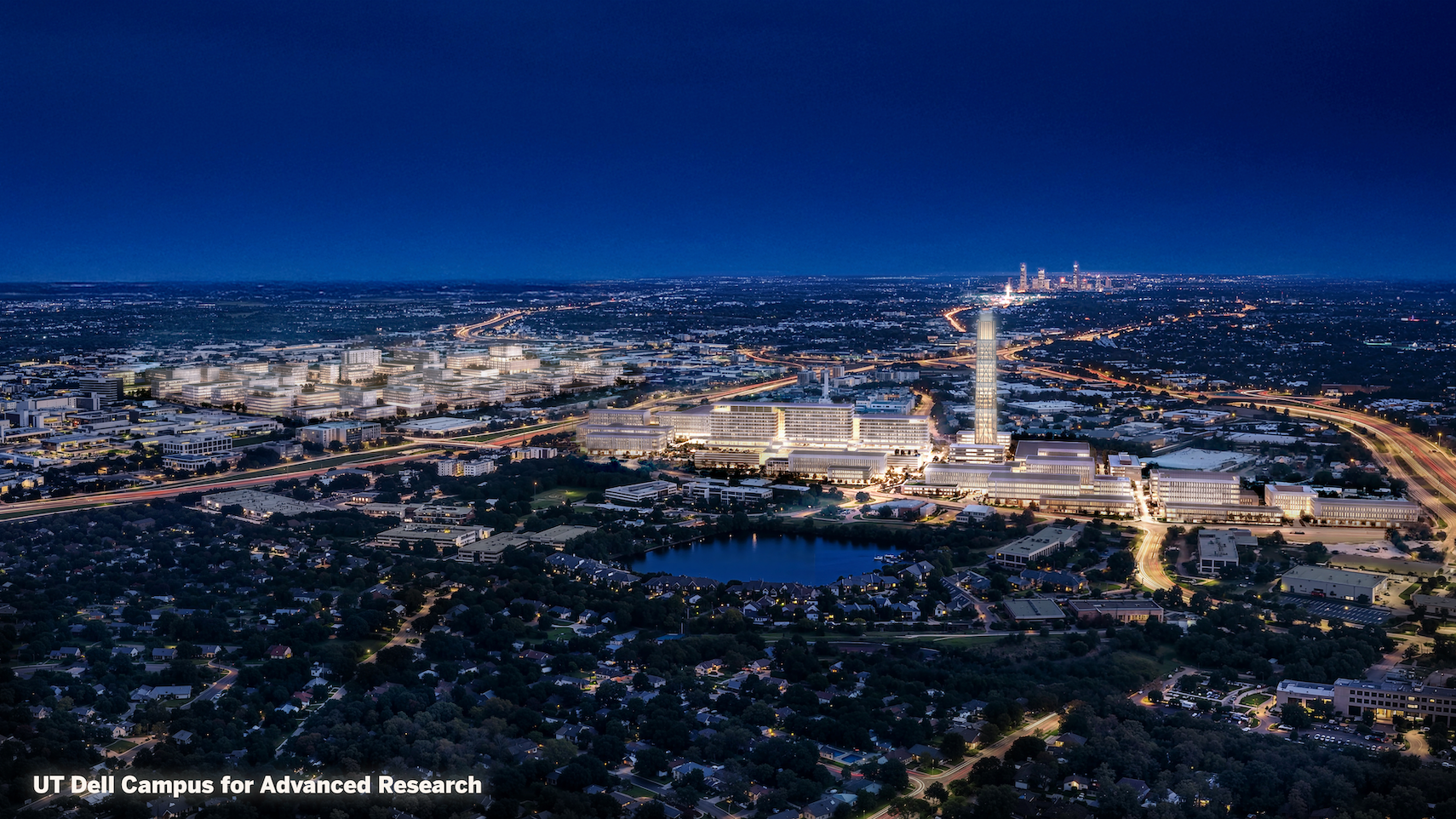
How the UT Dell Medical Center Changes the North Austin Housing Equation Through 2030
Every time a major project gets announced in Austin, somebody tells a homeowner nearby that their property just went up in value, and most of the time that is not how it works. So let me take the UT Dell Medical Center, which is a real $5 billion project with a real construction schedule starting this fall at MoPac and Braker, and walk through what it plausibly does to housing in North and Northwest Austin, what it plausibly does not do, and what the timing actually looks like for someone making a decision this year.
The short answer up front is that this is a slow, structural change rather than a fast, price-moving one, and the near term effect on the neighborhoods closest to the site is more likely to be construction traffic than appreciation.
The scale is real, and so is the timeline
The facts are not in dispute. The UT System Board of Regents authorized up to $1 billion for the first phase on August 12, 2026, the total project is budgeted at $5 billion, the medical center occupies 27 acres southwest of West Braker Lane and MoPac inside a research campus of more than 300 acres, and the program calls for roughly 2.5 million square feet with a 300 to 500 bed hospital operated in partnership with MD Anderson. Early site work begins in fall 2026, substantial completion is targeted for July 2030, final completion for December 2030, and the full slate of specialty programs phases in by 2032.
That schedule is the single most important thing for a homeowner to internalize. The first billion dollars is site development, excavation, design fees, and long lead equipment procurement, with $650 million of it going to site development alone. None of that puts a nurse, a researcher, or an oncologist into a house near Braker Lane. The people arrive at the end of the pipeline, not the beginning.
The employment number nobody actually has
I want to flag something, because I have already seen versions of this story floating around with confident job figures attached to it. UT has not published a permanent employment count for the medical center, and it has not published a construction employment figure either. As of early September 2026, those numbers do not exist publicly.
What we do know is that MD Anderson is contributing financially and relocating some of its Houston faculty to Austin, that Dell Medical School currently runs roughly 200 active students and nearly 500 residents and fellows, and that a hospital of 300 to 500 beds with a full service emergency department and an outpatient network is, by the nature of the thing, a large employer with a broad wage range. Nurses, techs, imaging staff, pharmacy, food service, facilities, administration, research staff, and physicians all sit in different parts of the housing market, and they will not all be shopping in the same price band.
If somebody hands you a specific job number for this project right now, ask them where it came from.
What a permanent institution does to a market, and how slowly
Here is the honest mechanism. Major employers do not raise home values by existing. They change where a certain number of households want to live, and they do it gradually, and the effect gets absorbed by whatever supply exists in the area.
That last clause is the part most people leave out, and in this corridor it is decisive. The North Burnet/Gateway 2035 master plan anticipates roughly 40,000 residential units in the district, along with 12 to 13 million square feet of office and commercial space, 4 to 5 million square feet of retail, and 3,000 to 4,000 hotel rooms. The area was already rezoned to allow buildings between 120 and 491 feet in the research and sciences subdistrict, and the entitlements for that density are on the books today.
So the same district that is gaining a $5 billion hospital is also the district planned to absorb tens of thousands of new housing units. A medical center adds demand. The zoning adds supply. Anyone telling you the first one automatically wins is selling something.
Where the effect is more likely to show up is in the character of demand rather than the raw number. Hospital and research employment is stable, it is not cyclical the way tech hiring has been, and a lot of it cannot be done remotely. A cardiac nurse working twelve hour shifts is going to care a great deal about a fifteen minute commute in a way a software engineer on a hybrid schedule does not. That is the type of demand that supports established, close-in neighborhoods over time, and it is a different flavor from what the Domain office buildout brought.
Which neighborhoods sit closest
The site is at MoPac and Braker, which puts it inside a genuinely short drive of a long list of established Northwest and North Austin neighborhoods. On the west side of MoPac, in 78759 and 78750, that includes Angus Valley, Barrington Oaks, Balcones Woods, Great Hills, Spicewood Estates, and the Balcones Village and Balcones Country Club area. On the east side, in 78758 and 78727, it includes Gracywoods, North Park Estates, Scofield Farms, Milwood, and Wells Branch, along with the Domain-adjacent condo and apartment inventory that already exists.
The commute geography is the thing to pay attention to. Everything I just listed is inside roughly a ten to fifteen minute drive of the site under normal conditions, which is exactly the radius that matters to shift workers. That is a much larger and more established housing supply than most new employment centers get to draw on, and it is one reason I do not expect a dramatic squeeze in any single neighborhood.
Transit is a live variable too. The CapMetro Red Line runs through the district, the McKalla Station is already operating, the Broadmoor Station is planned inside Uptown ATX, and double tracking work is intended to add operational flexibility on the line. Whether hospital staff actually use it depends on schedules that rail service has historically not matched well, so I would not price that in yet.
The near term is construction, not appreciation
Between now and 2030, the practical experience of living near this site is a very large construction project. Site clearing and excavation on 27 acres, inside a campus of more than 300 acres that is also developing research facilities and student housing, generates heavy truck traffic on Braker and on the MoPac frontage for years.
That is happening on top of the road and drainage work already reshaping Northwest Austin through 2029, which is its own multi-year disruption in this part of town. If you are a seller in one of the neighborhoods immediately adjacent to the site, a construction detour on the route a buyer takes to your showing is a real and immediate factor, and the hospital that opens in 2030 is not.
I would rather you know that going in than find out from a buyer's agent.
What this means if you are selling
If you are selling in the next twelve months, the medical center is a talking point and not a pricing input. Appraisers work from closed comparable sales, and there are no closed sales anywhere in Austin that reflect a hospital opening in 2030. Pricing a house above the comps because of a future employment center is how you sit on the market for ninety days and then reduce.
Where it does help is in marketing narrative and buyer confidence, particularly with relocating buyers who are trying to evaluate whether this part of Austin has staying power. A buyer moving from out of state who is nervous about tech layoffs hears "academic medical center, MD Anderson partnership, opens 2030" differently than they hear a generic growth pitch, and that can matter at the margin on days on market.
For context on the market they are pricing into, the Austin-Round Rock-San Marcos metro median sale price was $435,000 in July 2026, up about 1 percent year over year, on more than 2,700 closed sales, which was up 4.4 percent from July 2025. Travis County came in at a $520,000 median with 6,586 active listings, and Williamson County at $415,000 with 4,258 active listings. That is a market with real inventory, and real inventory means buyers have choices, and buyers with choices do not pay a premium for a hospital that opens in four years.
What this means if you are buying
If you are buying in this corridor now, you are buying ahead of the opening, and that is a legitimate position to take as long as you take it for the right reasons. Buy the house, the lot, the school assignment, and the commute you actually want today. If the medical center adds something over the next several years, treat it as upside rather than as the thesis.
The one place I would think harder is the condo and townhome inventory near the Domain and along the Braker corridor, because that segment is the most exposed to the new supply the North Burnet/Gateway plan contemplates. Adding a hospital nearby helps demand, but so does a lot of new construction competing for the same renter and buyer, and in an area entitled for tens of thousands of units the supply side is not a footnote.
If you are a healthcare professional relocating for this project specifically, the timing is unusual in a useful way. You have four years of visibility on where your job will be, which almost nobody gets, and you are not competing yet with the wave of colleagues who will be shopping in 2029 and 2030.
Frequently asked questions
Will the UT Dell Medical Center raise home values in North Austin?
Probably over time and modestly, through employment demand rather than proximity itself, and not on a schedule that shows up in 2026 or 2027 comparable sales. The district is also entitled for roughly 40,000 new residential units, which works against a sharp price effect.
When will the hospital actually open?
Substantial completion is targeted for July 2030, final completion for December 2030, and full specialty programs are expected to phase in by 2032.
Which neighborhoods are closest to the site?
On the west side of MoPac, Angus Valley, Barrington Oaks, Balcones Woods, Great Hills, Spicewood Estates, and Balcones Village. On the east side, Gracywoods, North Park Estates, Scofield Farms, Milwood, and Wells Branch, plus Domain-adjacent condos and townhomes.
How many jobs will the medical center create?
UT has not published a permanent or construction employment figure as of early September 2026. Any specific number you see attributed to this project right now is an estimate rather than an announcement.
Should I buy near the site now to get ahead of it?
Only if the house works for you on its own merits. A 2030 opening date is too far out to justify overpaying today, and the construction period between now and then is a real negative for the closest streets.
Should I wait to sell until the hospital opens?
That is a four year hold, and four years of carrying costs, interest, taxes, and maintenance almost never pencil against a speculative and unquantified appreciation bump. Sell when your own situation says to sell.
Where I land on it
This is a structural change to North Austin and it belongs in the same conversation as the Domain buildout, the North Burnet/Gateway rezoning, and the tech corridor along Parmer, which is to say it is one more reason this part of the city keeps attracting institutional capital rather than a reason to change what you are doing this month.
The mistake is treating a 2030 project like a 2026 event. The other mistake, and the one I see more often, is ignoring it entirely and then being surprised in three years when the corridor looks different.
If you own in Northwest or North Austin and you want a straight read on how this fits your specific street, your specific timeline, and what your house is worth today rather than in 2030, reach out. I will give you the honest version.
