What Buyers Should Know About the Jollyville Corridor Before Making an Offer
The Jollyville corridor is one of those parts of Northwest Austin that everyone drives through and almost nobody shops as a single place. Jollyville Road runs the spine of it, roughly parallel to US 183 between the Arboretum area and Parmer Lane, and the neighborhoods that hang off it cover a wide range of ages, prices, and school assignments. That is exactly why buyers get confused here. Two houses less than a mile apart on the same corridor can feed different schools, sit in different zip codes, and trade at prices that are $150,000 apart for reasons that are not obvious from the curb.
This guide is written to fix that. If you are looking along Jollyville Road because a relocation package pointed you at Northwest Austin, because you work at Apple or the Domain, or because you searched "homes near McNeil High School" and this corridor kept coming up, here is what actually matters before you write an offer.
Where the Jollyville corridor actually is
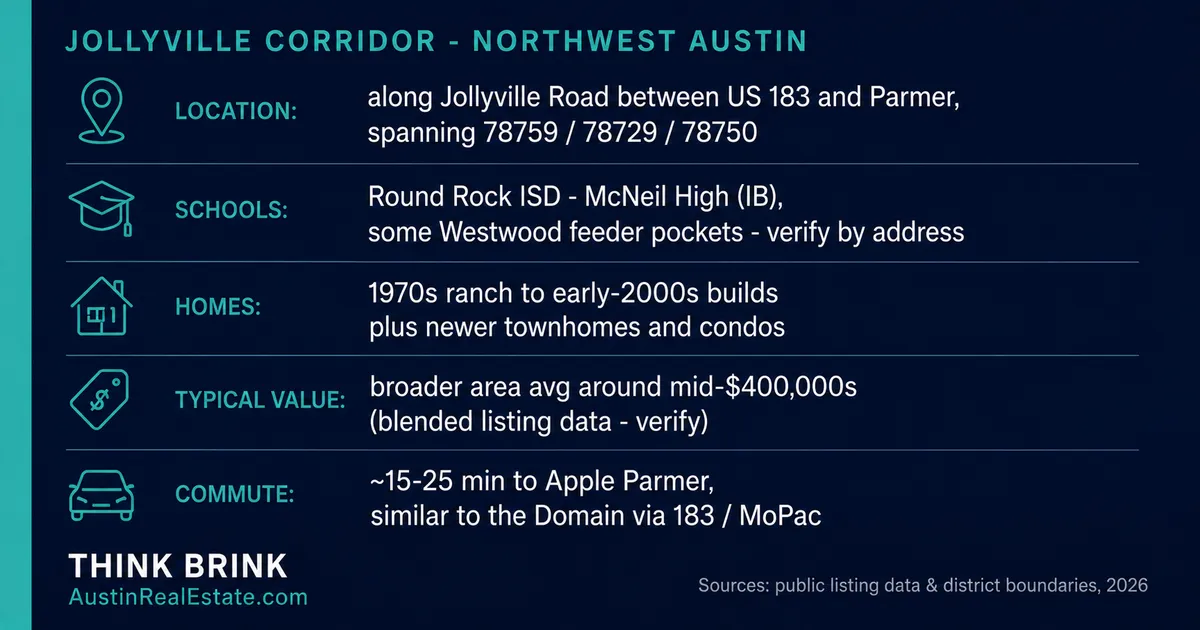
When people say Jollyville, they can mean two things. There is the historic Jollyville community, an older unincorporated pocket up near McNeil Road and the 78729 zip code. And there is the broader Jollyville Road corridor, the string of established neighborhoods that line Jollyville Road as it runs through 78759 and edges into 78729 and 78750. This guide treats it as the corridor, because that is how buyers experience it: a north-south band of 1970s-through-early-2000s neighborhoods sitting between US 183 to the east and the greenbelt and MoPac side to the west.
The corridor's appeal is location, and it is a specific kind of location. You are inside the loop of Northwest Austin's job access without being in a master-planned community forty minutes north. From most of the corridor you have quick reach to US 183, MoPac, Parmer Lane, and SH 45, which is the combination that gets you to Apple's Parmer campus, the Domain, Dell in Round Rock, and the 183 tech corridor without committing to a single one of them. That optionality is worth more than buyers realize until they have lived through a job change and kept the same house.
The school picture, and why it is the whole game here
The single most important thing to understand about the Jollyville corridor is that it is served by Round Rock ISD, and Round Rock ISD is a big part of why these homes hold value. But "Round Rock ISD" is not one answer. Depending on the exact address, students along the corridor may attend Jollyville Elementary, Live Oak Elementary, or Pond Springs Elementary, then Deerpark Middle School or Pearson Ranch Middle School, and then McNeil High School. Some southern and western pockets adjacent to the corridor feed the Canyon Vista and Westwood pathway instead, which is the most sought-after feeder in this whole part of Austin.
That difference matters in dollars. McNeil High School is a strong, well-regarded campus and an IB World School, and homes zoned to it command a real premium over comparable homes outside Round Rock ISD. Westwood High School, also an IB World School, sits at the very top of the local hierarchy, and the handful of corridor-adjacent homes that feed the Canyon Vista and Westwood pathway trade accordingly. The practical takeaway is simple and it is the one mistake I see relocating buyers make most: do not assume the school assignment from the listing photos or the neighborhood name. Verify the elementary, middle, and high school for the specific address with the district before you fall in love with a house. Boundaries have been redrawn in this part of Round Rock ISD before, and a street you assumed fed McNeil may not, or may feed a different elementary than the one two blocks over.
If schools are the reason you are shopping this corridor, build your search around the verified feeder first and the house second. It is the opposite of how most people shop, and it is the right order here.
What the homes are actually like
The Jollyville corridor is not a single vintage. That is its strength and its complication. You will find original 1970s single-story ranch homes on generous lots, 1980s and 1990s two-story traditionals, and pockets of newer townhome and condo product built in the late 1990s and 2000s. Lots on the older sections tend to be larger than what newer subdivisions to the north offer, with mature trees that took forty years to grow and cannot be bought at any price in a new build.
Because the housing stock spans decades, condition is everything here. A 1978 house that has been thoughtfully updated, with the foundation watered and maintained, the original cast-iron or galvanized plumbing addressed, the electrical panel modernized, and the single-pane windows replaced, is a genuinely good home. The same floor plan next door that has had nothing done since the Reagan administration is a very different purchase, even at a lower price. On this corridor, the spread between an updated home and a dated one is not just cosmetic. It is roof, HVAC, plumbing, electrical, and windows, and those systems on a forty-plus-year-old house are where the real money hides.
The condition tiers to shop by
It helps to sort corridor homes into three honest buckets. The first is the fully renovated home, where a previous owner or a flipper has already spent the money on systems and finishes. You pay the most per square foot for these, but you inherit the fewest surprises. The second is the well-maintained original, where the house is dated in style but the bones and systems have been kept up. This is often the best value on the corridor for a buyer willing to update on their own timeline. The third is the deferred-maintenance home, priced to reflect the work it needs, which can be a strong buy for someone who understands renovation costs and a trap for someone who does not. Knowing which bucket a listing falls into before you tour it will save you a lot of wasted Saturdays.
The commute reality
The corridor sells itself on job access, so let us be specific about it rather than waving at "convenient location." From the Jollyville corridor you are positioned for a genuinely short run to Apple's Parmer Lane campus, typically on the order of fifteen to twenty-five minutes depending on where on the corridor you start and how Parmer is behaving that morning. The Domain and its employers, including Amazon and Indeed, are a similar reach down MoPac or 183. Dell's Round Rock campus is a straightforward run north. And because you have both 183 and MoPac available, you are not hostage to a single road having a bad day.
Compare that to buying further north in Cedar Park or Leander for the same money and a newer house. You gain square footage and lose your mornings. For a two-income tech household where both commutes matter, the corridor's central position inside the job triangle is frequently the deciding factor, and it is a rational one. Time in traffic is the one cost you cannot refinance later.
What the market looks like along the corridor
The corridor trades as a location play, which keeps a floor under values even when the broader Austin market softens. Because the neighborhoods here are established and the school access is strong, well-priced, updated homes tend to move faster than dated ones sitting on aspirational prices. As a rough reference point, public listing data has put the average home value in the broader Jollyville area in the mid-$400,000s, though that figure blends a lot of different housing types, from smaller condos to full-size single-family homes, so treat it as a directional anchor rather than a precise number for any one house. Your actual price depends heavily on the sub-neighborhood, the school feeder, the lot, and the condition tier.
Fresh, neighborhood-specific MLS figures move month to month, so if you want current medians for the exact pocket you are targeting, that is a quick pull rather than a guess, and it is worth doing before you set a budget. The honest way to think about corridor pricing is that you are paying primarily for location and school access, and the house itself is the variable you negotiate.
How the Jollyville corridor compares to its neighbors
Buyers rarely shop the corridor in isolation. It usually comes down to the corridor versus a named neighborhood or versus going further out. Against a place like Milwood, the corridor overlaps heavily in age, price band, and Round Rock ISD access, and the decision often comes down to the specific school feeder and which streets feel right to you. Against the newer communities up north, the corridor trades newness and a few hundred square feet for a materially better commute and mature lots. And against the pricier established neighborhoods just south and east, the corridor is often the more affordable way to buy into the same general job access and school quality.
If you are weighing the corridor as part of a broader Northwest Austin search, the North Austin neighborhood guide and the rundown of the best neighborhoods between MoPac, 183, and Parmer are the two pieces I would read alongside this one, because they place the corridor in the context of everything it competes with.
What to check before you make an offer
On a corridor this varied, due diligence is not a formality. Before you write an offer on a Jollyville-area home, get concrete answers on a short list of things. Confirm the exact school assignment for the address with Round Rock ISD, not the listing. Get eyes on the age and condition of the roof, HVAC, water heater, and electrical panel, because on a home built in the 1970s or 1980s these are the systems that determine whether you are buying a house or a project. Ask about the plumbing material and whether any galvanized or cast-iron original piping remains. Look hard at the foundation, which in Central Texas clay soils is always worth a specific look, especially on older slabs. And understand the lot, including drainage, tree health, and whether any of that mature canopy is a hazard rather than an asset.
None of these are reasons to avoid the corridor. They are reasons to buy the right house on it at the right price, which is a very different thing from avoiding a mistake by luck.
Property taxes and the homestead exemption
Like the rest of this area, Jollyville corridor homes carry Central Texas property tax rates that relocating buyers from lower-tax states should budget for honestly. Effective rates in the Austin area generally land in a range that is higher than what many California and Pacific Northwest buyers are used to, and the tradeoff is Texas having no state income tax. If you will make the home your primary residence, file for the homestead exemption, which reduces the taxable value used for school district taxes and caps how fast your assessed value can rise year to year. The specific rate and exemption math depends on your taxing jurisdictions and situation, so confirm the numbers for the exact address, and check with a CPA or tax professional on how it applies to you.
Who the Jollyville corridor fits, and who it does not
The corridor is a strong fit for a buyer who prioritizes commute and Round Rock ISD school access over having a brand-new house, who is comfortable either buying an updated home at a premium or taking on updates over time, and who values mature lots and an established setting. It fits two-income tech households especially well, because the central position inside the job triangle serves both careers rather than optimizing for one.
It is a weaker fit for a buyer who wants turnkey new construction with a warranty and modern open floor plans as the top priority, who is not prepared to verify and possibly compromise on school feeders across a varied boundary map, or who wants a large uniform master-planned community with amenities and an HOA managing everything. Those buyers are usually happier further north, and that is a legitimate choice, just a different one.
The honest summary is this. The Jollyville corridor is a location-and-schools buy dressed up as a neighborhood, and the buyers who do best here shop it that way. Verify the feeder, understand the condition tier you are buying, price the location correctly, and you are buying one of the more durable value propositions in Northwest Austin. Skip that homework and you can overpay for the wrong house on a very good road.
Frequently Asked Questions
Is the Jollyville corridor in Round Rock ISD or Austin ISD?
The Jollyville corridor is primarily served by Round Rock ISD, which is a major part of its appeal. Depending on the exact address, elementary assignments can include Jollyville, Live Oak, or Pond Springs, with Deerpark or Pearson Ranch Middle and McNeil High School most common, and some corridor-adjacent pockets feeding the Canyon Vista and Westwood pathway. Assignments vary street by street, so always verify the specific schools for an address with the district before you buy.
What schools does the Jollyville area feed into?
The most common high school for the corridor is McNeil High School, an IB World School in Round Rock ISD with a strong reputation. Some southern and western pockets near the corridor feed Westwood High School, which is the most sought-after high school in this part of Austin. Elementary and middle school assignments depend on the exact location, so confirm all three levels by address.
How far is the Jollyville corridor from Apple and the Domain?
From most of the corridor, Apple's Parmer Lane campus is typically a fifteen to twenty-five minute drive depending on your exact start point and traffic, and the Domain is a similar reach via MoPac or US 183. The corridor's access to both 183 and MoPac, plus Parmer and SH 45, is what makes it convenient to multiple major employers rather than just one.
How old are the homes along Jollyville Road?
The corridor spans several decades. You will find 1970s single-story ranch homes, 1980s and 1990s two-story traditionals, and newer townhomes and condos built in the late 1990s and 2000s. Because the housing stock is older on average, condition and systems updates matter enormously to value, and two similar floor plans can be very different purchases based on what has been maintained.
Is the Jollyville corridor a good value compared to other Northwest Austin neighborhoods?
It often is, because you are buying into strong Round Rock ISD school access and central job-corridor location at a price band that tends to undercut the pricier established neighborhoods nearby. Public listing data has put the broader area's average value in the mid-$400,000s, though that blends many housing types. The value case is strongest for buyers who prioritize commute and schools over new construction.
What should I inspect on an older Jollyville corridor home?
Focus on the expensive systems first: roof, HVAC, water heater, and electrical panel, plus the plumbing material on homes old enough to have original galvanized or cast-iron piping. Get a careful look at the slab foundation, which is always worth specific attention in Central Texas clay soils, and evaluate lot drainage and the health of any mature trees. These items, not finishes, are where the real cost differences between corridor homes live.
Why do two similar Jollyville homes sell for very different prices?
Usually it comes down to three things: the verified school feeder, the condition tier, and the lot. A home zoned to a more desirable feeder, updated on its major systems, and sitting on a better lot can trade well above a similar-looking home a short distance away that is dated or fed by a different school. This is why verifying the specifics of a given address is so important on this corridor.
Should I buy on the Jollyville corridor or go further north for a newer house?
It depends on what you value most. Going north to Cedar Park or Leander typically gets you a newer, larger house for the money, at the cost of a longer daily commute. The corridor trades newness for a materially better central location inside the job triangle and mature lots. For two-income households where both commutes matter, the corridor's position often wins, but a buyer who prioritizes new construction may be happier further out.
