What Buyers Should Know About Wells Branch Before Making an Offer
Wells Branch doesn't come up in the same conversations as Milwood, Scofield Farms, or the other established North Austin neighborhoods that tech corridor buyers typically research. It's east of MoPac, which puts it in a different mental bucket for a lot of buyers. That's worth examining, because the neighborhood gets overlooked in ways that don't quite match the reality of what it actually offers.
This is a buyer's guide for Wells Branch - not a general overview of what the neighborhood is, but a detailed look at what matters before you go under contract. The location nuances, the school situation, the price point, what the community infrastructure actually looks like, and where the honest tradeoffs are.
What North Austin Growth Means for Homeowners Near The Domain, Apple, and Parmer
What Wells Branch Actually Is - and Why It Gets Overlooked
Wells Branch is a census-designated place, not a formal City of Austin neighborhood. It's a small community of about 2.5 square miles, sitting at the northern edge of Travis County between MoPac to the west and I-35 to the east, with Wells Branch Parkway running through it as the main east-west corridor. The zip code is primarily 78728.
The "east of MoPac" positioning is the main reason Wells Branch gets passed over by buyers who are anchored to the classic Northwest Austin search. There's a mental map a lot of North Austin buyers carry that puts MoPac as the dividing line between "established Northwest Austin" and "everything else." That framing causes some buyers to skip Wells Branch before they've done the math on what it actually offers.
What it offers is a combination that's genuinely hard to find in this price range: established single-family housing between MoPac and I-35, with access to both major commuting routes and a more approachable entry point than some nearby North Austin areas. The neighborhood has its own municipal utility district, its own parks system, its own library, its own recreation infrastructure - it functions more like a self-contained suburb than most "neighborhoods" in Austin do.
That's the core thing to understand going in. Wells Branch is not a subdivision within Austin. It's a place that built its own civic infrastructure, and that shows up in ways that matter to buyers who are paying attention.
The Location: What the Map Doesn't Tell You
Wells Branch sits roughly 15 miles north of downtown Austin, snugly between MoPac to the west and I-35 to the east. That positioning gives it something most North Austin neighborhoods don't have: legitimate two-highway access. Depending on your destination and the time of day, you can route through MoPac or through I-35 without one being clearly dominant.
A few things worth understanding about the location that the map doesn't communicate:
The neighborhood itself is tucked in from both highways. You're not living on a frontage road or backing to an on-ramp - the residential streets are interior and the highway access is a short drive from most homes. The noise envelope from I-35 is more present on the eastern edges of Wells Branch than in the interior sections, which is worth keeping in mind when you're evaluating specific streets.
Wells Branch also has access to the CapMetro MetroRail Red Line, with the Howard stop just outside the neighborhood. This is genuinely useful for buyers who commute downtown occasionally or want a car-free option on some days. Most North Austin neighborhoods don't have this.
The Domain is about 5 miles from Wells Branch. That's close enough to use regularly without feeling like a production. Round Rock is roughly 15 minutes north on I-35, which matters for buyers who want access to Round Rock's retail and amenities without living there.
Where to Live in North Austin if You Want a Yard and Not a Condo
Commute Reality for the Major Employers
This is where Wells Branch's positioning creates meaningful differences compared to Milwood or Scofield Farms.
Apple Campus (Parmer near MoPac): This is Wells Branch's longest reach in the North Austin employer landscape. You're crossing to the west side of MoPac, and the routing typically means Wells Branch Parkway to MoPac and then north. Budget 20 to 30 minutes in morning traffic, potentially more depending on where in Wells Branch you start. This is the honest tradeoff compared to Milwood, where Apple is a 10 to 15 minute drive.
Parmer corridor employers (eastern end near I-35/35 overlap with Parmer): This is where Wells Branch's positioning actually works in its favor. If your employer is on the eastern end of the Parmer corridor - or in the broader area near 35 and Parmer - Wells Branch's access to I-35 makes the commute shorter than buyers coming from the other side of MoPac would experience.
The Domain (Indeed, Amazon, and other Domain-area tenants): About 5 miles, typically 15 to 20 minutes depending on time of day and routing. Reasonable and usable on a regular basis.
Downtown Austin: I-35 and MoPac both provide access to downtown Austin, with the MetroRail Red Line at Howard Station offering an alternative without the traffic. Drive time in peak traffic is 30 to 45 minutes. The MetroRail option is a legitimate differentiator for buyers who work downtown a few days a week.
Dell (Round Rock campus): I-35 north is the obvious route and it's one of Wells Branch's stronger commute cards. Round Rock is roughly 15 minutes under normal conditions. This is meaningfully better than what buyers in Milwood or far-west Cedar Park deal with.
Work from home: Wells Branch works well for WFH buyers. The neighborhood is genuinely quiet during the day, the infrastructure for daily errands is functional, and the parks system gives you places to decompress without getting in a car.
The Parks and Community Infrastructure: This Is Real
Most neighborhoods in the "established North Austin" category don't have what Wells Branch has in terms of community infrastructure. This is worth spending real time on because it affects day-to-day quality of life in ways that don't show up in listing descriptions.
The Wells Branch MUD maintains the neighborhood's parks and multiple recreation sites, which include a disc golf course, soccer fields, a community garden, butterfly gardens, fitness classes at the recreation center, and a skate park.
The neighborhood has its own greenbelt with 6 miles of hike and bike trails connecting Katherine Fleischer Park, Willow Bend pool, Mills Pond, and the disc golf course. These aren't just the trails that exist in theory and aren't maintained. Residents who actually use them describe them as genuinely functional and well-kept.
Katherine Fleischer Park is a 22-acre green space at the heart of the community and hosts events throughout the year including live music performances. Mills Pond has a fishing pier and is a recognized birding spot. The Wells Branch library is inside the community, not a drive to a branch elsewhere in Austin.
The neighborhood governs itself through a Board of residents that has expanded the park system, developed community and recreation centers, added a skate park, and raised funds for the local library.
For buyers who value this kind of infrastructure - especially families with kids or people who want walkable green space without commuting to it - Wells Branch offers something that costs significantly more in neighborhoods further west.
78727 vs 78759: Which North Austin Zip Code Fits You Better?
What the Homes Are Like
Wells Branch homes are on the smaller side on average, with most falling around 1,650 square feet and a range of roughly 1,000 to 2,800 square feet. The neighborhood was built primarily from the late 1970s through the 1990s, so the housing stock age is comparable to Milwood or Scofield Farms.
A few practical things buyers should know:
The size range is real and matters. If you're looking for 2,400-plus square feet of established single-family home in this neighborhood, you'll need to search specifically for the larger end of the inventory, which exists but isn't the majority. Wells Branch skews smaller than some buyers expect.
Condition varies significantly. Like any neighborhood with 30-to-45-year-old housing stock, Wells Branch has homes that have been fully updated and homes that are still carrying original 1985 or 1992 finishes. The gap between a renovated Wells Branch home and an original-condition Wells Branch home can be meaningful in terms of both price and what you're inheriting. Always go in knowing which you're buying.
Lot character is one of Wells Branch's stronger suits. Buyers looking for affordable homes with larger lots and mature trees consistently get pointed toward Wells Branch. The established tree coverage in many sections of the neighborhood is genuine - not the sparse 2-inch-caliper trees that come with newer suburban construction.
Some newer construction exists. Not all of Wells Branch is 1980s and 1990s inventory. There are some homes built after 2000 in the neighborhood, and occasional newer standalone builds have gone in as lots get redeveloped. These will feel different from the majority of the housing stock and will price differently.
Schools: This Requires Careful Attention
The school situation in Wells Branch is more complex than most North Austin neighborhoods, and buyers should go in with a clear understanding of it.
Most of Wells Branch is zoned to Round Rock ISD, though the southeast portion of the neighborhood falls into Pflugerville ISD. This is not a clean, neighborhood-wide assignment - where you land depends on your specific address.
Within Round Rock ISD, Wells Branch students start at either Wells Branch Elementary or Joe Lee Johnson Elementary, then move on to Deerpark Middle School and McNeil High School. McNeil is an International Baccalaureate World School, giving students the opportunity to pursue the IB Diploma. McNeil's IB program is a legitimate draw for some buyers and worth researching if high school programming is a priority.
The elementary situation deserves honest context. Wells Branch Elementary Arts Integration Academy is a RRISD dual language campus with an arts-integration focus, which is genuinely distinctive. But buyers researching the school should look at the actual academic performance data alongside the programming - state test scores show approximately 30% of students proficient in math and 37% in reading, which is on the lower end. Joe Lee Johnson Elementary, the other RRISD elementary option, has a stronger academic reputation. Your specific address determines which elementary you're zoned to, so verify before you make a decision based on school assignment.
For buyers who are specifically seeking RRISD over Pflugerville ISD, address verification is essential. Don't assume RRISD coverage based on the neighborhood name.
Price Point: What Makes Wells Branch Different
This is the central value argument for Wells Branch, and it's real.
The average home sale price in Wells Branch over the past 12 months has been around $448,000, down modestly year-over-year. Price per square foot has generally been running in the $230 to $260 range depending on condition and timing. That puts Wells Branch meaningfully below what comparable square footage costs in Milwood, Scofield Farms, or any neighborhood west of MoPac in the same general North Austin belt.
The honest version of the value story is this: you're getting established trees, a functional neighborhood with real community infrastructure, dual highway access, and Round Rock ISD high school (McNeil IB) - at a price point that is typically $50,000 to $100,000 below what comparable-size homes in Milwood or Scofield are trading for.
What you're giving up for that discount is the prestige of the "northwest of MoPac" positioning, proximity to the Apple corridor and western Parmer employers, and the social cachet that comes with some of the more recognized neighborhood names. Whether that trade is worth it depends entirely on your employer location, what you actually value in daily life, and how much the MoPac-as-dividing-line framing matters to you personally.
For buyers who work on the eastern side of the metro, commute downtown, or work from home, that discount is hard to ignore.
Where to Live in North Austin if You Work at Apple, Indeed, or The Domain
The Apartment Question: What to Know Before You Tour
Wells Branch has a meaningful apartment presence. Several apartment communities including larger complexes are located in and around the Wells Branch Parkway corridor. This is relevant for buyers evaluating the neighborhood's residential character.
The apartment density is primarily along Wells Branch Parkway and near the I-35 corridor, not deep in the residential interior sections. Interior streets are genuinely residential. But buyers who are specifically sensitive to apartment adjacency should pay attention to which streets and sections they're touring - the feel in the interior of Wells Branch is different from the feel along the main commercial and apartment corridor.
This is worth mentioning not to discourage Wells Branch consideration, but because buyers who tour one location in the neighborhood and form an impression from it may not be seeing the full picture in either direction.
The Community Feel: What Residents Actually Say
This is one area where Wells Branch genuinely stands apart from most comparable-priced neighborhoods in North Austin. The community identity here is real and active in ways that go beyond what most subdivisions of similar vintage produce.
Residents describe Wells Branch as a place with themed events throughout the year, its own library and recreation center, two pools, disc golf, tennis and basketball courts, hike and bike trails, and a dog-friendly environment. The MUD structure means the neighborhood has actual governance and a funding mechanism for maintaining what it has.
Long-term residents describe it with genuine affection - the kind of place where people who considered leaving ended up staying. That's not universal, and no neighborhood is perfect, but the community attachment data in Wells Branch is notably strong for a neighborhood in its price tier.
For buyers who want to live somewhere with an actual neighborhood identity - not just a collection of houses near a highway - that matters.
What to Check Before You Make an Offer
Run through this before you go under contract on any Wells Branch home:
Which part of the neighborhood is this address in? Interior residential streets feel very different from addresses along Wells Branch Parkway or near the I-35 edge. Drive the specific street at multiple times of day.
Is this address RRISD or Pflugerville ISD? Verify with both districts directly - do not rely on listing descriptions or automated school tags, which are frequently wrong or outdated.
Which elementary school is this address zoned to? Wells Branch Elementary Arts Integration Academy and Joe Lee Johnson Elementary are both RRISD but serve different sections and have meaningfully different profiles. Know which one applies to your address.
What is the condition of the major systems? Homes from the late 1970s through 1990s are now old enough that HVAC, roof, water heater, and windows may be on their second or third replacement cycle - or may still be original. Always verify.
Lot and drainage situation. Flood risk data for Wells Branch indicates that about 4% of properties carry some risk of severe flooding over the next 30 years, which is relatively contained but not zero. Creek and drainage adjacency varies by section. Pull the FEMA flood map for the specific address.
Apartment adjacency. Know where the larger apartment complexes are relative to the home you're considering and whether that affects your evaluation.
Internet infrastructure. If remote work matters, confirm fiber availability at the specific address before going under contract.
North Austin vs Round Rock - Which Fits You Better if You Want Convenience?
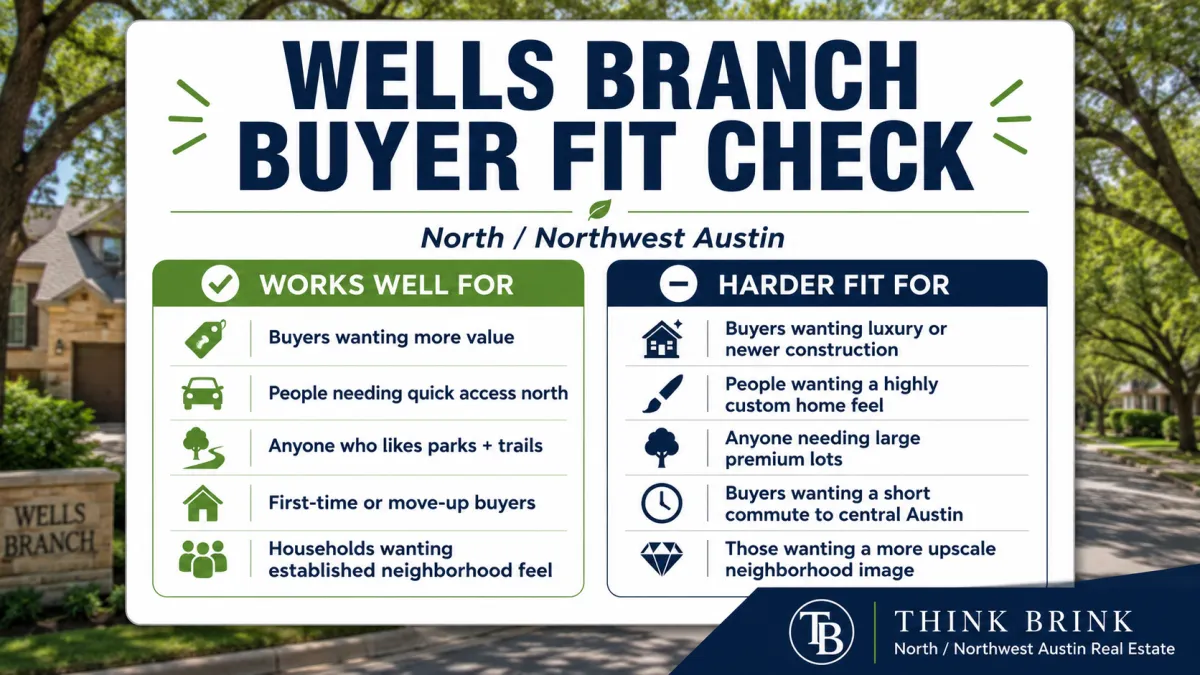
The Buyer Fit Check
Wells Branch tends to work well for buyers who:
Want detached single-family with mature trees at a price point below what comparable inventory costs west of MoPac
Commute to Dell in Round Rock, downtown Austin (especially via MetroRail), or employers on the eastern Parmer / I-35 corridor
Have kids and are specifically interested in McNeil High School's IB program
Value walkable community infrastructure - trails, parks, rec center, a real neighborhood identity
Are comfortable with 1980s-1990s housing stock and either want renovated inventory or plan to update over time
Want dual highway access without being on a frontage road
Wells Branch tends to be a harder fit for buyers who:
Work at Apple Campus or western Parmer corridor employers and want a short commute
Are specifically anchored to the "northwest of MoPac" neighborhoods for lifestyle or proximity reasons
Need large square footage and want plenty of options - the inventory skews smaller
Are sensitive to apartment adjacency and haven't researched which specific streets to avoid
Want Pflugerville ISD rather than RRISD (address matters - verify)
The Honest Summary
Wells Branch is a legitimate option that gets filtered out of too many North Austin buyer searches based on geography bias rather than actual evaluation. It offers established trees, real community infrastructure, dual highway access, and a detached single-family market that prices below Milwood and Scofield Farms in a consistent and meaningful way.
The tradeoffs are real - Apple commute is longer, the neighborhood name doesn't carry the same cachet, and some sections feel more commercial than others. But for buyers whose employers are on the eastern side of the metro or who work downtown, and who care about what a neighborhood actually offers day-to-day rather than what it's called, Wells Branch deserves a serious look before you make a decision.
Go in knowing the school nuances, know which part of the neighborhood you're in, and do the commute math honestly based on your actual employer location. If those numbers work, the value case is hard to argue with.
Frequently Asked Questions
Is Wells Branch in Austin or a separate city?
Wells Branch is a census-designated place at the northern edge of Travis County. It's not an incorporated city and not technically within Austin city limits, though it's commonly referred to as part of the North Austin area. It has its own Municipal Utility District that manages parks, utilities, and community infrastructure.
What school district is Wells Branch in?
Most of Wells Branch is zoned to Round Rock ISD. The southeast portion of the neighborhood falls into Pflugerville ISD. School assignment depends on your specific address - always verify with the relevant district before making a decision based on school district.
What high school do Wells Branch students attend?
Most RRISD-zoned Wells Branch students feed into McNeil High School, which is an International Baccalaureate World School. This is one of Wells Branch's more distinctive selling points for families with high-school-age kids.
How far is Wells Branch from Apple Campus?
Apple Campus on Parmer near MoPac is typically 20 to 30 minutes from Wells Branch in morning traffic, depending on your starting point and routing. It's a longer commute than Milwood offers and is the honest tradeoff for buyers choosing Wells Branch over west-of-MoPac neighborhoods.
Are home prices lower in Wells Branch than in Milwood or Scofield Farms?
Generally yes, and meaningfully so. Wells Branch has been trading at a price point that is typically below comparable square footage in Milwood and Scofield Farms, which are positioned west of MoPac. The gap varies by specific home and condition but is consistent enough to be a real consideration for value-focused buyers.
Does Wells Branch have good parks and trails?
This is genuinely one of Wells Branch's strongest suits. The MUD-operated parks system includes over 6 miles of hike and bike trails, Mills Pond, Katherine Fleischer Park, two pools, a recreation center, disc golf, a community garden, and a local library. For a neighborhood in its price tier, this infrastructure is unusually strong.
Is Wells Branch a good commute to downtown Austin?
The drive is 30 to 45 minutes in peak traffic via I-35 or MoPac. The MetroRail Red Line at nearby Howard Station offers an alternative for buyers who want a non-driving option for some downtown trips. The transit option is a genuine differentiator compared to most North Austin neighborhoods.
What are the biggest mistakes buyers make when considering Wells Branch?
Two main ones. First, ruling it out based on "east of MoPac" positioning without doing the commute math for their actual employer. Second, not verifying school assignments and elementary school by specific address - the RRISD vs Pflugerville split and the two different elementary options within RRISD both matter and both depend on the specific property.