What North Austin Growth Means for Homeowners Near The Domain, Apple, and Parmer
North Austin is not standing still.
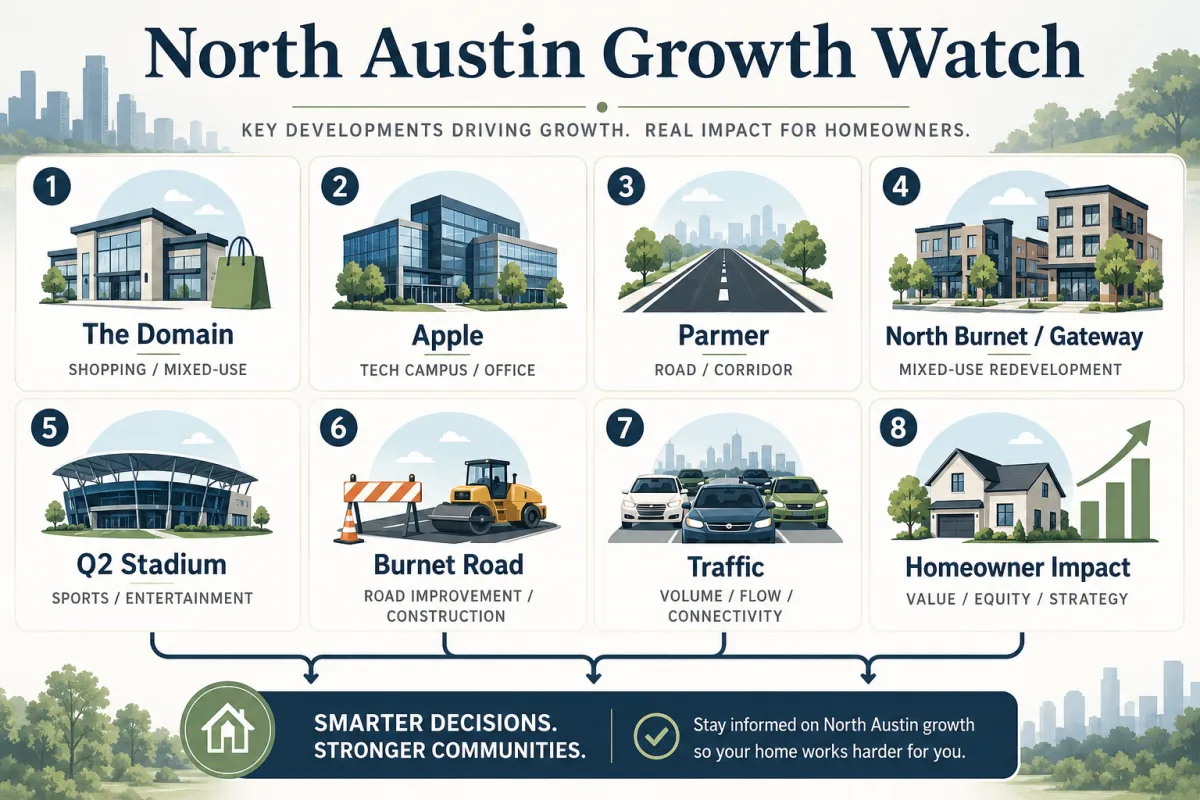
The Domain keeps growing as a lifestyle and employment anchor. North Burnet/Gateway continues moving toward a denser mixed-use future. Apple’s Austin presence helped reinforce the Parmer corridor as one of the area’s biggest employment anchors. Q2 Stadium added another layer of entertainment, traffic, and destination activity. Burnet Road, Braker, MoPac, 183, Parmer, and nearby neighborhoods are all part of the same bigger story.
That story is simple:
North Austin is becoming more important, more connected, more active, and more complicated.
For homeowners near The Domain, Apple, Parmer, Great Hills, Balcones Woods, Mesa Park, Milwood, Scofield Farms, Jollyville, Anderson Mill, Wells Branch, Avery Ranch, and nearby Northwest Austin pockets, that growth can be a good thing.
But it is not all upside.
Growth can support long-term demand, bring more restaurants and services, and make certain locations more valuable to buyers. It can also bring traffic, density, road noise, construction, redevelopment pressure, and buyer questions about what the area will feel like in five or ten years.
So the question is not:
“Is North Austin growth good or bad?”
The better question is:
“How does this growth affect my home, my neighborhood, my buyer pool, and my long-term options?”
Why North Austin growth matters
For years, people talked about downtown Austin as the main center of gravity.
Downtown still matters.
But North Austin has developed its own pull.
That pull comes from several anchors:
The Domain and Domain Northside
North Burnet/Gateway redevelopment
Apple and the Parmer corridor
Q2 Stadium
Arboretum and Gateway
MoPac, 183, Burnet, Braker, Parmer, and 620
nearby tech, office, retail, residential, and mixed-use growth
The City of Austin describes North Burnet/Gateway as an area intended to accommodate regional growth over a 30-year period with better design, connectivity, and mixed uses.
That is the big picture.
This is not just about one new building or one new restaurant. It is about an entire part of Austin becoming more urban, more employment-oriented, and more central to how people live and work.
Living Near Q2 Stadium in Austin - What Buyers and Sellers Should Know
The Domain changed how people think about North Austin
The Domain is no longer just a place to shop.
It has become a major North Austin lifestyle hub with restaurants, retail, hotels, office space, entertainment, and residential uses. Austin’s tourism site describes The Domain as a mixed-use development with shopping, dining, hotels, offices, and residential space, while Domain Northside adds more retail, restaurants, events, and Rock Rose nightlife.
For homeowners nearby, that matters because buyers often want access to lifestyle.
They may want:
restaurants nearby
shopping nearby
fitness options
nightlife
hotels for visiting family
employers nearby
Q2 Stadium access
shorter drives to everyday conveniences
a more urban North Austin feel without living downtown
A home near The Domain can appeal to buyers who want access without necessarily living inside the density.
That is especially true for single-family neighborhoods nearby.
Where to Live Near The Domain if You Want a House, Not a Condo
Apple reinforced the Parmer corridor
Apple’s North Austin expansion also matters.
Apple announced in 2018 that it would invest $1 billion in a new North Austin campus, and in 2019 announced construction had started on that new campus.
That kind of employer presence affects buyer behavior.
Buyers working near Apple or other Parmer corridor employers often think about:
commute time
access to Parmer
access to 183, MoPac, 620, 45, and 183A
neighborhoods like Milwood, Scofield Farms, Avery Ranch, Cedar Park, Jollyville, Anderson Mill, and Wells Branch
whether they want North Austin access or suburban northwest-side living
whether they want a yard and garage instead of apartment living
For homeowners in those areas, the employer base can support demand, especially when the home fits the lifestyle buyers want.
But again, location alone is not enough.
A home near Apple still has to compete on condition, price, layout, road noise, and daily livability.
What Nobody Tells You About Buying Near Apple in Northwest Austin
North Burnet/Gateway is the long-term density story
North Burnet/Gateway is one of the most important pieces of this conversation.
The City of Austin’s planning material describes the area as a place intended for mixed-use growth, better connectivity, and higher-quality design over time.
The city’s SpeakUp Austin project page also notes that amendments since 2013 have helped redevelopment shift older industrial, office, and warehouse sites toward mixed-use development with increased housing density, office space, and retail storefronts.
That matters because North Burnet/Gateway is not just “more buildings.”
It is a change in the kind of place North Austin is becoming.
For nearby homeowners, that could mean:
more people living nearby
more retail and restaurant demand
more office and employment activity
better long-term walkability in certain pockets
more redevelopment
more traffic pressure
more construction
more contrast between older single-family neighborhoods and denser mixed-use corridors
This is the heart of the tradeoff.
Growth can strengthen demand, but it can also change the feel of nearby areas.
North Burnet and Gateway: Austin’s Second Downtown
Q2 Stadium added another lifestyle and traffic layer
Q2 Stadium is another major North Austin anchor.
Austin FC’s stadium has made the area around Burnet, Braker, North Burnet, and The Domain more event-oriented. The stadium is a major destination with matchday and event activity, which can benefit nearby businesses and create more North Austin visibility.
For homeowners, Q2 can be a plus or a tradeoff.
It can be a plus because buyers may like:
entertainment nearby
sports culture
restaurants and pregame/postgame activity
a more active North Austin lifestyle
regional destination appeal
It can be a tradeoff because buyers may worry about:
event traffic
parking spillover
noise
rideshare activity
weekend and evening congestion
road closures or access complications
This does not make nearby neighborhoods bad.
It means the right buyer has to value the energy enough to accept the traffic.
Burnet Road improvements and construction are part of the story
Infrastructure changes also affect day-to-day life.
Austin’s Burnet Road corridor project page says construction began in 2026 on a phase of safety, mobility, drainage, and connectivity improvements between Koenig Lane and MoPac, with crews working toward US 183 through the rest of 2026.
For homeowners and buyers, that is exactly the kind of thing that matters.
Short term, construction can be annoying.
Long term, mobility and corridor improvements may help an area function better.
But during the transition, sellers and buyers need to understand:
temporary traffic disruption
changing routes
construction noise
lane changes
improved pedestrian/bike/safety features over time
how road work affects buyer perception
Current infrastructure stories should not be ignored, but they also should not be overhyped.
They are part of the long-term direction of the area.
What growth means for homeowners
If you own a home near The Domain, Apple, Parmer, or surrounding North/Northwest Austin neighborhoods, growth can affect your home in several ways.
1. Your buyer pool may become broader
More jobs, restaurants, offices, apartments, entertainment, and services can bring more people into the area.
That can increase interest from:
tech workers
relocation buyers
hybrid workers
buyers wanting shorter commutes
people wanting restaurants and lifestyle nearby
buyers priced out of closer-in Austin
buyers who want a house near job centers
investors in some situations
downsizers who want convenience
A home near these anchors may appeal to more than one buyer type.
That is good for long-term marketability.
2. Single-family homes near growth can become more distinctive
As North Burnet/Gateway and The Domain become more urban and mixed-use, nearby single-family homes with yards can become more distinctive.
A buyer may say:
“I want to be near The Domain, but I still want a yard.”
That buyer is not looking for an apartment in the middle of the action.
They may be looking for:
Great Hills
Balcones Woods
Mesa Park
Jollyville
Milwood
Scofield Farms
Barrington Oaks
Oak Forest
nearby North Austin pockets
For sellers, this is an important positioning angle.
The value may not simply be “near The Domain.”
It may be:
“Near The Domain, but still a real neighborhood.”
3. Condition matters even more
Growth does not erase buyer standards.
A buyer may love the location, but they will still compare:
price
condition
roof age
HVAC age
updates
flooring
layout
road noise
yard maintenance
natural light
inspection risk
competing homes
In a growing area, sellers sometimes assume location will do all the work.
That is a mistake.
Growth gets attention.
Condition and pricing convert that attention into offers.
4. Traffic becomes part of the value conversation
This is the obvious tradeoff.
North Austin growth can make an area more convenient and more congested at the same time.
For buyers, traffic questions may include:
What is the commute to Apple?
How is Parmer at peak times?
How close is this to The Domain traffic?
Does Q2 Stadium affect this area?
Is there road noise from 183, MoPac, Burnet, Braker, or Parmer?
Are there multiple ways in and out?
Is the home close enough to convenience without being too close to congestion?
For homeowners, this means traffic is not just a lifestyle issue.
It can be a marketing and pricing issue.
5. Road noise and backing conditions matter more
As corridors get busier, buyers pay more attention to the exact lot.
Homes may be affected by:
road noise
commercial backing
apartment or mixed-use density nearby
construction noise
school traffic
event traffic
cut-through patterns
Two homes in the same neighborhood may have very different appeal depending on street and lot position.
Growth makes micro-location more important, not less.
6. Older homes may need stronger positioning
Northwest Austin and North Austin have many established homes.
That is part of the appeal.
But as buyers compare older homes near growth with newer homes farther north, sellers need to be sharp.
An older home near The Domain or Apple should be positioned around:
location
yard
trees
neighborhood feel
access
renovation potential
system updates if available
shorter commute or lifestyle convenience
uniqueness compared with newer suburban options
Do not make the buyer guess.
Tell the story clearly.
7. Property taxes and total cost still matter
Growth can influence value, but homeowners and buyers still need to understand total cost.
Buyers may compare:
purchase price
property taxes
insurance
HOA dues
repair costs
commute costs
tolls
maintenance
future updates
A home near growth may justify a premium, but only if buyers see the value.
The price has to fit the total cost picture.
What growth means for sellers near The Domain
If you are selling near The Domain, your strongest buyer story may be lifestyle access.
Buyers may care about:
restaurants
shopping
nightlife
Q2 Stadium
offices
hotels
The Domain and Domain Northside
access to MoPac, Burnet, Braker, 183, and Gateway
single-family living near urban energy
But do not oversell walkability unless it is truly walkable.
Many single-family homes near The Domain are close by car but not necessarily comfortable for walking.
The better message may be:
“Minutes from The Domain, with the privacy and space of an established neighborhood.”
That is stronger and more accurate.
What growth means for sellers near Apple and Parmer
If you are selling near Apple or Parmer, your strongest buyer story may be workday convenience.
Buyers may care about:
shorter commute
Apple access
Parmer corridor employers
access to 183, MoPac, 620, 45, or 183A
practical North Austin location
suburban home options
yard and garage near major employment
But again, do not assume “near Apple” is enough.
The home still needs to show well and be priced correctly.
The better message may be:
“A practical North Austin home base near Apple, Parmer, and major employer routes.”
What growth means for buyers
Buyers should not only ask whether the area is growing.
They should ask whether the growth fits their life.
Growth may be positive if you want:
restaurants nearby
job access
more services
more urban energy
a location with long-term demand
shorter commute
more things to do
Growth may be frustrating if you want:
quiet streets
low traffic
minimal construction
fewer apartments nearby
less density
less road noise
a more purely residential feel
Both reactions are valid.
That is why buyers need to understand their tolerance for activity.
The middle-ground buyer
Many buyers want the middle ground.
They want access to The Domain, Apple, and North Austin growth, but they do not want to live directly inside the densest part of it.
That is where established neighborhoods become important.
Neighborhoods that can offer access plus residential feel may include:
Great Hills
Balcones Woods
Mesa Park
Jollyville
Milwood
Scofield Farms
Barrington Oaks
Oak Forest
Anderson Mill
Wells Branch
Avery Ranch, depending on lifestyle
This is a key buyer profile:
Near the growth, not swallowed by it.
Homeowners who understand that buyer can market more effectively.
Apple vs The Domain: Where Should North Austin Tech Buyers Actually Live?
What homeowners should watch over the next few years
1. North Burnet/Gateway redevelopment
Watch how density, mixed-use projects, transportation changes, and commercial activity continue to evolve.
2. Apple and Parmer corridor employment
Employer activity can influence buyer demand, commute patterns, and neighborhood interest.
3. Domain-area traffic and amenities
The more The Domain functions like a second downtown, the more nearby neighborhoods need to balance lifestyle appeal with congestion.
4. Burnet and Braker corridor changes
Road work, redevelopment, and mobility improvements can change daily experience.
5. Q2 Stadium event impact
For nearby areas, event traffic and entertainment energy remain part of the lifestyle.
6. Buyer preference for single-family homes near urban amenities
This may be one of the strongest long-term themes.
Many buyers want convenience, but not necessarily apartment-style living.
That can support demand for nearby established neighborhoods.
Current events vs evergreen strategy
This is where current events fit your content strategy.
A post like this works because it ties current growth stories to evergreen homeowner questions:
Will growth help my home value?
Should I sell now or wait?
Will traffic get worse?
Should I update before selling?
Are buyers still interested in this area?
Is being near The Domain or Apple a selling point?
What should I watch if I own nearby?
That is the right use of current events.
Not news for the sake of news.
News translated into homeowner meaning.
How sellers should use this growth in their marketing
If you are selling near these North Austin anchors, your listing should not sound generic.
Avoid:
“Great location.”
Use specifics.
Examples:
“Near The Domain without giving up a yard”
“Single-family living close to North Austin job centers”
“Practical access to Apple and Parmer corridor employers”
“Minutes from restaurants, shopping, offices, and Q2 Stadium”
“Established neighborhood feel near North Austin growth”
“Access to MoPac, 183, Burnet, Braker, and Parmer”
“A quieter home base near North Austin’s major lifestyle and employment anchors”
Specific positioning helps buyers understand why the home matters.
When growth can hurt a listing
Growth is not always a clean positive.
A listing may need extra strategy if it is affected by:
road noise
heavy traffic
apartment density nearby
construction
commercial backing
limited parking
difficult access
school or event congestion
buyer concern about future development
Those issues do not make a home unsellable.
But they need to be priced and positioned realistically.
A home with a location tradeoff can still sell if the value is clear.
When growth can help a listing
Growth can help when the home offers:
convenient access
strong employment proximity
lifestyle amenities nearby
single-family space near urban activity
yard and garage near job centers
mature trees close to modern amenities
shorter commute
long-term location relevance
buyer flexibility across multiple demand groups
This is especially true when the home is clean, well-presented, and correctly priced.
Growth helps most when the property itself still makes sense.
The common mistake homeowners make
The biggest mistake is thinking growth automatically equals higher value.
It might support value over time.
But a specific home’s value still depends on:
condition
pricing
buyer demand
street
lot
noise
layout
schools
systems
competition
presentation
Growth is a tailwind.
It is not a magic wand.
A poorly presented or overpriced home near growth can still sit.
A well-positioned home near growth can stand out.
My practical take
North Austin growth is one of the most important real estate stories in the Austin area.
The Domain, North Burnet/Gateway, Apple, Parmer, Q2 Stadium, Burnet Road improvements, and surrounding neighborhood demand all point to a part of Austin that continues to matter more.
For homeowners, that is generally positive.
But the details matter.
If you own a home nearby, you should understand what kind of buyer your location attracts, what tradeoffs your specific property has, and how to position the home if you decide to sell.
The winning message is not simply:
“North Austin is growing.”
The winning message is:
“Here is how this specific home fits the way North Austin is growing.”
Final thought
Growth near The Domain, Apple, and Parmer can be a major advantage for North and Northwest Austin homeowners.
It can bring stronger buyer awareness, more lifestyle convenience, more employment access, and more reasons for people to consider the area.
But growth also brings traffic, density, road noise, construction, and changing neighborhood dynamics.
The smart homeowner does not ignore either side.
They understand the opportunity and the tradeoff.
That is how you make better decisions about selling, updating, pricing, or simply holding and watching the area evolve.
FAQ
What does North Austin growth mean for homeowners near The Domain?
It may increase buyer interest because The Domain offers restaurants, shopping, offices, hotels, nightlife, and nearby entertainment. But homeowners should also watch traffic, density, road noise, and construction effects.
Does Apple’s Austin presence help nearby home demand?
Apple and the Parmer corridor can support demand from buyers who want shorter commutes and practical North Austin access. But the home still needs to be priced and presented correctly.
Is North Burnet/Gateway becoming Austin’s second downtown?
North Burnet/Gateway is planned for long-term mixed-use growth, density, connectivity, and redevelopment. It is one of the major reasons North Austin is becoming more urban and more important.
Does Q2 Stadium affect nearby homeowners?
It can. Q2 Stadium adds entertainment and destination appeal, but it can also create event traffic, parking pressure, and congestion depending on the exact location.
Should I sell my North Austin home because the area is growing?
Not automatically. Growth may support demand, but the right decision depends on your home’s condition, your timing, market competition, your next move, and whether the property still fits your life.
How should sellers market a home near The Domain, Apple, or Parmer?
Sellers should be specific. Highlight access to employers, restaurants, shopping, major roads, single-family living near urban amenities, mature trees, yard space, and the specific lifestyle advantage the home offers.
