Chisholm Trail vs Cedar Valley: How the McNeil-Feeder Middle Schools Compare for Buyers
McNeil High School is fed by four Round Rock ISD middle schools: Pearson Ranch, Deerpark, Cedar Valley, and Chisholm Trail. I have already compared the first two in detail. This post covers the other two, Chisholm Trail and Cedar Valley, which completes the set for buyers who are trying to understand what they are actually buying when they target a McNeil-feeder address in North Austin.
Here is the honest headline: within the McNeil feeder, Cedar Valley and Chisholm Trail are not the same tier, and the market treats them differently. Both are legitimate RRISD schools that send students to the same strong high school. But their ratings, their size, and the neighborhoods they draw from differ enough that it changes the calculus on price and fit. This is the comparison I walk buyers through.
They both feed McNeil, and that matters
Start with what these two schools share, because it is the most important thing and it is easy to lose in a ratings comparison. Chisholm Trail and Cedar Valley both feed McNeil High School. Whatever happens in middle school, a student from either campus lands at the same high school on the same diploma track. McNeil is a large, well-regarded RRISD high school with strong academics, a deep extracurricular and athletics program, and a solid college-placement record. If your real goal is the McNeil pathway, both of these middle schools get you there.
That shared endpoint is why I tell buyers not to over-index on the middle-school rating gap. The four McNeil feeders converge, and the high school is where students spend the four years that matter most for college. For the full picture of the pathway itself, including what the McNeil program offers, I laid it out in my McNeil High School feeder guide.
Cedar Valley Middle School: the higher-rated, larger campus
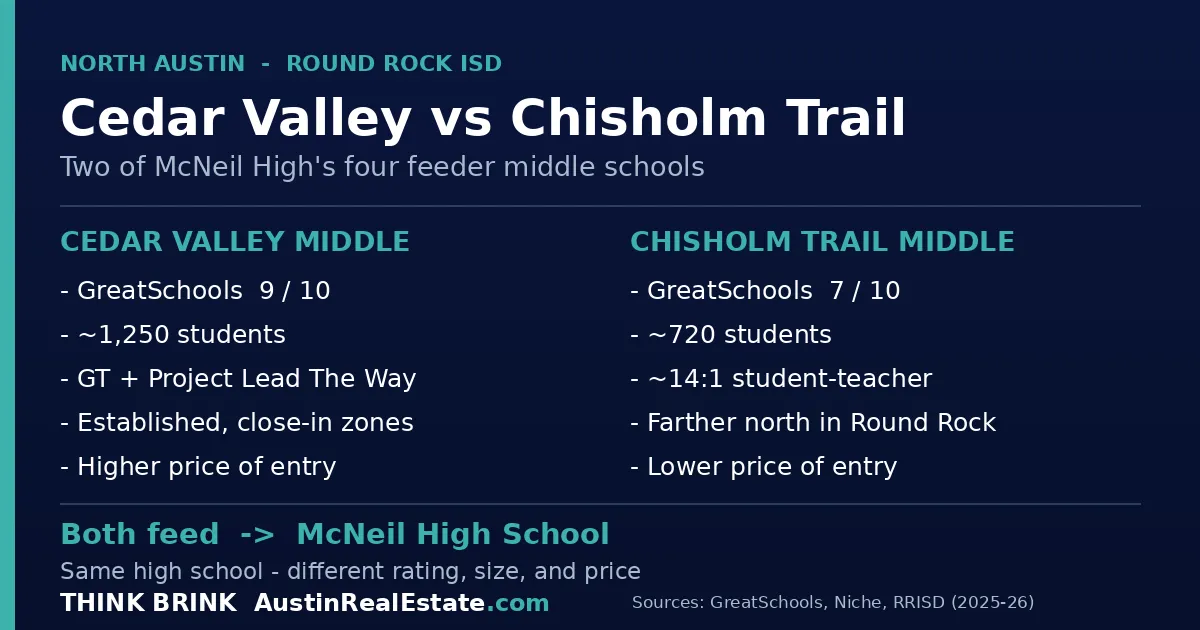
Cedar Valley is the stronger performer of the two on paper. It carries a 9 out of 10 GreatSchools rating, enrolls roughly 1,250 students across grades 6 through 8, and runs a full slate of advanced programming including a gifted and talented track and Project Lead The Way engineering curriculum. Among the four McNeil feeders, Cedar Valley sits at or near the top on rating.
A 9 out of 10 puts Cedar Valley in the same rating tier as Canyon Vista and the top RRISD middle schools, which tells you something about the households in its attendance zone. The campus draws from established, higher-income North Austin neighborhoods, and the test performance that drives the GreatSchools number reflects that. For a buyer, a Cedar Valley address means a top-decile middle school on the way to McNeil, and the market prices that combination accordingly.
The size is worth flagging. At roughly 1,250 students, Cedar Valley is a large middle school. For a student who thrives with more electives, more course levels, and a bigger peer group, that scale is a feature. For a kid who does better in a smaller, more contained environment, it is something to weigh.
Chisholm Trail Middle School: the smaller, solid campus in Round Rock
Chisholm Trail carries a 7 out of 10 GreatSchools rating, enrolls roughly 720 students, and runs a low student-to-teacher ratio around 14 to 1. It is a Niche A-rated school, performs above the Texas state average, and posts solid proficiency numbers, with roughly two-thirds of students meeting the math standard and just under six in ten meeting reading on recent state tests. It is fed by Bluebonnet, Deep Wood, and Fern Bluff elementaries, and it sits geographically up in Round Rock proper rather than in the close-in Austin tech corridor.
A 7 out of 10 is a good, above-average rating, not a warning sign. The gap from Cedar Valley's 9 mostly reflects a different attendance-zone profile and a smaller, more community-scaled campus rather than a school with academic problems. In fact, the smaller size and lower student-teacher ratio are genuine positives for the right kid. A student who would feel lost in a 1,250-student building may do better in a 720-student school where teachers know them.
The location is the other differentiator. Chisholm Trail sits farther north, up in Round Rock, which puts it in a different housing market than the close-in McNeil feeders. That generally means a lower price of entry for comparable square footage, and a longer commute to the central Austin and Domain employers, though it can be competitive to the far-north tech corridor.
What the rating gap does and does not mean
A 9 versus a 7 looks like a real spread, and in one narrow sense it is: Cedar Valley posts higher standardized test performance, driven substantially by the socioeconomic profile of its attendance zone. But there are three things that gap does not tell you, and buyers should hold all three in mind.
First, it does not mean Chisholm Trail is a weak school. A 7 out of 10 is above the state average, the campus is Niche A-rated, and its proficiency numbers are solid. This is a good school, full stop. Second, the rating says nothing about the high school, and both schools feed the same McNeil program, so the four-year destination is identical. Third, the rating does not capture fit, and the two campuses differ most in size and feel. Chisholm Trail's smaller, lower-ratio environment is an advantage for some students that no rating number will show you.
The way I put it to families: if you are choosing purely on the printed rating, Cedar Valley wins. If you are choosing on what will actually serve your specific child and your budget, the answer is genuinely open, and for some households Chisholm Trail is the better call.
How the two show up in price
The clearest practical difference between these two addresses is what you pay to live in each zone. Cedar Valley draws from more established, higher-income, close-in North Austin neighborhoods, and its 9 out of 10 rating adds a school premium on top of that. A Cedar Valley address generally costs more for comparable square footage and condition than a Chisholm Trail address.
Chisholm Trail, sitting up in Round Rock and carrying a 7 out of 10, typically offers a lower entry point. For a buyer who wants the McNeil pathway and a solid, above-average middle school but does not want to pay the Cedar Valley premium, Chisholm Trail is often the value option, with the tradeoff of a farther-north location and a longer central-Austin commute.
I am not going to publish specific neighborhood median prices here, because those numbers move month to month and I would rather run you current comparables than hand you a stale figure that publishes under my license. The directional truth is stable, though: Cedar Valley zones sit at a premium to Chisholm Trail zones for similar houses, and both are on the same McNeil track. If you want the current spread for the specific streets you are weighing, that is a quick pull and I am glad to do it.
Who should target Cedar Valley
Cedar Valley makes the most sense for buyers who want the highest-rated middle school on the McNeil track and are willing to pay the associated premium, who value a larger campus with more course offerings and a deeper GT and engineering program, and who want to be in the more established, close-in North Austin neighborhoods with better access to central employers and the Domain. If your student is academically aggressive and will use the advanced offerings hard, the depth at Cedar Valley is real.
The tradeoff is price. You are paying both for the neighborhood and for the school rating, and in a competitive market that combination draws other school-motivated buyers, which keeps the entry point up.
Who should target Chisholm Trail
Chisholm Trail makes the most sense for buyers who want the McNeil pathway and a solid, above-average middle school at a lower price of entry, who prefer or whose child would benefit from a smaller campus and a lower student-teacher ratio, and who are comfortable being farther north in Round Rock rather than in the close-in tech corridor. If your work anchors to the north end of the corridor or you simply want more house and lot for the money on the McNeil track, Chisholm Trail deserves a serious look.
The tradeoff is the location and the longer commute to central Austin and the Domain, plus a rating that, while good, is a notch below Cedar Valley. For buyers who weight the printed rating heavily or who need the shorter central commute, that is a real consideration.
The full McNeil feeder picture
With this comparison, you have the whole McNeil feeder set. Cedar Valley and Chisholm Trail here, plus Pearson Ranch and Deerpark, which I compared separately in my Pearson Ranch vs Deerpark breakdown. Across the four, the pattern is consistent: they all feed the same strong high school, they differ meaningfully in rating, size, and the neighborhoods and prices attached to each, and the right one for you depends on your budget, your child, and your commute far more than on the rating alone.
If your decision is really McNeil versus a different high school track altogether, that is a bigger question, and I compared the two most common North Austin high-school choices in my McNeil vs Westwood breakdown.
How to verify the assignment before you offer
Round Rock ISD draws attendance boundaries at the address level and adjusts them over time as it manages capacity. Do not assume a house feeds Cedar Valley or Chisholm Trail because a listing says so or because it is in a given subdivision. Two homes on the same street can occasionally fall on different sides of a line.
Before you write an offer on a school thesis, confirm three things: the exact address on the Round Rock ISD boundary lookup, the current feeder chart for both the middle school and the high school it rolls up to, and whether any boundary change is pending that would take effect before your child enrolls. I run this check for every buyer purchasing for schools, because the premium you pay is only worth it if the address actually zones where you think it does.
Frequently asked questions
Do Chisholm Trail and Cedar Valley feed the same high school?
Yes. Both are Round Rock ISD middle schools that feed McNeil High School. They are two of the four McNeil feeders, along with Pearson Ranch and Deerpark. Whichever of the two a student attends, they land at the same high school.
Which is better, Cedar Valley or Chisholm Trail?
On the printed rating, Cedar Valley is higher, at 9 out of 10 versus Chisholm Trail's 7 out of 10. But both feed the same McNeil High School, and Chisholm Trail is a smaller campus with a lower student-teacher ratio that suits some students better. The better choice depends on your budget, your child's fit, and your commute, not on the rating alone.
Why is Cedar Valley rated higher than Chisholm Trail?
GreatSchools ratings lean heavily on standardized test performance, which tracks closely with the income profile of a school's attendance zone. Cedar Valley draws from more established, higher-income close-in neighborhoods, which lifts its scores. The gap reflects that profile difference and campus size more than a difference in whether either is a good school; both are above the state average.
Is Chisholm Trail a good middle school?
Yes. Chisholm Trail carries a 7 out of 10 GreatSchools rating, is Niche A-rated, performs above the Texas state average, and has a low student-teacher ratio around 14 to 1. It is a solid, above-average school, and its smaller size is a genuine advantage for students who do better in a more contained environment.
Which one is cheaper to buy into?
Generally Chisholm Trail. It sits farther north in Round Rock and carries a lower rating premium, so comparable homes typically cost less than in the Cedar Valley zone. The tradeoff is a longer commute to central Austin and the Domain. Cedar Valley zones sit at a premium for the higher rating and more central location. For current numbers on specific streets, ask me for a comparables pull.
What high school do these middle schools feed?
Both feed McNeil High School in Round Rock ISD. McNeil's four feeder middle schools are Cedar Valley, Chisholm Trail, Pearson Ranch, and Deerpark. None of them feed Westwood or Vandegrift.
The honest summary
Cedar Valley and Chisholm Trail both put your student on the McNeil track, and that shared destination is the most important fact in the comparison. Cedar Valley is the higher-rated, larger, more central, more expensive option, with a 9 out of 10 rating and deep programming. Chisholm Trail is the smaller, farther-north, lower-priced option with a solid 7 out of 10 rating and a more intimate campus.
Choose Cedar Valley if you want the top rating and central location and will pay for it. Choose Chisholm Trail if you want the McNeil pathway at a better price, or if your child would do better in a smaller school. Either way, verify the assignment at the exact address and run your real commute before you offer, because those two checks are what separate a good school thesis from a good purchase.
