Pearson Ranch vs Deerpark: How the Two McNeil-Feeder Middle Schools Differ for Buyers
If you are buying in the 78729 and Anderson Mill part of the North Austin tech corridor, and schools matter to you, there is a decision hiding inside the map that most buyers never notice until they are under contract. Two Round Rock ISD middle schools, Pearson Ranch and Deerpark, both feed the same high school, McNeil, an IB World School. On paper that sounds like it does not matter which one your address is zoned to. Look one level closer and the two schools carry very different rating profiles, very different student populations, and, for some buyers, a very different answer to the question of where to make an offer.
This is the kind of thing I get asked about constantly by relocating tech families, and it is exactly the kind of detail that a generic neighborhood description glosses over. So here is the honest, specific breakdown of how Pearson Ranch and Deerpark differ, what the ratings actually mean and do not mean, and how to think about the choice as a buyer rather than a spreadsheet.
The setup: two middle schools, one high school
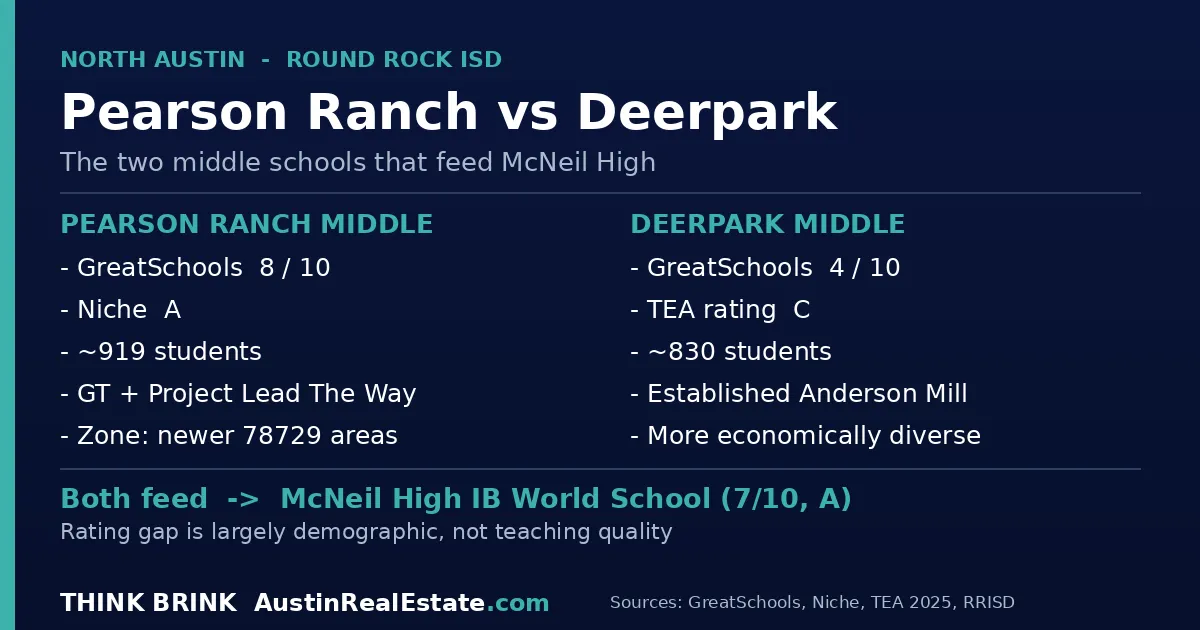
Both Pearson Ranch Middle and Deerpark Middle are Round Rock ISD campuses serving grades six through eight, and both feed into McNeil High School at 5720 McNeil Road in 78729. McNeil is an IB World School, carries a GreatSchools rating of 7 out of 10, and earned an A in the most recent Texas Education Agency accountability ratings. That shared destination is the important context: whichever middle school your address is zoned to, the high school pathway lands in the same place, and that place is strong. I covered McNeil's IB program in depth in my McNeil High School feeder guide, and this post zooms in on the middle-school fork that sits underneath it.
Pearson Ranch Middle sits at 8901 Pearson Ranch Road in 78729, serving the newer neighborhoods on the north and west side of the feeder area. Deerpark Middle sits at 8849 Anderson Mill Road, in the heart of the older, established Anderson Mill area. Their addresses tell you a lot about the difference before you even get to the ratings: Pearson Ranch draws from newer housing stock and Deerpark draws from an established 1970s and 1980s neighborhood. If you are considering the Anderson Mill area specifically, my Anderson Mill buyer guide covers the neighborhood side of this in detail.
The ratings, stated plainly
I am going to give you the verified numbers and then spend the rest of the post explaining why the raw numbers are the least useful part of this comparison.
Pearson Ranch Middle holds a GreatSchools rating of 8 out of 10 and an A grade on Niche. It serves roughly 919 students. It offers a Gifted and Talented program and the Project Lead The Way curriculum, and it tests above the Texas state average across the board.
Deerpark Middle holds a GreatSchools rating of 4 out of 10 and earned a C in the most recent TEA accountability rating. It serves roughly 830 students. Its student body is more economically diverse, with about 41 percent of students classified as economically disadvantaged and a student population that is roughly 42 percent Hispanic. On the state assessments, about 40 percent of students test proficient in math and about 54 percent in reading.
Read those two paragraphs cold and it looks like an easy call. An 8 versus a 4 is a big gap on a ten-point scale, and I am not going to pretend it is meaningless. But if you stop there, you will draw the wrong conclusion, overpay to be on one side of a line, and miss what the numbers are actually measuring. So let me take that apart.
What a GreatSchools rating actually measures
GreatSchools ratings and TEA accountability grades are heavily driven by standardized test performance, and standardized test performance at the campus level correlates strongly with the economic profile of the student body. That is not a controversial claim, it is one of the most consistent findings in education data. A school where a larger share of students face economic hardship, are still learning English, or arrive below grade level will, on average, post lower aggregate test scores, and that pulls the composite rating down regardless of how good the teaching is.
What that means for you as a buyer is specific and important. A 4 out of 10 does not tell you the teachers are worse, the building is worse, or that a prepared, supported student will learn less there. It largely tells you the aggregate test scores are lower, which is heavily a function of who is enrolled, not solely how well the school does its job. Deerpark's demographic profile, with a substantially higher share of economically disadvantaged students than Pearson Ranch, is a large part of why its rating sits where it does.
This is the honest part that a listing agent trying to sell you a Pearson Ranch-zoned house will not volunteer: the rating gap between these two schools is real, but a meaningful portion of it is a demographic gap, not an instructional-quality gap. Both are Round Rock ISD schools, held to the same district standards, feeding the same well-regarded IB high school. If your child arrives at either prepared and supported, the ceiling at both is the same McNeil IB pathway.
Where the ratings do carry real signal
I do not want to over-correct into telling you the ratings do not matter. They do, in a few concrete ways.
Peer environment is real. A middle school where more students test at or above grade level generally has a classroom environment where the median pace is faster and a student is surrounded by more grade-level-and-above peers. For families who weigh peer academic environment heavily, that is a legitimate factor, and it favors Pearson Ranch. The Gifted and Talented and Project Lead The Way offerings at Pearson Ranch are also concrete programming that some families specifically want.
Resale is real. In this market, buyers act on ratings whether or not the ratings measure what they think they measure. A home zoned to an 8-rated middle school will, all else equal, attract more buyer attention and hold value slightly better than an otherwise identical home zoned to a 4-rated one, because the next buyer will run the same GreatSchools search you did. That resale dynamic is a genuine reason the Pearson Ranch zoning carries a small premium, independent of the education question.
So the ratings matter for peer environment and for resale. They are a much weaker signal for "will my prepared kid get a good education," where the answer at both schools, feeding the same IB high school, is closer than the numbers suggest.
The price angle, and why I am careful with it
Buyers always want the next sentence to be "and here is exactly how much more the Pearson Ranch zoning costs." I am not going to invent that number. School-driven price premiums move with the market and with individual homes, and I do not have a current, verified neighborhood-level figure isolating the two zonings this month. What I can tell you qualitatively, from how this market behaves, is the direction and the mechanism.
The direction: homes zoned to the higher-rated middle school generally carry some premium over comparable homes zoned to the lower-rated one, because school ratings are one of the first filters relocating buyers apply. The mechanism is the resale dynamic above, not any guarantee about outcomes.
The nuance that actually saves buyers money: the Deerpark-zoned Anderson Mill area, precisely because it carries a lower middle-school rating, is often where the value is for a buyer who has looked closely enough to understand what the rating does and does not mean. You are buying into the same district, the same IB high school pathway, and an established neighborhood with mature trees and larger lots, at a price that the rating-driven crowd has bid down. For a buyer without school-age children, or one who is comfortable with the demographic-driven rating gap, that can be one of the better values in the corridor. This is the same logic I apply across the affordability side of the corridor generally.
How to actually make this decision as a buyer
Here is the framework I walk buyers through when this fork comes up.
Confirm the zoning at the specific address, not the neighborhood
Round Rock ISD assigns schools by address, and boundaries do not follow neighborhood names cleanly. Do not assume a house is Pearson Ranch or Deerpark based on the subdivision. Verify the exact assignment for the specific property with the district's boundary tool or the district directly before you write an offer, because attendance boundaries can and do get redrawn. I explain the address-level mechanics of this in my post on how school zoning by address changes what you pay.
Decide how much weight middle school actually deserves for you
Middle school is three years, and both of these feed the same high school. If you have a rising sixth grader, the middle-school environment is immediate and worth weighting. If your kids are younger, you are making a decision about a school your child will not attend for years, during which boundaries and ratings can both change. And if you do not have school-age children, you are buying the resale-value version of this factor, not the education version.
Visit both, and look past the score
If you can, tour both schools. Talk to the counseling office about the IB pathway into McNeil, the GT and PLTW offerings, and how they support students at the top and bottom of the range. A campus visit tells you things a composite number cannot, and families are sometimes surprised to find the lower-rated school is a better fit for their specific kid.
Weigh the neighborhood you actually want to live in
The Deerpark-zoned Anderson Mill area and the Pearson Ranch-zoned newer areas are genuinely different places to live, separate from schools: different housing eras, lot sizes, tree cover, and price points. Do not let a middle-school rating override a decision about where you actually want to spend the next decade. Buy the neighborhood that fits your life, verify the schools honestly, and weigh them together.
Frequently asked questions
Do Pearson Ranch and Deerpark both feed McNeil High School?
Yes. Both Pearson Ranch Middle and Deerpark Middle are Round Rock ISD schools that feed into McNeil High School in 78729, which is an IB World School with a GreatSchools rating of 7 out of 10 and an A in the most recent TEA accountability ratings. Whichever of the two middle schools your address is zoned to, the high school pathway is the same, which is a big part of why this decision is more nuanced than the middle-school ratings alone suggest.
Why is Deerpark rated lower than Pearson Ranch?
Pearson Ranch holds a GreatSchools rating of 8 out of 10 and Deerpark a 4 out of 10, with Deerpark also carrying a C in the latest TEA rating. A large part of the gap reflects the difference in student populations rather than teaching quality. Deerpark serves a more economically diverse student body, with about 41 percent of students economically disadvantaged, and campus ratings are heavily driven by aggregate standardized test scores, which correlate strongly with economic profile. Both are Round Rock ISD schools feeding the same IB high school.
Is the Pearson Ranch zoning worth paying more for?
It depends on why the schools matter to you. If you weigh peer academic environment heavily or you have a child entering middle school soon, Pearson Ranch's higher rating, GT program, and Project Lead The Way curriculum are concrete reasons some families pay a premium. If you are focused on the long-run education outcome for a prepared student, both schools feed the same strong IB high school, so the gap is smaller than the numbers suggest. And if you have no school-age children, you are mostly paying for the resale-value version of the rating, which is real but smaller.
Is the Deerpark-zoned Anderson Mill area a good value?
For the right buyer, yes. Because the Deerpark zoning carries a lower middle-school rating, homes there are often priced below comparable homes zoned to higher-rated schools, even though you are buying into the same district and the same McNeil IB high school pathway. For a buyer without school-age children, or one comfortable with the demographic-driven rating gap, the established Anderson Mill area can be one of the better values in the tech corridor. Verify the specific address zoning before you rely on it.
How do I find out which middle school a specific house is zoned to?
Use Round Rock ISD's attendance boundary tool or contact the district directly with the exact property address. Do not rely on the subdivision name or a listing's school claims, because boundaries do not follow neighborhood lines cleanly and can be redrawn. Confirm the assignment in writing for the specific property before you make an offer if schools are a deciding factor.
Can Round Rock ISD change these attendance boundaries?
Yes. School districts redraw attendance boundaries periodically in response to enrollment growth and new campuses, and Round Rock ISD is in a growing part of the metro. A home zoned to a given middle school today is not guaranteed that zoning indefinitely. If you are buying largely for a specific middle-school assignment, understand that the assignment can change, which is one more reason the shared McNeil high school pathway is the more durable thing to anchor on.
Are these schools in Austin or Round Rock?
Both are in Round Rock Independent School District, but they are physically located in Austin, in the 78729 and Anderson Mill part of North Austin. This is a common source of confusion in the tech corridor: many neighborhoods with Austin mailing addresses are served by Round Rock ISD rather than Austin ISD. The district, not the mailing city, is what determines the schools your child attends.
Which should I choose if my kids are still in elementary school?
If middle school is several years away, weight it less. Ratings and boundaries can both change before your child ever enrolls, and both schools feed the same high school regardless. Focus more on the neighborhood that fits your life, the elementary assignment that matters sooner, and the durable fact of the McNeil IB pathway, and treat the current middle-school rating as one input rather than the deciding factor.
The honest summary
Pearson Ranch and Deerpark look far apart on a ratings page and are closer than they look in the ways that matter most. Pearson Ranch is the higher-rated campus, with GT and Project Lead The Way programming and a peer environment that some families specifically want, and its zoning carries a real, if modest, resale advantage. Deerpark is lower-rated in large part because it serves a more economically diverse student body, not because it is a worse school, and the established Anderson Mill area it serves is often where the value is for a buyer who understands what the rating is measuring. Both feed the same McNeil IB high school, which is the most durable fact in this whole comparison.
If schools are driving your search in the 78729 and Anderson Mill area, the right move is to verify the zoning at the specific address, decide honestly how much middle school weighs for your family, and not let a single composite number override a decade-long decision about where to live. If you want help mapping specific addresses to their assignments and weighing the price tradeoff, that is exactly the kind of thing I do with North Austin buyers.
