What Buyers Should Know About Anderson Mill Before Making an Offer
Anderson Mill is one of the largest established neighborhoods in Northwest Austin, and almost every important thing about it, the schools, the taxes, even the county you live in, changes depending on exactly where in it you buy
Anderson Mill is a neighborhood that a lot of buyers underestimate until they start looking closely. It is big, it is established, and it sits at one of the most useful road intersections in Northwest Austin, where RM 620 meets US 183 as the city gives way to Cedar Park. Buyers are drawn to it for the mature trees, the larger lots, the amenities, and prices that generally undercut the hillside neighborhoods to the south and east. But Anderson Mill is also unusually variable inside its own boundaries. It straddles the line between Austin and Cedar Park, it sits in Williamson County rather than Travis County like most of Austin, parts of it are inside a municipal utility district, and it can feed more than one high school depending on the address. This is a neighborhood where "which part of Anderson Mill" is not a small question. It is the whole question.
This guide covers what the neighborhood actually is, where it sits, what the schools and taxes mean for your money, what the housing stock will and will not give you, and what to confirm before you make an offer. As always, I am going to be direct about the tradeoffs, because in a neighborhood this varied, the tradeoffs are exactly what separate the buyers who are happy here from the ones who bought the wrong part of it.
Where Anderson Mill is, and why its location works
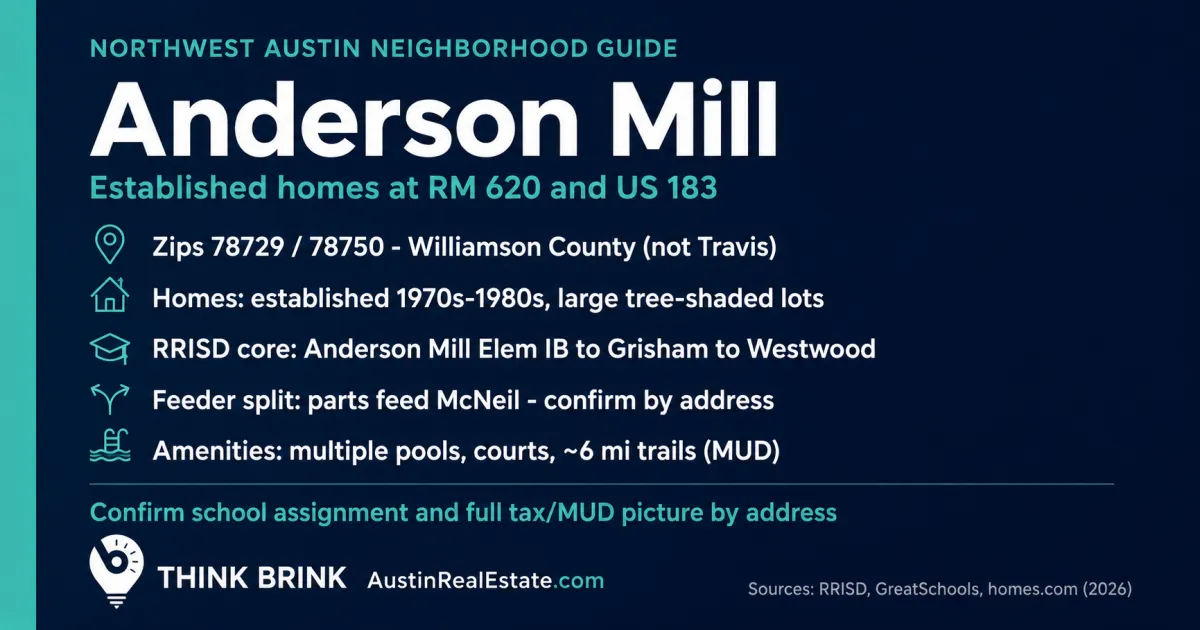
Anderson Mill sits in Northwest Austin, straddling the border between the City of Austin and Cedar Park along US 183, centered roughly on the intersection of RM 620 and US 183. It spans the 78729 and 78750 zip codes on the Austin side, with adjacent areas reaching toward Cedar Park's 78681. The neighborhood is large and was built out over a long stretch, so it reads less like a single subdivision and more like a collection of connected pockets under one name.
The location is the practical heart of the pitch. From the 620 and 183 intersection, you have direct access to two major arterials that connect you across Northwest Austin, up toward Cedar Park and Leander, and down toward the tech corridor. The Apple campus on Parmer, The Domain and North Burnet job core, and the broader 183 tech corridor are all reachable without fighting your way through central Austin. For buyers who work in the northwest arc of employers, Anderson Mill's position is genuinely convenient, and it is a big part of why the neighborhood holds demand. I put it in context with its neighbors in the North Austin neighborhood guide.
The honest caveat is the one that comes with every good-access location: the 620 and 183 corridors carry heavy traffic, and they back up at peak hours. The convenience is real, but it is convenience relative to busy roads, and a home near the edges of the neighborhood on those arterials lives differently from one tucked into the interior. If your commute matters, drive your actual route at your actual departure time before you commit.
The Williamson County and MUD wrinkle that most Austin buyers miss
Here is something that surprises buyers moving in from other parts of Austin: Anderson Mill is in Williamson County, not Travis County. Most of Austin sits in Travis County, so buyers who have been shopping elsewhere in the city often assume the whole metro is Travis. It is not. The county you buy in affects your property tax jurisdictions, your appraisal district, and which county offices you deal with, and it is worth understanding before you offer rather than after.
On top of that, portions of Anderson Mill sit within the Anderson Mill Municipal Utility District, a MUD that provides and maintains many of the neighborhood's amenities. A MUD is a local governmental entity that funds infrastructure and amenities, and it typically levies its own tax that is part of your total property tax bill. The upside is tangible: the MUD supports the neighborhood's amenity package, which includes multiple pools, a kiddie pool, sports courts, and a substantial network of hike-and-bike trails. The tradeoff is that a MUD tax is a component of your tax rate, and the total tax picture in a MUD can differ from a non-MUD neighborhood nearby.
I am going to keep the specific tax rate qualitative here rather than quote a number, because tax rates are set annually by multiple jurisdictions and a figure I quote today could be stale by the time you read this. What matters is the principle: in Anderson Mill you need to look at the full tax picture, county plus school district plus any MUD, for the specific address, because it can vary within the neighborhood and it affects your monthly cost meaningfully. Confirm the current combined rate for the exact property with the appraisal district, and because tax and jurisdiction questions can get technical, consult a qualified CPA or tax professional about how the MUD and county specifics apply to your situation.
The schools: a Westwood and McNeil split that you must confirm by address
Schools are where Anderson Mill's internal variability matters most, and where buyers make the most expensive assumptions. The neighborhood is served by Round Rock ISD, which is a strong district and a major reason buyers target this part of Northwest Austin. But Anderson Mill is large enough that it does not feed a single, uniform school pathway, and this is the detail to get right.
The core, best-known pathway runs through Anderson Mill Elementary, which is a designated International Baccalaureate World School, on to Grisham Middle School, and then to Westwood High School. Westwood is an IB World School and one of the most sought-after high schools in Round Rock ISD, and it is physically located in the Anderson Mill area. For buyers targeting the Westwood pathway, the Anderson Mill Elementary to Grisham to Westwood chain is the heart of what they are after.
Here is the catch. Anderson Mill is a broad, sprawling neighborhood, and portions of the wider area can fall into different feeder assignments, including the McNeil High School pathway rather than Westwood. Round Rock ISD sets attendance by address, and the boundaries within and around a neighborhood this large do not always follow the lines a buyer would assume from the neighborhood name. That means two homes both accurately described as being "in Anderson Mill" can feed different high schools. If the specific high school matters to you, and for most families it does, you cannot rely on the neighborhood name or a listing description. You confirm the elementary, middle, and high school assignment for the exact address directly with Round Rock ISD, every time, especially near the edges of the neighborhood. If you want to understand what the McNeil pathway offers on its own terms, I cover it in the McNeil High School feeder guide, and the broader point about assignment driving price is laid out in how school zoning by address changes what you pay in Northwest Austin.
Confirm the assignment before you fall in love with the house
I cannot say this strongly enough in a neighborhood like this one. The Westwood versus McNeil question can be the difference between the home you wanted and a home that feeds a pathway you did not intend, and it is set by a line on a map that has nothing to do with how the house shows. Confirm it first, with the district, for the specific address. It takes thirty minutes and it protects one of the biggest reasons most people buy here.
What the housing stock is actually like
Anderson Mill is an established neighborhood, and the homes reflect when it was built. The core of the housing stock dates to the 1970s and 1980s, with a mix of architectural styles ranging from traditional to early-modern, on lots that are generous by current standards and shaded by mature trees that took decades to fill in. Many homes have been thoughtfully remodeled over the years with opened-up floor plans and updated kitchens, while others remain closer to original. This spread is the defining feature of shopping here.
What that means for a buyer is that condition, not floor plan, is the main thing you are shopping for. These are homes that are forty to fifty years old. The systems behind the finishes, foundation, plumbing, electrical, roof, and HVAC, vary widely depending on whether and when a given home was updated. Because this vintage sits right in the window where certain era-specific issues appear, this is a neighborhood where understanding the build era pays off directly. I wrote a full breakdown of what to watch in homes of exactly this age in mid-century vs 1980s-1990s homes in North Austin, and it applies squarely to Anderson Mill.
The most common pricing mistake here is the same one I see across established Northwest Austin: paying an updated price for a home that has updated finishes sitting on top of original systems. A remodeled kitchen tells you nothing about the plumbing supply lines, the panel, or the age of the roof and HVAC. In a neighborhood built in the 1970s and 1980s, the systems questions are real, and the price you pay should track to where a specific home genuinely sits across all of them, not to how it photographs.
The amenities are a genuine differentiator
One place Anderson Mill clearly outperforms many of its established neighbors is amenities. Supported in part by the MUD, the neighborhood offers an amenity package that is unusually deep for an established Austin neighborhood: multiple junior Olympic-sized pools, a kiddie pool, sports courts, and roughly six miles of hike-and-bike trails woven through the area. For families, that is a real quality-of-life asset, and it is the kind of thing that keeps a neighborhood in demand across market cycles because it is not something a newer, smaller subdivision can easily replicate.
That amenity depth is part of what you are paying for through the MUD, which is why the tax picture and the amenity picture are two sides of the same coin. Buyers who value pools, courts, and trails within walking distance get real use out of what the MUD funds. Buyers who would not use them are still paying toward them. Neither is wrong, but it is worth being honest with yourself about which one you are.
How to think about price and value
I am going to keep the pricing qualitative here rather than quote a single median, because listing data for a neighborhood this large blends too many housing vintages, pockets, and condition tiers to produce an honest number, and a blended figure would mislead more than it informs. What holds true across the cycle is more useful than a snapshot that may be stale by the time you read this.
Anderson Mill generally prices below the hillside and top-feeder neighborhoods to the south and east, the Great Hills and Spicewood Estates tier, while offering larger lots, deep amenities, and the Round Rock ISD school access that draw buyers to this part of the city. Within the neighborhood itself, the biggest swing factors on price are the school assignment, whether the home lands on the Westwood or McNeil pathway, the condition of the specific home across its systems, and the position of the lot, since an interior street lives very differently from a home on or near the 620 or 183 arterials. A buyer who reads all three can understand why one Anderson Mill home costs far more than another and decide which premiums are worth paying. For a nearby 78729 tech-corridor comparison point, my guide to what buyers should know about Rattan Creek covers one of the adjacent neighborhoods buyers often weigh against Anderson Mill.
Who Anderson Mill is right for, and who it is not
Anderson Mill is a strong fit if you want an established Northwest Austin neighborhood with larger lots and mature trees, deep amenities, and Round Rock ISD access, at a price that undercuts the hillside neighborhoods. It is a strong fit if the 620 and 183 location works for your commute and you value being close to the northwest arc of employers. It is a strong fit if you are comfortable buying an older home and either renovating it or paying appropriately for one already updated. And it is a strong fit if you will actually use the pools, courts, and trails you are helping fund through the MUD.
Anderson Mill is the wrong fit if you want new construction with a warranty and modern systems out of the box, since the neighborhood is almost entirely 1970s and 1980s stock. It is the wrong fit if you need certainty about feeding a specific high school and are not willing to confirm the assignment carefully by address, because the Westwood and McNeil split is real. It is the wrong fit if the MUD tax component pushes the total tax picture past your comfort and you would not use the amenities it funds. And it is the wrong fit if you cannot tolerate arterial proximity and every home you are shown happens to sit near 620 or 183, in which case you simply need to be shown interior streets instead.
What to check before you make an offer on an Anderson Mill home
If Anderson Mill is your neighborhood, here is the pre-offer checklist, ordered roughly by how much it costs to get wrong.
The exact school assignment for the specific address. Confirm the elementary, middle, and high school directly with Round Rock ISD, and specifically whether the address feeds Westwood or McNeil. This is the single most important step in this neighborhood.
The full tax picture, including any MUD. Confirm the combined county, school district, and MUD rate for the exact property with the appraisal district, and consult a qualified CPA or tax professional about how the Williamson County and MUD specifics affect you. This is not tax advice; it is a reminder to get it.
Foundation and structural condition. Get a professional opinion on any sign of movement. In forty to fifty year old homes on Central Texas clay, this is the most expensive thing to be wrong about.
Plumbing, electrical, roof, and HVAC age. In 1970s and 1980s homes, verify the systems and price any updates into your offer. Homes of this era can carry era-specific plumbing and electrical concerns worth identifying before you commit.
The true condition tier. Decide whether you are buying updated, partially updated, or dated, and make sure the price matches the systems rather than the staging.
Where the home sits relative to 620 and 183. An interior street versus a home near the arterials is a major difference in daily livability and resale.
Handle those six and the neighborhood will not surprise you after closing.
Frequently asked questions about buying in Anderson Mill
What school district is Anderson Mill in?
Anderson Mill is served by Round Rock ISD. The core pathway runs through Anderson Mill Elementary, an International Baccalaureate World School, to Grisham Middle School, and on to Westwood High School. However, the neighborhood is large enough that portions can feed a different high school, including McNeil, so you must confirm the assignment for the specific address directly with Round Rock ISD before buying.
Does Anderson Mill feed Westwood or McNeil High School?
It depends on the exact address. The best-known Anderson Mill pathway feeds Westwood High School through Anderson Mill Elementary and Grisham Middle. But because Anderson Mill is a large, sprawling neighborhood, portions of the wider area can fall into the McNeil High School attendance zone instead. Round Rock ISD assigns schools by address, so two homes both in Anderson Mill can feed different high schools. Always confirm with the district for the specific property.
Why is Anderson Mill in Williamson County and not Travis County?
Most of Austin sits in Travis County, but Anderson Mill lies in Williamson County, which covers the northern arc of the metro including much of the Cedar Park and Round Rock area. The county affects your property tax jurisdictions, your appraisal district, and which county offices you deal with. Buyers moving from elsewhere in Austin are often surprised by this, so it is worth confirming the county specifics for your address before you offer.
What is the Anderson Mill MUD and how does it affect my taxes?
Portions of Anderson Mill sit within the Anderson Mill Municipal Utility District, a local governmental entity that funds and maintains infrastructure and amenities, including the neighborhood's pools, courts, and trails. A MUD typically levies its own tax that becomes part of your total property tax bill. That means the total tax picture in the MUD can differ from a non-MUD neighborhood nearby. Confirm the current combined rate for the specific address with the appraisal district, and consult a CPA about how it applies to you.
What kind of homes are in Anderson Mill?
Anderson Mill is an established neighborhood built mostly in the 1970s and 1980s, with a mix of traditional and early-modern styles on generous, tree-shaded lots. Many homes have been remodeled with updated kitchens and opened-up floor plans, while others remain closer to original. Condition varies widely across the neighborhood, and that condition spread is the biggest driver of price differences between otherwise similar homes.
Is Anderson Mill a good location for commuting to Apple or The Domain?
For the northwest arc of employers, the location is genuinely convenient. From the 620 and 183 intersection, you have direct access to reach the Apple Parmer campus, The Domain and North Burnet job core, and the broader 183 tech corridor without cutting through central Austin. The caveat is that 620 and 183 both carry heavy traffic and back up at peak hours, so drive your specific route at your real commute time before committing.
What amenities does Anderson Mill offer?
Anderson Mill has an unusually deep amenity package for an established Austin neighborhood, supported in part by its MUD: multiple junior Olympic-sized pools, a kiddie pool, sports courts, and roughly six miles of hike-and-bike trails. For families who will use them, these are a real quality-of-life asset and part of what keeps the neighborhood in demand. They are also part of what you fund through the MUD tax component.
Is Anderson Mill cheaper than Great Hills or Spicewood Estates?
Generally yes. Anderson Mill typically prices below the hillside and top-feeder neighborhoods to the south and east, while offering larger lots, deep amenities, and Round Rock ISD access. You are trading the hillside prestige and the very top elementary pathways for more lot, more amenities, and a more attainable price, which is exactly what makes it attractive to value-focused buyers who still want strong schools.
The honest summary
Anderson Mill is a large, established Northwest Austin neighborhood with a genuinely useful location at 620 and 183, larger lots, mature trees, an unusually deep amenity package, and Round Rock ISD access, at prices that undercut the hillside neighborhoods to the south and east. What makes it different from most neighborhoods is how much varies inside its own boundaries. It sits in Williamson County rather than Travis, parts of it are inside a MUD that shapes both the amenities and the tax bill, and it can feed either Westwood or McNeil depending on the exact address. Those are not footnotes. They are the central facts of buying here.
For a buyer who wants space, amenities, and strong schools at an attainable Northwest Austin price, and who does the work to confirm the school assignment, understand the tax picture, and read a home's real condition, Anderson Mill is one of the better values in this part of the city. For a buyer who needs turnkey new construction, or who assumes the neighborhood name alone guarantees a specific high school or tax situation, it can be an expensive misunderstanding. If you want help confirming which pathway an address feeds, sorting the interior streets from the arterials, and figuring out what a specific Anderson Mill home is worth once you account for the systems and the taxes, that is exactly the conversation I am here to have.
