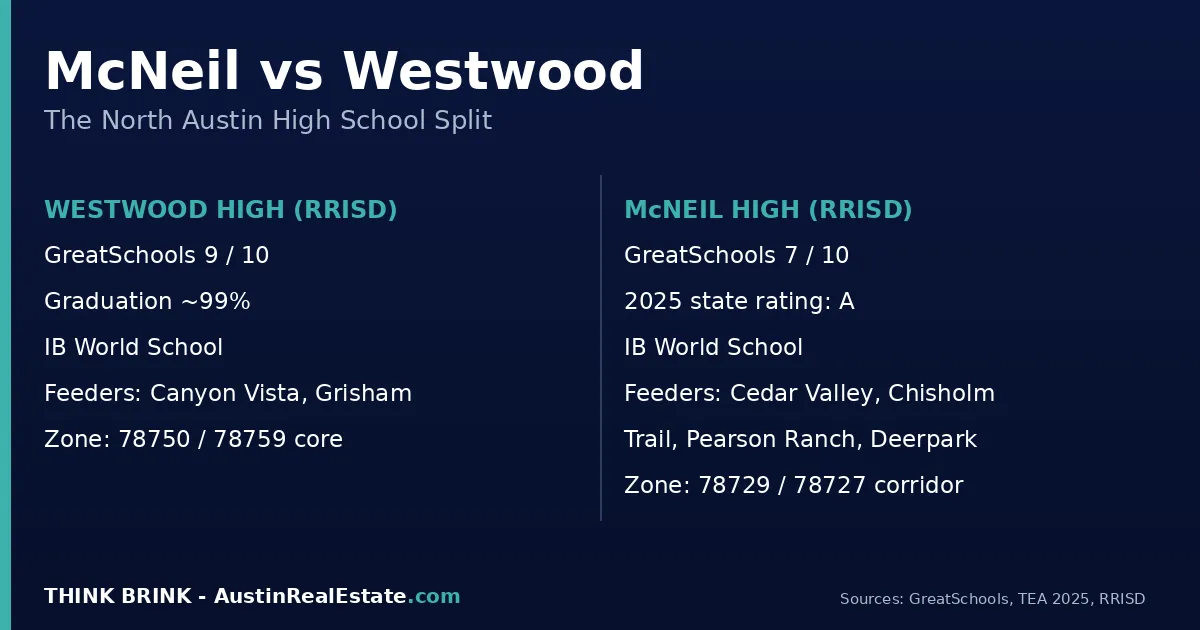
McNeil vs Westwood: What the North Austin High School Split Means for Buyers
If you are shopping the north Austin tech corridor and schools are part of your decision, you are going to run into two Round Rock ISD high schools over and over: McNeil and Westwood. They sit only a few miles apart, both carry the International Baccalaureate World School designation, and both pull from the same broad pool of professional, dual-income, relocation-heavy families that fill the neighborhoods between MoPac, 183, and Parmer. To a buyer skimming listings, they look interchangeable. They are not.
The split between these two attendance zones is one of the quieter forces shaping what you pay per square foot in this part of Austin. It is not always visible in a listing photo, and it is almost never explained honestly by a listing agent whose job is to make every house sound like it feeds the best possible school. So here is the honest version, from a broker who works these zip codes every week and has watched buyers overpay and underpay because they did not understand which side of the line a house was on.
The short version, before the detail
Westwood High School is the more sought-after of the two for most buyers, and it commands a measurable premium in the neighborhoods zoned to it. It carries a 9 out of 10 GreatSchools rating, a graduation rate around 99 percent, and one of the strongest IB and academic reputations in the entire Austin metro. Its attendance zone covers the established 78750 and 78759 neighborhoods closest to the 183 and 360 corridors, the Great Hills and Spicewood area, and the pathway most buyers researching Northwest Austin already have in their heads.
McNeil High School is also an IB World School, also strong, and carries a 7 out of 10 GreatSchools rating with a 2025 state accountability rating of A. It sits at 5720 McNeil Drive in 78729 and pulls from the tech-corridor neighborhoods farther north and west: Milwood, Anderson Mill, Rattan Creek, and the surrounding 78727 and 78729 pockets. It is a genuinely good school that gets overshadowed in buyer conversations because Westwood absorbs so much of the attention.
The practical takeaway is this: if your budget is stretched and you want RRISD, an IB high school, and the tech-corridor location, the McNeil zone often gets you meaningfully more house for the money than the Westwood zone does, without giving up nearly as much as buyers assume. If you specifically want the Westwood pathway and the resale story that comes with it, you pay for it, and in a lot of cases it is worth paying for. The mistake is not knowing which one you are buying into before you write the offer.
Both are IB World Schools, and that matters more than most buyers realize
The single most misunderstood fact about this comparison is that both McNeil and Westwood are International Baccalaureate World Schools. Buyers routinely assume the IB Diploma Programme is a Westwood-only feature and that choosing McNeil means giving up that pathway. It does not.
The IB Diploma Programme at both schools is an advanced academic track available to juniors and seniors, an alternative to the AP-heavy path that most Texas high schools default to. IB is a full two-year curriculum with its own assessment structure, extended essay, and theory-of-knowledge component. For families relocating from parts of the country or the world where IB is the prestige academic credential, having it available at your zoned school is a real consideration. Both McNeil and Westwood offer it. Both also offer AP courses and Project Lead The Way engineering curriculum, so a student is not forced to choose IB to access rigor.
Where the schools diverge is in scale, culture, and the depth of the honors pipeline underneath the IB track, not in whether IB exists. If IB access is a hard requirement for you, both zones qualify, and that alone can widen your search radius and lower your price by thousands of dollars if you were assuming Westwood was the only option. For the deeper detail on how the IB designation actually plays out at McNeil day to day, the McNeil High School feeder guide covers it in more depth than most buyers ever get.
What actually separates the two schools
Ratings and reputation
On the public rating scales, Westwood is the higher-rated school. Its 9 out of 10 GreatSchools rating, roughly 99 percent graduation rate, and long track record of National Merit finalists and top-decile testing put it in the conversation with the strongest public high schools in Central Texas. When a relocating family types "best high school in Northwest Austin" into a search engine, Westwood is the name that comes back.
McNeil's 7 out of 10 GreatSchools rating and A accountability grade describe a school that is performing above the Texas average and preparing students well for college, but that does not carry the same halo. The gap in the numbers is real. Whether the gap in outcomes for a specific motivated student is real is a much harder question, and one no rating captures. A strong student who takes the IB or AP track at McNeil is not being held back by the campus average. But you are buying a house in a market, and the market prices the reputation, not the outlier student. That is the honest tension every buyer in this comparison is navigating whether they name it or not.
Location and the neighborhoods each serves
Westwood's attendance zone is anchored in the more established, closer-in Northwest Austin neighborhoods. It covers streets in the Spicewood, Mellow Meadow, and Barrington Way areas straddling 78750 and 78759, the neighborhoods near the 183 and 360 intersection, and the more mature parts of Great Hills. These are the areas with larger lots, older tree canopy, and the location premium that comes with being close to the Arboretum, the Domain drive, and the fastest routes to major employers.
McNeil's zone reaches farther north and west into the newer tech-corridor subdivisions: Milwood, Anderson Mill, Rattan Creek, and the surrounding 78729 and 78727 neighborhoods. These areas were largely built out in the late 1970s through the 1990s, tend to sit on flatter and more uniform lots, and generally price below the closest-in Westwood neighborhoods for a comparable house. The tradeoff is a slightly longer reach to the 183/360 hub and a different, more suburban feel.
If you are weighing a specific house at the edge of these zones, do not trust the neighborhood name to tell you the school. The boundary between McNeil and Westwood runs through areas where two houses on nearby streets can feed different high schools. This is exactly the kind of address-level detail that changes what a house is worth, and it is worth reading how school zoning by address changes what you pay in Northwest Austin before you fall in love with a listing.
The feeder patterns underneath each high school
The two schools also differ in how many middle schools feed them, which affects the culture and the size of the incoming classes.
Westwood is fed by two middle schools, Canyon Vista and Grisham. That is a relatively tight, concentrated pipeline, and it is part of why the Westwood pathway feels cohesive and why families in Canyon Vista and Grisham zones tend to plan their whole home search around staying in it. The two middle schools are not identical, and the difference between them is meaningful enough that I wrote a full comparison of how Canyon Vista and Grisham differ for buyers.
McNeil is fed by four middle schools: Cedar Valley, Chisholm Trail, Pearson Ranch, and Deerpark. A four-school feeder means larger, more diverse incoming classes drawn from a wider geographic area. For some families that breadth is a positive; for others the more concentrated two-school Westwood pipeline feels more predictable. Neither is better in the abstract. It is a fit question, not a quality question.
What the school split does to home prices
Here is where I have to be careful and honest, because current month-by-month price data for these specific micro-markets moves, and I will not publish a precise figure I have not verified this month. What I can tell you is the durable pattern I see in these zip codes.
Homes zoned to Westwood, all else equal, carry a premium over comparable homes zoned to McNeil. That premium shows up two ways: in the price a seller can command, and in how fast the home sells. The Westwood zone consistently draws relocating families who have researched the school before they landed in Austin and who treat the attendance zone as a filter rather than a preference. That steady, motivated demand is what supports the premium.
The McNeil zone does not lack demand, but the demand is broader and less school-driven. Plenty of McNeil-zone buyers are choosing the neighborhood for the commute, the price, or the specific house, with the school as a solid bonus rather than the deciding factor. That produces a market that is still active but priced more on the fundamentals of the house and the lot than on the school premium.
What this means in practice: if you can be flexible on the school and you want to stretch your budget toward more square footage, a larger lot, or an updated house, the McNeil zone frequently delivers it. If the Westwood pathway is the point of the purchase, expect to compete, expect to pay closer to the top of the comparable range, and expect the best-located, best-condition homes to move quickly. For a sense of how quickly the strongest established neighborhoods move in this part of town, the pattern in places like Balcones Woods, where well-located homes have historically posted single-digit median days on market, is a useful reference point for how school-and-location demand compresses timelines.
Who should target Westwood
Westwood is the right target if any of the following describe you. You are relocating with school-age children and the high school is a top-three factor in the purchase. You value the resale story, because a Westwood zoning is one of the more durable resale advantages in Northwest Austin and it protects your position if you have to sell in a softer market. You want the more concentrated, established-neighborhood feel and you are buying closer to the 183 and 360 corridor anyway for the commute. Or you specifically want the Canyon Vista or Grisham middle-school experience for the years before high school.
Be realistic about what it costs. You will generally pay more per square foot than you would a few miles north in the McNeil zone, you will have less room to negotiate on the best homes, and you may end up in an older house that needs updating in order to stay in the zone at your budget. For a lot of families that is a trade worth making. Just make it with your eyes open.
Who should target McNeil
McNeil is the smarter target if your budget is the binding constraint and you are not willing to buy a dated or compromised house just to hold a Westwood address. It is the smarter target if your commute points north or west, toward the Parmer employers or the 45 tollway, where the McNeil neighborhoods are genuinely more convenient. It is the right call if you want a newer or larger home on a flatter, more workable lot, which the 78729 and 78727 subdivisions supply in volume. And it is the honest choice if you have looked hard at the actual school and concluded, correctly, that an A-rated IB World School with a 7 out of 10 rating is more than good enough for your child.
The neighborhoods here reward buyers who do their homework. Anderson Mill in particular sits in an interesting position on the McNeil and Westwood boundary and mixes housing eras and price points, which is why it deserves its own close read in what buyers should know about Anderson Mill before making an offer.
The mistakes I watch buyers make in this comparison
The first mistake is assuming the neighborhood name tells you the school. It does not. The McNeil and Westwood boundary does not follow subdivision lines cleanly, and the only reliable way to confirm a specific address is to verify it against the current Round Rock ISD attendance boundaries, not a listing description or a neighborhood website. Attendance zones also get adjusted over time as the district manages capacity, so a boundary that held five years ago is not a guarantee today.
The second mistake is paying the Westwood premium for a house that is actually zoned to McNeil, or the reverse, missing a genuinely well-priced Westwood-zoned house because the listing buried the school. I have seen both. The zoning is worth confirming in writing during your option period, every single time.
The third mistake is treating the GreatSchools number as the whole story. A 9 versus a 7 is a real signal about the average, but your child is not the average, and the IB and AP tracks at McNeil serve motivated students well. If you have a strong student and a tight budget, letting a two-point rating difference push you into a house you cannot comfortably afford is a decision you may regret for reasons that have nothing to do with school.
The fourth mistake is ignoring the middle-school years. You are not just buying a high school zone. You are buying the Canyon Vista or Grisham pathway on the Westwood side, or one of the four McNeil feeders on the other. Those middle-school years shape your child's experience and your family's routine for three years before high school even starts. Factor them in.
A fit check before you write the offer
Ask yourself four questions honestly. First, is the high school a top-three factor in this purchase, or is it one of many? If it is not top-three, do not let it override commute, budget, and the house itself. Second, have I confirmed the exact attendance zone for this specific address in writing, not from the listing? Third, if I am paying a Westwood premium, am I getting the house I actually want, or am I buying a compromised house just to hold the zone? And fourth, if I am choosing McNeil, have I actually looked at the school, or am I just reacting to a rating number?
Buyers who answer those four questions clearly rarely regret the school side of their purchase. Buyers who skip them are the ones who call me two years later wishing they had understood the split before they signed.
Frequently Asked Questions
Is McNeil or Westwood the better high school in Round Rock ISD?
Westwood is the higher-rated of the two, with a 9 out of 10 GreatSchools rating, a graduation rate near 99 percent, and a stronger overall reputation. McNeil carries a 7 out of 10 rating and a 2025 state accountability rating of A. Both are International Baccalaureate World Schools. Westwood is generally considered the stronger campus by the public ratings, but McNeil is a genuinely good school, and a motivated student on the IB or AP track at McNeil is well served.
Do both McNeil and Westwood offer the IB program?
Yes. This surprises a lot of buyers. Both McNeil and Westwood are International Baccalaureate World Schools offering the IB Diploma Programme to juniors and seniors, alongside AP courses and Project Lead The Way curriculum. Choosing the McNeil zone does not mean giving up IB access.
Which neighborhoods feed Westwood versus McNeil?
Westwood generally serves the more established 78750 and 78759 neighborhoods closer to the 183 and 360 corridor, including parts of the Spicewood and Great Hills areas, fed by Canyon Vista and Grisham middle schools. McNeil serves the tech-corridor neighborhoods farther north and west, including Milwood, Anderson Mill, and Rattan Creek in the 78729 and 78727 areas, fed by Cedar Valley, Chisholm Trail, Pearson Ranch, and Deerpark middle schools. Because the boundary does not follow subdivision lines cleanly, you must confirm any specific address against current district boundaries.
Does being zoned to Westwood make a home worth more?
In general, yes. Homes zoned to Westwood tend to command a premium over comparable homes in the McNeil zone and often sell faster, because the Westwood pathway draws steady, school-motivated demand from relocating families. The size of that premium varies by neighborhood, condition, and market conditions, so it should be evaluated on the specific house rather than assumed.
Can I get more house for my money in the McNeil zone?
Often, yes. Because demand in the McNeil zone is driven more by commute, price, and the house itself than by the school premium, buyers can frequently find more square footage, a larger or more workable lot, or a more updated home for the same budget than they would in the Westwood zone. If school flexibility is acceptable to you, the McNeil zone is where the value often is.
How do I confirm which high school a specific address is zoned to?
Verify the address directly against the current Round Rock ISD attendance boundaries rather than relying on the listing, the neighborhood name, or a real estate website. Attendance zones near the McNeil and Westwood boundary can differ street to street, and the district adjusts boundaries over time to manage capacity. Confirm it in writing during your option period, before you are committed.
Is McNeil a good school for a strong student?
Yes. McNeil is an A-rated IB World School offering IB, AP, and engineering curriculum. A motivated student who takes the advanced tracks has access to genuine rigor and a strong college-preparation pipeline. The lower overall rating relative to Westwood reflects the campus average, not a ceiling on what a driven student can achieve there.
Should I choose my Northwest Austin home based on high school zone?
Only if the high school is genuinely a top-three factor for your family. Many buyers in these neighborhoods reasonably weight commute, budget, and the specific house more heavily, with the school as a strong bonus. The right approach is to be honest about where school ranks for you, confirm the zone for any address you are serious about, and avoid overpaying for a compromised house simply to hold a particular attendance zone.
The bottom line
McNeil and Westwood are both good Round Rock ISD high schools, both IB World Schools, and both anchor large, desirable stretches of the north Austin tech corridor. Westwood is the higher-rated, higher-demand, higher-priced option, and for buyers who want the strongest resale story and the most established neighborhoods, it earns its premium. McNeil is the underrated value play, an A-rated IB school in tech-corridor neighborhoods where your budget stretches further. The buyers who do best in this market are the ones who decide honestly how much the school matters, confirm the exact zone for the specific address, and refuse to overpay for a house that is worse just because it holds a better school name. If you want help pinpointing which side of the line a specific home sits on, that is exactly the kind of question worth answering before you write the offer, not after.
School ratings, attendance boundaries, and program offerings change over time. Verify current attendance zones and program availability directly with Round Rock ISD for any specific address before relying on them in a purchase decision.
