Earnest Money vs the Option Fee in Texas: Two Deposits, Two Jobs, and Which One You Can Get Back
Almost every Northwest Austin buyer I work with writes two checks in the first three days of a contract, and almost none of them can tell me why there are two. They know they are handing over money. They are less sure what each payment is for, which one they get back if the deal falls apart, and whether either one is just gone. In a balanced, mildly buyer-favorable market like the one we have across 78750, 78759, and 78726 right now, you usually have enough room to slow down and understand what you are signing. You should use it.
The two deposits are the option fee and the earnest money. They are written into the same paragraph of the Texas contract, they are often paid in a single combined payment, and they are both credited back to you at closing if the sale goes through. That is where the similarities end. They do two completely different jobs, they carry two completely different levels of risk, and confusing them is how buyers either lose money they did not have to lose or walk away from protection they already paid for. This post is the plain-English version of what each one does.
One note before we start: I am a broker, not your attorney, and the paragraphs below describe how the standard Texas promulgated contract works in general terms. The specific numbers, dates, and boxes in your contract are what actually govern your deal. Read your own contract, and when a real dispute is on the line, talk to a real estate attorney.
The short version: two deposits, two jobs
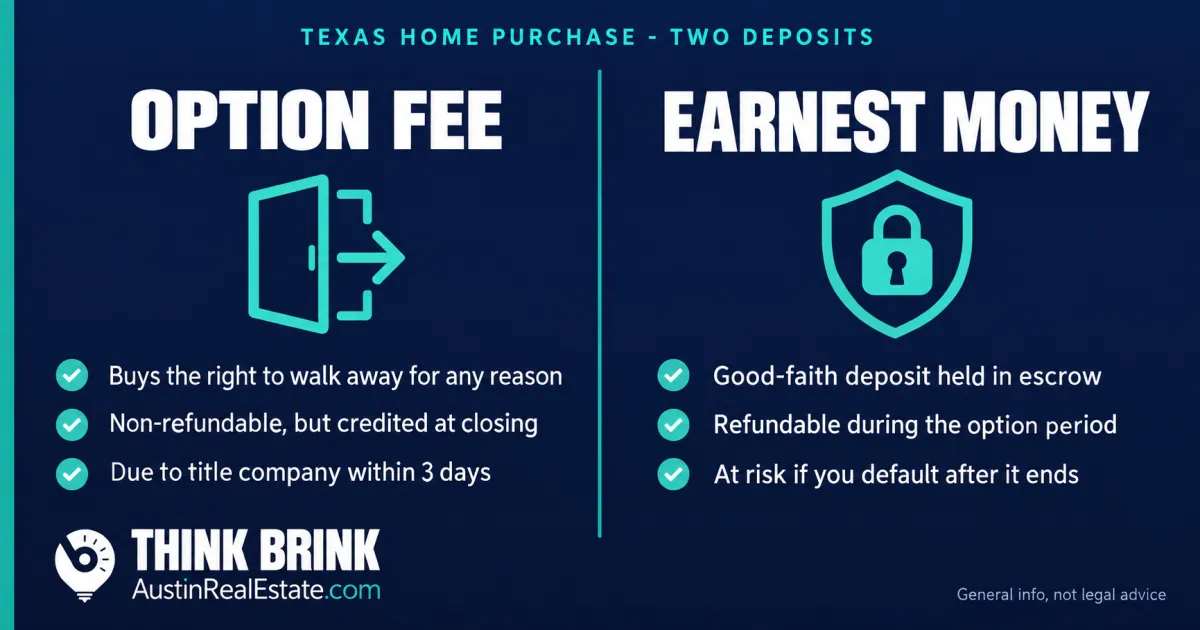
The option fee buys you time and an exit. In exchange for a relatively small payment, the seller gives you the unrestricted right to terminate the contract for any reason during a set number of days called the option period. That is your inspection window, your think-it-over window, your get-cold-feet window. You do not have to justify walking, the option fee is the price of that right.
The earnest money is different. It is your good-faith deposit, the money that says you actually intend to close. It is not payment for a right. It sits in escrow at the title company as a signal to the seller that you are serious, and it becomes the seller's compensation if you breach the contract without a valid reason. The earnest money is the money at stake in the deal itself.
So the clean way to hold the two in your head: the option fee is what you pay to be allowed to back out; the earnest money is what you risk if you back out the wrong way. Everything else follows from that distinction.
Where these live in the contract
Both deposits are handled in Paragraph 5 of the current Texas Real Estate Commission One to Four Family Residential Contract (Resale), the form most Northwest Austin resale deals run on. TREC combined the earnest money and the termination option into that single paragraph in its recent contract revisions, so if you are looking at an older explanation online that talks about the option fee living in Paragraph 23, that guidance is out of date. Make sure your agent has you on the current version of the form.
Paragraph 5 has a blank for the earnest money amount, a blank for the option fee amount, and a blank for the number of days in the option period. None of those numbers are set by law. They are negotiated between you and the seller like everything else in the contract, and what is customary in Central Texas shifts with how competitive the market is.
The option fee, in detail
What it buys
The option fee purchases the unrestricted right to terminate. During the option period, you can cancel the contract for any reason or no stated reason at all, deliver written notice of termination to the seller, and get your earnest money back. The bad inspection, the second thoughts, the appraisal you got nervous about, the job offer in another city: none of it has to be explained. That is the whole point of the option period, and the option fee is what you paid to have it. The option period is also the window when you should be lining up other things that have their own deadlines, and I walk through one of the most overlooked in what buyers should know about homeowners insurance and the option period in Central Texas.
How much and how long
Option fees in the Austin area are usually a few hundred dollars, and option periods commonly run in the range of about five to ten days, though I have seen both go higher and lower depending on the deal. In a hot stretch, buyers shorten the option period and raise the fee to make an offer look stronger. In a slower, more balanced market like the one we are in now, buyers have more room to ask for a longer window and a smaller fee. Neither number is fixed, and both are fair game in negotiation. Do not let anyone tell you there is a "standard" option fee that you have to match.
Is the option fee refundable?
No, and this is the part people get wrong. The option fee is not refundable. You do not get it back if you terminate. What you should understand, though, is that you are not really losing it either, at least not if you close. Under the current contract, the option fee is credited to the sales price at closing. So if you go through with the purchase, the money comes off what you owe. It only truly disappears if you use the option period to walk away, and in that case you got exactly what you paid for: the right to walk away and take your earnest money with you. That is a bargain, not a loss.
Where it goes and by when
Since April 2021, the option fee is delivered to the title company (the escrow agent), not to the seller directly. That was a real change, and it matters: it means the payment is documented and receipted by a neutral third party instead of floating around as a personal check to the seller. You authorize the escrow agent to release the option fee to the seller, and the title company can do so without asking you again. You must deliver the option fee within three days after the effective date of the contract.
Miss that deadline and the consequence is specific and painful: if you fail to pay the option fee on time, you do not get the unrestricted right to terminate. The option period effectively never comes into existence for you. You would still be under contract, but without the free exit you thought you had bought. This is why the three-day clock is not something to be casual about.
The earnest money, in detail
What it is
Earnest money is your performance deposit. It is not consideration for a right the way the option fee is; it is a show of good faith that you intend to close, and it doubles as the seller's remedy if you default. It goes into escrow at the title company and sits there through the life of the contract. At closing, it is applied to your bottom line, your down payment and closing costs, so like the option fee, it is not an extra cost if the deal closes. It is simply money you paid early.
How much
In the Austin market, earnest money is commonly around one percent of the purchase price, though it is negotiable and buyers sometimes offer more to strengthen an offer or less when they have leverage. On a Northwest Austin home, one percent is not a trivial number, which is exactly why understanding when it is and is not at risk matters so much.
When you get it back, and when you do not
This is the heart of the whole subject. Your earnest money is refundable in several situations and forfeitable in others, and the difference usually comes down to whether you had a contractual reason to terminate.
You generally get your earnest money back when:
You terminate during the option period. This is the big one, and it is why the two deposits are so often confused. The option fee bought you the right; exercising that right returns your earnest money.
You terminate under a valid contingency in the contract, such as a financing condition under the Third Party Financing Addendum if you cannot obtain your loan approval within the time allowed.
You make a proper, timely objection to a title or survey problem under Paragraph 6 and the seller cannot or will not cure it. This is where your title commitment and survey review connects directly to your earnest money.
The seller defaults, meaning the seller fails to perform. In that case you can terminate and recover your earnest money, and you may have other remedies as well.
You generally lose your earnest money when:
You default. If you walk away after the option period has ended, with no contractual contingency to stand on, you have breached the contract. Under the default paragraph, the seller can terminate and keep the earnest money as liquidated damages. That is the risk the earnest money exists to cover.
Put simply: the option period is the window during which your earnest money is fully protected no matter your reason. After that window closes, your earnest money is only protected if a specific contingency in the contract gives you an out. That is why buyers who understand the difference treat the end of the option period as the real commitment point of the deal.
The delivery deadline, and why timing is everything
Like the option fee, the earnest money must be delivered to the escrow agent within three days after the effective date. If you fail to deliver it on time, the seller may terminate the contract or pursue the contract's default remedies by giving you notice before you deliver. For both deposits, if that third day lands on a Saturday, Sunday, or legal holiday, the deadline extends to the next day that is not one of those. And the contract states that time is of the essence for delivering the earnest money, which is legal language meaning the deadline is treated as a hard one, not a suggestion.
How the two get paid, and how they come back to you
In practice, most buyers deliver both deposits together. The current contract explicitly allows the option fee and earnest money to be paid separately or combined in a single payment, and when they are combined, the money is applied first to the option fee and then to the earnest money, with anything left over going to any additional earnest money. So a single wire or check to the title company within three days can cover both, which is why so many buyers experience it as one payment and never register that two different things just happened.
At closing, both come back to your side of the ledger. The earnest money has been sitting in escrow and is applied to your cash to close. The option fee is credited against the sales price. If the deal closes, you have effectively paid both amounts toward the home. The only scenario in which the option fee is money spent for its own sake is the one where you used it to terminate, and in that scenario it did its job.
Why this matters more in some Northwest Austin deals than others
The practical weight of all this depends on the kind of home and the kind of deal. On an older, unrenovated home in Balcones Woods, Milwood, or one of the 1970s and 1980s pockets of the tech corridor, the option period is where you find out what you are actually buying: foundation movement on Central Texas clay, an aging roof, dated systems, a pool that needs work. That is exactly the situation where paying a modest option fee to preserve a clean, no-questions exit is worth every dollar, because the odds that inspection turns up something worth renegotiating or walking from are real.
On a newer or already-updated home, or in a multiple-offer situation, the calculus shifts. Sellers weigh a short option period and a healthy earnest money deposit as signs of a committed buyer. Buyers competing for a well-priced listing sometimes shorten the window or raise the fee to win. There is nothing wrong with that as a strategy, as long as you understand that you are trading away protection to make your offer more attractive. The mistake is doing it without realizing that is the trade.
Either way, budget for both deposits as part of your cash needs up front, alongside your other closing costs, your prorated property taxes, and, now, potentially your buyer's agent's fee. They are not lost money if you close, but they are money you need available within three days of going under contract, and a surprising number of buyers do not have that framed correctly when they write the offer.
Frequently asked questions
What is the difference between the option fee and earnest money in Texas?
The option fee buys you the unrestricted right to terminate the contract for any reason during the option period, and it is non-refundable but credited to the sales price at closing. The earnest money is a good-faith deposit that shows you intend to close, is held in escrow, is refundable in several situations including termination during the option period, and is forfeited to the seller if you default. One pays for an exit; the other is what is at stake in the deal.
Is the option fee refundable if I close on the house?
The option fee is never refundable in the sense of being handed back to you, but under the current Texas contract it is credited to the sales price at closing. So if you close, the amount is applied toward what you owe for the home, and you are not out the money. It is only truly spent if you use the option period to terminate.
Do I get my earnest money back if I cancel during the option period?
Yes. Terminating during the option period is the classic way to recover your earnest money. You deliver written notice of termination to the seller within the option period, and your earnest money is returned. That is the protection the option fee purchased for you.
Can I lose my earnest money?
Yes, if you default. If you back out after the option period has ended without a valid contractual reason such as a financing or title contingency, you have breached the contract, and the seller can keep your earnest money as liquidated damages. The option period is the window during which your earnest money is protected regardless of your reason; after it closes, you need a specific contract contingency to get the money back.
When are the option fee and earnest money due?
Both are due to the title company (the escrow agent) within three days after the effective date of the contract. If that third day falls on a weekend or legal holiday, the deadline moves to the next business day. Missing the earnest money deadline can let the seller terminate; missing the option fee deadline means you do not get the right to terminate at all.
Who holds the option fee and earnest money?
Since April 2021, both are delivered to the title company acting as escrow agent, not to the seller directly. The title company holds the earnest money in escrow and is authorized to release the option fee to the seller. Delivering payments to a neutral third party with a receipt is a protection for you, so keep proof of when and how you delivered.
How much should the option fee and earnest money be?
Neither amount is set by law. In the Austin area, option fees are usually a few hundred dollars with option periods commonly running about five to ten days, and earnest money is often around one percent of the purchase price. All of it is negotiable and moves with market conditions and how competitive a particular listing is. Your agent should help you set numbers that protect you without weakening your offer more than necessary.
Can I pay both in one payment?
Yes. The current contract allows the option fee and earnest money to be paid separately or combined in a single payment to the escrow agent. When combined, the money is applied first to the option fee and then to the earnest money. This is why many buyers experience it as one transaction and never realize two distinct things happened.
What this means for you
If you remember nothing else, remember this: the option fee is small money that buys you a large protection, and the earnest money is larger money that is protected only as long as you play by the contract's rules. During the option period, you hold almost all the leverage. You can inspect, renegotiate, or walk, and your earnest money comes home. Once that window closes, the deal gets serious, and your earnest money is only as safe as the contingencies still standing in your favor.
That is not a reason to be nervous. It is a reason to be deliberate. Set an option period long enough to actually complete your inspections and think clearly. Deliver both deposits on time and keep your receipts. Watch the calendar as the option period runs down, because that date, not the closing date, is when you are truly committing. And read your own contract, because the numbers and boxes in it are what govern, not any general summary, including this one.
If you are buying in 78750, 78759, or 78726 and want a walk-through of how these two deposits should be structured for your specific situation and the specific home, that is exactly the kind of thing I help buyers think through before they sign. It is a lot easier to get right at the offer stage than to fix after the fact.
This article is general information for Northwest Austin buyers and sellers, not legal advice. The promulgated Texas contract and its deadlines govern your transaction, and the specifics of your deal are what matter. For questions about your own contract or a dispute over a deposit, consult a Texas real estate attorney.
