Title Commitment and Survey in a Texas Home Purchase: What to Read and What Can Kill a Deal
Most Northwest Austin buyers spend their diligence window worrying about the inspection: the roof, the foundation, the HVAC. But the inspection is not the only clock running after you go under contract, and it is not usually where a clean-looking deal quietly falls apart. That happens in two documents almost nobody reads carefully until a title company or an attorney forces the issue: the title commitment and the survey.
This is the paperwork that decides whether the person selling you the house actually owns what they are selling, whether you can build the pool or the addition you have already sketched in your head, and whether the fence in the backyard is where the deed says the property line is. It is dry, and it is where real money and real ownership rights live. Here is how to read both documents, what to look for, and what can actually kill a deal.
A note before we start: I am a real estate broker, not a title attorney. This is general information about how the process works in Texas, not legal advice on your specific transaction. Read your own title commitment with your title company and, when something looks off, a real estate attorney.
What a title commitment actually is
When you buy a home in Texas, you are buying not just the structure but a chain of ownership that may stretch back decades, along with every easement, lien, restriction, and recorded claim attached to the land along the way. Title insurance exists to protect you and your lender against defects in that chain that nobody caught before closing.
The title commitment is the title company's written promise to issue that insurance policy once certain conditions are met. In Texas it comes on a standardized form, the T-7 Commitment for Title Insurance, and you typically receive it during your option period along with legible copies of the documents it references. Do not treat it as junk mail. It is the single best map of what you are actually buying, and the reason the option period matters as much for title as it does for the inspection.
One thing that surprises relocating buyers from California or the Pacific Northwest: in Texas, title insurance rates are promulgated. The Texas Department of Insurance sets the basic premium, and every title company charges the same base rate for the same coverage on the same policy amount. So you cannot shop title companies on price the way you shop lenders. What you can shop on is the escrow team and how hard they will work to clear a problem before your closing date, which in a complex purchase is worth more than a discount you are not legally allowed to get anyway.
The four schedules, and the two that decide whether you have a problem
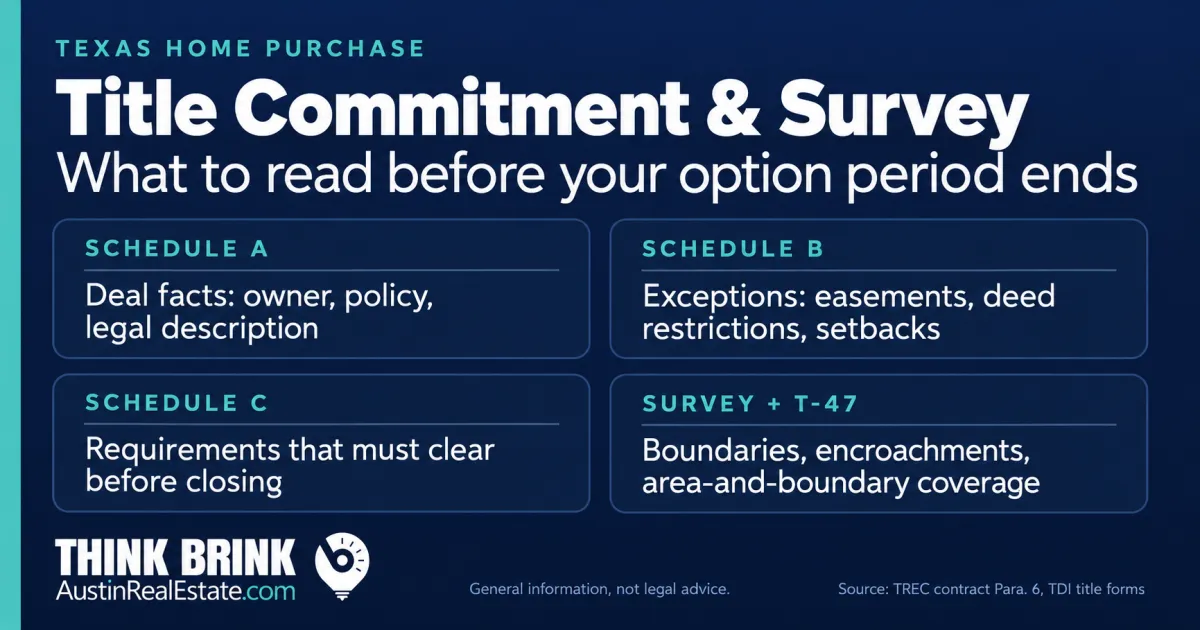
Every Texas title commitment is organized into four sections, labeled Schedule A through Schedule D. Two of them are informational. Two of them are where deals live or die.
Schedule A: the deal facts
Schedule A is the summary of the transaction. It lists the effective date of the commitment, the dollar amount of the policy, the type of policy (owner's, lender's, or both), the name of the proposed insured, the current record owner of the property, the estate being insured (this should read fee simple in almost every residential purchase), and the legal description of the land.
Read it anyway, for two quick checks. The current owner of record should be the person or entity actually selling you the house; if the seller on your contract does not match the owner on Schedule A, ask about it immediately, because it can signal an estate, divorce, trust, or entity issue that has to be resolved before anyone can convey clean title. And the legal description should match the property you toured. A mismatched or incomplete legal description is fixable, but only if it is caught before closing.
Schedule B: the exceptions, or what the policy will not cover
Schedule B lists the exceptions to coverage: the recorded matters the title policy specifically will not insure against. Do not panic when you see a full page of them. Some are standard boilerplate that appears in every Texas transaction. Others are specific to your property and deserve a careful read.
The specific exceptions are the ones that describe your land: recorded restrictive covenants (the deed restrictions and HOA rules that govern what you can build and how you can use the property), utility and drainage easements, building setback lines, and any mineral or royalty reservations that a prior owner carved out. In an established Northwest Austin neighborhood, expect to see subdivision deed restrictions and a utility easement running along the front or rear of the lot. That is normal. What you are looking for is anything unusual: a pipeline easement crossing the buildable part of the lot, a shared-access or ingress-egress easement, a right-of-way you did not know about, or a mineral reservation that grants someone surface access.
Here is the practical point. Schedule B is where you find out whether the addition, pool, casita, or workshop you are planning is even legal on this lot. A utility easement along the back fence can mean you cannot build a permanent structure over it, ever, because the utility has the legal right to dig it up. If your plans depend on a specific part of the lot, match them against Schedule B and the survey before you waive your option period, not after.
Schedule C: the deal-killer schedule
If you read only one schedule closely, read this one. Schedule C lists the requirements: the things that must be resolved before the title company will issue a clean policy. These are the curative items, and they are where transactions stall or collapse.
Common Schedule C requirements include paying off and releasing the seller's existing mortgage or deed of trust, clearing delinquent property taxes, releasing judgment liens or abstracts of judgment against the seller, releasing mechanic's or contractor's liens from recent work, correcting a gap in the chain of title, resolving probate when a prior owner has died, and verifying the signing authority of any trust, LLC, or estate involved in the sale.
Most Schedule C items get handled quietly by the title company and seller before closing, and you never think about them again. The dangerous ones reveal that the seller may not be able to deliver clean title on your timeline: an unresolved probate, a lien larger than the equity in the home, a disputed judgment, or a missing heir who has to sign. When you see something that looks like more than routine payoff paperwork, ask your title company how it gets cleared and how long it takes. That answer, more than almost anything on the inspection report, tells you whether you will close on time.
Schedule D: the disclosure schedule
Schedule D discloses who shares in the title insurance premium: the underwriter, the title agent, and their respective percentages. It exists for transparency and rarely affects your decision. Glance at it and move on.
The survey: an existing one with a T-47, or a new one
The commitment tells you who owns the land and what is recorded against it. The survey tells you where the land actually is and what physically sits on it. You need both, because they check each other.
A survey is a drawing, prepared by a licensed surveyor, showing the boundary lines of the lot, the location of the house and other improvements, the easements and setback lines from the commitment plotted onto the actual ground, and any encroachments across the lines. It is how you find out that the back fence is three feet inside the true property line, that the neighbor's shed sits partly on your lot, or that the covered patio the previous owner built extends into a utility easement.
In the standard TREC One to Four Family Residential Contract, the survey question lives in Paragraph 6, and there are essentially three ways it gets handled. The seller can furnish an existing survey along with a signed and notarized T-47 affidavit. The buyer can pay for a new survey. Or the seller can pay for a new survey. Which path applies depends on how Paragraph 6C is filled out in your contract, so read that paragraph before you assume who is paying.
The T-47 is the document that makes an existing survey usable. It is a Texas Department of Insurance form on which the seller swears, under oath, that nothing material has changed on the property since the survey was made: no new structures, no moved fences, no added pool, no new driveway. If the seller signs a valid T-47 and the title company and lender accept the existing survey, you avoid the cost and the several-week wait of a new one. If the seller will not sign, or if the property has visibly changed since the old survey (common with a remodeled or expanded home), the existing survey is not reliable and a new one has to be ordered. Sellers sometimes resist signing precisely because they know something changed and do not want to swear otherwise, and that reluctance is a signal worth noticing.
My honest advice: do not skip a reliable survey to save a few hundred dollars and a couple of weeks. A survey you can trust is cheap insurance against a boundary or encroachment problem that costs far more to untangle later, and that your title policy will not cover if you never got the survey. On an older Northwest Austin lot, or anything with acreage or an irregular boundary, I would want a survey I trust every time.
The area-and-boundary exception, and whether to buy it off
Here is a piece of Texas title mechanics that trips up even experienced buyers. By default, your owner's title policy contains an exception for shortages in area and for matters a survey would show, often called the area-and-boundary exception or the survey exception. In plain terms, unless you do something about it, your title policy will not cover boundary disputes, encroachments, or acreage shortages.
You can have that exception amended so that the policy covers everything except shortages in area, but two things are required. You need an acceptable survey, and you pay a promulgated add-on premium. Under the current Texas Department of Insurance rules, that amendment runs about five percent of the basic premium for residential property, subject to a small minimum. Confirm the exact current figure with your title company, since promulgated rates are periodically updated, but the order of magnitude is small relative to what it protects.
For most residential buyers, amending this exception is a routine and worthwhile step, because it turns your title insurance into something that actually backs you up if a boundary problem surfaces after closing. The point to remember is that the coverage is not automatic. It depends on an acceptable survey and on someone actually requesting the amendment, so ask whether it is being done on your file.
What a survey actually catches
When people say a survey killed a deal, they almost always mean one of three things showed up on the drawing.
Encroachments. An encroachment is any improvement that crosses a boundary line, in either direction: the seller's shed, driveway, or fence extending onto the neighbor's lot, or the neighbor's structure sitting on the lot you are buying. A fence a few inches over the line is usually a shrug. A garage or addition that crosses the line is a real title and liability problem that has to be resolved, sometimes with a boundary-line agreement, sometimes by moving the improvement, and occasionally by walking away.
Easement conflicts. This is the one that catches buyers with big plans. If a permanent improvement such as a pool, deck, or workshop sits partly inside a recorded utility or drainage easement, the survey will show it. The utility that holds the easement has the legal right to access it, which can mean tearing out the obstruction, and the obligation to rebuild it is generally not theirs. You want to know before closing, not the day the utility crew shows up.
Setback violations. Subdivision deed restrictions and city rules require structures to sit a certain distance from the property lines. A survey plots those setback lines and shows whether the house or an addition crosses them. A setback encroachment can complicate future permits, insurance, and resale, and it can signal a prior addition built without proper approvals.
A survey can also confirm whether part of the lot sits in a mapped floodplain, which near creek drainages in the 78750, 78759, and 78726 area affects insurance and buildability. It is not the last word on flood risk, but it is one more place the question surfaces.
The objection clock: how your termination right on title works
Finding a problem on the commitment or survey does not automatically let you out of the deal. Texas gives you a specific, time-limited right to object, and it is separate from your option-period termination right.
Under Paragraph 6D of the TREC contract, once you have received the commitment, the survey, and legible copies of the exception documents, you have a stated number of days to object in writing to defects, exceptions, or encumbrances that are not acceptable to you. Objections you do not raise in that window are generally waived, and the items you accept become permitted exceptions in your policy. That is the trap: if you never read the documents during your diligence window, you can silently accept an easement or a restriction you would have fought.
When you do object, the seller generally has fifteen days to cure, and if that cure period runs past your original closing date, closing extends to accommodate it. If the seller cures the problem, you proceed. If the seller cannot or will not, you typically choose between terminating the contract for a refund of your earnest money and waiving the objection to close with the problem intact.
So the option period and the title-objection window work together. Your option period is your general right to walk for any reason during a short window. Your title-objection right is your specific tool for forcing the seller to fix a defect, or return your earnest money if they cannot. Both depend on reading the documents while the clocks are running. A balanced, buyer-favorable market like the one Northwest Austin has seen recently gives you more room to insist on cures rather than eat problems, but only if you raise them in time.
What can actually kill a deal
Here is the honest list of what genuinely ends transactions at the title-and-survey stage, as opposed to what merely creates paperwork:
A seller who cannot deliver clean title on time. Unresolved probate, a missing or uncooperative heir, a lien or judgment larger than the seller's equity, or a title dispute that cannot be cleared before closing.
A serious encroachment. A structure crossing a boundary line in a way that cannot be resolved with a simple agreement, especially when a neighbor will not cooperate.
A valued improvement sitting in an easement. The pool or addition you are buying the house for is partly inside an easement, so it becomes either a liability or a dead plan.
A deal-relevant restriction on Schedule B that blocks what you intended to do with the property.
A survey the seller will not stand behind, refusing both to sign a T-47 on the existing survey and to pay for a new one, leaving you to absorb the cost and the risk.
Most of these are discoverable during your option period if you read the commitment and get a reliable survey. The deals that die badly are the ones where the buyer treated title and survey as rubber stamps and understood the problem only when it was too late to object.
Northwest Austin specifics worth watching
The general Texas process is the same everywhere, but a few things come up more often in our footprint.
Established neighborhoods across 78750, 78759, and 78726 were platted decades ago and carry layered deed restrictions and utility easements that are easy to overlook. Older lots are also the ones most likely to have a fence that drifted off the line or a shed placed without regard to an easement, which is exactly what a survey catches, and remodeled or expanded homes are where an old survey is least likely to be reliable, so scrutinize the T-47 question hard on an updated home. Parts of the area are also governed by municipal utility districts and limited districts rather than a simple city-and-HOA structure, and those can bring their own recorded assessments and easements onto Schedule B. Anything on the wildland edge or with acreage on the outer edges tends to carry access, easement, and boundary questions that make a current survey non-negotiable in my view.
The tax items you see referenced on Schedule C also connect directly to your first bill and the closing proration. For the money side of closing, it is worth understanding how property tax proration works at a Texas closing and what Northwest Austin buyers should know about property taxes and exemptions.
Because the title and survey diligence runs on the same short clock as your insurance and inspection work, treat it as part of the same push. The same window where you should be lining up homeowners insurance during the option period is when the commitment and survey need a careful read. And if you are looking at anything with land, the easement and boundary stakes are higher, which is covered in more depth in the guide to buying an acreage or larger-lot home on the outer edges.
Frequently asked questions
What is the difference between a title commitment and a title policy in Texas?
The commitment is the title company's written promise to issue a policy once its requirements are met, and it comes before closing. The policy is the actual insurance, issued at or after closing, that protects you against covered title defects. The commitment is your chance to see and object to problems. The policy is the protection you carry afterward.
Do I really need a survey if the seller has an existing one?
Often the existing survey works, but only if the seller signs a valid T-47 affidavit swearing nothing material has changed, and the title company and lender accept it. If the property has been remodeled, fenced differently, or had structures added since the old survey, or if the seller will not sign the T-47, you need a new survey. Skipping a reliable survey to save money means your title policy keeps the survey exception and will not cover boundary or encroachment problems.
What is a T-47 and who signs it?
The T-47 Residential Real Property Affidavit is a Texas Department of Insurance form. The seller signs and notarizes it to swear that an existing survey is still accurate and that no material changes have been made to the property since it was done. It is what lets the title company rely on an old survey instead of requiring a new one.
Who pays for the owner's title policy in Central Texas?
It is negotiable in the contract, and Paragraph 6A of the TREC contract is where it is specified. By custom in much of Central Texas the seller pays for the owner's title policy, while the buyer typically pays for the lender's policy, often at a reduced simultaneous-issue rate. Because rates are promulgated by the state, the base premium is the same regardless of which title company you use.
What does it mean to amend the area-and-boundary exception?
Your default policy will not cover matters a survey would show. Amending, or deleting, the area-and-boundary exception extends your coverage to everything except shortages in area, but it requires an acceptable survey and a small promulgated add-on premium, currently around five percent of the basic premium for residential property. For most buyers with a survey in hand, it is a worthwhile upgrade. Confirm the current figure with your title company.
How long do I have to object to items on the title commitment or survey?
Under Paragraph 6D of the TREC contract you have a stated number of days after you receive the commitment, the survey, and legible copies of the exception documents to object in writing. The exact number is written into your contract. Objections you do not raise in that window are generally waived, so read the documents promptly during your option period.
What happens if the seller cannot cure a title problem I object to?
If you object properly and the seller cannot or will not cure the defect within the cure period, you generally may either terminate the contract and receive your earnest money back or waive the objection and close with the problem in place. That is a different mechanism from the option-period termination right, and it is your leverage to force a fix or get out cleanly on title issues specifically.
What this means for you
The inspection tells you about the house. The title commitment and survey tell you about the ownership and the land, and they are where an otherwise clean deal quietly runs into trouble. The good news is that almost every serious title-and-survey problem is discoverable during your option period, when you still have both the general right to walk and the specific right to object and force a cure.
So do the unglamorous work. Read Schedule B to see what the policy will not cover and whether your plans for the property are even legal. Read Schedule C to see whether the seller can actually deliver clean title on your timeline. Get a survey you can rely on, either an existing one backed by a T-47 or a fresh one, and make sure someone is amending the area-and-boundary exception. Raise your objections in writing, in time. Buyers who do this close with confidence. Buyers who skip it tend to be the ones telling a cautionary story a year later.
If you are buying in Northwest Austin and want a second set of eyes on a commitment or a survey before your option period runs out, that is exactly what a local broker should walk through with you. Bring me the documents and we will read them together, and take the genuinely thorny questions to a real estate attorney and your title company for advice specific to your transaction.
This article is general information about the Texas title and survey process and is not legal advice. Every transaction is different. Review your own title commitment and survey with your title company, and consult a licensed Texas real estate attorney for questions about your specific situation.
