Property Tax Proration in Texas: What Actually Happens to Your Taxes at Closing
Property Tax Proration in Texas: What Actually Happens to Your Taxes at Closing
Somewhere on your closing statement, in the middle of a page full of numbers you have never seen before, there is a line for property tax proration. In most Northwest Austin transactions it is a credit from the seller to the buyer, and it is often one of the larger adjustments on the page. Buyers see it, nod, and sign, because the number is going in their favor and nobody wants to slow down a closing to ask about a line item that helps them.
That is a mistake worth avoiding. The proration is frequently misunderstood, and it is not the real property tax story of your purchase. In a market like 78750, 78759, and 78726, where homes have appreciated for years and where a meaningful share of sellers are older owners with a frozen tax ceiling, the number that matters most is not what shows up at closing. It is what shows up on your tax bill the second year you own the home, and that number can be dramatically higher than the proration suggested.
This is a broker's walk-through of how Texas property tax proration actually works at closing, why the credit exists, where the number comes from before the tax bill even exists, and the reset that catches so many Northwest Austin buyers off guard the year after they move in. It is general information, not tax or legal advice. Confirm the specifics for your transaction with your title company, your agent, and where the dollars are large, a CPA or property tax professional.
Why Texas Property Taxes Are Paid in Arrears
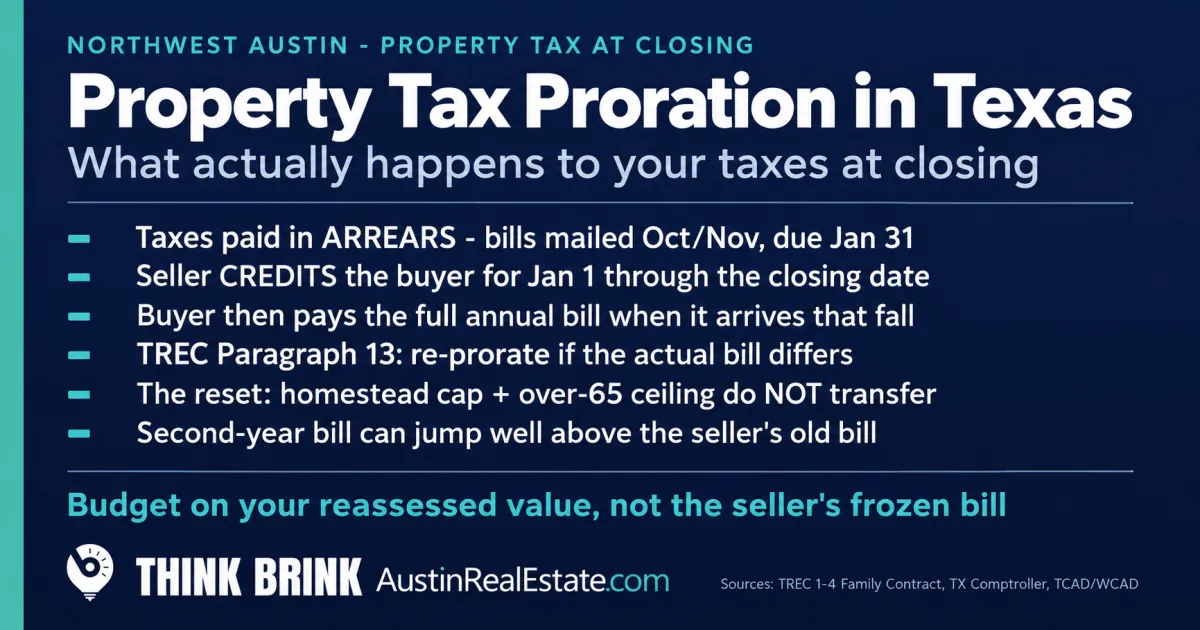
The whole thing starts with timing. Texas property taxes are paid in arrears, which means you pay for a year of ownership after that year is over, not before it begins. The 2026 tax bill covers all of calendar year 2026, but the tax offices do not mail those bills until roughly October or November of 2026, and the bill is not delinquent until February 1, 2027. In practice you have from that fall mailing until January 31 to pay without penalty.
That lag is the source of nearly everything confusing about taxes at closing. If you buy a home in June, the tax bill for that year has not been issued yet and will not be issued for months. Nobody has paid it. There is no receipt to split. Yet both you and the seller will have owned the home during the tax year, and the fair result is that each of you pays for the portion of the year you actually owned it. Proration is the mechanism that sorts that out at the closing table instead of leaving the two of you to settle up months later on your own.
How Proration Actually Works
The principle is simple. The seller is responsible for the taxes that accrued from January 1 up to the closing date. The buyer is responsible for the taxes from the closing date through the end of the year. The title company calculates each side's share based on the number of days each party owned the property.
Here is the part that trips people up. Because the tax bill has not been paid yet, and because the buyer will eventually receive and pay the entire year's bill, the seller does not write a check to the tax office at closing. Instead, the seller gives the buyer a credit at closing for the seller's share of the year. The buyer then pays the full annual bill when it arrives that fall, having already been compensated by the seller for the months the seller owned the home.
A clearly labeled hypothetical makes this concrete. Say a home's annual property taxes work out to 10,000 dollars for the year, and the sale closes on June 30, exactly halfway through the year. The seller owned the home for roughly half the year, so the seller credits the buyer about 5,000 dollars at closing. When the tax bill for the full 10,000 dollars arrives in the fall, the buyer pays all of it, but the buyer is out of pocket only about 5,000 dollars net, because the seller already handed over the other half at closing. The 10,000 dollar figure here is illustrative arithmetic to show the mechanism, not a market statistic for any particular home. Your actual number depends entirely on the assessed value and the combined tax rate for your specific parcel.
The direction of the credit surprises some out-of-state buyers. In states where taxes are paid in advance, the buyer often reimburses the seller. In Texas the flow usually runs the other way: the seller credits the buyer. If you are relocating from California or the Pacific Northwest, do not assume the mechanics you are used to apply here.
Where the Number Comes From When the Bill Does Not Exist Yet
If the current year's tax bill has not been issued at the time you close, the title company cannot prorate the actual amount, because there is no actual amount. So it estimates, and the estimate follows a fairly standard convention.
For closings early in the year, before the appraisal district has released proposed values in the spring, title companies generally prorate using the prior year's actual taxes, because that is the most recent hard number available. For closings later in the spring and summer, after the appraisal district has published the current year's proposed market value but before the fall tax bills come out, the proration is commonly based on that year's assessed value multiplied by the prior year's tax rates, since the new rates are not adopted until late summer or fall. Once the actual bills are available, prorations are based on the real billed amount.
None of these methods is perfect, and everyone involved knows it. Assessed values change, tax rates change, and exemptions change. Some title companies build in a small cushion so the estimate is more likely to be adequate than short. The point for you as a buyer or seller is that the proration on your closing statement is an estimate, not a settled account, and the contract anticipates exactly that.
The Reproration Clause Almost Nobody Reads
The standard TREC One to Four Family Residential Contract handles this in its prorations paragraph, Paragraph 13 in the current resale form. Buried in that paragraph is a sentence that does real work: if the taxes for the current year turn out to differ from the amount that was prorated at closing, the parties agree to adjust the proration once the actual tax statements are available.
That is the reproration clause. It means the number at closing is not necessarily final. If the estimate was based on the prior year's taxes and the actual bill comes in higher, the buyer may be entitled to collect the difference from the seller for the seller's portion of the year. If it comes in lower, the seller could be owed money back. In practice, small differences often go unaddressed because neither party bothers to chase a modest sum months after closing. But if the difference is large, and in this market it can be, the clause is your contractual basis for squaring up.
The catch is that reproration does not happen automatically. No one mails you a check. You or your agent has to notice the discrepancy when the actual bill arrives and make the request, which is why it is worth keeping your closing statement somewhere you can find it that fall.
The Tax Certificate and Delinquent Taxes
Separate from proration, the title company orders a tax certificate from each taxing authority as part of the closing. That certificate shows whether any prior-year taxes are unpaid. If the seller owes delinquent taxes from earlier years, plus any penalties and interest, those are deducted from the seller's proceeds at closing and paid off, so that you as the buyer take clear title without inheriting someone else's tax debt.
This is quiet, routine, and one of the genuine protections of buying with a title policy. It is also the reason the proration conversation and the delinquent tax conversation are two different things. Proration splits the current year fairly. The tax certificate clears the past. Do not confuse the two if a number on your statement looks unfamiliar; ask the closer which is which.
The Real Northwest Austin Surprise: The Reset
Here is where the proration line stops being the important part of the story. The proration handles the year of the sale. What buyers in 78750, 78759, and 78726 need to understand is what happens the year after, because in these specific neighborhoods the second-year tax bill can jump well above anything the closing statement hinted at. Two things drive it.
The homestead cap resets when the home sells
Texas gives homesteaded owners a 10 percent cap on how much their taxable assessed value can rise each year, no matter how fast the market climbs. In a place where values have appreciated for years, a long-term owner can end up with an assessed value that sits far below what the home would actually sell for, because the cap has been holding their taxable value down year after year. Their tax bill reflects that suppressed, capped value.
That accumulated benefit does not transfer to you. When a home changes hands, the cap resets. The appraisal district can reassess the property toward current market value, and the new owner starts from that full appraised value rather than inheriting the seller's built-up cap protection. Your own 10 percent cap does not begin protecting you until you have qualified the home as your residence homestead and owned it through a full calendar year; it generally takes effect on January 1 of the year after you first qualify. So the first full year you own the home, you can be taxed on a value that is markedly higher than what the previous owner was paying on, and there is no cap cushioning the jump.
This is why a buyer can look at the seller's current tax bill during due diligence, budget around it, and then be genuinely shocked the following year. The seller's bill was the product of years of cap protection you do not get to keep. Look at what the home is likely to be assessed at near its purchase price, not at what the seller was paying, when you are estimating your real ongoing cost.
The over-65 ceiling does not come with the house
The second driver is specific to a very common Northwest Austin situation: buying from an older owner. Many long-tenured sellers in these established neighborhoods are 65 or older and have an over-65 tax ceiling that has frozen the school district portion of their taxes, sometimes for many years. That ceiling is tied to the owner, not to the house. When a buyer who does not independently qualify for the over-65 exemption takes over the home, the ceiling is removed and the school taxes are recalculated without the freeze.
Combine the two effects and you can see how the arithmetic runs against a new owner. You buy from a senior whose taxable value was both capped and frozen. The cap resets to market value and the over-65 freeze disappears at the same time. The result can be a second-year tax bill that is a large multiple of what the seller was paying, even though nothing about the house changed. If you want the mechanics of that ceiling and how it works for the seller who is moving, I covered it in depth in how the Texas over-65 school tax ceiling ports when you downsize, and the related over-65 property tax deferral.
None of this is a reason to avoid buying from an older owner. It is a reason to price your ownership on what you will actually be taxed, not on the seller's frozen bill. A good listing agent will show the seller's low taxes as a feature. A good buyer's agent will tell you plainly that those low taxes are not part of what you are buying.
Escrow Reserves Are Not the Same as Proration
One more source of confusion at the closing table: if you are financing the purchase and your lender requires an escrow account for taxes and insurance, you will fund that account at closing with several months of reserves. That is a separate transaction from the tax proration and serves a different purpose.
Proration settles who owes whom for the year of the sale. Escrow reserves are money your lender collects up front and holds so that, when the actual tax bill comes due, the servicer can pay it out of the account you feed through your monthly payment. Because the lender wants the account to cover a bill it knows will be based on your new, post-reset value, the reserves and your monthly escrow portion can be set higher than the seller's old taxes would suggest. If your payment estimate seems high relative to the seller's tax history, that reset-aware math is often why, and it is also why some buyers face an escrow shortage and a payment bump after the first real bill posts. Ask your lender whether they estimated your escrow on the seller's taxes or a reassessed value.
What Sellers Should Watch
Proration is not only a buyer's concern. As a seller, the credit you give the buyer for your share of the year comes out of your proceeds, so it is real money off your net. Close late in the year and your share is larger, because you owned the home for most of it; close early and your share is small. Have your agent walk you through the estimated net sheet so the number is no surprise.
Sellers should also know the reproration clause can cut the other way. If your taxes were prorated using an estimate and the actual bill comes in lower, you may be owed a small refund from the buyer. And if you are an over-65 seller who has been paying a frozen or ceiling-limited amount, the buyer's future higher bill is not your responsibility. Your obligation is your share of the current year, not a make-whole for the buyer's reset.
A Few Special Cases
New construction throws proration off predictably. If you buy a newly built home, the prior year's taxes were assessed on vacant land, not a finished house, so any proration based on last year's taxes will be far too low relative to what the completed home will be billed. Expect the first real tax bill on new construction to be much higher than the land-only proration implied, and budget for it deliberately.
Rollback taxes show up on land that carried an agricultural or open-space valuation. If that special-use valuation is changed, the taxing authorities can recover taxes for prior years at the higher non-agricultural rate. This is uncommon inside the established residential neighborhoods that make up most of 78750 and 78759, but it can surface on larger tracts and acreage parcels on the outer edges. The TREC contract addresses rollback taxes in the same paragraph as prorations, so if you are buying land with an ag exemption, read that language and ask who bears the rollback risk.
Frequently Asked Questions
Are Texas property taxes paid in advance or in arrears?
In arrears. You pay for a calendar year of ownership after that year, with bills mailed around October or November and payment due by January 31 of the following year. Because of that timing, when a home sells mid-year the tax bill for the current year usually has not been issued yet, which is exactly why proration exists.
Who pays the property taxes at closing in Texas, the buyer or the seller?
Both, for their share of the year. The seller is responsible for January 1 through the closing date and the buyer for the closing date through December 31. Because the bill is not paid yet, the seller typically credits the buyer for the seller's portion at closing, and the buyer pays the full bill when it arrives.
Why did the seller give me a credit instead of paying the tax office?
Because the tax bill has not been issued. There is nothing to pay yet. Rather than have the seller pay a bill that does not exist, the title company credits you the seller's share at closing, and you pay the entire year's bill later, having already been compensated for the months the seller owned the home.
What happens if the prorated taxes turn out to be wrong?
The standard TREC contract includes a reproration clause, in Paragraph 13 of the current resale form, saying the parties will adjust the proration once the actual tax statements are available if the real amount differs from the estimate. It does not happen automatically. You or your agent must notice the difference when the real bill arrives and request the adjustment, so keep your closing statement handy that fall.
Why is my property tax bill so much higher than what the seller was paying?
Usually because of the reset. When the home sold, the previous owner's 10 percent homestead cap was removed and the appraisal district can reassess toward current market value. If the seller was 65 or older, their over-65 tax ceiling also went away, because it belongs to the owner, not the house. In neighborhoods that have appreciated for years, those two effects together can push your second-year bill well above the seller's old one, even though nothing about the property changed. Budget on your likely reassessed value, not on the seller's frozen taxes.
When can I file for my own homestead exemption?
Since a law change effective in 2022, Texas buyers can file for the residence homestead exemption in the same year they purchase, qualifying from the date they own and occupy the home as their principal residence, rather than waiting until the following year. File it as soon as you close and move in. It lowers your taxable value and starts the clock toward your own 10 percent cap, which begins protecting you on January 1 of the year after you first qualify. Confirm the current filing process with the Travis or Williamson County appraisal district.
Does the tax proration cover delinquent taxes from prior years?
No. Proration only splits the current tax year. Delinquent taxes from earlier years are caught separately when the title company orders the tax certificate, and they are paid out of the seller's proceeds at closing so you take clear title. Those are two different lines and two different purposes.
How do I estimate my real Northwest Austin tax bill before I buy?
Start with the likely assessed value near your purchase price rather than the seller's capped value, apply the current combined tax rate for that specific parcel from the appraisal district, and subtract the exemptions you personally qualify for, primarily the homestead exemption. Do not rely on the seller's current bill, especially if the seller is over 65 or has owned the home a long time. Your agent, the appraisal district, and your lender can each help you build a realistic number.
What This Means for You
The proration line on your closing statement is fair, routine, and usually in the buyer's favor, and it is the least important part of your property tax story. It settles the year of the sale. What determines your real cost of owning a Northwest Austin home is the reset that follows: a homestead cap that starts over at market value and, when you buy from an older owner, an over-65 ceiling that does not come with the house. In a market where values in 78750, 78759, and 78726 have climbed for years, that reset is precisely where buyers get surprised.
The fix is not complicated. Read your closing statement and understand which lines are proration, which are escrow reserves, and which are the tax certificate clearing old debt. Keep the statement so you can invoke the reproration clause if the real bill comes in off. Estimate your ongoing taxes on what you will actually be assessed, not on what the seller was paying. File your homestead exemption the day you are eligible. And if the dollars are significant, which in these neighborhoods they usually are, put the question to a CPA or property tax professional rather than to the internet.
If you want the surrounding pieces, I have written companion guides on Texas homestead exemptions and property tax caps and on homeowners insurance and the option period, both of which touch the same closing process from different angles.
This article is general information for Northwest Austin buyers and sellers and is not tax, legal, or accounting advice. Property tax rules, exemptions, and appraisal practices change, and every parcel and every household is different. Confirm the numbers for your specific transaction with your title company, your agent, the Travis or Williamson County appraisal district, and a qualified CPA or property tax professional before you rely on them.
