McCallum vs Anderson High: What the AISD Fine Arts vs IB Pathway Means for Northwest Austin Buyers
When Austin ISD families in the northwest and central parts of town talk about the two flagship high schools that are not Westlake or a magnet, they are almost always talking about McCallum and Anderson. Both are strong, both draw families who could have chosen private, and both anchor real estate demand in their attendance zones. But they are strong in genuinely different ways, and that difference should shape where you buy if a specific high school pathway is driving your search.
This is not a ranking. I am not going to tell you one is better, because for the right kid they each clearly are. What I can do, as a broker who works the Northwest Austin and North-Central AISD neighborhoods every week, is lay out what each school actually offers, which neighborhoods feed which, and how to think about the tradeoff before you commit six figures of housing budget to one zone over the other.
The short version of the difference
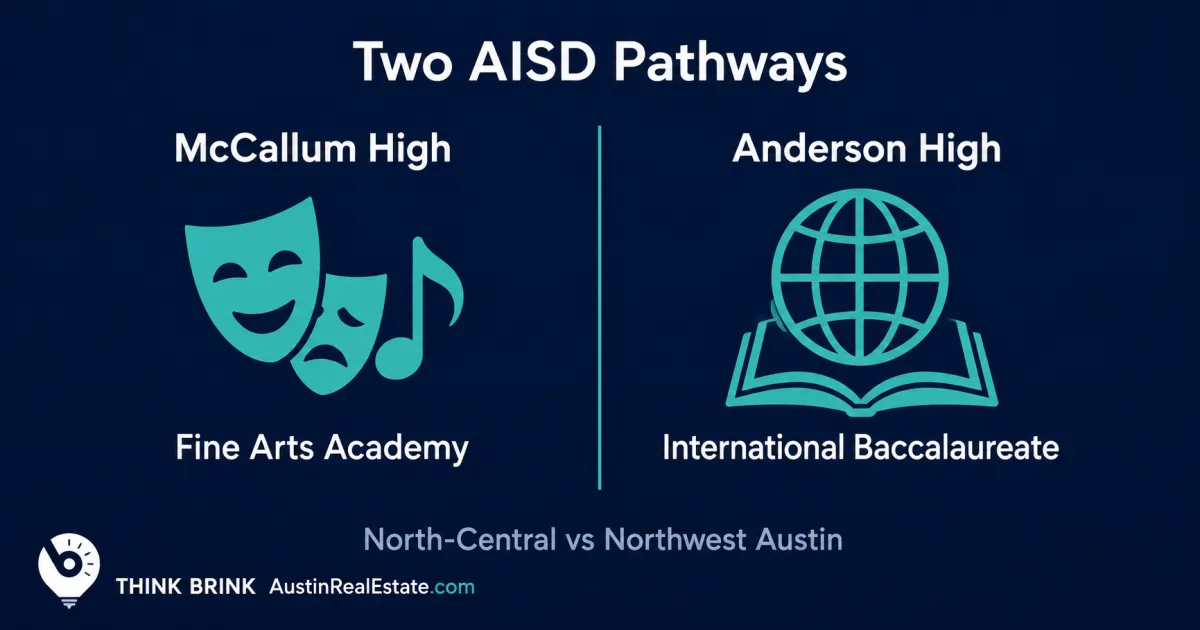
McCallum is Austin ISD's fine arts high school. Anderson is Austin ISD's International Baccalaureate high school. That single sentence captures most of what families are actually choosing between.
McCallum, established in 1953, became home to the district's first fine arts intensive program, the Austin ISD Fine Arts Academy, in 1993. Anderson has been an International Baccalaureate school since 1991, making it the oldest IB program in central Texas and, as of recent years, the only IB high school in Austin ISD. Those are not marketing labels bolted on for a brochure. They are decades-deep institutional identities that shape the culture, the course catalog, and the kind of student who thrives at each.
McCallum: the Fine Arts Academy
McCallum's Fine Arts Academy is the real thing, not a token arts elective wing. The academy offers concentrations across visual arts, dance, theatre, cinematic arts, voice, instrumental band, orchestra, classical guitar, and collaborative piano. It admits students through a competitive application process, and critically, it accepts students from anywhere in Austin ISD if they are admitted, not just kids who live in the McCallum attendance zone.
The program's reputation is national, not local. In 2015 it was named the Grammy Foundation's national Signature School, recognized as the best public school music program in the United States. That is the kind of distinction that draws serious young musicians, actors, and artists from across the district and beyond.
On the standard academic measures, McCallum holds a GreatSchools rating of 8 out of 10 and a Niche grade of A, which places it above the Texas average for public high schools. So the picture is a strong academic base with a genuinely elite arts overlay. For a family with a kid who is serious about the arts, or who simply thrives in a creative, expressive school culture, McCallum is one of the best public options in the state, and its citywide admission means you do not strictly have to live in the zone to access the academy.
That last point matters for real estate. Because the Fine Arts Academy takes qualified students district-wide, buying into the McCallum zone is not the only way to get a child into the arts program. It is, however, the way to guarantee access to McCallum itself as your neighborhood school for all your children regardless of whether they audition into the academy, and the McCallum zone neighborhoods carry their own strong appeal.
Anderson: the IB high school
Anderson's identity is the International Baccalaureate program, and IB is a fundamentally different animal from Advanced Placement or a standard honors track. Rather than a menu of individual advanced courses, the IB Diploma Programme is an integrated two-year curriculum for the junior and senior years, built around higher-level thinking, interdisciplinary connection, a research-intensive extended essay, a theory of knowledge course, and a service and creativity component. It is demanding, internationally recognized, and prized by selective universities that understand what an IB diploma represents.
Anderson has run this program since 1991, so it is not a recent add-on. The institutional muscle memory of three-plus decades of IB shows up in the depth of the teaching and the support structure around the diploma. Anderson posts a graduation rate around 98%, well above the Texas state average, with an enrollment in the low 2,000s and a student-teacher ratio around 18 to 1. Its GreatSchools rating sits at 7 out of 10.
A quick word on that rating gap. GreatSchools scoring 7 for Anderson and 8 for McCallum does not mean Anderson is a weaker school. Those composite scores lean heavily on standardized test proficiency and demographics and do not capture the rigor of a full IB diploma or the depth of a nationally ranked arts academy. Two strong schools can land a point apart on a blunt composite for reasons that have little to do with what your specific child would get out of either. Read the ratings as one input, not a verdict.
Anderson is also the Austin ISD high school that most directly serves Northwest Austin. Its feeder pattern runs through Murchison Middle School and pulls from elementaries including Doss, Hill, Davis, Summitt, Pillow, and Zavala, which places the heart of the AISD portion of Northwest Austin, the 78731 and adjacent 78759 pockets, squarely in the Anderson zone. If you are buying in Northwest Hills, Cat Mountain, or the AISD slice of the Great Hills and Balcones area, Anderson is very likely your high school.
Which neighborhoods feed which
This is where the real estate decision gets concrete, and it is worth being precise, because the two zones sit next to each other but pull from different housing.
The Anderson zone covers the Austin ISD neighborhoods of Northwest Austin proper. Think Northwest Hills, Cat Mountain, Highland Park West Balcones in part, and the AISD-zoned sections around Far West and the 360 corridor. These are established, hilly, often view-lot neighborhoods with 1970s through 1990s housing stock and a price point that reflects both the land and the schools. The feeder runs Doss or Hill to Murchison to Anderson for much of this area. I have written detailed buyer guides on Northwest Hills and Cat Mountain that go deeper on the housing in the Anderson zone.
The McCallum zone sits to the east and southeast, anchored in the Allandale, Rosedale, Crestview, Brentwood, and Wooten neighborhoods of North-Central Austin, generally 78756, 78757, and 78751. This is flatter, closer-in, more walkable territory with a heavy concentration of mid-century homes, and it has become some of the most sought-after and fastest-appreciating property in the city precisely because of that combination of location, character, and the McCallum and Lamar Middle feeder. My guide to the Wooten and Burnet corridor pocket covers the more affordable end of the McCallum zone.
So the geographic tradeoff is real. Anderson zone buyers are generally getting more house, bigger lots, and the hills, a bit farther out. McCallum zone buyers are generally paying up for close-in, walkable, character neighborhoods with smaller mid-century homes. The school pathway and the lifestyle come bundled with the geography, which is exactly why you want to sort out which pathway matters to you before you fall in love with a house.
How to actually choose between them
Strip away the neighborhood question for a moment and the school choice comes down to your child and your priorities.
Choose the Anderson pathway if your child is an academically driven, globally minded student who would benefit from the integrated rigor of a full IB diploma, or if you want the Northwest Austin geography of bigger lots and the hills and Anderson simply comes with the zone you were already drawn to. IB is not for every kid, it is genuinely demanding, but for the right student it is one of the most respected college-preparatory credentials available in a public school.
Choose the McCallum pathway if your child is serious about the arts, or thrives in a creative and expressive culture, and you value the close-in, walkable North-Central neighborhoods. Remember the wrinkle that gives McCallum extra flexibility: because the Fine Arts Academy admits qualified students district-wide, a musically or artistically serious kid can potentially access the academy even without living in the zone, though you would then attend the academy rather than have McCallum as your default neighborhood school.
For a lot of families, the honest driver is not the school philosophy at all, it is the housing. You want the hills and the bigger lot, so Anderson it is. Or you want to walk to a coffee shop and bike to work, so McCallum it is. There is no wrong answer there, but do go in knowing which pathway you are buying into, because switching zones later means moving.
The pieces that matter beyond the label
Two things buyers routinely underweight when comparing these schools.
First, the feeder middle school shapes the experience as much as the high school. Anderson pulls through Murchison, McCallum through Lamar Middle, and both middle schools carry strong reputations that factor into the neighborhood premium. If middle school matters to your timeline, look at the full pathway, not just the high school name. I compared the Austin ISD middle school options in my piece on Murchison vs Lamar, which is the natural companion to this post.
Second, verify the zone at the specific address, not the neighborhood. Austin ISD attendance boundaries do not follow neighborhood names cleanly, and parts of a subdivision can split between zones. A house you love on the edge of Northwest Hills might feed differently than the house two streets in. Before you write an offer with a school pathway in mind, confirm the actual attendance zone for that exact address with the district, because the label on the listing is not the authority.
Frequently asked questions
Is McCallum or Anderson the better high school in Austin ISD?
Neither is simply better. They are strong in different ways. McCallum is the district's fine arts high school with a nationally recognized arts academy and a GreatSchools rating of 8 out of 10. Anderson is the district's International Baccalaureate school, the oldest IB program in central Texas, with a roughly 98% graduation rate and a GreatSchools rating of 7. The right choice depends on whether your child is drawn to the arts and a creative culture or to the integrated academic rigor of IB.
Does Anderson High School have an IB program?
Yes. Anderson has been an International Baccalaureate school since 1991, the oldest IB program in central Texas and the only IB high school in Austin ISD. The IB Diploma Programme is a demanding, integrated two-year curriculum for juniors and seniors that is well regarded by selective colleges.
Can my child attend McCallum's Fine Arts Academy if we do not live in the zone?
Potentially, yes. The Fine Arts Academy admits qualified students from anywhere in Austin ISD through a competitive application process, so you do not have to live in the McCallum attendance zone to access the academy if your child is accepted. Living in the zone is what guarantees McCallum as your default neighborhood school for all your children regardless of the audition.
Which Northwest Austin neighborhoods feed Anderson High School?
The Austin ISD neighborhoods of Northwest Austin, including Northwest Hills, Cat Mountain, and adjacent 78731 and 78759 areas, largely feed Anderson through Murchison Middle and elementaries such as Doss and Hill. Always confirm the exact attendance zone for a specific address with the district, because boundaries do not follow neighborhood names cleanly.
Which neighborhoods feed McCallum High School?
McCallum draws from the North-Central Austin neighborhoods of Allandale, Rosedale, Crestview, Brentwood, and the Wooten and Burnet corridor pocket, generally in the 78756, 78757, and 78751 zip codes, feeding through Lamar Middle. These are closer-in, walkable neighborhoods with heavy mid-century housing stock.
How does the choice between these schools affect where I should buy?
Substantially. The Anderson zone means the established, hilly Northwest Austin neighborhoods with bigger lots and 1970s to 1990s homes, a bit farther out. The McCallum zone means close-in, walkable, character-heavy North-Central neighborhoods with smaller mid-century homes at a premium. The school pathway and the lifestyle come bundled with the geography, so decide which pathway matters before you commit to a house.
Is IB or the AP track better for college admissions?
Both are respected, and it depends on the student. IB offers an integrated, internationally recognized diploma that selective universities value, while AP lets a student pick individual advanced courses. Anderson's strength is the full IB diploma. The better fit is the one that matches how your child learns and what a target college weighs, which is a conversation worth having with the school counselors at each campus.
Do the GreatSchools ratings mean Anderson is weaker than McCallum?
No. A one-point gap on a composite score that leans on standardized proficiency and demographics does not capture the rigor of a full IB diploma or a nationally ranked arts academy. Both are strong schools that attract families who could have chosen private. Treat the ratings as one input among several, not a verdict.
The honest summary
McCallum and Anderson are two of the strongest non-magnet public high schools in Austin, and the choice between them is really a choice between an arts identity and an IB identity, bundled with two genuinely different housing geographies. Anderson gives you the hills, the bigger lots, and the established Northwest Austin neighborhoods with a decades-deep IB program. McCallum gives you close-in, walkable North-Central character neighborhoods with a nationally recognized fine arts academy that admits district-wide.
Sort out which pathway fits your child and your lifestyle first, then let that steer the neighborhood search, not the other way around. And whatever you decide, verify the attendance zone at the exact address before you write the offer, because in Austin ISD the boundaries do not care what the listing calls the neighborhood. If you want help matching a specific pathway to the right neighborhood and price point, that is exactly the kind of search I run for Northwest Austin families every week.
