Northwest Hills vs Balcones Woods: Which Established Northwest Austin Neighborhood Fits You?
Northwest Hills and Balcones Woods land on the same shortlists more often than you would expect, usually for buyers who want an established Northwest Austin neighborhood with mature trees, good schools, and central access, but who are not chasing new construction. On paper they sound similar. In practice they solve different problems, sit at different price points, and point in different directions, both literally and in terms of who they are built for. I am James Brinkman, a broker who works these zip codes, and this is the honest comparison I give buyers who are trying to decide between them.
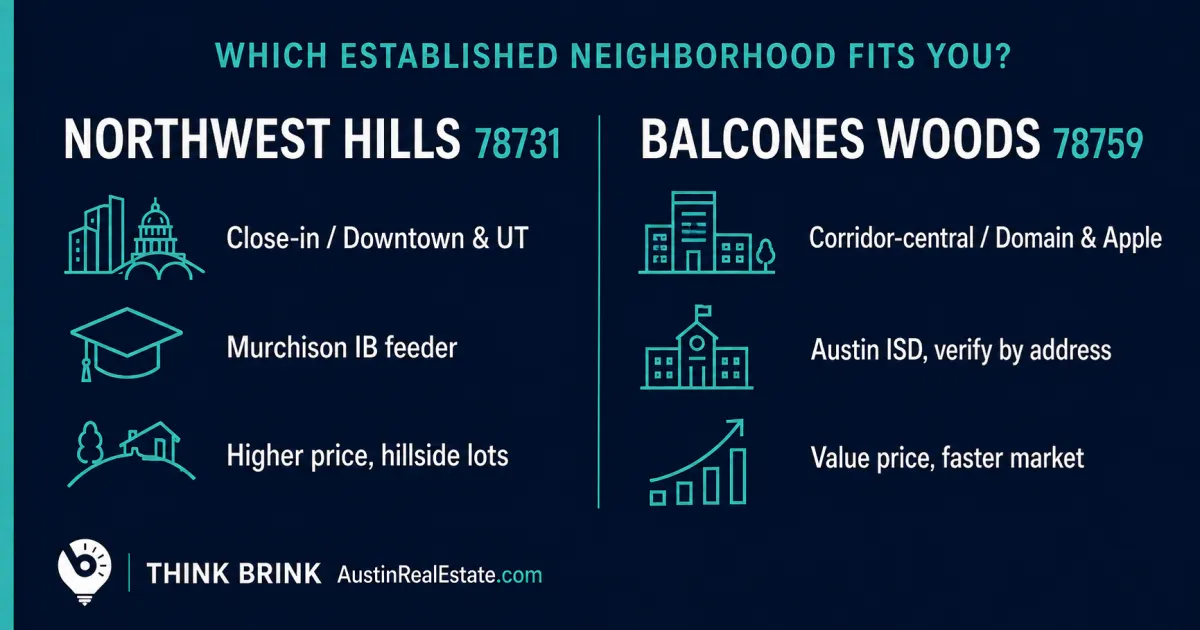
The short version: Northwest Hills is the closer-in, higher-priced, hillier neighborhood with a marquee Austin ISD school path and quicker access to downtown and the University of Texas. Balcones Woods is the more affordable, flatter, faster-moving neighborhood sitting right in the middle of the Domain, Arboretum, and Apple tech corridor. Which one fits depends less on which is objectively better and more on where you work, what you want to spend, and whether you value a prestige school feeder or central convenience most.
Location and positioning: closer-in versus corridor-central
Northwest Hills sits in the 78731 zip code, tucked into the hills west of MoPac and anchored by Loop 360 and Far West Boulevard. It is genuinely close-in. From most of Northwest Hills you are 10 to 20 minutes from downtown Austin and the University of Texas in normal traffic, and the neighborhood has a settled, wooded, almost canyon-like feel because it was carved into the Balcones escarpment in the 1960s and 1970s. This is a neighborhood people move to when they want to be near central Austin without living in the density of the urban core.
Balcones Woods sits a few miles north in the 78759 zip code, in the flatter, more grid-like part of Northwest Austin near the intersection of MoPac and US-183. Its defining feature is not proximity to downtown, it is proximity to everything buyers target in the tech corridor. The Domain, the Arboretum, Stonelake, and a dense cluster of grocery and dining are all within a few minutes, and the Apple campus on Parmer and the broader 183 tech corridor are an easy commute. Where Northwest Hills points south toward central Austin, Balcones Woods points north and east toward the job centers most of my relocating tech buyers are actually commuting to.
That single difference, which direction the neighborhood points, resolves a lot of decisions on its own. If your office is downtown, at UT, or in the medical district, Northwest Hills has a real daily advantage. If your office is at the Domain, along 183, or at Apple's Parmer campus, Balcones Woods puts you closer to it and you will feel that difference every weekday.
Price and value: what each one costs to get in
This is where the two neighborhoods separate most clearly. Northwest Hills is the more expensive neighborhood, and it has been for a long time. The combination of close-in location, larger and more custom homes, hillside lots, and a prestige school feeder keeps prices elevated. Buyers targeting Northwest Hills should expect to pay a genuine premium over the broader Northwest Austin average, and the entry point for a livable, updated home here is meaningfully higher than in Balcones Woods.
Balcones Woods is the value play of the two. Third-party neighborhood data puts the average home value in the Balcones Woods pocket in the mid-to-upper $600,000s, and it consistently undercuts comparable established neighborhoods for similar proximity to the corridor. That is not a knock on the neighborhood. It is the reason a lot of smart buyers target it. You are trading some of the prestige and the close-in central access for a lower entry price and a location that is arguably more convenient to the specific parts of Austin that are growing. For exact current pricing you should always run live comps, because these figures move, but the directional truth holds: Balcones Woods gets you into established Northwest Austin for less.
Market pace: Balcones Woods moves fast
One thing buyers underestimate about Balcones Woods is how quickly the good listings move. It is one of the faster-moving established markets in the zip code, and buyers who know it act quickly when something comes available. That is a function of the value equation: when a neighborhood offers corridor-central location at a below-average price, demand outruns supply on the well-presented homes. If you are targeting Balcones Woods, you need to understand the neighborhood before you need to make a decision on a specific house, not after, because you may not have the luxury of a long deliberation. Northwest Hills, at its higher price point and lower turnover, tends to give buyers a bit more room to think, though the best updated homes there still move.
Housing stock and lots: hillside custom versus established uniform
Northwest Hills was developed into the hills, and it shows in the housing stock. You get a lot of variety, larger lots, custom and semi-custom homes, dramatic elevation changes, mature canopy, and in some pockets genuine hill-country views. The tradeoff is that hillside living comes with hillside realities: steeper driveways, more complex drainage, and homes from the 1960s and 1970s that may need systems and foundations evaluated carefully. The character is a real draw, but you pay for it in both price and in the diligence a hillside 1960s home requires.
Balcones Woods is flatter and more uniform, developed largely in the 1970s and 1980s as a planned residential neighborhood with an active HOA and real community identity. Lots are more consistent, the streets are more grid-like, and the homes are more predictable in style and size. For a lot of buyers that predictability is a feature, not a bug: it is easier to comp, easier to renovate, and easier to resell, and the flatter terrain means fewer of the drainage and access headaches that come with hillside lots. You give up some of the drama and individuality of Northwest Hills in exchange for a more straightforward, community-oriented setting.
Schools: a verified marquee feeder versus verify-by-address
Schools are usually the deciding factor for family buyers, and here the two neighborhoods require different levels of homework.
Northwest Hills has one of the cleanest, most sought-after Austin ISD feeder paths in the city. The core of the neighborhood feeds Doss or Hill Elementary, then Murchison Middle School, then Anderson High School. Murchison is worth pausing on: it is a member of the International Baccalaureate network and, as of recent data, the only IB middle school in Austin ISD, which is a real differentiator for families who value that track. The Doss or Hill to Murchison to Anderson pathway is widely regarded as the top feeder in northwest Austin ISD, and it is a large part of why Northwest Hills commands the prices it does. If you want the full breakdown of what this path means, I wrote a dedicated Anderson High School feeder guide.
Balcones Woods requires more care. The neighborhood is served by Austin ISD, with A-rated elementaries including Summitt and Hill nearby and Anderson High as the associated high school in available data. But this part of 78759 sits near district and feeder boundaries, and feeder assignments here can vary by the specific address. I do not give buyers a single guaranteed feeder for Balcones Woods the way I can for the core of Northwest Hills, and any honest agent should tell you the same. If schools are your top priority in Balcones Woods, confirm the exact elementary, middle, and high school assignment for the specific address with the district before you write an offer, rather than assuming from the neighborhood name. That is not a weakness of the neighborhood, it is just the reality of where it sits on the map.
The honest takeaway on schools: if you want a locked-in, prestige AISD path with the IB middle school option, Northwest Hills delivers it more cleanly. If you are more flexible on schools or your children are not yet school-aged, Balcones Woods removes that premium from the price without necessarily removing quality, but it puts the verification burden on you.
Commute: the tiebreaker for most buyers
For a lot of buyers the commute settles it. Northwest Hills, sitting close-in off Loop 360 and MoPac, is the better neighborhood if your daily destination is downtown, the University of Texas, the Capitol complex, or the central medical district. You are simply closer, and the drive is shorter and more predictable.
Balcones Woods is the better neighborhood if your daily destination is the Domain, the 183 corridor, the Apple campus on Parmer, or the broader north tech corridor. From Balcones Woods you are minutes from the Domain and have a clean shot up MoPac or 183 to the Parmer employers. Relocating tech workers who assume they should live closer to downtown often discover that their actual office is north, and that a neighborhood like Balcones Woods cuts their real commute meaningfully compared to a closer-in choice like Northwest Hills. Match the neighborhood to where you actually drive, not to where Austin's map looks most central.
Lifestyle and daily rhythm
Northwest Hills feels residential and wooded, with a close-in convenience to central Austin's restaurants, culture, and the greenbelt. It reads as a neighborhood for people who want quiet, trees, and elevation but still want to be a short drive from the heart of the city. The Far West and Loop 360 corridors give it its own established retail and dining base, and the overall feel is settled and mature.
Balcones Woods feels like Northwest Austin convenience distilled. The whole appeal is that the useful parts of the city are arranged around you: multiple grocery options, the Arboretum, the Domain and Rock Rose for a night out, and an easy return to a calm, residential home base. It is a neighborhood built around routine and practicality more than scenery, and for corridor-focused professionals that is exactly the point. If you want the deeper single-neighborhood dives, see my Northwest Hills buyer guide and my Balcones Woods buyer guide.
Fit check: who should choose which
Choose Northwest Hills if you want to be close to downtown and UT, you value a locked-in, prestige Austin ISD feeder with the Murchison IB middle school, you are drawn to hillside character and larger custom homes, and you have the budget to pay the premium those things command. It is the neighborhood for buyers prioritizing central access and school pedigree over price.
Choose Balcones Woods if your work or your life is oriented toward the tech corridor and the Domain, you want established Northwest Austin at a more accessible price, you prefer flatter, more predictable lots and an active HOA community, and you are either flexible on schools or willing to verify the specific feeder for your address. It is the neighborhood for buyers prioritizing corridor-central value and convenience over prestige and close-in central access.
If you are weighing these two, it is also worth reading how each stacks up against Great Hills, the other established neighborhood buyers in this area cross-shop, in my comparisons on Northwest Hills versus Great Hills and Great Hills versus Balcones Woods.
Frequently asked questions
Is Northwest Hills or Balcones Woods more expensive?
Northwest Hills is the more expensive of the two, and has been for years. Its close-in location, larger custom homes, hillside lots, and prestige Austin ISD feeder keep prices well above the Northwest Austin average. Balcones Woods is the more affordable neighborhood, with third-party data putting average values in the mid-to-upper $600,000s, and it consistently undercuts comparable established neighborhoods. Run current comps for exact figures, but the direction is clear: Balcones Woods gets you in for less.
Which neighborhood is better for commuting to the Apple campus or the Domain?
Balcones Woods. It sits in 78759 near MoPac and 183, minutes from the Domain and with a clean shot to the Apple campus on Parmer and the north tech corridor. Northwest Hills is better if you commute to downtown, UT, or central Austin, but for the Domain and the Parmer employers, Balcones Woods puts you closer and cuts your daily drive.
What schools does Northwest Hills feed into?
The core of Northwest Hills feeds Doss or Hill Elementary, then Murchison Middle School, then Anderson High School, all in Austin ISD. Murchison is the only IB middle school in Austin ISD in recent data, which is a significant draw for families. This Doss or Hill to Murchison to Anderson path is widely considered the top feeder in northwest Austin ISD and is a major reason Northwest Hills commands its prices.
What schools does Balcones Woods feed into?
Balcones Woods is served by Austin ISD, with A-rated elementaries including Summitt and Hill nearby and Anderson High as the associated high school in available data. However, this part of 78759 sits near district and feeder boundaries, and assignments can vary by address. If schools are a priority, confirm the exact elementary, middle, and high school for the specific property with the district before making an offer rather than assuming from the neighborhood name.
Is Balcones Woods in Round Rock ISD or Austin ISD?
Available neighborhood data indicates Balcones Woods is served by Austin ISD, but the 78759 area is a place where Austin ISD and Round Rock ISD boundaries can run close together, and some nearby pockets fall into Round Rock ISD. Because the assignment depends on the exact address, do not rely on the zip code or neighborhood name. Verify the district and feeder for the specific home you are considering with the appraisal district or school district.
Which neighborhood is better for families?
If your top priority is a locked-in, prestige school path, Northwest Hills has the edge with its clean Doss or Hill to Murchison IB to Anderson feeder. If you want more house or a lower price and are willing to verify the school assignment at the address, Balcones Woods can be an excellent family value with A-rated elementaries nearby. Both are established, residential, family-oriented neighborhoods; the difference is whether you are paying for school certainty or trading it for value.
Why do Balcones Woods homes sell so quickly?
Balcones Woods offers corridor-central location at a below-average price, so demand outruns supply on well-presented homes, and it is one of the faster-moving established markets in the zip code. Buyers who know the neighborhood act quickly. If you are targeting it, get familiar with the streets and pricing before a listing appears, because you may not have long to decide once one does.
Which neighborhood holds its value better?
Both are established Northwest Austin neighborhoods with durable demand, so both tend to hold value well. Northwest Hills is anchored by its close-in location and marquee school feeder, which support its premium over time. Balcones Woods is anchored by its corridor-central convenience and value pricing, which keep it in steady demand. Neither is speculative; the choice is about fit and budget, not about betting on appreciation.
The honest summary
Northwest Hills and Balcones Woods are not really competing for the same buyer once you look past the surface similarities. Northwest Hills is the close-in, higher-priced, hillside neighborhood with a marquee Austin ISD feeder and quick access to downtown and UT. Balcones Woods is the corridor-central, value-priced, flatter neighborhood built for the tech-corridor life, with schools you need to verify at the address but a location that is hard to beat for the Domain and Parmer employers.
If budget and school certainty are your top priorities and you work central, Northwest Hills earns its premium. If value, corridor convenience, and a fast, practical Northwest Austin home base matter most and you work north, Balcones Woods is the smarter buy. Decide by matching the neighborhood to where you actually work, what you can comfortably spend, and how much you need a guaranteed school feeder, and the choice usually makes itself. If you want help running current comps and confirming the school assignment on specific homes in either neighborhood, that is exactly the kind of side-by-side I do with buyers.
