Scofield Farms vs Milwood: Which North Austin Neighborhood Actually Fits Better?
Both neighborhoods get mentioned in the same breath when buyers are searching near Apple, the Parmer corridor, or the Domain. They're close to each other, both established, both in the 78727 and 78750/78759 zip code range, and both offer something that newer far-north suburbs can't - mature trees, proximity to major employers, and homes that don't feel like they were stamped out of the same mold last year.
But they are not interchangeable. The buyers who fit Scofield Farms and the buyers who fit Milwood often want different things, and if you buy in the wrong one, you'll figure that out pretty quickly.
This is a straight comparison. No hype, no "both are great" hedging. Just what actually makes them different, who tends to land well in each, and what to watch out for before you commit.
Is Northwest Austin Still Worth the Premium?
The Short Version If You're in a Hurry
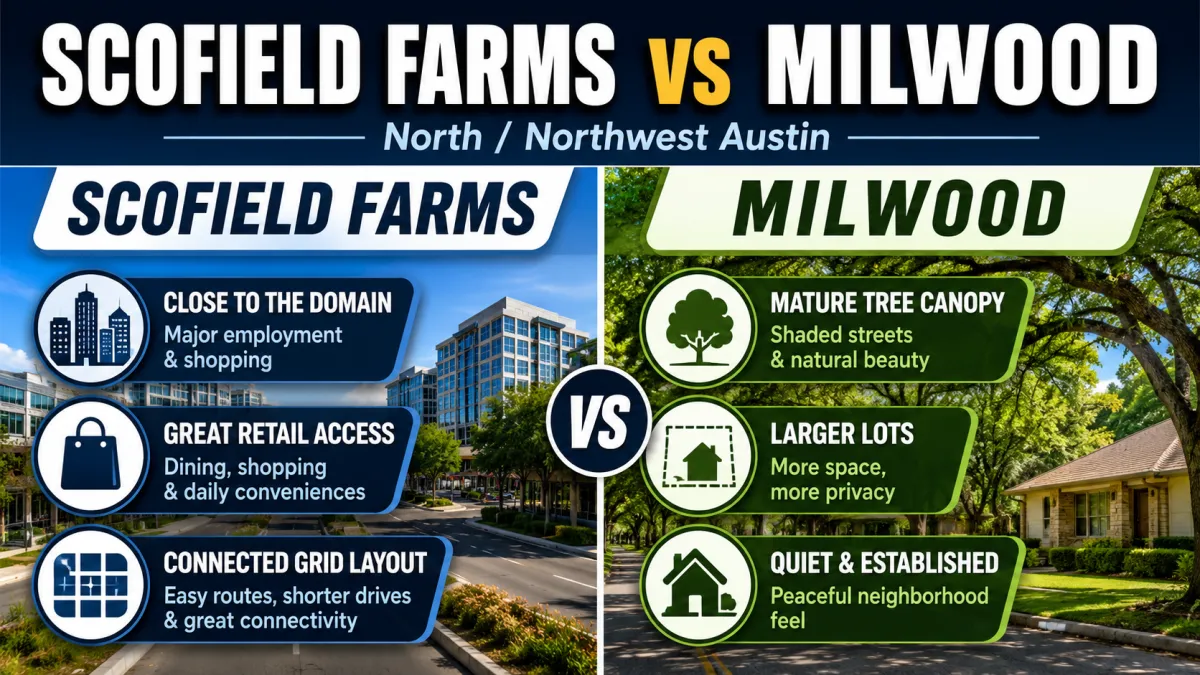
Scofield Farms is more connected to the Domain energy, slightly more walkable to retail, and tends to attract buyers who want to feel like they're close to the action without paying Domain-adjacent prices. Milwood is quieter, greener, more tucked in, and tends to attract buyers who prioritize neighborhood feel over convenience to nightlife or lifestyle retail. Both have solid access to Apple and Parmer employers. Neither is a wrong choice - but they pull different buyers.
Where They Actually Are
Scofield Farms sits roughly between Parmer Lane to the north, Metric Boulevard to the east, and MoPac (Loop 1) to the west. The neighborhood has multiple sections that were built out across different eras, mostly from the mid-1980s through the mid-1990s. It's bisected by Scofield Farms Drive and has several smaller sub-sections with their own street layouts.
Milwood is positioned a bit further west and slightly south, generally between Spicewood Springs Road to the south, 183 to the east, Parmer to the north, and McNeil Drive/MoPac to the west. Like Scofield, it was built largely in the late 1980s and early 1990s, with some sections going back a bit earlier.
The two neighborhoods are separated by maybe 10 to 15 minutes of surface streets depending on where exactly you are in each. They share the general "inner Northwest Austin" feel, but the surrounding context is meaningfully different.
What North Austin Growth Means for Homeowners Near The Domain, Apple, and Parmer
Commute Access: Closer Than You Think, but Not Identical
For Apple Campus (off Parmer near MoPac), both neighborhoods give you reasonable access. From Scofield Farms, most buyers are looking at a 10 to 20 minute drive depending on which section they're in and what time they leave. From Milwood, the same general range applies, though the western portions of Milwood can actually be slightly closer to Apple via MoPac.
For the broader Parmer corridor - NXP, National Instruments (now part of Emerson), other tech employers along Parmer between MoPac and 35 - Scofield Farms sits a bit closer to the eastern portion of that corridor, which matters if your employer is toward the 35 end. Milwood has better natural access to the MoPac/Parmer intersection and westward.
For the Domain, Scofield Farms wins on proximity and feel. You can get to the Domain in 5 to 15 minutes from most of Scofield depending on traffic, and the commercial energy along Metric and the Parmer/MoPac area bleeds into what buyers experience when they're in Scofield. From Milwood, the Domain is accessible but it takes a few more minutes and it genuinely feels further away.
For downtown Austin: both neighborhoods are roughly equal - count on 25 to 40 minutes depending on traffic, and MoPac is the primary route for both.
What the Homes Look Like
Scofield Farms homes are mostly single-story and two-story builds from the late 1980s through mid-1990s. Lot sizes vary by section but generally run from the mid-6,000 square feet range up to around 9,000 to 10,000 square feet in some sections. You'll see a lot of brick exterior, traditional floor plans, and the kind of layouts where the kitchen and living room aren't fully open to each other - because open-concept wasn't really the standard when most of these were built.
The updates question matters a lot in Scofield. Some homes have been substantially updated - kitchen remodels, primary bath renovations, new flooring - and they show well against newer construction. Others are still carrying original finishes from 1990 or 1993, and those need a pricing conversation. Square footage typically runs from around 1,600 to 2,800 square feet for most of the inventory, with some outliers on both ends.
Milwood homes follow a similar general profile - late 1980s and early 1990s construction, mix of one-story and two-story, brick exteriors common, traditional layouts. What tends to differentiate Milwood is the lot character. Several sections of Milwood have larger lots with significant tree coverage, and the street layout in parts of Milwood is more curvilinear - less grid, more winding. That contributes to the "tucked away" feeling that Milwood buyers often describe.
Square footage ranges are comparable to Scofield, but Milwood has some sections with notably larger lots than you'd find in most of Scofield Farms. If outdoor space is a priority - real backyard, room for a pool, established trees that actually shade the yard - Milwood tends to win more of those comparisons.
Should You Buy an Older Home in Northwest Austin or a Newer Home Farther North?
The Updates Gap: Same Problem, Same Decade
This is important for both neighborhoods: because they were built in the same era, both Scofield and Milwood carry the same challenge for sellers and buyers. Homes that haven't been updated since original construction can feel very dated relative to newer product in Cedar Park, Leander, or even Pflugerville. The original tile, the oak cabinets, the brass fixtures, the carpet in the bedrooms - buyers who moved here from elsewhere often react to that more strongly than local buyers who understand the value of the location.
This is relevant for buyers because it affects how you negotiate and what you're inheriting. A Scofield or Milwood home with good bones but original finishes is not a bad deal if you're priced accordingly and you go in with a realistic plan. But it's a different purchase than buying something already renovated.
For sellers in both neighborhoods, the strategy question is the same: what updates actually move the needle, and what's over-improving for the zip code. That's a separate conversation, but both neighborhoods face it equally.
Schools
Both neighborhoods primarily feed into Round Rock ISD, which tends to be the draw for buyers coming from out of state who are researching Texas school districts. The specific campus assignments can vary by section and have shifted over time, so always verify current assignments directly with RRISD before relying on anything you read online - including this post.
The school factor doesn't meaningfully separate the two neighborhoods in most buyer conversations. Both are in reasonable proximity to solid campuses, and buyers who are in Austin ISD territory (some edges of both neighborhoods can be zoned differently) will want to verify that before assuming RRISD assignment.
What Nobody Tells You About Buying in Scofield Farms
Walkability and Day-to-Day Errands
This is where the neighborhoods diverge more clearly.
Scofield Farms has better walkable or bikeable access to everyday retail. The commercial density along Metric, Parmer, and the areas near the Domain and Rundberg/Metric intersection means that coffee shops, grocery options, restaurants, and services are closer and feel more accessible. This doesn't mean Scofield is a walkable neighborhood in the urban sense - you're still largely driving - but the distance to "I need something quick" is shorter.
Milwood is more residential in character. The surrounding commercial areas are there, but they feel further from the core of the neighborhood. Buyers who want to feel more separated from commercial energy often prefer this. Buyers who want to pop out for dinner at 7pm without a 15-minute drive are sometimes surprised by how residential Milwood actually is.
HOA Situation
Both neighborhoods have sections with and without HOAs. Scofield Farms has multiple sections and not all of them carry the same HOA structure or dues. Milwood similarly has some sections under HOA governance and others that are not.
This matters for buyers who are specifically seeking no-HOA options, and it also matters for sellers because HOA status affects how you disclose and market. Never assume - always confirm the specific HOA status for the specific address.
Price Range and Value
As of mid-2025, both neighborhoods generally sit in a similar price band for comparable homes. Detached single-family homes in reasonably updated condition in both Scofield and Milwood have been trading in roughly the $400s to low $600s depending on size, condition, and lot. Fully renovated homes push toward the upper end and above. Original-condition homes with deferred updates tend to land lower and stay there if priced too optimistically.
Scofield Farms has seen some price differentiation within sections - sections that back to commercial areas or sit on busier internal streets tend to discount relative to quieter interior locations. Milwood has similar variation, and lots that back to greenbelts or creeks can command a meaningful premium.
Neither neighborhood is undervalued in the traditional sense - both have risen significantly over the past decade. But relative to what you'd pay for comparable square footage in the Domain proper or in newer Cedar Park subdivisions, both still represent reasonable value for the location and access they deliver.
Who Fits Scofield Farms
Buyers who want proximity to the Domain lifestyle without Domain prices
Tech employees who want shorter commute time to the eastern Parmer corridor
Buyers who prioritize retail and restaurant access over neighborhood quietude
People who are comfortable with a more traditional subdivision grid layout
Buyers who understand they may be updating the home over time
Who Fits Milwood
Buyers who prioritize lot size, tree coverage, and neighborhood feel
Apple employees or western Parmer corridor workers who use MoPac regularly
Buyers who want a more tucked-away residential feel
Families who want more outdoor space without going to far-north suburbs
Buyers who are specifically looking for one-story options under mature trees (Milwood has more of these in certain sections)
What to Check Before You Make an Offer in Either Neighborhood
Back to anything commercial or busy. Both neighborhoods have sections that back to retail corridors, busy arterials, or high-traffic internal roads. In Scofield this is especially true near Metric and Parmer edges. In Milwood it shows up near some of the busier collector streets. Always drive the street at multiple times of day before you fall in love with the house.
Flood plain and drainage. Both neighborhoods have sections with creek drainage and some with prior flood plain designations. Check the current FEMA maps and ask your agent specifically about flood plain status for the specific address. This affects insurance and sometimes limits what you can do with the yard.
School assignment. As mentioned above - verify RRISD vs AISD assignment for the specific address before making decisions based on school district.
HOA status. Confirm for the specific section.
Age and condition of major systems. Homes built in 1988 to 1995 are now 30 to 37 years old. HVAC, water heater, roof, and foundation have likely been through at least one replacement cycle - but not always. A good inspection in either neighborhood should include a careful look at what's been updated and when.
Living in Milwood (Amherst), Austin
The Honest Summary
Scofield Farms and Milwood are both legitimate options for North Austin buyers who want established neighborhoods with proximity to major employers and the Domain. They're not interchangeable. Scofield leans more toward buyers who want connectivity and convenience. Milwood leans toward buyers who want space and neighborhood character. The homes are similar in age and profile, the price ranges overlap substantially, and both carry the updates question that comes with buying 1990s Austin construction.
The right answer isn't which neighborhood is better. It's which one fits the way you actually want to live day to day - and that question is worth answering before you start touring homes.
Frequently Asked Questions
Is Scofield Farms or Milwood closer to Apple Campus?
It's close enough that it depends more on the specific address within each neighborhood than on the neighborhood label. Both are generally in the 10 to 20 minute range. Western Milwood sections can edge out on Apple proximity via MoPac access, but it's not a dramatic difference.
Are Scofield Farms and Milwood in Round Rock ISD?
Most of both neighborhoods feed into Round Rock ISD, but not all sections do. School assignments have changed over time and vary by specific address. Always verify with RRISD directly before making a decision based on school district.
Do Scofield Farms and Milwood have HOAs?
Both have some sections under HOA governance and some that are not. You have to check the specific address and section rather than assuming neighborhood-wide.
Are homes in these neighborhoods dated?
Most of the housing stock was built in the late 1980s to mid-1990s. Some homes have been substantially updated; others still carry original finishes. Condition varies significantly and is reflected in pricing - or should be.
Which neighborhood has bigger lots?
Milwood has sections with notably larger lots, particularly those in more interior locations with significant tree cover. Scofield Farms lots are generally more uniform across sections and tend to be slightly smaller on average, though there are exceptions.
Is it possible to find a one-story home in either neighborhood?
Yes in both, but Milwood tends to have more one-story inventory in certain sections, which makes it a common destination for buyers specifically seeking single-level living near the Apple/Parmer corridor.
What's the flood risk in these neighborhoods?
Some sections of both neighborhoods have properties near creek drainage areas. Flood plain status varies by specific address and should be verified via current FEMA maps before purchase.
How do prices compare between the two neighborhoods?
The price ranges overlap substantially. Comparable homes in similar condition in both neighborhoods trade in similar bands. Premium lots (greenbelt, cul-de-sac, significant trees) and fully renovated condition push prices higher in both. Deferred maintenance or original-condition homes discount in both.