What Relocating Buyers Should Know About Choosing a Real Estate Agent From Out of State
When you buy a home in the town you already live in, you are your own first line of research. You drive the streets, you notice which intersection backs up at 5 p.m., you know which grocery store is the good one and which neighborhood floods. When you buy from another state, you have none of that. You are making one of the largest purchases of your life in a place you may have visited twice, and the person standing in for all the local knowledge you do not have is the agent you hire. Choosing that agent well is not a formality. For a relocating buyer, it is the single most important decision you make before you ever look at a house.
I work with relocating buyers constantly in Northwest Austin, a lot of them from California, the Pacific Northwest, and other tech hubs, and I have seen what happens on both ends of this. A buyer with the right local agent lands in a home that fits their commute, their schools, and their budget, and feels like they had a native guide the whole way. A buyer who picked the wrong agent from 1,500 miles away ends up in the wrong part of town, overpays for the wrong tradeoffs, and spends the first year wishing they had bought three neighborhoods over. This guide is about how to be the first kind of buyer.
Why choosing an agent remotely is a different problem
Picking an agent when you can meet three of them for coffee is easy. You get a read on them in person, you see their signs around town, your neighbor vouches for one. Picking an agent from another state strips all of that away. You are evaluating people through a phone screen, a website, and a handful of reviews, and the usual instincts do not transfer cleanly.
The bigger difference is dependency. A local buyer uses an agent as a transaction professional. A relocating buyer uses an agent as a proxy for the entire market. Your agent is going to preview homes you cannot see, walk them on video, tell you what a listing photo is hiding, warn you that a street is louder than it looks, and steer you toward or away from neighborhoods based on things no algorithm surfaces. That is a much higher bar than helping you write an offer. You are not just hiring competence. You are hiring judgment, local depth, and honesty, because you will not be there to check any of it yourself.
This is also why the relocation questions stack on top of each other. Whether to rent first or buy right away, whether to buy before or after you sell your current home, how to time a cross-country move: all of it runs through the agent you choose. I have written separately about renting first versus buying right away and about buying before versus after selling in a different state, and in both cases the quality of your agent is what determines whether those decisions go smoothly.
What to actually look for
A real estate license means someone passed a state exam. It does not mean they know the three streets you should actually be looking at. Here is what separates an agent who can genuinely represent a relocating buyer from one who just holds the credential.
Hyperlocal knowledge, not broad Austin claims
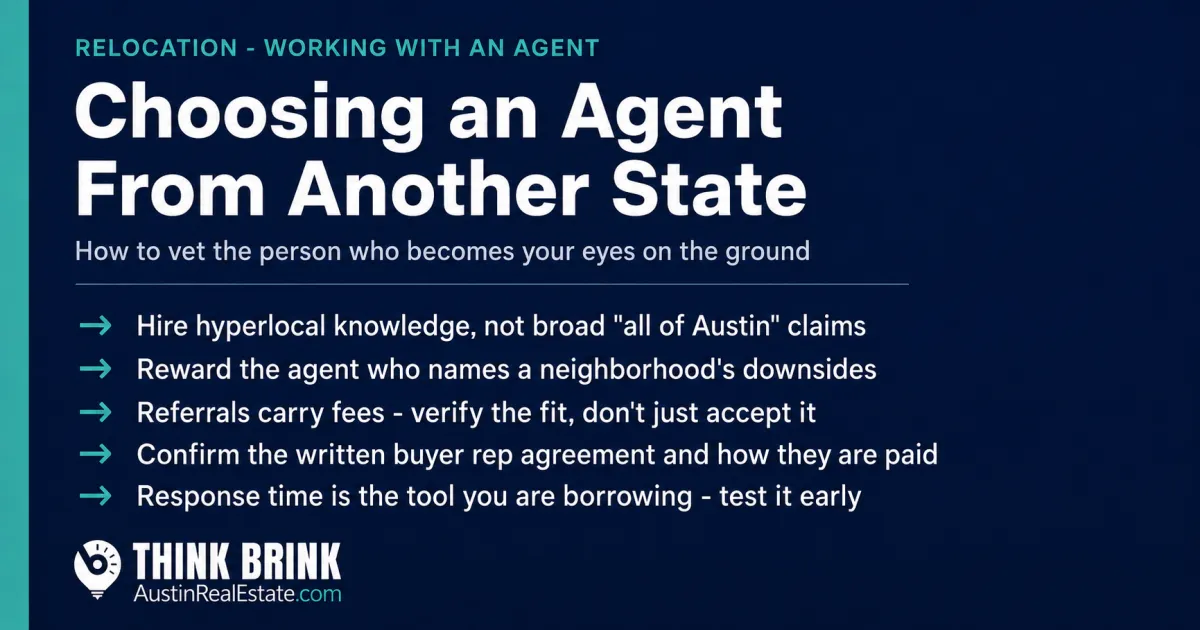
The most important filter is specialization by geography. An agent who says they cover all of Austin is telling you they cover none of it deeply. Austin is enormous and its submarkets are wildly different. The commute math, the school districts, the flood and wildfire exposure, the price per square foot, and the character of the housing stock change completely from one side of town to the other.
You want an agent whose knowledge gets more specific the more you push, not vaguer. Ask a candidate about the difference between two neighborhoods you are considering. A specialist will tell you which one feeds which high school, which one has the shorter drive to your office, which one has the HOA and which one does not, and which one holds value better and why. A generalist will tell you they are both great areas. When I am working a relocating buyer, that level of specificity is the whole job. It is why my content is built neighborhood by neighborhood rather than as one big living in Austin page.
Designations and experience that fit your situation
Designations are not magic, but the right ones tell you an agent invested in a specialty. A few worth knowing: the ABR, or Accredited Buyer's Representative, signals focused training in representing buyers specifically. The CRS, or Certified Residential Specialist, is a more advanced production and education credential held by a smaller share of agents. The SRES, or Seniors Real Estate Specialist, matters if you are an older buyer or helping a parent relocate and downsize. None of these guarantees a good fit, but they tell you where an agent has put their energy.
More than any letters, ask about relevant experience. How many relocating buyers have they worked with in the last year? Are they used to the video-tour, remote-offer workflow, or will you be their experiment? Have they handled out-of-state buyers who needed to close before they physically arrived? A relocation is not the transaction to be someone's first time doing it long distance.
Communication style and the time-zone reality
You are going to live in this agent's inbox for weeks or months, often across a two or three hour time difference. Their communication style is not a soft factor, it is a daily one. Some agents are texters, some are callers, some disappear for a day and resurface with a long email. When you are three states away and a house you want just hit the market, a slow responder can cost you the home. Ask directly how fast they typically respond, how they prefer to communicate, and how they handle a hot listing when you are asleep in a different time zone. Then notice how they handled you during the interview. If they were slow to call you back before you were a client, that is the fast version of how it goes after.
Where to find candidates, and the referral-fee reality
There are a few honest paths to a good relocation agent, and one thing you should understand about how the money moves behind the scenes.
Personal referrals are the strongest starting point when they are truly local. If a coworker who moved to the same metro two years ago loved their agent, that is a real lead. Be careful, though, that the referral is actually specific to your part of town. A great agent for a downtown condo may be the wrong agent for a suburban school-district house.
Your employer's relocation department or relocation management company may assign or suggest agents, especially if the company is covering relocation costs. These can be fine, but understand the incentive: relocation companies typically collect a referral fee from the agent they place you with, often a substantial percentage of the agent's commission. That is not automatically bad, but it means the agent was chosen partly for being in the network, not purely for being the best fit for your neighborhood. You are usually still allowed to interview and choose your own agent. Ask.
Brokerage referral networks work the same way. An agent in your current city can refer you to an agent in your destination city and collect a referral fee for the introduction. Again, the fee itself is normal and does not come out of your pocket directly. Just know that a referral is a business arrangement, not necessarily a match made on your criteria, so you should still vet the person on the other end yourself.
The takeaway is not to avoid referrals. It is to treat every source as a lead to be verified, not a decision that has been made for you. You are allowed to interview several agents and pick the one who actually knows your target neighborhoods, regardless of who suggested them.
Questions to ask before you commit
When you interview a candidate, these questions separate the specialists from the generalists quickly:
Which specific neighborhoods do you work most, and why those?
Compare the two areas I am considering. What are the real tradeoffs between them?
How many out-of-state or relocating buyers did you close in the last year?
How do you handle showings and offers when I cannot be here in person?
What does the school assignment look like for the exact addresses I am interested in, and how do I verify it?
What are the parts of this area you would steer a buyer like me away from, and why?
How do you get paid, and what will my buyer representation agreement say about compensation?
How fast do you typically respond, and what is your preferred way to communicate?
Pay attention to whether they will tell you something negative. An agent who cannot name a downside to any neighborhood, or who will not point you away from anything, is selling, not advising. The honest ones will tell you which tradeoffs to accept and which to avoid. That is exactly the kind of candor I try to bring to posts like what relocating tech workers get wrong about Northwest Austin commutes, because the useful information is usually the tradeoff, not the sales pitch.
Red flags to watch for
A few signals should make you slow down:
The everything-is-great agent. If every neighborhood is wonderful and every listing is a great opportunity, you are not getting representation, you are getting cheerleading. You are relocating precisely because you need someone to tell you the things you cannot see.
The vague-on-geography agent. If they cannot get more specific than the city name, they cannot be your eyes on the ground. Specificity is the whole value.
The pressure agent. An agent who pushes you to skip the buyer representation conversation, waive your due diligence, or commit before you are comfortable is optimizing for their timeline, not yours. Relocation already compresses your timeline enough. You do not need someone adding pressure on top of it.
The slow responder. Covered above, but it is worth repeating because it is the most common and most costly. In a fast market, response time is a competitive weapon, and you are borrowing your agent's.
How buyer representation actually works in Texas
One thing that surprises a lot of out-of-state buyers is that the rules around buyer representation changed recently and are now more formal than they may remember from their last purchase. As of changes that took effect in August 2024, a buyer in Texas signs a written buyer representation agreement before touring homes with an agent. That agreement spells out what the agent will do, how they are compensated, and who is responsible for paying them.
Two practical points follow from that. First, buyer-side compensation is now negotiated on each transaction rather than being posted in advance for every listing, and the amount or rate has to be clearly stated in your agreement with your agent. Second, the buyer is generally responsible for the agent's fee unless the seller agrees to cover it, and seller-paid compensation is still common but is negotiated deal by deal. In some cases seller-paid compensation can effectively be worked into the financing at closing.
None of this should scare you. It mostly means the conversation about how your agent gets paid happens up front and in writing, which is a good thing. But it does mean you should read the agreement, understand the compensation terms, and ask questions before you sign. This is an area where the details matter and vary by situation, so treat the specifics as something to confirm with your agent and, where money and contracts are involved, your own attorney or advisor rather than something to assume from how it worked in your previous state.
The remote workflow: how buying long distance actually goes
If you have never bought a home without standing in it, here is what a well-run remote purchase looks like, so you know what to expect and what to demand from your agent.
Your agent previews homes for you, either in person or by walking them live on video so you can direct the camera: open that cabinet, show me the backyard, point down the street. A good relocation agent narrates what the photos leave out, the road noise, the slope of the lot, the condition of the roof, the neighbor's yard. When you find one worth pursuing, you can often make an offer remotely, sign electronically, and put the home under contract before you ever fly in.
The due diligence period is where a remote purchase lives or dies. In Texas, buyers typically negotiate an option period, a short window early in the contract to inspect the home and, if it is not right, walk away. Your agent lines up the inspection, sends you the report, walks you through what is normal wear versus what is a real problem, and helps you decide whether to negotiate repairs, ask for a price adjustment, or terminate. When you cannot be there yourself, your agent's read on the inspection is doing a lot of work. This is another place where local knowledge matters, because what counts as a routine Central Texas issue, foundation movement on clay soil, for instance, is not obvious to someone arriving from a different climate and soil type.
Handled well, you can go from a video tour to keys in hand having set foot in the house only once, or occasionally not until closing. Handled poorly, you find out about the problems after you move in. The difference is almost entirely the agent.
Fit check: are you set up to choose well?
Before you commit to anyone, run this quick self-check.
You are ready if: you have narrowed your destination to a specific part of the metro, you have interviewed more than one agent, at least one of them told you something you did not want to hear about a neighborhood, and you understand how your agent will be paid. That combination usually means you have found a specialist and gone in with clear eyes.
You are not ready yet if: you picked the first name a relocation company handed you without talking to anyone else, you cannot say why that agent is right for your specific neighborhoods, or you have not read the representation agreement. None of that is fatal, it just means slow down and do the interview step. It costs you a few conversations and saves you from the most expensive mistake a relocating buyer can make.
Choosing a home from another state is hard enough. Choosing the person who chooses homes for you is the part you actually control. Spend your energy there. If you get the agent right, the rest of the relocation gets dramatically easier. If you want a sense of how Northwest Austin fits your situation before you even pick an agent, the overview of what it is like to live here is a good place to start.
Frequently asked questions
How do I choose a real estate agent when I am moving from out of state?
Start by narrowing your destination to a specific part of the metro, then interview more than one agent who specializes in those neighborhoods. Judge them on how specific their local knowledge gets, how honestly they discuss tradeoffs, how they handle remote showings and offers, and how quickly they respond. Do not simply accept the first agent a referral source or relocation company hands you. You are allowed to choose your own.
Should I use the agent my relocation company recommends?
You can, but understand that relocation companies and brokerages typically collect a referral fee from the agent they place you with, so the recommendation is partly a business arrangement. That does not make the agent bad, but it means they were chosen partly for being in the network. You are usually free to interview them alongside other candidates and pick the best fit for your target neighborhoods.
Do I have to pay my buyer's agent in Texas now?
Under changes effective August 2024, you sign a written buyer representation agreement that states how your agent is compensated, and the buyer is generally responsible for that fee unless the seller agrees to cover it. Seller-paid compensation is still common but is negotiated on each deal. Read the agreement, understand the terms, and confirm the specifics with your agent and, for contract and money questions, your own attorney or advisor.
Can I buy a house without seeing it in person?
Yes, and relocating buyers do it regularly. Your agent previews homes on live video, narrates what photos hide, and helps you make an offer, sign electronically, and go under contract remotely. The inspection and option period are where you protect yourself, so lean heavily on your agent's read of the inspection report when you cannot be there yourself.
What questions should I ask a relocation real estate agent?
Ask which neighborhoods they work most and why, ask them to compare the two areas you are considering, ask how many out-of-state buyers they closed last year, ask how they handle remote showings and offers, ask which parts of the area they would steer you away from, and ask how they get paid. The answers separate genuine local specialists from generalists quickly.
What are the warning signs of the wrong relocation agent?
Watch for the agent who says every neighborhood is great and never names a downside, the one who cannot get more specific than the city name, the one who pressures you to skip due diligence or commit before you are ready, and the slow responder. Any of those means you are getting a salesperson rather than a representative, which is the opposite of what a remote buyer needs.
Does it matter which specific Austin neighborhood my agent specializes in?
It matters a great deal. Austin's submarkets differ enormously in commute, schools, flood and wildfire exposure, price, and housing character. An agent who covers one part of town deeply will serve you far better there than a generalist who covers the whole metro shallowly. Match the agent's specialty to the specific area you are targeting.
How important is response time when buying from another state?
Very. Across a two or three hour time difference in a fast market, a slow agent can cost you a home that sells before you even see the listing. Ask candidates how quickly they respond and how they handle a hot listing while you are asleep, and treat how they handled you during the interview as a preview of how responsive they will be as your agent.
The honest summary: when you buy from far away, your agent is not a convenience, they are your substitute for everything you would normally know yourself. Interview more than one, insist on real local specificity, reward the ones willing to tell you the downsides, and understand up front how they are paid. Get that decision right and a cross-country home purchase becomes something you can do with confidence instead of dread. That is the standard I try to meet for every relocating buyer who lands in Northwest Austin, and it is a fair standard to hold any agent to.
