Should You Rent First or Buy Right Away When You Move to Northwest Austin?
Should You Rent First or Buy Right Away When You Move to Northwest Austin?
This is the question I get from almost every out-of-state buyer, usually within the first ten minutes of the first call. You have accepted a job at Apple, or the Domain, or you are moving a family for reasons that have nothing to do with a paycheck, and now you are staring at a decision that feels like it should have a clean answer. Rent for a year and learn the city, or buy now and stop paying someone else's mortgage.
There is no universal right answer, and anyone who gives you one without asking about your situation is selling you something. What there is instead is a set of tradeoffs that shift depending on how much you already know about Northwest Austin, how settled your job and family situation are, how much cash you have available, and how you personally handle the risk of being wrong. This post walks through those tradeoffs the way I walk through them with clients, so that by the end you can tell which side of the line you actually fall on rather than defaulting to whatever your last move taught you.
Why This Decision Feels Harder in Austin Than It Did Where You Came From
Most relocating buyers I work with are coming from California, the Pacific Northwest, or another large metro where they had lived long enough to know the neighborhoods in their bones. When you have spent fifteen years in the Bay Area, you do not need to rent to figure out which side of the freeway you want to live on. You already know. Austin resets that knowledge to zero, and the metro is large and genuinely varied, so the instinct to slow down and learn is a reasonable one.
At the same time, Austin is not a place where you can casually assume you will find the same house next year for the same money. The market here moves in cycles, established neighborhoods in the 78750, 78759, and 78726 zip codes hold their value because the land is finite and the school feeders do not change, and the inventory of well-located established homes is not large. So the cost of waiting is real, even in a slower market, and it is not only a price question. It is also an inventory question. The specific house you would want may simply not be available when you are finally ready.
Those two forces pull in opposite directions. The unfamiliarity argues for renting. The scarcity of the right home argues for buying. The rest of this decision is about figuring out which force is stronger for you specifically.
The Honest Case for Renting First
Renting for six to twelve months is the right call for more people than the real estate industry likes to admit, and I would rather tell you that up front than push you into a purchase you regret.
You genuinely do not know the geography yet
Northwest Austin is not one place. The established 78750 and 78759 neighborhoods near the 183 and 360 corridors live and commute differently than the newer Leander ISD subdivisions out toward Four Points and RM 620, which live differently again than the North Austin tech-corridor neighborhoods between MoPac, 183, and Parmer. A twenty-minute difference in where you land changes your commute, your school feeder, your property tax rate, and the character of your street. If you cannot yet picture those differences, renting buys you the time to feel them instead of guessing.
Your job situation is not fully settled
If you are new to a company, new to a role, or joining a team that could relocate you again within a year or two, buying introduces transaction costs that renting does not. Buying and then selling inside of two or three years is one of the most reliable ways to lose money in real estate, because the costs of getting in and getting out have to be earned back through appreciation and principal paydown before you break even, and a short hold rarely gives you enough time. If there is a real chance you move again soon, renting protects you from that trap.
You are moving a family and the school decision is doing the driving
When the entire point of the move is a specific school pathway, and you are not yet certain which feeder you want, renting inside your target attendance zone for a year lets you confirm the fit before you commit hundreds of thousands of dollars to an address. This matters more in Northwest Austin than in a lot of metros, because here the school district assignment is set at the address level and does not follow you if you guess wrong. I have written separately about how school zoning by address changes what you pay in Northwest Austin, and that dynamic is exactly why a rental in the right zone can be worth its cost as a form of tuition-free due diligence.
Your down payment is still tied up in the home you are selling
Plenty of relocating buyers have their equity locked inside a house in another state that has not sold yet. Renting first lets that sale close on its own timeline, so you are buying in Austin with cash in hand rather than juggling a contingency or a bridge loan. I cover the mechanics of that sequencing in more depth in the post on buying before versus after selling in a different state, but the short version is that a clean, non-contingent offer is stronger, and renting is one way to get there.
You want to test the commute in real traffic, not on a map
Commute estimates from a mapping app during a relocation trip are not the same as living the drive at 8 a.m. on a Tuesday in February. Renting lets you experience the real MoPac and 183 and Parmer flows before you lock yourself into a specific distance from the office. I say this as someone who has watched buyers fall in love with a house that was fifteen minutes from work in the middle of the day and thirty-five minutes from work at rush hour.
The Honest Case for Buying Right Away
Renting is not free, and the money you spend on a lease is money you will not get back. For a large share of relocating buyers, buying right away is the better financial and practical decision, and here is when.
You already know the neighborhood you want
If you have done your homework, visited on a scouting trip, walked the streets you care about, and you can already tell me the difference between why you would pick one established Northwest Austin neighborhood over another, then renting is mostly delaying a decision you have already made. In that case a year of rent is a year of building someone else's equity while the specific home you want may sell to somebody who moved faster.
Your job and family situation are stable
Long tenure at your company, a role you expect to keep, and a family that is done moving all argue for buying now. When the hold period is going to be long, the transaction costs of buying get spread across enough years that they stop being the dominant factor, and the compounding benefits of ownership, principal paydown, a fixed housing payment, and the Texas homestead protections I describe below, start to work in your favor.
You want the Texas homestead clock to start
Texas has no state income tax, which is one of the reasons the move pencils out for a lot of relocating professionals, but Texas funds a large share of local services through property tax, so the property tax bill here is meaningfully higher than what buyers from income-tax states are used to. The offset is the homestead exemption and the appraisal cap that come with owning and homesteading your primary residence. Those benefits only exist once you own the home and file the homestead paperwork, and the appraisal cap that limits how fast your taxable value can rise each year only starts protecting you after you have owned and homesteaded for a full year. Every year you rent is a year that clock is not running. This is a general description and not tax advice, and you should confirm the specifics of exemptions and caps with a CPA or the county appraisal district for your exact situation. I go deeper on the mechanics in the post on Texas homestead exemptions and property tax caps.
The rental market is not saving you as much as you think
Renting a comparable single-family home in a good Northwest Austin school zone is not cheap, and when you compare the monthly rent on that house against the monthly cost of owning something similar, the gap is often smaller than relocating buyers expect. When the rent-versus-own gap is narrow, the case for renting weakens, because you are paying nearly as much to build no equity as you would pay to build some. The rent-versus-own comparison changes with market conditions and rates, so run it on real numbers for the specific homes you are choosing between rather than relying on a rule of thumb.
The Questions That Actually Decide It
When a client cannot tell which way to go, I stop talking about the market and start asking about them. These are the questions that move the needle, in the order I usually ask them.
How confident are you about where you want to live?
If you can name the neighborhood and defend the choice, that points toward buying. If you are still saying things like "somewhere near work with good schools," that points toward renting, because that sentence describes a dozen very different neighborhoods and you have not actually narrowed anything yet.
How long do you realistically expect to stay?
Under three years, lean toward renting because you may not clear the transaction costs. Five years or more, lean toward buying because you almost certainly will, and the longer hold turns ownership's slow-moving advantages into real money. The three-to-five year zone is genuinely a judgment call and depends on the rest of these answers.
Is your down payment liquid right now?
If your cash is available and not stuck in an unsold house, buying is more feasible immediately. If it is tied up, renting while the other sale closes may simply be the practical path, regardless of what you would prefer in the abstract.
How much does uncertainty cost you personally?
Some people sleep fine knowing they made a fast decision with incomplete information and will adjust later. Some people will lie awake for a year second-guessing a house they bought in week two of living in a new city. Neither temperament is wrong, but they lead to different decisions, and you should be honest with yourself about which one you are.
What happens to the specific home you want if you wait?
If your target is a common floor plan in a large subdivision with steady turnover, waiting costs you less because another one like it will come along. If your target is a specific kind of home in a tightly held established neighborhood where only a handful trade each year, waiting can mean the home you want simply is not there when you are ready. Inventory scarcity is a real cost of renting, and it does not show up on a rent-versus-buy spreadsheet.
A Middle Path Most People Overlook: Rent Short, Buy Deliberately
The framing of rent-for-a-year versus buy-right-now is a false binary. There is a version that captures most of the benefit of both, and it is the one I steer a lot of relocating buyers toward.
Sign a short or flexible lease, ideally month-to-month or a short term, in or very near your target area rather than wherever is convenient on moving week. Use those first weeks to drive the commute, tour homes in person, and confirm the school zone with your own eyes. Then start your home search in earnest with the goal of buying within the first few months, not treating the full lease term as time you are obligated to burn. This way you get the orientation benefit of renting without paying a full year of rent to build no equity, and you are buying with local knowledge rather than guessing from another state.
The mistake to avoid inside this middle path is signing a long, inflexible lease far from where you actually want to end up. That combination gives you the cost of renting without the benefit, because you are not even living in the area you are trying to learn, and you are locked in when the right home appears. If you are going to rent first, rent close to the target and keep the lease flexible.
What Relocating Buyers Get Wrong on Both Sides
The renters who regret it usually rented too far from their target and signed too long a lease, so they learned nothing useful about the neighborhood they wanted and could not move when the right home came up. Or they treated the year of renting as a reason to stop paying attention to the market, and then were surprised by both prices and inventory when they finally re-engaged.
The immediate buyers who regret it usually bought in week two based on a scouting-trip impression, picked the wrong side of a commute corridor, or guessed at a school feeder and got it wrong. In almost every one of those cases, a few weeks of living in the area first would have surfaced the problem before it cost them a transaction.
Notice that both sets of regrets come from the same root, which is not renting or buying itself but doing either one without local knowledge and without a plan. The decision that goes badly is almost never "I rented" or "I bought." It is "I committed to something specific before I understood it." Whichever path you choose, the protection is the same: get real local information before you sign anything long or irreversible.
How I Actually Advise Relocating Clients
When someone calls me from out of state, I do not start by telling them to rent or to buy. I start by asking the questions above, and then I tell them what their own answers point toward. Often a buyer who was sure they needed to rent for a year turns out to already know exactly where they want to be and has liquid cash and a stable job, in which case renting is just an expensive delay. Just as often, a buyer who wanted to buy immediately turns out to be new in a role, unsure of the school decision, and carrying an unsold house in another state, in which case a short flexible rental is obviously the safer move.
My job is not to push you toward a purchase. My job is to make sure that whichever way you go, you go in with your eyes open and with the local specifics in hand, because the buyers who do well here are the ones who understood the neighborhood before they needed to make a decision about it, not after.
Frequently Asked Questions
Is it better to rent or buy when relocating to Northwest Austin?
It depends on how well you know the area, how stable your job and family situation are, whether your down payment is liquid, and how long you plan to stay. If you already know the neighborhood you want, have stable employment, and have cash available, buying right away is usually the stronger financial move because renting builds no equity and the right established home may not still be available next year. If you are unsure of the geography, new in your role, uncertain about the school feeder, or waiting on another home to sell, a short flexible rental in your target area first is the safer choice.
How long should I rent before buying a house in Austin?
If you rent first, aim to rent for the shortest term that still lets you learn what you need, often just a few months, in or very near the specific neighborhood you are targeting. Signing a full year on an inflexible lease far from your target area is the version of renting that tends to backfire, because you neither learn the neighborhood you want nor stay free to act when the right home appears.
What are the risks of buying a home right after moving to a new city?
The main risks are picking the wrong side of a commute corridor, guessing wrong on a school feeder that is set at the address level and does not change, and buying before you have experienced the neighborhood in daily life. All three are avoidable by spending a few weeks living in or near your target area and driving the real rush-hour commute before you commit.
Does renting first cost me the Texas homestead tax benefits?
Renting delays them. The homestead exemption and the annual appraisal cap that limit how fast your taxable value can rise only apply once you own and homestead your primary residence, and the cap generally begins protecting you after you have owned and homesteaded for a full year. Every year you rent is a year that clock is not running. Confirm the specifics with a CPA or your county appraisal district, because this is general information and not tax advice.
Is renting cheaper than buying in Northwest Austin right now?
Not always by as much as relocating buyers expect. Renting a comparable single-family home in a strong school zone is not cheap here, and the monthly gap between renting and owning something similar is often narrower than people assume. Because that gap shifts with market conditions and interest rates, run the comparison on real numbers for the specific homes you are choosing between rather than trusting a rule of thumb.
Should I rent first if my current home in another state has not sold yet?
Often yes. Renting lets your out-of-state sale close on its own timeline so you can buy in Austin with cash in hand and make a clean, non-contingent offer rather than juggling a sale contingency or a bridge loan. A short flexible lease is a reasonable bridge while the other transaction completes.
Where should I rent if I am going to rent before buying?
Rent in or immediately adjacent to the specific area you are targeting, and keep the lease as flexible as you can. The point of renting first is to learn the neighborhood and stay free to act, and you get neither benefit if you rent somewhere convenient but far from where you actually want to end up.
How do I decide between renting and buying if I am torn?
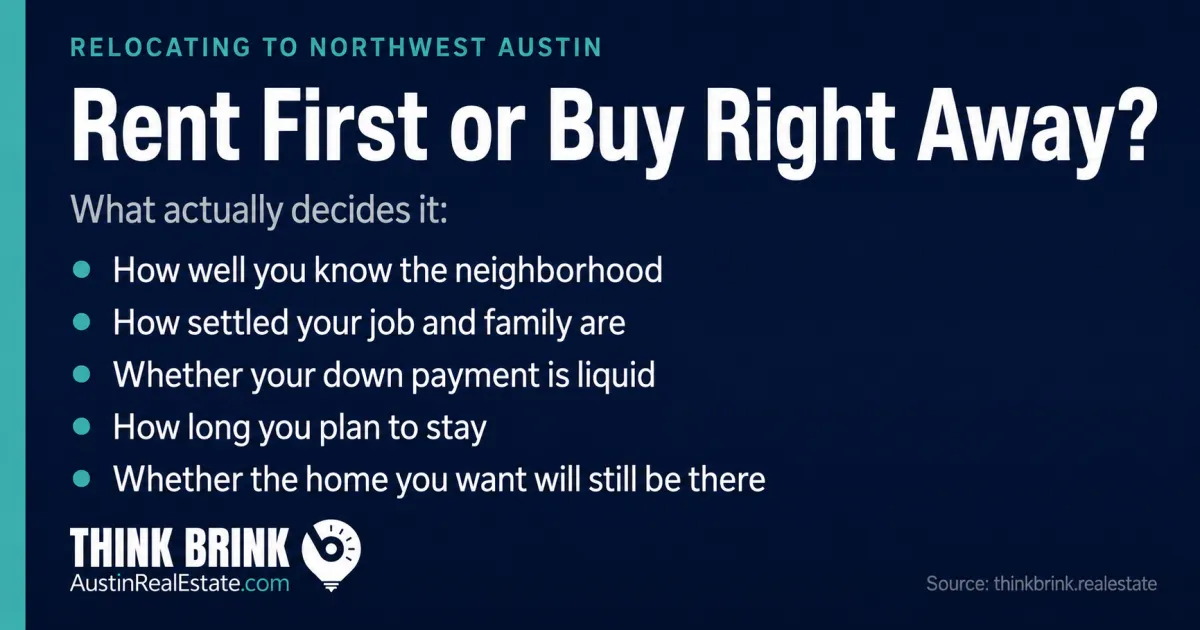
Answer five questions honestly: how confident you are about where you want to live, how long you realistically expect to stay, whether your down payment is liquid, how much uncertainty personally stresses you, and whether the specific home you want will still be available if you wait. If most of your answers point toward confidence, stability, and liquidity, buy. If most point toward uncertainty, a short hold, or tied-up cash, rent short and buy deliberately.
Fit Check: Which One Is You?
Rent first, briefly, if you cannot yet name and defend your target neighborhood, if your job or family situation is unsettled, if your down payment is stuck in an unsold home, or if the uncertainty of buying fast would genuinely keep you up at night. In that case, rent close to your target on a flexible lease and start looking to buy within a few months.
Buy right away if you already know the neighborhood, your employment and family are stable, your cash is liquid, and the specific home you want is the kind that does not come around often. In that case, renting is mostly an expensive delay while someone else buys the house you would have wanted.
Whichever side you land on, the thing that protects you is the same. Get real, local, address-level information before you sign anything long or irreversible. If you want help pressure-testing which side of this line you are actually on, that first conversation is exactly what I do, and it costs you nothing to have it before you commit to a lease or an offer.
