What the I-35 Capital Express Project Means for Northwest Austin Commutes, ZIP by ZIP
The short version: for most of Northwest Austin, I-35 is not your road
If you live in 78750, 78759, or 78726 and you have been reading the headlines about the I-35 Capital Express project - the multi-billion-dollar rebuild of Interstate 35 through Austin - your first question is usually some version of "how badly is this going to wreck my commute?" For the core of Northwest Austin, the honest answer is: probably far less than you think, and for a different reason than you would guess.
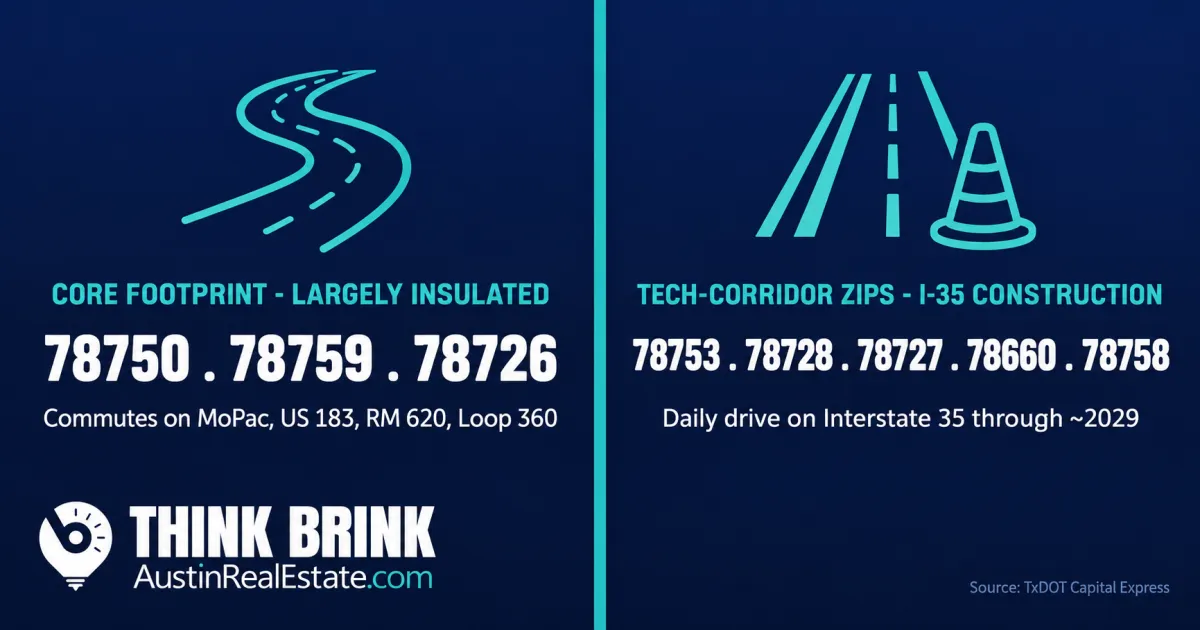
Northwest Austin's established neighborhoods are oriented to MoPac (Loop 1), US 183, RM 620, and Loop 360. The daily destinations buyers here actually drive to - Apple's Parmer Lane campus, The Domain, the 183 tech corridor, downtown - are reachable without ever touching Interstate 35. The people who feel the I-35 rebuild every morning are on the other side of the map: the North Austin tech-corridor ZIPs that sit right on the interstate. That split is the whole story, and it is the part the general Austin coverage does not break down for you.
This post is the broker's read on what the I-35 Capital Express project is, which parts of the Northwest Austin footprint it touches and which it barely grazes, and how it should - and should not - factor into a buying, selling, or staying decision by ZIP. As always, verify anything time-sensitive against TxDOT's project pages before you make a decision on it; construction schedules move.
What the I-35 Capital Express project actually is
Capital Express is TxDOT's program to rebuild roughly 79 miles of Interstate 35 across the Austin region. It is broken into three construction projects, and they are at very different stages. Understanding which segment you are talking about matters, because "the I-35 project" gets used loosely to mean all of them at once.
Capital Express Central (the big one)
This is the roughly eight-mile, approximately $4.5 billion rebuild of I-35 through the middle of Austin, running between US 290 East and State Highway 71 / Ben White Boulevard. It is the most visible and most disruptive piece. The plan tears down the aging upper decks between Manor Road and Airport Boulevard, lowers the main lanes from Airport Boulevard down to Lady Bird Lake, and adds two managed lanes in each direction (high-occupancy vehicle lanes restricted to buses, first responders, and vehicles with more than one person). It also creates the structural opportunity for "cap and stitch" deck plazas over the lowered highway downtown. TxDOT has put the full-corridor completion around 2033, weather permitting, and the timeline on individual elements has already moved - reporting in late 2025 indicated a multi-year delay on some roadway elements. Treat any single completion date as a moving target.
Capital Express North (the one closest to the footprint)
This is the segment Northwest and North Austin residents should actually pay attention to. Capital Express North runs about 11.5 miles along I-35 from US 290 East up to SH 45 North, near the Williamson County line. It adds one managed HOV lane in each direction, reconstructs bridges and ramps, and includes a diverging diamond interchange at Wells Branch Parkway. Construction started in spring 2023, and TxDOT has not expected the contractor to finish until around early 2029. If your daily drive uses I-35 anywhere between US 290 and SH 45 North, this is a years-long reality, not a someday project.
Capital Express South
The southern segment runs from Ben White south toward the SH 45 Southeast area. It is real construction, but it is far enough from the Northwest Austin footprint that it does not shape a commute decision for buyers in 78750, 78759, or 78726. It matters mainly for trips to Buda, Kyle, and the southern suburbs.
The geography that decides whether this affects you
Here is the piece that gets lost. Interstate 35 runs north-south on the eastern side of the Austin urban area. The Northwest Austin footprint sits well to the west of it, closer to MoPac and US 183. So whether the I-35 rebuild touches your life comes down to one question: where do you actually drive? This is the same trap relocating tech workers often fall into when they misjudge Northwest Austin commutes - they assume the interstate that dominates the national coverage is their road, when it usually is not.
For the established core - Spicewood Estates, Balcones Village, Great Hills, Balcones Woods, Canyon Creek, Grandview Hills - the answer is that the big employment and lifestyle destinations do not require I-35. Apple's Parmer Lane campus sits at Parmer and MoPac; from 78750 that is roughly a 10 to 20 minute drive in normal traffic via MoPac north, no interstate involved. The Domain, Q2 Stadium, and the North Burnet job cluster are reachable off MoPac and Braker, which is why Domain-area buyers weighing Northwest Austin neighborhoods and commutes rarely find I-35 in their daily drive. Downtown is a MoPac or 183-to-MoPac trip. You would use I-35 to get to the airport, to Round Rock's east side, to Georgetown, or to the eastern suburbs - real trips, but not the daily grind for most households here.
The people for whom I-35 is the daily road live in a specific set of ZIPs, and those are the ones where this project belongs in the buying decision.
ZIP by ZIP: who feels it and who does not
78750 (Spicewood Estates, Balcones Village, Jester)
Largely insulated. These neighborhoods commute via US 183, MoPac, and RM 620. The I-35 project should not change a Parmer-campus, Domain, or downtown commute here in any meaningful way. Where it shows up is on trips east - to Round Rock's retail and medical district, to Georgetown, or to the airport - where you would want to build in buffer during peak construction. For most buyers weighing 78750, I-35 construction is a footnote, not a factor.
78759 (Balcones Woods, Great Hills, Mesa Park)
Also largely insulated. The 183 / Loop 360 / MoPac triangle is what makes 78759 central to Northwest Austin, and none of those depend on the interstate. Great Hills's value proposition - fast access to the Arboretum, Domain, and the Parmer job corridor - runs entirely off 183 and MoPac. The one honest caveat is that as I-35 construction pushes more regional drivers onto parallel routes over the next several years, MoPac and 183 can absorb some of that spillover at peak. That is a diffuse, region-wide effect, not a 78759-specific problem.
78726 (Canyon Creek, Grandview Hills, Estates of Brentwood)
Insulated, and arguably the least I-35-dependent of the three core ZIPs. This far-northwest pocket lives on RM 620, 2222, and 183A. A buyer in Canyon Creek is not fighting I-35 construction to get to work; they are managing 620 and the 183A corridor. The Capital Express project is essentially off their map for daily driving.
The tech-corridor ZIPs where I-35 is the daily road
This is where the project stops being a footnote. If you are shopping the North Austin tech corridor rather than the established core, I-35 construction is a live variable through the rest of the decade:
- 78753 sits directly on I-35 in North Austin. Daily drivers here are inside the Capital Express North work zone. Build in time, and expect ramp and bridge work to shift patterns for years.
- 78728 (Wells Branch) is home to the diverging diamond interchange at Wells Branch Parkway. A diverging diamond is a genuine improvement once finished - it moves left turns onto the highway far more efficiently - but the construction phase is disruptive, and the interchange itself will drive differently than what residents are used to. If you are buying in Wells Branch, this is worth a specific conversation - see the Wells Branch buyer guide for the fuller picture on the neighborhood.
- 78727 straddles the Parmer/I-35 area near the Domain's northeast edge. Some trips lean on the interstate, others on MoPac; it depends on the specific street and destination.
- 78660 (Pflugerville) is an I-35-and-SH-130 commute market. Pflugerville buyers should treat Capital Express North as part of the daily calculus.
- 78758 sits between I-35 and MoPac near the Domain. Whether the project touches you here depends heavily on which side of the ZIP you are on and whether your commute uses the interstate or MoPac.
The pattern is clean: the closer a neighborhood sits to I-35, the more the project belongs in the decision. The established Northwest Austin core sits far enough west that it mostly does not.
What it means if you are buying
Do not let I-35 headlines scare you off the core footprint, and do not let them lull you if you are shopping the corridor. Match the concern to the ZIP. If you are targeting 78750, 78759, or 78726, test-drive your real commute at your real departure time - to the actual campus or office you will use - and you will usually find the interstate is not in it. If you are targeting the tech-corridor ZIPs on or near I-35, drive it during morning and evening peak now, while construction is active, so you are pricing in today's reality rather than a finished-highway fantasy that is still years out.
There is also a longer-game point for corridor buyers. A finished diverging diamond and added managed lanes are net improvements. A buyer who can tolerate several more years of construction may be buying into a corridor that drives better on the other side of it. That is a real thesis, but it requires patience and clear eyes about the timeline, which has already slipped once.
What it means if you are selling
If you are selling in the established core, the I-35 project is not a liability you need to get ahead of, and you should not volunteer it as one. Your commute story is a MoPac, 183, and 360 story. Where it helps to be prepared is with relocating buyers from California or the Pacific Northwest who have read national coverage of the Austin I-35 rebuild and assume it affects everyone. It does not affect your street, and being able to explain why - calmly, with the geography - is a selling point, not a defense.
If you are selling in a corridor ZIP that does sit on the interstate, honesty is the better strategy. Buyers will find the construction on their own the first time they tour at rush hour. Framing it accurately - what is being built, when it is expected to finish, and what the finished interchange or managed lanes will do - lands far better than hoping nobody notices.
What it means if you already own here and are staying
For most owners in the core footprint, the practical answer is: adjust your east-side trips during peak construction and otherwise carry on. The airport run, the drive to Round Rock or Georgetown, and any regular I-35 trip east are the places to add buffer over the next several years. Your everyday driving on MoPac, 183, 620, and 360 is not part of this project.
For owners in the corridor ZIPs, the near-term is more construction and the longer-term is a rebuilt interstate with added managed capacity. If your commute has become materially worse and shows no near-term relief, that is a legitimate input into a stay-or-move conversation - but weigh it against the finish line, not just the current mess.
Frequently asked questions
Does the I-35 Capital Express project affect Northwest Austin commutes?
For the established core ZIPs - 78750, 78759, and 78726 - mostly no, because those neighborhoods commute via MoPac, US 183, RM 620, and Loop 360 rather than Interstate 35. The project mainly affects trips heading east, such as to the airport, Round Rock's east side, or Georgetown. The North Austin tech-corridor ZIPs that sit on or near I-35, such as 78753, 78728, and 78660, feel it far more directly.
Will the I-35 construction make my drive to Apple's Parmer campus worse?
From the Northwest Austin core, the Apple Parmer Lane campus is a MoPac drive, not an I-35 drive - roughly 10 to 20 minutes from 78750 in normal traffic via MoPac north. The Capital Express project does not sit on that route. If you commute to Parmer from the east side of I-35, your experience is different and construction is a factor.
What is the diverging diamond interchange at Wells Branch Parkway?
It is a redesigned I-35 interchange in the Wells Branch area (78728) that briefly shifts traffic to the opposite side of the road to move left turns onto the highway more efficiently. Once finished it typically improves flow and safety, but the construction phase is disruptive and it drives differently than a standard interchange, so first-time users should take it slowly.
When will the I-35 project be finished?
It depends on the segment. Capital Express North, from US 290 East to SH 45 North, began in spring 2023 and has been expected to finish around early 2029. The larger Capital Express Central rebuild through downtown has been targeted for completion around 2033, and some elements have already been delayed. Any single date should be treated as subject to change - verify current schedules on TxDOT's project pages.
Should I avoid buying near I-35 because of the construction?
Not necessarily, but you should price it in. Drive your actual commute during peak hours now, while construction is active, so you are evaluating today's reality. Some buyers reasonably accept several more years of construction in exchange for buying into a corridor that will drive better once the added managed lanes and rebuilt interchanges are complete. The key is a clear-eyed view of the timeline.
Which Northwest Austin ZIP is least affected by I-35 construction?
78726 - the Canyon Creek and Grandview Hills area - is arguably the least I-35-dependent of the core ZIPs, because it commutes on RM 620, RM 2222, and 183A rather than the interstate. 78750 and 78759 are also largely insulated. The interstate is simply not part of most daily trips from these neighborhoods.
Do the new managed lanes cost money to use?
The managed lanes being added in the Capital Express segments are high-occupancy vehicle lanes, generally restricted to buses, emergency vehicles, and vehicles carrying more than one person, rather than tolled express lanes. Confirm the specific rules for a given segment with TxDOT, since managed-lane policies can vary and can change.
What this means for you
The useful way to think about the I-35 Capital Express project in Northwest Austin is not "how bad will it be" but "does it touch the roads I actually use." For buyers, sellers, and owners in the established core of 78750, 78759, and 78726, the honest answer is that it mostly does not - your life runs on MoPac, 183, 620, and 360, and the interstate is an occasional east-side trip. For the tech-corridor ZIPs that sit on I-35, it is a genuine multi-year factor that belongs in the decision, with a finish line worth weighing against the near-term disruption.
Either way, the move is the same: test your real commute, at your real time, to your real destination, before you decide anything based on a headline about a highway you may never drive. If you want help mapping a specific neighborhood against a specific commute, that is exactly the kind of question worth walking through address by address before you write an offer.
