Great Hills vs Canyon Creek: What Northwest Austin Buyers Are Choosing Between
Great Hills and Canyon Creek come up together in almost every Northwest Austin buyer conversation I have where the family has a school-age kid, a tech job somewhere on the Parmer or 183 corridor, and a budget that lands somewhere in the high-$600,000s to low-$900,000s. They both point to Westwood High School. They both put you inside a 15-to-30-minute commute of Apple, the Domain, and the 183 tech spine. And on paper they look close enough that a lot of buyers assume the decision comes down to which listing hits the market first.
It does not. These are two genuinely different neighborhoods that happen to overlap on the two things buyers filter for first, schools and commute. Once you get past the surface, they diverge on almost everything that actually shapes how you live in the house and what you pay for it: the age and style of the housing stock, the lot topography, the school district assignment, the price ceiling, and the kind of buyer each one attracts. This post walks through those differences the way I would if we were driving both neighborhoods in an afternoon, so you can figure out which one fits your situation before you are standing in a house trying to make a decision in 48 hours.
The one-sentence version
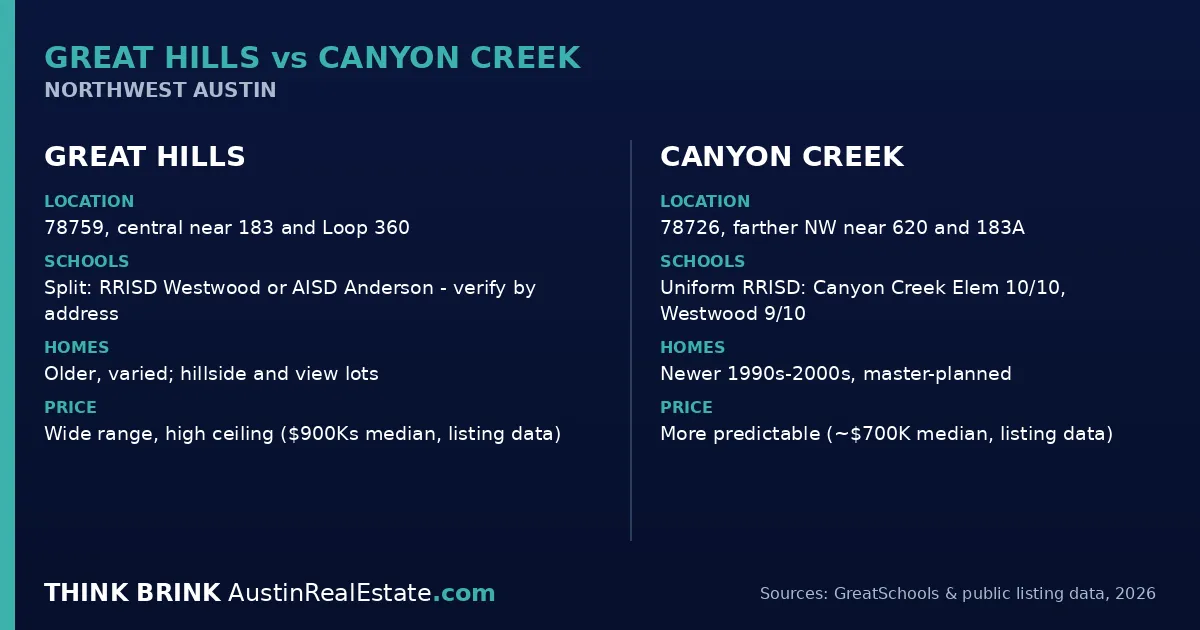
If you want a newer, more uniform, master-planned feel with a single clean Round Rock ISD feeder and a strong HOA-driven community, Canyon Creek is probably your neighborhood. If you want an established, architecturally varied, hill-country-textured neighborhood with a wider price range and a location that is closer to the center of Northwest Austin, Great Hills is probably your neighborhood. The rest of this is the detail behind that sentence.
Where each one actually sits
Great Hills is in 78759, tucked into the area around the 183 and Loop 360 intersection, close to the Arboretum and the Great Hills Country Club. It is central in the truest sense of the word for Northwest Austin. From most of Great Hills you are minutes from the Arboretum and Domain retail, a short hop to MoPac and 183, and inside a tight commute radius to almost every major employer buyers in this area target. It is the kind of location where you are not organizing your life around a single highway on-ramp because you have several.
Canyon Creek sits farther northwest, in 78726, off Boulder Lane and Canyon Creek Drive near the intersection of RM 620 and 183A, backing up against the Bull Creek greenbelt and preserve land. It is more removed, more residential, and quieter. That distance is the tradeoff at the heart of the whole comparison: Canyon Creek buys you a newer master-planned neighborhood and a top-rated elementary in exchange for being a little farther out from the center of everything and a little more dependent on 620 and 183A for getting around.
I have written full standalone guides for each of these neighborhoods, and if you are seriously considering either one you should read the one that applies to you. Start with the Great Hills buyer guide or the Canyon Creek buyer guide. This post is the head-to-head; those are the deep dives.
Schools: this is where most buyers start, so let's be precise
Both neighborhoods land students at Westwood High School, and Westwood is the reason a lot of families are looking at this part of Northwest Austin in the first place. Westwood is a Round Rock ISD school and an International Baccalaureate World School. It currently carries a 9 out of 10 GreatSchools rating, earned an "A" accountability rating from the Texas Education Agency for the 2024-2025 school year, and reports a graduation rate around 99 percent. It is one of the most sought-after public high school feeders in the entire Austin metro, and it is the common denominator between these two neighborhoods.
The difference shows up below the high school, and it is a real difference.
Canyon Creek: one clean, top-rated RRISD feeder
Canyon Creek is straightforward. The neighborhood feeds Canyon Creek Elementary, Grisham Middle School, and Westwood High, all Round Rock ISD. Canyon Creek Elementary is the headline here: it currently holds a 10 out of 10 GreatSchools rating and ranks in the top 1 percent of Texas public elementary schools, with recent proficiency figures around 92 percent in math and 88 percent in reading. Grisham Middle carries an 8 out of 10. For a family that wants a clean, uniform, all-RRISD path with a genuinely elite neighborhood elementary, Canyon Creek is hard to beat, and that consistency is a big part of why the neighborhood holds its value.
Great Hills: strong schools, but assignment depends on your exact address
Great Hills is more complicated, and this is the single most important thing to understand before you make an offer there. Great Hills is split between two school districts depending on where the specific home sits. Part of the neighborhood is Round Rock ISD, feeding schools like Laurel Mountain Elementary and Canyon Vista Middle before Westwood. Part of it is Austin ISD, feeding Hill Elementary and Murchison Middle before Anderson High School rather than Westwood.
Both districts here are strong. Canyon Vista Middle carries a 9 out of 10, and Anderson High in Austin ISD is an IB school with a 7 out of 10 GreatSchools rating and a graduation rate around 98 percent. But they are different pathways, and if you are buying Great Hills specifically to land at Westwood, you cannot assume the house you like is on the Round Rock side. You have to verify the district and feeder assignment at the exact street address before you write the offer, not after. Two homes a few streets apart in Great Hills can feed entirely different high schools. I cannot stress this enough, because it is the mistake I see buyers make most often in this neighborhood.
The takeaway on schools: if a specific, guaranteed Westwood-with-a-10-rated-elementary path is the whole point of your search, Canyon Creek gives you that with zero address-level risk. If you are comfortable verifying by address and you value the location and housing variety of Great Hills, the schools there are excellent too, you just have to confirm which set you are getting.
Housing stock: newer and uniform versus older and varied
This is where the two neighborhoods stop looking similar.
Canyon Creek is a master-planned neighborhood built largely from the 1990s into the 2000s. The homes are newer, more architecturally consistent, and generally laid out on the kind of curved streets and cul-de-sacs that came with that era of development. Square footage in the broader 78726 area runs roughly from the 1,600s up past 4,500 square feet, with a lot of the neighborhood sitting in the larger family-home range. If you want a house that feels current without a full renovation, that has the floor plans buyers expect from a 1990s-2000s build, and that sits in a neighborhood where the homes relate to each other, Canyon Creek delivers that consistency.
Great Hills is older and far more varied. It developed earlier and grew in over time, so you get a genuine mix: mid-century-influenced designs, custom builds, contemporary homes, and everything in between, on lots that follow the natural hill-country terrain rather than a flattened master plan. Homes range widely in size, roughly from under 1,500 square feet up past 5,000. This variety is either the appeal or the frustration depending on your temperament. If you want character, mature trees, dramatic lots, and no two houses looking alike, Great Hills is that. If you want predictability and a home that will not need thought about updates, Great Hills asks more of you as a buyer because condition and era vary house to house.
Lots and topography
Great Hills is hilly, and some of its lots are genuinely special: slopes, views, tree cover, and larger parcels that in a few cases run to multiple acres. That topography is a real part of the value in certain sections, and it is why some Great Hills homes command a significant premium over others that feed the same schools. I have written separately about what makes a Great Hills lot worth the premium, because in that neighborhood the lot can matter as much as the house.
Canyon Creek is gently rolling rather than steep, with wide streets, mature trees, and greenbelt backing along the Bull Creek preserve for the lots that abut it. It is a softer, more walkable topography. You will not find the dramatic hillside view lots that Great Hills has, but you also will not deal with the steep driveways and grade challenges that come with some of those Great Hills parcels.
Price: the ranges overlap, but the ceilings do not
Here is where I have to be careful, because I will not publish a precise median that I cannot stand behind under my license, and current MLS figures are refreshed monthly rather than daily. So treat the following as web-verified public listing-data ranges, not exact MLS medians, and ask me for a live comparative market analysis when you are ready to actually move.
Great Hills has the wider spread and the higher ceiling. Public listing data shows homes there ranging from the mid-$400,000s at the low end up toward and past $1.8 million at the top, with the average sitting near seven figures and the median around the $900,000s. That range reflects exactly what I described above: a small dated home on a modest lot and a large custom home on a view lot can both be "Great Hills," and they price completely differently. Recent public data has shown average days on market in the low 30s with homes selling close to 97 percent of list, which tells you the neighborhood moves at a healthy but not frantic pace.
Canyon Creek, as part of 78726, has been running a trailing-12-month median sale price around $700,000 in mid-2026 public data, with active listings spanning roughly the mid-$400,000s up past $3 million for the largest and most premium homes. The typical Canyon Creek family home clusters more tightly than Great Hills does, because the housing stock is more uniform, so you get less of the extreme high-end and low-end spread and more predictability about what your dollar buys.
The practical read: if your budget tops out around the mid-$700,000s and you want a newer, larger, move-in-ready family home with a top-1-percent elementary, Canyon Creek stretches further and is more predictable. If you have room above $900,000 and you want either a special lot or a specific architectural character, Great Hills opens up options Canyon Creek simply does not have, along with the risk that you overpay for the wrong tier if you do not know the neighborhood. For a broader picture of pricing across the whole area, the Living in 78750 and 78759 guide puts these two in context with their neighbors.
Commute: both are good, but not identical
Both neighborhoods sit inside a genuinely convenient commute radius for Northwest Austin employers, which is a big part of why they compete for the same buyers. But central versus northwest matters here.
Great Hills, from the 183/360 area, gives you multiple routes to almost everything: quick access to MoPac and 183, a short drive to the Domain and the Arboretum, and a reasonable run up to the Apple Parmer campus. Because it is more central, you are rarely captive to a single road. That flexibility is underrated until the one highway you depend on has a wreck on it.
Canyon Creek, being farther northwest near 620 and 183A, leans more heavily on those two roads. Your run to Apple's Parmer campus and up the tech corridor is straightforward via 183A, and for a lot of Canyon Creek buyers that specific commute is actually very clean. But you are more dependent on 620 and 183A behavior than a Great Hills buyer is, and getting to more central and southern parts of Austin takes a little longer from Canyon Creek than from Great Hills. If your work and your life are oriented up the Parmer and 183A corridor, Canyon Creek's location is excellent. If they are more central or spread out, Great Hills' position gives you more slack.
Community feel
Canyon Creek has a stronger master-planned community identity. There is an active HOA, neighborhood amenities, and the kind of cohesion that comes from a neighborhood that was designed and built as a unit over a defined period. Families who want organized community, consistent standards, and a clear neighborhood identity tend to gravitate here.
Great Hills is more of an established, organically grown neighborhood. It has community and it has the country club nearby, but it does not have the uniform master-planned HOA structure that Canyon Creek does. It feels more like a mature Austin neighborhood that grew in over decades, which is a plus if you find master-planned uniformity a little sterile and a minus if you want the structure and amenities of an active HOA community.
Who each neighborhood actually fits
Canyon Creek fits you if
You want a newer, larger, move-in-ready family home without renovation risk. You want a single guaranteed Round Rock ISD feeder path with a top-1-percent elementary and no address-level district guessing. Your commute and your life are oriented up the 183A and Parmer corridor. You value a master-planned neighborhood with an active HOA, greenbelt access, and community cohesion. And your budget is most comfortable in the roughly high-$500,000s to high-$700,000s range where Canyon Creek's typical family home lives.
Great Hills fits you if
You want a central Northwest Austin location with multiple commute routes and quick access to the Arboretum, the Domain, and 183/360. You value architectural variety, mature trees, and the possibility of a special hillside or view lot over master-planned uniformity. You either have budget above $900,000 for the upper tier or you know the neighborhood well enough to find real value at the entry tier. And you are willing to verify the school district and feeder assignment at the exact address, because Great Hills is split between Round Rock ISD and Austin ISD and you cannot assume Westwood without checking.
The honest tradeoff nobody puts in the listing
The cleanest way I can frame this: Canyon Creek reduces the number of things you have to get right, and Great Hills increases the number of things you can get right. In Canyon Creek, the schools are settled, the housing stock is consistent, and the risk of buying the wrong tier is low, so you are mostly deciding whether you like the specific house and whether the northwest location works for your commute. In Great Hills, there is more upside, a special lot, a central location, real character, but also more that can go sideways if you do not know what you are looking at: a house on the Austin ISD side when you wanted Westwood, an over-improved home priced like a view lot without the view, a dated interior that eats your renovation budget.
Neither of those is better in the abstract. They are better or worse for a specific buyer with a specific budget, a specific commute, and a specific tolerance for doing homework before they offer. That is the actual decision, and it is why I do not think the "whichever comes on the market first" approach serves anyone well here.
Frequently asked questions
Do Great Hills and Canyon Creek go to the same high school?
Both can feed Westwood High School in Round Rock ISD, which is the main reason they attract the same buyers. But Canyon Creek is uniformly Round Rock ISD feeding Canyon Creek Elementary, Grisham Middle, and Westwood, while Great Hills is split. Part of Great Hills is Round Rock ISD and feeds Westwood, and part is Austin ISD and feeds Anderson High instead. In Great Hills you have to verify the assignment at the specific address; in Canyon Creek you do not.
Is Canyon Creek or Great Hills better for schools?
They are both excellent, but they answer different questions. Canyon Creek gives you a guaranteed top-1-percent elementary, Canyon Creek Elementary at a 10 out of 10 GreatSchools rating, plus Grisham Middle and Westwood, all Round Rock ISD, with no address-level uncertainty. Great Hills, on the Round Rock side, feeds strong schools including Canyon Vista Middle at 9 out of 10 and Westwood, and on the Austin ISD side feeds Anderson, an IB high school. If your priority is a single clean, elite, guaranteed feeder, Canyon Creek has the edge. If you want the location and are comfortable verifying, Great Hills schools are also very strong.
Which is more expensive, Great Hills or Canyon Creek?
Great Hills has the higher ceiling and the wider range. Public listing data shows Great Hills spanning from the mid-$400,000s to past $1.8 million with a median in the $900,000s, driven by its architectural variety and premium lots. Canyon Creek, as part of 78726, has run a trailing-12-month median around $700,000 in mid-2026 public data, with a more predictable clustering of family homes. If your budget is in the $600,000s to mid-$700,000s, Canyon Creek generally stretches further. For an exact comparison on homes you are actually considering, ask me for a live comparative market analysis, since these are public listing ranges rather than current MLS medians.
Is Canyon Creek too far out compared to Great Hills?
It depends entirely on where you work and how you live. Canyon Creek sits farther northwest near RM 620 and 183A, so it leans on those two roads and is a little farther from central and south Austin. If your commute runs up the 183A and Parmer corridor toward Apple, Canyon Creek's location is actually very convenient. Great Hills is more central near 183 and Loop 360, so it gives you more routes to more places. Neither is "too far," but Great Hills has more locational flexibility and Canyon Creek has a cleaner shot up the tech corridor.
Which neighborhood is better for a family relocating from out of state?
For a relocating family that wants certainty, especially one moving sight-unseen or on a tight timeline, Canyon Creek is often the easier first move: uniform housing stock, a guaranteed elite feeder, and a master-planned community that is easy to understand from a distance. Great Hills rewards buyers who can spend time in the neighborhood, because the variety in housing, price tier, and school district assignment means you get more out of it when you know what you are looking at. If you are relocating and cannot be here to study the differences, lean toward the neighborhood with less to get wrong, or have a broker verify the address-level details for you.
Do both neighborhoods have an HOA?
Canyon Creek has an active HOA with real community identity and neighborhood amenities, which is part of its master-planned appeal. Great Hills, as an older organically developed neighborhood, does not have that same uniform master-planned HOA structure. If an active HOA and the community structure that comes with it matters to you, that difference favors Canyon Creek. If you would rather not deal with an HOA's rules and dues, that favors Great Hills.
What are property taxes like in Great Hills versus Canyon Creek?
Both sit in the Northwest Austin range where effective property tax rates generally run somewhere around 1.8 to just over 2 percent of assessed value depending on the specific taxing jurisdictions and any municipal utility district. The exact rate depends on the property's location and district mix, and a Texas homestead exemption reduces the taxable value for your primary residence. Because rates and exemption amounts change and vary by address, confirm the specific figures with the county appraisal district and consult a CPA or tax professional before you rely on any tax number in your budget.
The bottom line
Great Hills and Canyon Creek are not interchangeable, even though they share Westwood and a commute radius. Canyon Creek is the newer, more uniform, single-feeder, master-planned choice that reduces what you have to get right, and it fits families who want certainty and a clean run up the tech corridor. Great Hills is the older, more varied, more central choice with a higher ceiling and more upside, and it fits buyers who value location and character and are willing to verify the details, especially the school district assignment, before they offer.
If you tell me your budget, your commute, and how much homework you want to do before writing an offer, I can tell you within about ten minutes which of these two neighborhoods you should be spending your weekends in, and which specific streets to focus on once you get there. That is the conversation worth having before either neighborhood's next listing goes live. Reach out through the 78726 guide or any of the neighborhood pages and let's narrow it down.
