How to Buy Into Great Hills Without Paying Hillside Prices
Most buyers who research Great Hills and then decide it's out of their budget have made one of two mistakes. Either they looked at the headline median - currently around $730,000 - and assumed that represents the floor, not the midpoint. Or they toured one or two hillside premium homes, fell in love with the price tags attached to those specific lots, and concluded the whole neighborhood is out of reach.
Great Hills has an entry tier. It's real, it's available, it still delivers the location and in most cases the school feeder that makes Great Hills worth targeting in the first place, and it consistently gets overlooked because buyers are searching the neighborhood name alongside a price ceiling that they've set too low, or they've given up without understanding what the neighborhood's internal price range actually looks like.
This post is for buyers with budgets in the $550,000 to $800,000 range who want to know whether Great Hills is actually achievable for them - and if so, what they'd be getting, what they'd be giving up compared to the premium sections, and how to approach the search correctly.
What Makes a Great Hills Lot Worth the Premium - and How to Know If You're Paying for the Right One
The Internal Price Range: What the Median Doesn't Tell You
The overall Great Hills median of approximately $732,500 is a useful starting point and a misleading one at the same time. It's the middle of a range that runs from the mid-$500,000s on one end to well above $2 million on the other. The median is being pulled upward by the hillside premium lots and the Fairway at Great Hills golf course section. It does not represent the floor of what Great Hills actually offers.
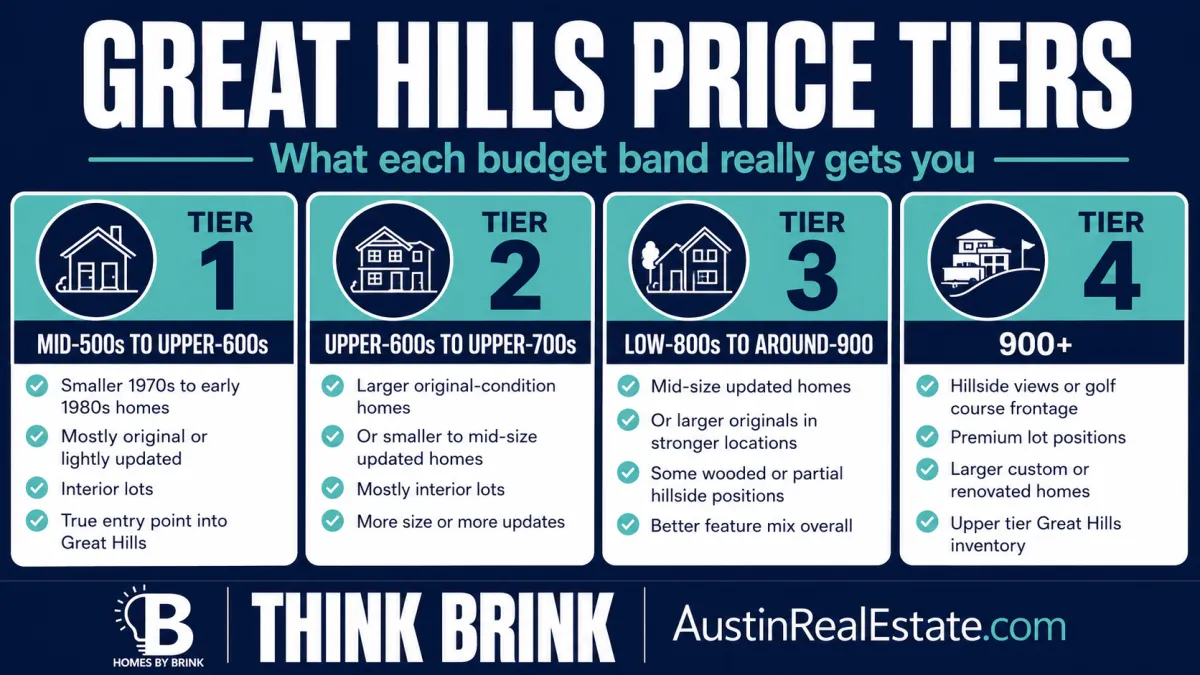
In practical terms, here is what the Great Hills price range looks like segmented by what you're actually buying:
Mid-$500,000s to upper $600,000s: Smaller homes in the 1,500 to 2,200 square foot range, built primarily in the 1970s and early 1980s, in original or minimally updated condition. Flat or gently sloped interior lots. This is the genuine entry point into Great Hills - the homes that were built when the neighborhood was first developed, that have been maintained to varying degrees, and that sit in Great Hills proper with access to the same schools and the same commute positioning that the $1.5 million hillside homes have.
Upper $600,000s to upper $700,000s: Larger original-condition homes, or smaller-to-mid-size homes with meaningful updates. This range starts to include more of the 1980s and 1990s construction. Still predominantly interior lots without the view premium.
Low $800,000s to around $900,000: Mid-size updated homes, or larger original-condition homes in good locations. The lower end of partial hillside or wooded lot positions starts to appear here.
$900,000 and above: This is where hillside views, golf course frontage, larger custom builds, and the premium lot positions described in the companion post begin to dominate.
A buyer with a $700,000 to $800,000 budget is not looking at the scraps of Great Hills. They are looking at a legitimate and meaningful portion of the neighborhood's housing stock.
What You Get at the Entry Price Points
This is the question buyers need answered honestly rather than optimistically. Here is what the Great Hills entry tier actually delivers and where the honest tradeoffs are.
What you get:
The same 78759 zip code and in most cases the same school feeder. The school district assignment at the address level doesn't change based on how much you spend within Great Hills. A $600,000 home in the RRISD section of Great Hills feeds the same Kathy Caraway or Laurel Mountain - Canyon Vista - Westwood pathway as a $1.5 million home six streets away. The location premium that makes Great Hills worth targeting - the 183/360 intersection access, the Arboretum adjacency, the 15 to 25 minute Apple commute - is equally available at the entry tier.
The neighborhood character and the established canopy. Great Hills has been maturing since the 1970s. The mature live oak canopy, the winding streets, the wooded character that gives the neighborhood its distinctive feel - that's not exclusive to the hillside sections. The flat interior sections of Great Hills are still part of the same neighborhood, still have mature trees on most lots, and still feel meaningfully different from a newer suburban subdivision built 20 years later.
Access to Great Hills Park, the 80-plus acre public park in the Bull Creek Watershed with 1.7 miles of trails. Every Great Hills resident has this available to them regardless of what they spent on the house.
Proximity to the Arboretum, Trader Joe's, the restaurants and retail along 183 Research Boulevard, and the broader Northwest Austin amenity infrastructure. This is a location advantage that the entry-tier buyer shares fully with the premium-tier buyer.
What you give up:
The view. The Hill Country views, the valley vistas, the sunset from the back deck over the treetops - these are specific to the hillside premium lots and are not available at the entry price point. If the view is specifically what you want from Great Hills, you need to budget for it or look elsewhere. The entry tier is not a compromise version of the hillside experience - it's a different experience that shares the location and schools but not the terrain character.
The privacy of cul-de-sac positioning. Many of the entry-tier homes are on through-streets rather than dead-end cul-de-sacs. The traffic character, the sense of who belongs on the street, and the outdoor privacy are all different from what a cul-de-sac position delivers.
Some square footage at mid-budget levels. The entry tier leans toward smaller homes - 1,500 to 2,200 square feet is common at the lower end. Buyers who specifically need 3,000-plus square feet at under $750,000 in Great Hills will find their options limited, though not nonexistent.
What Buyers Should Know About Great Hills Before Making an Offer
The School Feeder Reality: Verify at the Entry Tier Too
Everything said in the broad Great Hills buyer guide about school district verification applies equally at the entry price points - maybe more so, because the entry-tier homes are more concentrated in certain sections of the neighborhood and those sections have specific district assignments that can surprise buyers who haven't done the homework.
The accessible flat sections in the eastern and lower-elevation parts of Great Hills are more likely to be Austin ISD than RRISD. This is not a universal rule, but it's a pattern buyers should understand. A buyer whose primary motivation for targeting Great Hills is the RRISD Westwood feeder needs to verify that the specific entry-tier home they're considering is actually in RRISD - not assume it because it's in Great Hills.
If the specific address turns out to be AISD feeding Hill Elementary, Murchison, and Anderson, that is not necessarily a dealbreaker - Anderson is a strong high school with solid programs and has its own committed buyer pool. But it changes the school calculus, and buyers who specifically came to Great Hills for Westwood need to know before they're under contract.
The practical rule: call the specific district with the specific address before you go past the casual interest stage on any home in the entry tier. This is not a step to defer to after you've toured and fallen in love.
The Renovation Opportunity: Where Entry-Tier Great Hills Gets Interesting
This is the specific angle that experienced buyers and investor-minded buyers have been working in Great Hills for years, and it's worth explaining clearly for buyers who might not have considered it.
The entry tier of Great Hills - the 1970s and early 1980s homes in original or minimally updated condition in the mid-$500,000s to upper $600,000s range - represents a specific opportunity that doesn't exist in many comparable Northwest Austin neighborhoods at this price point. You are buying into a neighborhood with a $730,000 median on a home that the market is pricing below that median because of condition. If you can bring the home up to a standard that buyers in this neighborhood expect - updated kitchen, primary bath renovation, new flooring, fresh paint, new systems - the ceiling above you is meaningfully higher than the price you paid.
This is not a guarantee and it is not simple. Renovating a 1970s Great Hills home to current buyer expectations costs real money - a comprehensive renovation can run $100,000 to $200,000 depending on the scope and the size of the house. The math only works if the combination of your purchase price plus renovation cost lands you at or below what renovated comparable homes are selling for in the neighborhood. Your agent needs to pull those renovated comparable sales before you buy rather than after you've spent the renovation budget.
But the opportunity exists here in a way it doesn't in newer neighborhoods where everything is already at or near the same condition level. In Great Hills, the gap between original condition and renovated condition is wide enough that buying at the low end and improving thoughtfully is a legitimate strategy for buyers who have the appetite for a project.
What Sellers in 78750 and 78759 Should Know About the Market Right Now
Adjacent Neighborhoods That Deliver Similar Value
One of the most useful things a buyer targeting Great Hills on a more constrained budget can do is broaden the search to include the adjacent 78759 neighborhoods that share some of Great Hills' core attributes - the school feeder, the general location, the Arboretum proximity - at lower price points. These aren't consolation prizes for buyers who couldn't afford Great Hills. They're legitimate alternatives that some buyers actually prefer once they understand them.
Balcones Hills sits in 78759 with RRISD assignment feeding Kathy Caraway Elementary, Canyon Vista, and Westwood - the same feeder as the RRISD sections of Great Hills. The median in Balcones Hills has been running around $700,000 with homes averaging only 9 days on market, which signals strong demand relative to supply. Homes here were built from 1960 to 2015 in a wide range, with lot sizes from 0.24 to 0.56 acres. Buyers who specifically want the RRISD/Westwood feeder and can't find the right Great Hills home in their budget should have Balcones Hills on the active list.
Mesa Park sits in 78759 with RRISD assignment feeding Kathy Caraway Elementary, Canyon Vista, and Westwood. The median is approximately $525,000 with homes from the 1970s and early 1980s running 1,300 to 4,400 square feet on quarter-acre lots. Mesa Park is the most accessible entry point into the RRISD/Westwood feeder in 78759 and is consistently undervalued relative to its school access. Buyers who want Westwood and have a budget under $600,000 should start in Mesa Park.
Barrington Oaks also sits in 78759 with RRISD assignment feeding Kathy Caraway Elementary. Homes were built in the 1970s and 1980s on lots that run a quarter acre or larger. It's a common destination for buyers who want RRISD at an accessible price point.
The key insight: if your primary goal is the 78759 location and the RRISD Westwood feeder, and your budget is in the $500,000 to $650,000 range, there are three RRISD neighborhoods in the same zip code with the same high school pathway that price at lower medians than Great Hills. That doesn't mean Great Hills isn't worth stretching for - but it does mean there are legitimate alternatives if Great Hills inventory in your range is thin.
Living in 78750 and 78759: The Northwest Austin Zip Code Guide Buyers and Sellers Should Bookmark
What to Prioritize at the Entry Tier: A Practical Framework
Buyers in the Great Hills entry tier need to prioritize more carefully than buyers with larger budgets, because the available inventory is narrower and the decision about what to compromise on matters more.
Prioritize school district assignment over everything else. If RRISD and Westwood is your primary reason for targeting Great Hills, filter for confirmed RRISD address first. Don't fall in love with a home and then discover it's AISD. Start with the district filter and build your search from there.
Prioritize lot over condition. At the entry tier, you can renovate a house but you cannot change what the lot backs to or how the street is configured. A smaller original-condition home on a quiet wooded lot is a better long-term purchase than a larger updated home on a busy through-street. The renovation can be done over time. The lot position cannot be changed.
Prioritize major system condition over cosmetics. The homes in the Great Hills entry tier are primarily from the 1970s and 1980s. The systems - HVAC, roof, water heater, electrical panel, plumbing - are old enough that their condition and replacement history materially affect what you're inheriting. A house with original 1978 systems priced at $580,000 is not the same purchase as a house with updated systems at the same price. Cosmetic original condition is manageable. Original mechanical systems are a budget item.
Be realistic about what you'll actually renovate. Buyers who purchase entry-tier Great Hills homes with plans for a comprehensive renovation sometimes find that the renovation scope grows in ways they didn't anticipate once they're inside the walls of a 1970s home. Get a pre-purchase contractor walkthrough if you're buying with renovation intent, and budget conservatively rather than optimistically.
Is Northwest Austin Still Worth the Premium?
The Honest Case for the Great Hills Entry Tier
The buyers who do best at the Great Hills entry price points are typically the ones who came into the neighborhood without requiring the hillside premium experience - buyers who wanted the school feeder, the location, the neighborhood character, and the long-term value case, and who were willing to buy something that needed updating or that sat on an interior lot without a dramatic view.
Those buyers get a real deal relative to the neighborhood's overall premium. They are buying into a neighborhood that has maintained its desirability through multiple market cycles, with a school pathway that consistently ranks among the strongest in the Austin metro, at a price point that benefits from the neighborhood's wide internal range.
What they're not getting is the sunset view from the hillside deck, the cul-de-sac privacy, or the move-in-ready renovated condition that the upper tier delivers. Whether that trade is right depends entirely on what you actually prioritize in the home you're buying.
Great Hills at $625,000 in original condition on an interior lot is not the same experience as Great Hills at $1.4 million on a hillside cul-de-sac. Both are genuinely in Great Hills. Both benefit from the location and school access. Only one of them fits a buyer who needs the view and the private lot position to feel like the purchase was worth it. The other one fits a buyer who prioritizes the location, the feeder, and the long-term neighborhood value proposition - and who is comfortable either living in a home that needs updating or doing that updating themselves.
Know which buyer you are. Then decide whether Great Hills at the entry tier is your answer, or whether one of the adjacent RRISD neighborhoods at a lower price point is a better fit for where your money actually goes.
Why Some Northwest Austin Homes Sit While Others Still Sell
What Northwest Austin Sellers Should Know About Buyers Who Want Updated but Not Overpriced
Frequently Asked Questions
Can I actually buy into Great Hills for under $700,000?
Yes. Homes in the Great Hills entry tier - primarily 1970s and early 1980s construction in original or minimally updated condition on interior lots - have been trading in the mid-$500,000s to upper $600,000s. The inventory at this tier is more limited than at the mid-range and premium levels, but it exists and turns over. A buyer with a $650,000 to $700,000 budget has real options in Great Hills with patience and the right search approach.
Do entry-tier Great Hills homes still feed Westwood High School?
It depends on the specific address. The RRISD/AISD boundary runs through Great Hills at all price levels - it's not true that all entry-tier homes are AISD or that all premium homes are RRISD. Verify the specific address with both districts before making any school-based assumptions. Entry-tier homes in the RRISD sections of Great Hills do feed the same Westwood pathway as the premium homes.
Is it worth buying a fixer-upper in Great Hills?
It can be, if the math works. A 1970s Great Hills home at $575,000 that needs $100,000 to $150,000 in renovation puts you at $675,000 to $725,000 all-in. If renovated comparable homes at similar size and lot are trading at $800,000 to $900,000, the renovation creates value. If they're trading at $700,000, it doesn't. Run the specific comparable analysis before you buy with renovation intent, not after.
What are the best alternative neighborhoods to Great Hills for RRISD and Westwood access at a lower price?
Balcones Hills, Mesa Park, and Barrington Oaks are all in 78759 with RRISD assignment feeding Canyon Vista and Westwood. Mesa Park has the lowest median at approximately $525,000. Balcones Hills has been moving fast - averaging around 9 days on market - suggesting strong demand at its $700,000 median. All three are legitimate alternatives for buyers who want the Westwood feeder at a lower price than Great Hills typically requires.
What do I give up by buying at the Great Hills entry tier vs the premium tier?
Primarily the view and the lot position. The Hill Country views, hillside cul-de-sac privacy, and golf course frontage that define the premium tier are not available at entry-tier pricing. You retain the school feeder, the location, the neighborhood character, and the long-term value case for being in Great Hills. Whether that tradeoff works depends on how central the view and lot premium are to your vision of the home.
How long does it take to find a home at the Great Hills entry tier?
The entry tier has less inventory than the mid-range, which means buyers need more patience and a well-configured search that captures homes as they come available rather than assuming they'll be on the market long. Working with an agent who watches the Great Hills market actively and can alert you quickly when entry-tier inventory appears is more important here than in the broader market.
