Points, Buydowns, and ARM vs Fixed: What Northwest Austin Buyers Should Actually Weigh Before Locking a Rate
Points, Buydowns, and ARM vs Fixed: What Northwest Austin Buyers Should Actually Weigh Before Locking a Rate
Most of the mortgage advice floating around is written for a national reader who does not pay Texas property taxes and does not compete for a house in a market like 78750 or 78726. The mechanics are the same everywhere, but the decision is not. In Northwest Austin, where property taxes and insurance make up a large slice of the monthly payment and where a lot of buyers are relocating tech professionals sitting on equity from a California or Seattle sale, whether to buy points, take a temporary buydown, or use an adjustable-rate mortgage plays out differently than it does for a first-time buyer in a low-tax state.
As of early September 2026, Freddie Mac's Primary Mortgage Market Survey put the average 30-year fixed rate at 6.71 percent, up slightly from 6.66 percent the week before, with the 15-year fixed averaging 6.04 percent (source: Freddie Mac, week of September 3, 2026). A year earlier the 30-year sat at 6.50 percent. That is the environment you are locking into: rates in the high sixes, not the low threes people remember from 2021. In that band, the tools that lower your rate or your early payments are worth understanding, because using them well versus badly is real money over the years you own the home.
This is a general-information guide from a broker, not lending advice, and I am not a licensed mortgage lender. Every number below is either a published market figure with its source noted or a clearly labeled illustrative calculation to show the mechanics. Your actual rate, points pricing, and loan options depend on your credit, your down payment, the specific lender, and the day you lock. Run your real scenario with a licensed loan officer before you decide anything.
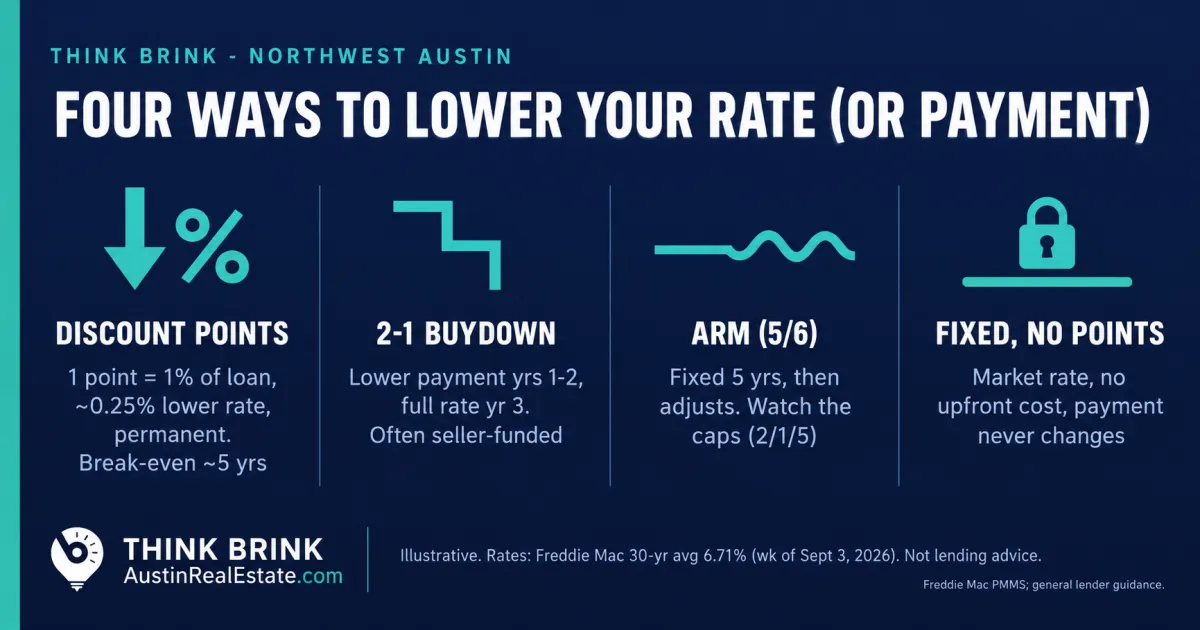
The four levers, and what each one actually does
When a buyer says "I want a lower rate," they are usually reaching for one of four different tools that get lumped together and should not be. Each solves a different problem and costs money in a different way.
1. Discount points (a permanent buydown)
A discount point is prepaid interest you hand the lender at closing to permanently lower your note rate for the life of the loan. One point equals one percent of the loan amount. On a $500,000 loan, one point is $5,000. As a rough industry rule, one point buys roughly a quarter-percent lower rate, though the exact amount moves with market conditions and lender pricing and is not fixed (source: Freddie Mac consumer guidance; Bankrate). So paying a point might take you from 6.71 percent to somewhere near 6.46 percent. Nothing about your payment changes temporarily; the lower rate is baked in from month one and stays for as long as you keep the loan.
Points are a bet on time. You pay cash now to save a smaller amount every month, and you only come out ahead if you keep the loan long enough to recover the upfront cost. More on the break-even math below, because that is the entire decision.
2. Temporary buydowns (2-1, 3-2-1, and 1-0)
A temporary buydown lowers your payment for the first year or two or three, then steps back up to the full note rate. The most common is the 2-1: your payment is calculated as if your rate were two percent lower in year one and one percent lower in year two, then you pay the full note rate from year three onward. A 3-2-1 does the same across three years starting three percent lower; a 1-0 covers a single year one percent lower (source: Movement Mortgage; Lower.com; The Mortgage Reports).
Here is the part that trips people up: your actual note rate never changes. The rate on your loan documents is fixed from day one. What happens is that a lump sum gets deposited into a separate buydown account at closing, and each month during the buydown period a portion of that account is released to cover the gap between your reduced payment and your full payment. When the account runs out, you are simply paying your normal payment. It is not a different loan; it is a subsidy sitting in escrow.
The critical detail for Northwest Austin buyers: temporary buydowns are usually funded by the seller or the builder as a concession, not by you. In a market where a home has sat for a while, or on new construction where a builder is trying to move standing inventory without dropping the list price, a seller-paid 2-1 buydown is one of the most common concessions you will see offered. That changes the whole calculation, because you are spending someone else's money to lower your early payments.
3. Adjustable-rate mortgages (ARMs)
An ARM gives you a lower fixed rate for an initial period, after which the rate floats. The common structure today is a 5/6 ARM: the rate is fixed for five years, then adjusts every six months for the rest of the term. A 7/6 fixes for seven years, a 10/6 for ten (source: Pennymac; AmeriSave).
After the fixed period ends, your rate is recalculated as an index plus a margin. Most ARMs today are tied to the SOFR index averages published by the New York Fed. Your margin is written into your contract and does not change; the index moves with the market. At each adjustment, the lender takes the index value, adds your margin, and applies the rate caps to get your new rate (source: New York Fed SOFR; lender ARM disclosures). Those caps are the safety rails. A common cap structure is written as 2/1/5: your rate can move at most two percent at the first adjustment, one percent at each adjustment after that, and never more than five percent above your starting rate over the life of the loan. So a 5/6 ARM that starts at, say, 5.75 percent with 2/1/5 caps could reach 7.75 percent at the first reset and, in a worst case, 10.75 percent years later.
4. A plain fixed-rate loan with no points
The baseline. You take the market rate, you pay no extra upfront, and your principal-and-interest payment never changes for 30 years. Simple, predictable, and often the right answer for buyers who value certainty or do not have spare cash to deploy at closing.
The math that actually decides it: break-even
Points and buydowns are not good or bad in the abstract. They are good or bad relative to how long you keep the loan. The single most useful thing you can do is calculate the break-even point, and it is simple arithmetic.
Take discount points first. Using the illustrative $500,000 loan at the current 6.71 percent, the principal-and-interest payment is roughly $3,230 a month. Pay one point ($5,000) to drop the rate about a quarter-percent to 6.46 percent, and the payment falls to roughly $3,147, a savings of about $83 a month. Divide the $5,000 cost by the $83 monthly savings and you get a break-even of about 60 months, or five years. Keep the loan longer than five years and the point paid for itself. Sell or refinance before then and you lost money on the point. (These are illustrative figures at a published rate, not a quote and not local sale-price data.)
That five-year break-even is the number to sit with. If you are a relocating tech worker who plans to stay in a Canyon Creek or Great Hills house for a decade-plus while your kids move through the Westwood or Anderson pipeline, points can make sense. If you are buying a tech-corridor starter home you expect to trade out of in four or five years, or you think you will refinance the moment rates dip, paying points is often just handing the lender money you will not stay in the loan long enough to recover.
Temporary buydowns work on the same logic but from the other direction. On that same $500,000 loan, a 2-1 buydown would run the payment near $2,595 in year one (as if the rate were 4.71 percent) and near $2,905 in year two (as if 5.71 percent), before returning to the full $3,230 in year three. The total subsidy sitting in that buydown account is roughly $11,500 across the two years. If the seller or builder is funding that, you are getting eleven-and-a-half-thousand dollars of payment relief for free, which is genuinely valuable. If you are funding it yourself out of pocket, the question is sharper: would that same cash do more for you as discount points that lower your rate permanently, or as a larger down payment? Often, for a buyer paying their own way and planning to stay, permanent points or a bigger down payment beats a temporary buydown. For a seller-funded concession, the buydown is close to a free lunch.
Why Texas property taxes change this conversation
Here is what the national articles miss. In Northwest Austin, your rate is only part of your monthly payment, and often not the biggest lever. Texas has no state income tax but funds a lot through property taxes, and combined rates across Travis and Williamson counties commonly land well above what buyers from lower-tax states are used to. Add homeowner's insurance, which has climbed across Central Texas, and your escrow for taxes and insurance can rival a meaningful chunk of your principal and interest.
What that means practically: shaving a quarter-point off your rate saves you tens of dollars a month, but it does nothing about the taxes and insurance that are driving a large part of your payment. For a lot of buyers, the higher-leverage moves are protesting an inflated appraisal, making sure your homestead exemption is filed the first year you are eligible, and shopping insurance aggressively, not squeezing the last eighth of a point out of the rate. I have written separately about what buyers should verify on property taxes and exemptions before making an offer and about homeowners insurance and the option period in Central Texas, and both matter as much as the rate decision for your real monthly cost.
The tax reality also cuts against ARMs for some buyers. If your escrow is already a large, somewhat unpredictable part of the payment, layering rate uncertainty on top may be more variability than you want in a payment you have to make every month.
When each tool tends to fit a Northwest Austin buyer
Discount points make the most sense when
You have cash beyond your down payment and closing costs, you are confident you will keep this loan well past the break-even (roughly five-plus years in the illustration above), and you are not counting on a refinance to bail you out. The classic fit is a relocating buyer who sold a home elsewhere, has liquidity, and is settling into a long-term family home. If buying points would drain your reserves to nothing, skip them; cash in the bank after closing is worth more than a slightly lower rate, especially with older homes on Central Texas clay where a foundation or HVAC surprise can hit early.
A temporary buydown makes the most sense when
Someone else is paying for it. If a seller or builder offers a 2-1 buydown as a concession, take it seriously; it front-loads real savings into the years when you are also buying window treatments, fixing the fence, and absorbing the first tax and insurance bills. Just do not let a buydown talk you into a payment you cannot sustain in year three when it burns off. Underwriters qualify you at the full note rate for exactly this reason, and you should qualify yourself the same way. If you cannot comfortably afford the year-three payment, the buydown is hiding a problem, not solving one.
An ARM makes the most sense when
You have a genuine reason to believe you will be out of the loan before the fixed period ends: a known relocation on a five-year horizon, a plan to trade up as your family grows, or an expected liquidity event. ARMs price lower than fixed loans, and if your timeline is genuinely shorter than the fixed period, you capture that lower rate and never face an adjustment. The danger is the buyer who takes an ARM purely to afford a house they cannot afford on a fixed rate, betting on rates falling. That is not a strategy; it is a hope, and the caps mean the downside is a materially higher payment you are contractually obligated to make. Read your caps and know your worst-case payment before you sign.
A plain no-points fixed loan makes the most sense when
You value certainty, you would rather keep your cash liquid, or your timeline is genuinely uncertain. There is nothing unsophisticated about taking the market rate and leaving it alone, and it leaves the refinance door open at no upfront cost if rates fall later.
The "marry the house, date the rate" question
You have heard the line, probably from someone trying to sell you something. The pitch is that you should buy now at today's rate and refinance when rates drop. There is truth in it and there is a trap in it.
The truth: your rate is refinanceable, but your purchase price is locked forever. If the right house in the right feeder pattern comes up, waiting years for a rate you cannot predict can cost more in appreciation and missed opportunity than the rate difference. In a supply-constrained submarket, the house is the scarce thing, not the financing.
The trap: "just refinance later" is doing a lot of work in that sentence. Refinancing is not free, and rates may not fall as far or as soon as anyone promises. If your entire plan depends on a refinance that has to happen for the numbers to work, you do not have a plan you can afford. Buy a payment you can live with at today's rate, and treat a future refinance as a bonus, not a bailout. This is also why paying points to chase a low rate can backfire: if you refinance in two years, the point you paid to lower a rate you no longer have was wasted money.
How this interacts with your offer
Financing choices are not separate from your contract. A seller-paid buydown or seller-paid points is a concession you build into the offer, and it competes with other asks like a price reduction or repair credits. A dollar of seller concession spent buying down your rate is a dollar not spent lowering your price. Sometimes the buydown is the better use because it front-loads cash-flow relief; sometimes a straight price cut serves you better, since a lower purchase price also lowers your taxable value going forward. There is no universal answer, which is the point of having an agent run the comparison on your actual numbers.
Timing matters too. Your rate lock, appraisal, and financing structure all have to be sorted within your contract timelines, and your insurance bound before closing. Relocating buyers sometimes underestimate how much of this happens fast and in parallel. If you are weighing whether to buy yet versus rent for a season while you learn the submarkets, I have written about renting first versus buying right away when moving to Northwest Austin, and the financing environment is part of that call.
Frequently asked questions
Are mortgage points worth it in 2026?
It depends entirely on how long you keep the loan. With rates in the high sixes, one point costs one percent of your loan amount and typically buys roughly a quarter-percent lower rate, which on a mid-size loan saves on the order of $80 a month and takes around five years to break even. If you will keep the loan well past break-even and you have cash to spare after closing, points can pay off. If you might sell or refinance sooner, they usually do not. Run your specific break-even before deciding.
What is a 2-1 buydown and who pays for it?
A 2-1 buydown lowers your payment as if your rate were two percent lower in year one and one percent lower in year two, then you pay the full note rate from year three on. Your actual note rate never changes; a lump sum is escrowed at closing and released monthly to cover the difference. It is most often funded by the seller or builder as a concession, which is when it is most valuable to you. You can pay for it yourself, but then you should compare it against permanent points or a larger down payment.
Is an ARM a good idea for a Northwest Austin buyer?
An ARM can be smart if you have a genuine reason to expect you will sell or refinance before the fixed period ends, since you capture a lower rate and may never face an adjustment. It is risky if you are using it only to stretch into a house you cannot afford on a fixed rate. Read your caps and margin, and make sure you can live with the worst-case adjusted payment before you sign. Given how large Texas property tax and insurance escrow already is, some buyers prefer not to add rate uncertainty on top.
Should I buy points or make a bigger down payment?
Both use cash at closing, but they do different things. A bigger down payment lowers your loan balance, can help you avoid or reduce mortgage insurance, and gives you more equity cushion. Points lower your rate but only pay off if you keep the loan long enough. If you are short on reserves, neither should come at the cost of draining your savings, especially with older homes where early repairs are common. Many buyers are better served keeping cash liquid than spending it on points.
Does a lower interest rate matter as much in Texas with high property taxes?
Less than buyers expect. Your monthly payment is principal and interest plus escrow for property taxes and insurance, and in Northwest Austin the tax and insurance piece is large. Shaving an eighth or quarter-point off your rate is real but modest next to what you can save by protesting an inflated appraisal, filing your homestead exemption on time, and shopping insurance. Do not obsess over the last fraction of a point while ignoring the bigger levers on your actual payment.
What is the difference between a temporary buydown and discount points?
Discount points permanently lower your note rate for the life of the loan in exchange for cash upfront. A temporary buydown does not change your note rate at all; it just subsidizes your payment for the first year or two or three from an escrowed account, then your payment steps up to the full rate. Points are a long-term bet that rewards staying in the loan; a temporary buydown is short-term cash-flow relief that is most attractive when someone else is paying for it.
How do rate caps on an ARM work?
Caps limit how much your ARM rate can move. A common structure written as 2/1/5 means the rate can rise at most two percent at the first adjustment, one percent at each adjustment after that, and never more than five percent above your starting rate over the life of the loan. Your new rate at each adjustment is the SOFR index plus your fixed margin, then held within those caps. Always ask for your specific caps and calculate your worst-case payment before committing.
What this means for you
In a high-sixes rate environment, the buyers who do best are not the ones who found a trick to a low rate. They are the ones who matched the tool to their situation: points only when the loan will outlive the break-even and the cash is spare, a temporary buydown mainly when a seller or builder funds it, an ARM only when the ownership timeline is honestly shorter than the fixed period, and a plain no-points fixed loan whenever certainty and liquidity matter more than shaving a fraction of a point.
And in Northwest Austin, remember the rate is one input into a payment heavily shaped by property taxes and insurance. Get those right, buy a payment you can sustain without betting on a refinance, and keep enough cash after closing to handle an older home's surprises. That is more durable than chasing the lowest number on the note.
If you want, I am happy to sit down with your real numbers, loop in a couple of local lenders for actual quotes, and run the break-even on your scenario before you lock, I can recommend some good ones for you. Relocating buyers in particular benefit from thinking about financing and neighborhood together; my guide to commute versus price tradeoffs in the Apple corridor is a good companion read, because where you buy and how you finance it are the same budget.
This post is general information from a licensed Texas real estate broker, not lending, tax, or financial advice, and I am not a licensed mortgage lender. Loan pricing, points, buydown terms, and ARM structures vary by lender, credit profile, and market conditions and change frequently. Confirm every number with a licensed loan officer, and consult your CPA on the tax treatment of points and mortgage interest, before making a decision.
