New Construction Warranties and Inspections in the Apple Corridor: What Buyers Should Verify Before Closing
Buying new construction in the Apple corridor feels like the safe move. The house is brand new, nothing has been lived in, the builder hands you a warranty binder at closing, and the whole thing smells like fresh paint and possibility. That impression is mostly right, and it is also exactly why buyers here skip the steps that protect them. A new home is not a defect-free home. It is a home whose defects have not surfaced yet, and whose warranty is a legal document with real limits that most buyers never read until something goes wrong.
I work with buyers all over Northwest Austin and the Parmer tech corridor, and the new-construction shoppers are often the ones moving fastest: relocating for a job at Apple, closing on a timeline set by a lease ending in California or Seattle, trusting that a national builder's name means they do not have to do the homework. This post is the homework. It covers what a Texas builder warranty actually promises, what it does not, why you still want an independent inspection on a house nobody has lived in, and the specific things to verify before you sign at closing in Avery Ranch, the Parmer Lane developments, or any of the newer pockets feeding the Apple campus.
One caveat up front: warranties and the law around construction defects are legal matters. I am a broker, not an attorney. The figures and framework below are accurate as of this writing, but for anything involving a dispute, a defect claim, or how a specific warranty clause applies to your situation, talk to a Texas real estate attorney.
The 1-2-10 warranty: what those numbers actually mean
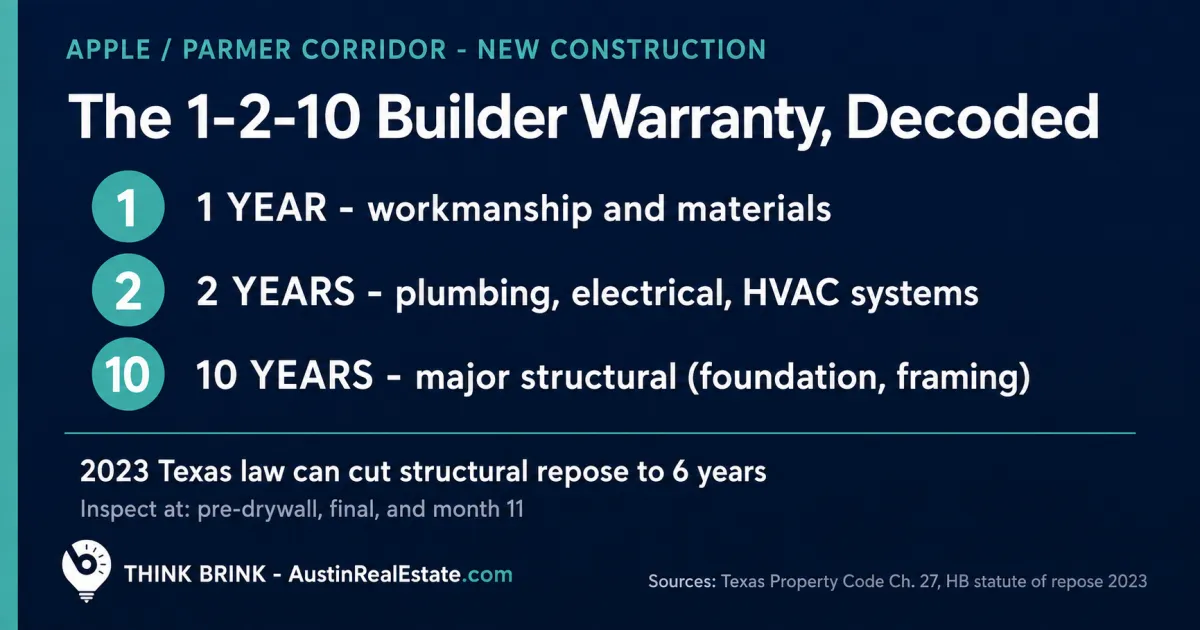
Almost every new-construction home in Texas comes with what the industry calls a 1-2-10 warranty. The numbers refer to years of coverage on three different categories, and understanding the split is the single most useful thing a new-construction buyer can learn.
The 1 is one year of coverage on workmanship and materials. This is the broadest and shortest tier. It covers the cosmetic and functional things a builder is responsible for getting right: drywall cracks beyond normal settling, paint, trim, cabinetry, tile, grout, doors that do not close, flooring defects, and the dozens of small items that show up in the first months of living in a house. It is also the tier you are most likely to actually use, and the one with the tightest deadline.
The 2 is two years of coverage on the delivery systems: plumbing, electrical, and HVAC distribution. This is the ductwork, the wiring, the pipes in the walls, the mechanical guts of the house. If a supply line was run wrong or a duct was never properly connected, this is the tier that covers it, and two years is usually enough time for those problems to reveal themselves under real use, including a full Texas summer running the air conditioning hard.
The 10 is ten years on major structural components: the foundation, the load-bearing framing, the roof structure, the elements that hold the house up. This is the tier buyers fixate on because it sounds the most reassuring, and it is also the tier with the highest bar to make a claim. Structural warranties do not cover a hairline crack in your slab. They cover actual structural failure, defined narrowly, and proving it usually requires an engineer.
That framing matters in Central Texas specifically because of what our soil does. Northwest Austin and the corridor sit on expansive clay that swells when it rains and shrinks when it bakes. Foundations here move. Some cracking in a slab or in interior drywall is normal seasonal behavior, not a warrantable structural defect, and the gap between "this is cosmetic movement" and "this is a structural failure" is where most disputes live.
The law changed in 2023, and it changed in the builder's favor
Here is something most buyers in the corridor have no idea about, because it happened quietly and it works against them. In 2023, the Texas Legislature passed a bill that shortened the statute of repose for residential builders. The statute of repose is the outer time limit on when you can bring a construction defect claim at all, separate from the warranty itself.
For decades that limit was ten years. Under the 2023 change, effective in the summer of 2023, a builder can cut that window to six years if they provide a written warranty that meets a defined minimum: at least one year on workmanship and materials, two years on the plumbing, electrical, and HVAC delivery systems, and six years on major structural components. If a builder offers that qualifying warranty, your window to sue over a latent structural defect closes at six years instead of ten. If a builder offers no written warranty at all, the old ten-year repose period still applies.
The practical result is a quiet shift. A "10-year structural warranty" and a "6-year statute of repose" are not the same thing, and a builder handing you a 1-2-6 warranty is offering you less legal runway than a buyer got a few years ago, even though the house looks identical. This is not a reason to avoid new construction. It is a reason to read the actual warranty document you are being handed, confirm whether it is a 1-2-10 or a 1-2-6, and understand that the number in the warranty is now doing double duty as the number that governs your right to sue. Ask the builder directly which one applies to your home. If you are weighing new construction against an established home, this is one more line item in the tradeoff, and I walk through the broader version of that decision in my guide on new construction versus established homes in the Apple corridor.
Worth knowing for context: Texas used to have a state agency, the Texas Residential Construction Commission, that administered a statewide builder warranty and complaint program. That agency was dissolved in 2009. There is no state warranty backstop today. The warranty you get is the warranty the builder writes, sometimes backed by a third-party warranty company, and the terms are theirs to set within the law. That makes reading the document, rather than trusting the binder exists, the entire game.
Why you still inspect a house nobody has lived in
The most common thing I hear from new-construction buyers is some version of "it's brand new, what could an inspector possibly find?" The honest answer is: a lot, and the fact that it is new is exactly why.
A new house was built fast, by multiple subcontractor crews working in sequence, often on a volume builder's schedule where the framing crew, the plumber, the electrician, and the HVAC installer never met each other. Mistakes at any handoff get covered by drywall and never seen again unless someone looks before the walls close up or catches the symptoms after. An older home has had years for its problems to surface and, often, to be addressed. A new home's problems are all still hidden, and you are the first person who will ever stress-test the systems by actually living there.
Independent inspectors on new construction routinely find missing or disconnected HVAC ducts, bathroom exhaust fans venting into the attic instead of outside, improper flashing around windows and rooflines, plumbing that was never fully secured, electrical outlets wired backward, insufficient attic insulation compared to what the plans called for, grading that slopes water toward the foundation instead of away from it, and roof penetrations that were not properly sealed. None of these are exotic. They are the normal error rate of building a house quickly, and the municipal inspection that the builder passes is a code-minimum check, not a quality inspection done on your behalf.
The key distinction: the city inspector works for the city and confirms the house meets minimum code. Your independent inspector works for you and tells you what is actually wrong. Those are different jobs. Passing the first does not accomplish the second.
The three inspection windows on new construction
On a home being built for you from the ground up, there are three moments worth an independent inspection, and most buyers use zero of them.
The pre-drywall inspection happens after framing, plumbing rough-in, electrical rough-in, and HVAC rough-in are done but before insulation and drywall go up. This is the only time anyone can see inside the walls. An inspector at this stage can catch framing problems, missing straps and connectors, plumbing and wiring errors, and duct issues while they are still cheap and easy to fix. If you are buying a to-be-built home, this is the highest-value inspection you can get, and it is the one builders least expect buyers to ask for.
The final inspection happens before closing, on the completed house, and functions like any resale inspection: a full walk of the systems, the roof, the exterior, the mechanicals, everything now that it is finished. This is where your punch list comes from.
The eleven-month inspection happens near the end of that first warranty year, before the one-year workmanship coverage expires. You get an inspector back through the house to document everything that has shown up during a full year of living in it, then you submit that list to the builder while the broadest tier of coverage is still active. Buyers who skip this one routinely discover, in year two or three, a list of things the builder would have fixed for free in month eleven. On a spec home you are buying finished, the final and the eleven-month inspections are the two that matter most.
What "the Apple corridor" actually means for new construction
When buyers say they want to be near Apple, they mean the Parmer Lane campus in far Northwest Austin, near the MoPac and Parmer intersection. The new-construction inventory that genuinely serves that commute is not in the established 78750 and 78759 neighborhoods, which are largely built out. It is farther north and west, in the newer master-planned areas and infill developments that still have builder activity: the Avery Ranch area, the Parmer and 45 developments, the Wells Branch and Pflugerville edges, and pockets pushing toward Cedar Park and Leander.
That geography carries a tradeoff I am blunt with buyers about. The newest homes with the most builder inventory are generally the farthest from the campus. A brand-new house is often a longer commute than an established resale in Milwood or Scofield Farms that sits closer in. If proximity to the Parmer campus is your priority, do not assume new construction and short commute come in the same package. I break down that commute-versus-price math in more detail in my post on what Apple corridor buyers should know about commute versus price tradeoffs, and there is a version aimed specifically at campus employees in what Apple employees should know before buying near the Parmer campus.
The other corridor-specific factor is the soil, which I mentioned above and will not belabor: the expansive clay under most of this area makes foundation performance the thing to watch on any home here, new or old. On new construction it means the pre-drywall and final inspections should pay specific attention to the foundation prep, drainage, and grading, because a foundation that was poured on poorly prepared soil or a lot that drains toward the house is a problem that will take years to fully express itself and lands right in the hardest tier of the warranty to claim against.
What to verify before you sign at closing
Here is the practical checklist I give buyers going into a new-construction closing in the corridor. None of it is exotic. All of it is the sort of thing that is easy to confirm before you sign and painful to chase after.
Get the actual warranty document, not a summary
Ask for the full written warranty before closing, not the marketing one-pager. Confirm whether it is a 1-2-10 or a 1-2-6. Find out whether it is administered by the builder directly or backed by a third-party warranty company, because that determines who you actually call when something breaks and whether the coverage survives if the builder goes out of business. Read the exclusions section specifically, because that is where the real scope of the warranty lives.
Understand the claim process and its deadlines
Warranties have procedures. Many require written notice within a set window, some require you to use the builder's chosen contractor for repairs, and many contain a mandatory arbitration clause that limits your ability to take a dispute to court. The Texas process for construction defect claims runs through a statute that requires you to give the builder written notice and an opportunity to inspect and offer to repair before you can sue. Know the steps before you need them, and again, on anything involving an actual dispute, this is where a Texas real estate attorney earns their fee.
Confirm the eleven-month clock and calendar it
The single most valuable free thing a new-construction buyer can do is calendar the end of the first warranty year and schedule an inspection and a builder punch list for month ten or eleven. Missing that window is the most common and most expensive new-construction mistake I see, because everything cosmetic and functional that the builder would have covered becomes your problem the day the year runs out.
Verify what conveys and what was actually finished
On a spec home, confirm that everything promised in the contract and the model is actually installed in your specific house: the appliance package, the finish level, the landscaping and sod, the fencing, the garage door opener, any options you paid for. Builders move fast and homes get closed with items outstanding. Get outstanding items in writing with a completion date, not a verbal "we'll take care of it."
Check the survey, the plat, and the drainage
Confirm the survey matches the lot you think you are buying, that there are no encroachments, and that the drainage and grading move water away from the foundation. On corridor lots specifically, walk the property after or during rain if you can, and look at where water goes. Grading is cheap to fix before closing and a nightmare to fix after.
Read the HOA documents and understand the assessments
Most new-construction developments in the corridor are governed by an HOA, and the newest ones sometimes carry additional assessments through a municipal utility district or public improvement district that funds the infrastructure. These add to your monthly cost and are entirely separate from the price of the house. Read the governing documents, confirm the dues and any special district assessments, and factor them into your real monthly number. I cover the broader version of this in my guide to HOA and country club communities in Northwest Austin.
The negotiation reality on new construction
One thing buyers coming from resale markets get wrong: new-construction pricing and terms are negotiated differently. Builders are reluctant to cut the base price because a lower recorded sale price affects the comparable values they use to sell the rest of the development. What they will negotiate is incentives: closing cost contributions, rate buydowns through their affiliated lender, upgrades, and options. If you are working a builder, the leverage is usually in incentives and upgrades, not headline price, and the end of a builder's quarter or their push to close out a phase is when that leverage is highest.
The other reality is representation. When you walk into a builder's model home alone, the friendly person at the desk works for the builder. Having your own agent, brought in from the first visit, costs you nothing on a new-construction purchase in almost every case and gives you someone whose job is to read the contract, push on the inspection contingencies, and make sure the incentives are real. Builders' contracts are written by the builder's lawyers to favor the builder. That is not a scandal, it is just whose paper it is, and it is the reason to have your own person reading it.
Frequently asked questions
Do I really need a home inspection on a brand-new house in Texas?
Yes. New homes are built quickly by multiple subcontractor crews, and independent inspectors routinely find real defects on brand-new construction: disconnected ducts, improper flashing, drainage that runs toward the foundation, wiring errors, and insufficient insulation. The municipal inspection the builder passes is a code-minimum check done for the city, not a quality inspection done for you. The two most valuable inspections are the final inspection before closing and an eleven-month inspection just before the first-year warranty expires.
What does a 1-2-10 builder warranty cover?
It is three tiers of coverage. One year on workmanship and materials, which is the broad cosmetic and functional tier you are most likely to use. Two years on the plumbing, electrical, and HVAC delivery systems. Ten years on major structural components like the foundation and load-bearing framing. The structural tier has the highest bar to claim against and generally requires proving an actual structural failure, not normal settling or cosmetic cracking.
Is a Texas builder warranty really only six years now?
It can be. A 2023 Texas law lets a builder shorten the statute of repose, the outer deadline to bring a defect claim, from ten years to six if they provide a written warranty meeting a defined minimum, including six years on structural components. So a home may come with a 1-2-6 warranty rather than a 1-2-10, which gives you less legal runway on a latent structural defect. Ask the builder which warranty applies to your specific home and read the document. For how a clause applies to your situation, consult a Texas real estate attorney.
What is the difference between a builder warranty and the statute of repose?
The warranty is the builder's contractual promise to repair defined defects for a set period. The statute of repose is a separate legal deadline that caps how long after construction you can bring any defect claim at all, regardless of the warranty. Since 2023 the two are linked: offering a qualifying written warranty lets a builder pull the repose deadline in from ten years to six. They are related but not identical, and the distinction matters if a serious defect surfaces years later.
When is the best time to inspect a home being built for me?
If the home is being built from the ground up for you, the highest-value inspection is the pre-drywall inspection, done after framing and the plumbing, electrical, and HVAC rough-ins but before insulation and drywall close up the walls. It is the only time anyone can see inside the walls and catch framing, wiring, and duct problems while they are cheap to fix. Follow it with a final inspection before closing and an eleven-month inspection before the first-year warranty expires.
Is new construction near the Apple Parmer campus a shorter commute than a resale?
Usually not. The established neighborhoods closest to the Parmer campus are largely built out, so the newest homes with the most builder inventory tend to be farther north and west, toward Avery Ranch, Pflugerville, Cedar Park, and Leander. That often means a brand-new home is a longer daily drive to the campus than an established resale in Milwood or Scofield Farms sitting closer in. If commute is your priority, do not assume new construction and short commute come together.
Can I use my own agent when buying new construction, or do I have to use the builder's?
You can and should use your own agent, and in almost every case it costs you nothing on a new-construction purchase. The person at the builder's model home works for the builder. Your own agent reads the builder's contract, which is written to favor the builder, pushes on inspection contingencies, and makes sure any incentives and upgrades are real. The key is to bring your agent in from your very first visit, because some builders will not honor buyer representation if you registered on your own first.
What monthly costs do new-construction buyers in the corridor underestimate?
The two big ones are HOA dues and special district assessments. Many newer corridor developments sit inside a municipal utility district or public improvement district that adds an assessment on top of your property taxes to fund the neighborhood's infrastructure. Combined with HOA dues, that can add a meaningful amount to your real monthly cost, entirely separate from the mortgage. Read the governing documents and confirm every recurring charge before you sign.
The honest summary
New construction in the Apple corridor is a legitimately good option for a lot of buyers, especially relocating tech professionals who want a home that needs nothing on day one. But "brand new" is not the same as "problem-free," and the warranty in the binder is a legal document with specific limits that got tighter in 2023, not a guarantee that nothing will go wrong. The buyers who do well are the ones who read the actual warranty, get their own independent inspections at the moments that matter, calendar the eleven-month deadline, verify what was actually finished, and bring their own representation to a contract written by the builder's lawyers.
Do those things and new construction is a strong buy. Skip them because the house looks perfect and the builder seems trustworthy, and you are betting that a house built fast by crews who never met each other happens to be the one with no hidden mistakes. If you are weighing new construction in the corridor and want a second set of eyes on the warranty, the incentives, or the inspection strategy, that is exactly the kind of thing I help Northwest Austin buyers think through before they sign.
