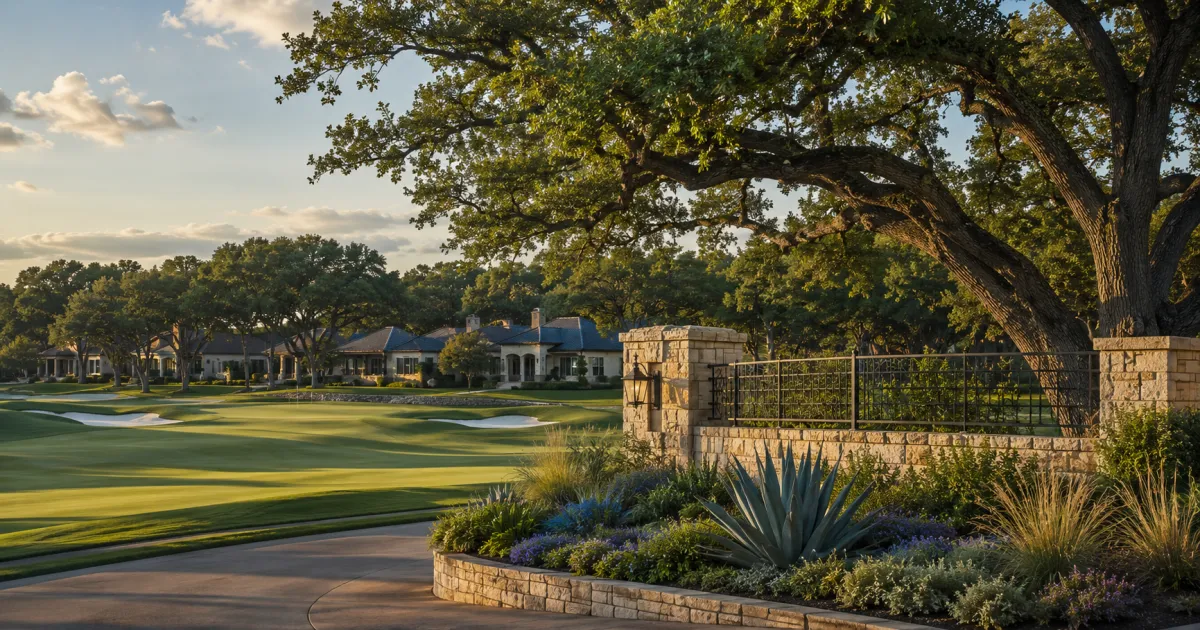
What Buyers Should Know About HOA and Country Club Communities in Northwest Austin
Northwest Austin is full of neighborhoods with a homeowners association, and a handful built around a country club and a golf course. For buyers coming from parts of the country where an HOA is either universal or unheard of, the local picture can be confusing. Some Northwest Austin neighborhoods have a mandatory HOA with real dues and real authority. Some have a voluntary association you can decline. Some sit next to a private country club whose membership has nothing to do with owning the house. And a few have almost no formal structure at all, just deed restrictions from decades ago.
Getting this right matters, because the HOA and club structure affects your monthly cost, what you are allowed to do with your own property, and in some cases whether you can even use the amenity you are paying to live near. I am James Brinkman, a broker who works these neighborhoods, and here is what I walk buyers through before they write an offer in an HOA or country club community.
The three structures you will actually encounter
Before you tour anything, understand that "HOA community" and "country club community" describe several different arrangements in Northwest Austin. They are not interchangeable.
Mandatory HOA
In a mandatory HOA, membership and dues are attached to the deed. You do not get to opt out. You pay the assessment on the schedule the association sets, and in exchange the HOA maintains common areas, may run amenities like a pool and tennis or pickleball courts, enforces the deed restrictions, and manages the neighborhood's shared interests. Many of the established Northwest Austin neighborhoods with community pools and greenbelts run on a mandatory HOA, though the dues levels vary widely from one neighborhood to the next.
The important thing about a mandatory HOA is authority. It can place a lien for unpaid dues, it can enforce architectural rules on paint colors, fences, roofs, and additions, and it can levy a special assessment if a major shared expense comes up. That authority is not automatically good or bad, it depends on whether the association is run well. It does mean the HOA is a party you are entering a long-term financial and legal relationship with, so you read its documents like you would read any contract.
Voluntary HOA
Some older Northwest Austin neighborhoods have a voluntary homeowners association. You can choose to join and pay dues, or decline. The tradeoff is obvious: a voluntary association usually has weaker enforcement power and a smaller, less predictable budget, because it can only spend what members choose to contribute. If amenity upkeep and consistent standards matter to you, a voluntary structure is a weaker guarantee than a mandatory one. If you value maximum freedom over your own property and minimal fixed cost, it can be a feature rather than a flaw. Just know which one you are buying into.
Country club community
This is the structure buyers most often misread. In a Northwest Austin country club community, the neighborhood is built around a private golf and social club, but living in the neighborhood and belonging to the club are usually two separate things. Owning a home there does not automatically make you a member, and it does not automatically give you access to the golf course, the clubhouse, or the pool. Club membership is generally a separate application, a separate initiation cost, and separate monthly dues, on top of whatever HOA the neighborhood carries.
That separation cuts both ways. It means you can buy a home on a golf course and enjoy the views and the setting without ever paying for a membership. It also means that if your reason for buying there is to play the course out your back door, you need to confirm that memberships are available, what they cost, and whether there is a waitlist, before you assume the house comes with the lifestyle. Never assume the club is included. Ask.
What HOA dues actually pay for, and what they do not
Buyers often ask whether HOA dues are "worth it" as if the dues were a fee for nothing. In a well-run association they fund specific, checkable things: common-area landscaping and irrigation, pool and amenity maintenance and staffing, shared insurance on common property, reserve savings for big future repairs, and the administrative cost of running the association. In a golf course or greenbelt community they may also cover maintenance of the shared open space that gives the neighborhood its character.
What HOA dues typically do not cover is anything inside your own lot line or your own walls. Your roof, your yard, your systems, and your insurance are still yours. Buyers sometimes assume an HOA is like a condo association that maintains the building. In a single-family HOA, it is not. You still own and maintain your entire house and lot.
The number that actually tells you whether an HOA is healthy is not the dues amount, it is the reserve fund. An association with adequate reserves can absorb a new pool pump, a roof on the amenity center, or a fence replacement without hitting every owner with a special assessment. An association with thin reserves and deferred maintenance is one bad year away from a surprise bill landing in your mailbox. Ask for the reserve study and the most recent budget. This is one of the most valuable and least requested documents in the entire purchase.
Deed restrictions: the rules you agree to by buying
Whether the HOA is mandatory, voluntary, or barely present, most established Northwest Austin neighborhoods carry deed restrictions. These are recorded rules that run with the land, covering things like allowed fence heights and materials, whether you can park a boat or RV in the driveway, short-term rental limits, home business restrictions, exterior modifications, and architectural review for additions and remodels.
Deed restrictions are not a formality. If you are planning to add a casita, put in a tall privacy fence, run a short-term rental, or repaint the exterior a bold color, the restrictions may govern all of it. In an active HOA, an architectural review committee has to approve exterior changes before you make them. Buyers with renovation or rental plans should read the restrictions specifically against those plans before they close, not after. What looks like a great candidate for a backyard workshop or a rental can be a neighborhood where none of that is allowed.
This is also where a country club or golf course setting can carry extra rules. Homes backing a course may have restrictions protecting sight lines, limiting fence heights, or governing the landscaping edge along the fairway, precisely because the course is a shared asset. Those rules are usually reasonable, but you want to know them if the golf-course lot is why you are buying.
Golf course and greenbelt lots: what the premium buys, and the catch
A lot backing a golf course or a protected greenbelt commands a premium, and in Northwest Austin that premium is often justified: you get a view, no rear neighbor, mature landscaping, and a setting that is genuinely hard to replicate. We break down that math in detail in Northwest Austin greenbelt and golf course lots and what the premium actually buys you.
The catch that buyers underweight on a golf course lot is that you do not control the land behind you, the club does. That is usually a good thing, because it stays open and maintained. But it also means golf balls, early-morning course maintenance, cart traffic, and occasionally chemical spraying are part of life on the fairway. None of that is a reason to avoid a golf course lot. It is a reason to spend time on the specific lot at different hours before you decide the view is worth the premium for you specifically.
And it circles back to membership: living on the course does not give you the right to play it. If playing the course is the dream, confirm the membership path separately from buying the house.
How the club's health affects your home
Here is a subtle point that matters in country club communities. The financial and operational health of the private club can affect the desirability, and therefore the value, of the homes around it. A thriving, well-maintained club with a strong membership makes the surrounding neighborhood more attractive. A club that is struggling, deferring maintenance on the course, or changing ownership can put a drag on the neighborhood's appeal even for homeowners who never intended to join.
You are not buying the club when you buy the house, but you are buying proximity to it, and proximity to a well-run club is worth more than proximity to a neglected one. It is fair to ask your agent what they know about the club's current standing and recent history before you commit to a golf course community specifically for that setting.
The documents to read before you offer
In an HOA community, the purchase should never happen blind. Texas gives buyers the right to obtain the association's resale certificate and governing documents, and you should actually read them. Prioritize these:
- The dues amount and payment schedule. Confirm the exact figure and how often it is billed. Do not rely on what a listing says, get it from the association.
- The reserve study and current budget. This tells you whether a special assessment is likely. It is the single most predictive document in the packet.
- Any pending or recent special assessments. A large repair that is coming but not yet billed can land on you as the new owner.
- The deed restrictions and architectural rules. Read these against your specific plans for the property.
- Rental and short-term-rental policy. If you ever intend to rent the home, confirm it is allowed and under what terms.
- Litigation history. An association in active litigation can signal governance problems and can complicate financing.
For a country club community, add the club's membership terms, current initiation cost, monthly dues, and waitlist status as separate items, because they are separate from the HOA. Legal and financial questions about association documents and assessments are worth running past your own attorney or CPA rather than relying on a summary.
Where these communities sit in Northwest Austin
Northwest Austin's HOA and country club neighborhoods run across the 78750, 78759, and 78726 zip codes, from established golf and social club communities to newer master-planned neighborhoods with amenity centers, to older neighborhoods with pools and greenbelts run by a homeowners association. Some of the best-known established neighborhoods, including parts of Great Hills and Canyon Creek, carry an HOA with real amenities, while others in the same zip codes have far lighter structure. Because it varies neighborhood by neighborhood and sometimes section by section, do not generalize from one community to the next.
If you are still mapping the area, the pillar guide to living in 78750 and 78759 lays out the core neighborhoods, and the Canyon Creek buyer guide is a good example of how an amenity-rich HOA neighborhood actually functions for the people who live there.
A fit check for HOA and country club buyers
An HOA community fits you if: you want consistent neighborhood standards, shared amenities like a pool and courts maintained by someone other than you, and protection against a neighbor doing something that tanks your value, and you are comfortable with an association having architectural authority over your exterior and the discipline of dues and rules.
A lighter-structure or voluntary neighborhood fits you if: you prioritize freedom over your own property, want the lowest fixed monthly cost, and are willing to trade guaranteed amenity upkeep and enforced standards for flexibility.
A country club community fits you if: you want the setting, the mature landscaping, and often the golf course or greenbelt views, and you understand that the club membership and its costs are a separate decision from the house. If you specifically want to play the course, verify the membership path before you fall for the lot.
The buyers who are unhappy after closing are almost always the ones who did not read the documents, assumed the club was included, or did not check the reserve fund and got a special assessment. None of that is hard to avoid. It just takes reading the packet before you sign, not after.
Frequently Asked Questions
Does buying a home in a country club community mean I get a membership?
Usually not. In most Northwest Austin country club communities, owning a home and belonging to the club are two separate things. Club membership typically requires a separate application, an initiation cost, and its own monthly dues, on top of any neighborhood HOA. You can often live on the golf course without a membership, and you cannot assume the house comes with course access. If playing the course is your goal, confirm the membership path, cost, and any waitlist before you buy.
What is the difference between a mandatory and voluntary HOA?
A mandatory HOA attaches membership and dues to the deed, so you cannot opt out, and it has real authority to enforce rules, collect dues, and levy special assessments. A voluntary HOA lets you choose whether to join and pay, but usually has weaker enforcement and a smaller, less predictable budget. Mandatory associations give you more consistent standards and amenity upkeep; voluntary ones give you more freedom and lower fixed cost. Confirm which structure a neighborhood has before you offer.
What do HOA dues in Northwest Austin actually pay for?
In a single-family HOA, dues fund common-area landscaping, pool and amenity maintenance, shared insurance on common property, reserve savings for future repairs, and the cost of running the association. They do not cover anything inside your own lot or walls, so your roof, yard, systems, and home insurance are still yours. Dues vary widely by neighborhood, so get the exact figure from the association rather than the listing.
How do I know if an HOA is financially healthy?
Look at the reserve fund, not just the dues. An association with adequate reserves can pay for big repairs without hitting owners with a special assessment, while one with thin reserves and deferred maintenance is a surprise bill waiting to happen. Ask for the reserve study, the current budget, and any pending or recent special assessments. This is the most predictive document in the packet and one of the least requested.
Can an HOA stop me from renovating or renting my home?
It can regulate a lot of it. Deed restrictions and architectural rules commonly govern fences, additions, exterior colors, home businesses, and short-term rentals, and an active HOA often requires architectural review before you make exterior changes. If you plan to add a casita, build a tall fence, or run a rental, read the restrictions against those specific plans before you close. What looks like a great candidate for a project can be a neighborhood where the project is not allowed.
Are golf course lots worth the premium in Northwest Austin?
Often, because you get a view, no rear neighbor, mature landscaping, and a setting that is hard to replicate. The catch is that you do not control the land behind you, so golf balls, early course maintenance, cart traffic, and occasional spraying come with it, and living on the course does not give you the right to play it. Spend time on the specific lot at different hours, confirm any lot-specific restrictions, and separate the membership decision from the home decision.
Does the country club's health affect my home value?
Yes, indirectly. A thriving, well-maintained club makes the surrounding neighborhood more desirable, while a struggling club that defers course maintenance or changes ownership can drag on the neighborhood's appeal even for owners who never join. You are not buying the club, but you are buying proximity to it, so it is fair to ask what your agent knows about the club's current standing before committing to a golf course community for its setting.
What documents should I request before buying in an HOA?
Request the resale certificate and governing documents, then actually read them. Prioritize the exact dues and schedule, the reserve study and current budget, any pending or recent special assessments, the deed restrictions and architectural rules, the rental policy, and any litigation history. For a country club community, add the club's separate membership terms, costs, and waitlist. Run legal and financial questions past your own attorney or CPA.
The bottom line
HOA and country club communities in Northwest Austin can be excellent places to own, with maintained amenities, protected standards, and settings you cannot get anywhere else. The buyers who do well are the ones who treat the association and the club as what they are: long-term financial and legal relationships that deserve the same scrutiny as the house itself. Read the documents, check the reserves, separate the club membership from the home purchase, and confirm the rules against your own plans. Do that, and the structure works for you instead of surprising you. If you want help reading a specific association's packet before you offer, that is a normal part of how I represent buyers in these neighborhoods.
