North Austin Neighborhood Guide: Where to Live Near Apple, The Domain, and the Parmer Corridor
If you're searching for a home in North Austin and trying to figure out which neighborhood actually makes sense for your situation, you've probably noticed that the information available online ranges from generic to useless. Most guides either cover the whole Austin metro at a surface level or focus on a single neighborhood without giving you the context to compare. Neither helps you make a real decision.
This guide covers the established single-family neighborhoods in the North Austin belt - the ones that come up most often for buyers who work near Apple, the Domain, the Parmer corridor, or from home - and gives you honest comparisons across the things that actually matter: commute, price, neighborhood character, schools, and who tends to land well in each one.
This is not a ranking. It's a framework for thinking about a geography that most buyers approach without nearly enough information.
What North Austin Growth Means for Homeowners Near The Domain, Apple, and Parmer
How North Austin's Geography Actually Works
The first thing to understand is that "North Austin" covers a lot of ground, and the mental map most buyers carry when they start searching is usually too compressed to be useful.
Austin's tech footprint doesn't work like San Francisco or Seattle, where most jobs cluster in a few square miles. Apple sits on Parmer Lane in far North Austin. Dell is in Round Rock. Amazon and IBM are at the Domain. Pick the wrong neighborhood and you're staring at a 45-minute commute you didn't plan for.
The practical geography for the neighborhoods covered in this guide breaks into two zones separated by MoPac (Loop 1):
West of MoPac is what most people mean when they say "Northwest Austin" - neighborhoods like Milwood, Great Hills, Balcones Woods, Anderson Mill, and the areas along 360 and Spicewood Springs. These neighborhoods sit closer to Apple's Parmer Lane campus and the western Parmer corridor employers. They generally carry a price premium for that positioning.
East of MoPac along the 183/I-35 corridor are neighborhoods like Scofield Farms, Wells Branch, and the areas that connect toward the Domain from the east and north. These neighborhoods have different commute profiles, different school situations, and meaningfully different price points for comparable square footage.
Understanding which side of MoPac your employer sits on - and how that maps to your daily drive - is the single most important piece of homework you can do before you start touring homes.
The Major Employers and Where They Actually Are
Getting this right matters more than almost any other factor in your neighborhood decision.
Apple Campus: Apple's campus sprawls along Parmer Lane between US-183 and TX-45, roughly 20 miles north of downtown. It's the largest single private employer in Austin and the anchor of the North Austin tech corridor. Neighborhoods west of MoPac have the most direct access. From the established neighborhoods in Milwood and the 78759 corridor, Apple is typically 10 to 15 minutes in normal conditions. From Scofield Farms or Wells Branch east of MoPac, budget 20 to 30 minutes.
Parmer corridor (Samsung, IBM, NXP, Emerson/NI, and others): The Parmer Lane tech corridor includes Samsung, Dell, GM, Apple, and 3M among its major employers, spread across several miles between MoPac on the west and I-35 on the east. Where your employer sits on that corridor matters as much as the corridor itself. Western Parmer employers favor MoPac-adjacent neighborhoods. Eastern Parmer employers are nearly equidistant from both sides.The Domain (Amazon, Indeed, and Domain-area tech tenants): The Domain sits roughly at MoPac and Braker Lane. From most of the established North Austin neighborhoods covered in this guide, the Domain is a 10 to 20 minute drive depending on your starting point and time of day. It's accessible from both sides of MoPac without a dominant routing advantage.
Dell (Round Rock campus): Dell's headquarters is in Round Rock proper, north of the metro. Neighborhoods that sit closer to I-35 - particularly Wells Branch - have a commute advantage here. Neighborhoods west of MoPac add meaningful drive time to get to Round Rock.
Downtown Austin: All of the North Austin neighborhoods in this guide are roughly 25 to 45 minutes from downtown in peak traffic, depending on specific location and routing. MoPac with express lanes and I-35 are the primary options. None of these neighborhoods are a downtown commute play - if daily downtown commuting is your primary requirement, you're in the wrong part of the metro.
The Neighborhoods: What Each One Is and Who It Fits
Milwood (78727)
Milwood sits west of MoPac in the 78727 zip code, generally bounded by Parmer to the north, Spicewood Springs to the south, MoPac to the west, and the 183/McNeil corridor to the east. It was built primarily from the late 1970s through the early 1990s.
What makes it distinctive: Milwood has more lot variation and tree character than most comparable neighborhoods in this price range. Several sections have genuinely large lots with established native trees and curvilinear street layouts that give the neighborhood a tucked-away feel despite its central location. One-story inventory is more available here than in many comparable North Austin neighborhoods, which makes Milwood a consistent destination for buyers specifically seeking single-level living.
Commute profile: Strong for Apple and western Parmer corridor employers - typically 10 to 15 minutes. Reasonable for the Domain. Longer for Dell in Round Rock.
Schools: Primarily Austin ISD, feeding Summitt Elementary, Murchison Middle, and Anderson High School. This surprises buyers who assume the North Austin location means Round Rock ISD. Verify by specific address.
Price range: Well-updated homes have generally been trading in the mid-$400s to low $600s depending on size and lot quality. Original-condition homes price lower and tend to sit if priced too optimistically.
Fits well for: Apple employees, western Parmer corridor workers, WFH buyers who want neighborhood character, buyers specifically seeking one-story homes under mature trees, families who want AISD and the Anderson High feeder.
Harder fit for: Buyers who need RRISD, buyers who want new construction, Dell commuters.
What Buyers Should Know About Milwood Before Making an Offer
Scofield Farms (78727 / 78758)
Scofield Farms sits north of the Domain, east of MoPac, and west of Metric Boulevard. It was built primarily from the mid-1980s through the mid-1990s and has multiple internal sections with different street layouts and surrounding contexts.
What makes it distinctive: Scofield Farms offers the closest thing to Domain-adjacent living in the established single-family category without paying Domain-adjacent prices. The commercial energy along Metric and the Parmer/MoPac corridor is within easy reach, and buyers who want shorter access to restaurants, retail, and the Domain lifestyle tend to find Scofield more convenient than neighborhoods further west or north.
Commute profile: Good for Apple and the central Parmer corridor. Particularly strong for employers on the eastern end of Parmer toward I-35. Domain access is 5 to 15 minutes depending on traffic.
Schools: Primarily Round Rock ISD, which is one of Scofield's consistent draws for buyers coming from out of state who are researching Texas school districts. Verify by specific address - some edge sections are zoned differently.
Price range: Comparable to Milwood - updated homes in the mid-$400s to low $600s range. Sections that back to commercial corridors or busy arterials typically discount relative to interior locations.
Fits well for: Buyers who want proximity to the Domain without Domain prices, tech employees on the eastern Parmer corridor, buyers who prioritize retail and restaurant access, RRISD-seeking families.
Harder fit for: Buyers who want a quieter residential feel removed from commercial energy, buyers specifically seeking large lots.
What Nobody Tells You About Buying in Scofield Farms
Wells Branch (78728)
Wells Branch is east of MoPac, sitting between I-35 and MoPac with Wells Branch Parkway as its main corridor. It functions more like a self-contained community than most Austin neighborhoods - it has its own Municipal Utility District, its own parks system, its own library, and its own recreation infrastructure. It's often overlooked by buyers anchored to the west-of-MoPac mental map, which means it's also often underpriced relative to what it offers.
What makes it distinctive: The community infrastructure here is genuinely unusual for a neighborhood in this price range. Over 6 miles of hike and bike trails connecting parks, a pond, recreation center, two pools, disc golf, and a fitness center - all maintained by the MUD. Add MetroRail access at the nearby Howard Station, dual highway access via both MoPac and I-35, and the result is a neighborhood with more day-to-day functionality than its price point suggests.
Commute profile: Best in this cluster for Dell in Round Rock and for employers on the eastern Parmer corridor. Apple is a longer drive - 20 to 30 minutes in morning traffic. Downtown via MetroRail is a genuine option for occasional commuters.
Schools: Primarily Round Rock ISD, with some southeast sections zoned to Pflugerville ISD. Within RRISD, Wells Branch feeds into McNeil High School, which carries an International Baccalaureate program - a legitimate draw for some families. Elementary assignments vary by section between Wells Branch Elementary Arts Integration Academy and Joe Lee Johnson Elementary, which have meaningfully different profiles. Always verify by specific address.
Price range: Generally the most accessible price point among the established North Austin single-family neighborhoods in this guide. Updated homes have been trading in the low-to-mid $400s, with original-condition homes lower. The discount relative to comparable west-of-MoPac inventory is real and consistent.
Fits well for: Dell commuters, downtown commuters (especially those willing to use MetroRail), eastern Parmer corridor workers, value-focused buyers who want established trees and real community infrastructure, families interested in McNeil's IB program.
Harder fit for: Apple Campus employees who want a short commute, buyers anchored to the Northwest Austin identity, buyers who are sensitive to apartment adjacency near Wells Branch Parkway.
What Buyers Should Know About Wells Branch Before Making an Offer
The Domain-Adjacent Options (North Burnet / Gateway area)
For buyers who specifically want to be close to the Domain's lifestyle retail, restaurant scene, and walkability - and who are willing to trade lot size and neighborhood character for that access - the North Burnet and Gateway corridor offers condos, townhomes, and a smaller selection of detached homes at prices that reflect the location.
This is a different type of purchase than the established single-family neighborhoods above. You're buying access and walkability rather than lot, trees, and neighborhood depth. The tradeoffs are real in both directions - buyers who want to walk to dinner and don't need a yard can find genuine value here. Buyers who want a yard, mature trees, and a residential feel tend to find the Domain-adjacent options undersatisfying once they're actually living there.
Fits well for: Single professionals or couples without kids, buyers who prioritize walkability and Domain access above all else, buyers who specifically don't want yard maintenance.
Harder fit for: Families who need space, buyers who want established neighborhood character, anyone who assumed "near the Domain" meant "quiet residential."
Living Near The Domain in Austin - What to Expect
How to Use This Guide: The Decision Framework
Rather than trying to identify the "best" neighborhood in the abstract, work through these questions in order:
Where do you actually work, and what time do you need to be there?
This is the question that eliminates options faster than anything else. If you work at Apple and need to be there by 8am five days a week, Milwood and the 78759 corridor are your primary targets. If you work at Dell in Round Rock, Wells Branch or Scofield Farms make more sense on commute math. If you work from home, the commute question drops in priority and neighborhood character, price, and school assignment take over.
What school situation do you need?
AISD vs RRISD vs Pflugerville ISD matters and the answer is not consistent across these neighborhoods - and in some cases not even consistent within a single neighborhood. Know what you need before you tour, and verify every address you're serious about directly with the relevant district.
What kind of home and lot are you actually trying to buy?
One-story vs two-story, lot size, tree coverage, and square footage vary significantly across these neighborhoods and even within sections of the same neighborhood. Know your non-negotiables before you start touring so you're not falling in love with a house that doesn't match your actual requirements.
What does your daily life actually look like?
Buyers who cook at home and use parks daily are going to experience Wells Branch very differently than buyers who eat out four nights a week and want to walk to dinner. Neither preference is wrong - but they point toward different neighborhoods.
What's your realistic price range, and what does the budget buy in each neighborhood?
The price gaps between these neighborhoods for comparable square footage are real and meaningful. If your budget is $450,000, what you get in Wells Branch is different from what you get in Milwood, which is different from what you get in Scofield Farms. Know the market in each neighborhood before you anchor on a neighborhood name.
What’s Changing Around North Burnet and The Domain in Austin?
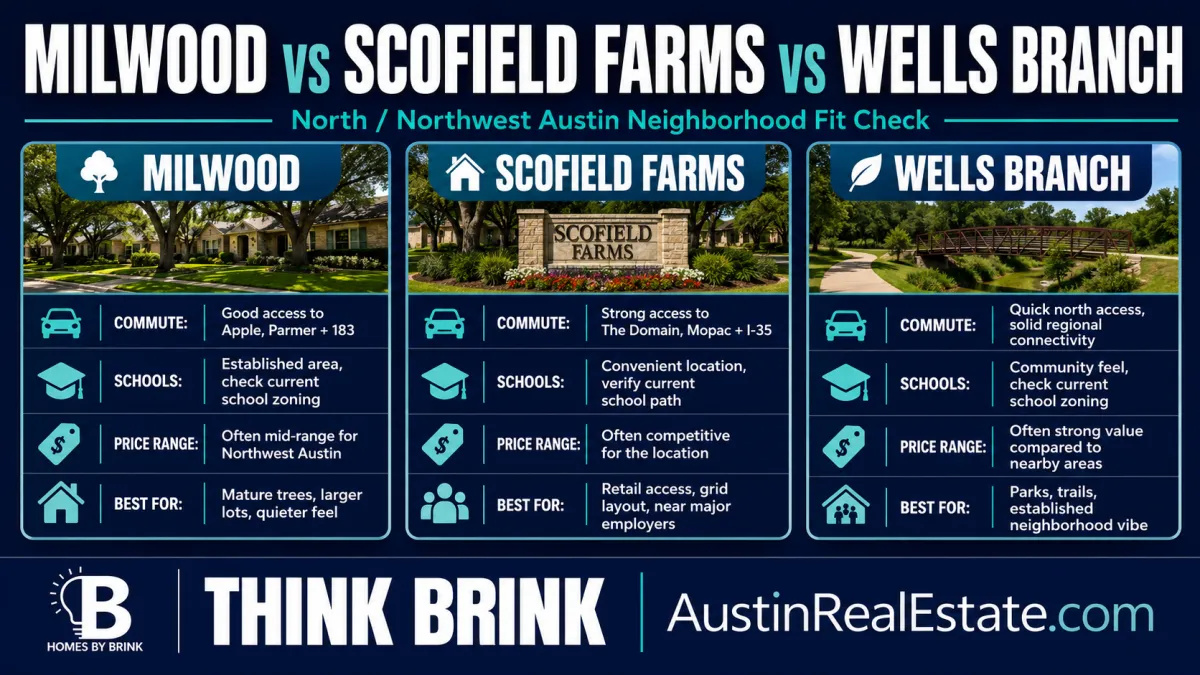
The Honest Cross-Neighborhood Comparison
Here's how the neighborhoods in this guide stack up across the factors that matter most for North Austin buyers:
Closest to Apple / western Parmer: Milwood, then Scofield Farms (longer)
Best value per square foot: Wells Branch, then Scofield Farms, then Milwood
Best lot size and tree character: Milwood (certain sections), then Wells Branch (certain sections)
Best for one-story homes: Milwood has the strongest inventory in the established category
Best for RRISD: Scofield Farms and Wells Branch (most sections); Milwood is primarily AISD
Best community infrastructure: Wells Branch, by a meaningful margin
Best Domain proximity and access: Scofield Farms, then Wells Branch
Best for Dell commuters: Wells Branch
Best for MetroRail access: Wells Branch
Most residential / tucked-away feel: Milwood interior sections
Most convenient to retail and dining without driving far: Scofield Farms
What to Know About the North Austin Market Right Now
The broader Austin market has softened meaningfully from its 2021-2022 peak, and the established North Austin neighborhoods covered in this guide reflect that. Buyers have more negotiating room than they did three years ago, days on market have extended, and the days of waiving inspections and competing against twelve offers are largely behind us - at least for now.
What hasn't changed is the underlying value case for this part of the metro. The employer base along the Parmer corridor and at the Domain isn't going anywhere. The school districts that draw buyers to Scofield Farms and Wells Branch haven't declined. The tree coverage and lot character in Milwood aren't getting replaced. These neighborhoods offer something that newer far-north suburbs in Leander and Georgetown can't replicate: established infrastructure, mature landscaping, and proximity to major employers - without the 45-minute commute that comes with buying further out.
For sellers in these neighborhoods, the current market rewards preparation and realistic pricing over optimism. Homes that are clean, well-presented, and priced in line with actual recent comps are still moving. Homes that are priced based on 2022 peak values or that need significant work without a corresponding price adjustment are sitting.
Going Deeper: Neighborhood-Specific Guides
This overview is designed to give you the framework. For buyers who are getting serious about a specific neighborhood, the detailed guides go deeper on section-by-section differences, what to check before making an offer, school assignment nuances, flood plain considerations, and the specific buyer profile that tends to land well in each one:
Scofield Farms vs Milwood: Which North Austin Neighborhood Fits Better?
What Buyers Should Know About Milwood Before Making an Offer
What Buyers Should Know About Wells Branch Before Making an Offer
More neighborhood deep-dives in this cluster are in progress. If you want a straight conversation about which of these neighborhoods actually fits your situation - employer location, budget, school needs, and what you want in a home - that's exactly what I do.
Frequently Asked Questions
What is the best North Austin neighborhood for Apple employees?
Milwood and the established neighborhoods in the 78727 and 78759 corridor give Apple employees the shortest commute to the Parmer Lane campus - typically 10 to 15 minutes in normal conditions. Scofield Farms is a reasonable second option, particularly for employees whose offices are on the eastern end of the Parmer corridor. Cedar Park and the 183A toll corridor are also common choices for Apple employees with families who want newer construction or specific school districts.
What North Austin neighborhoods are in Round Rock ISD?
Scofield Farms is primarily RRISD. Most of Wells Branch is RRISD, with some southeast sections in Pflugerville ISD. Milwood is primarily Austin ISD, which surprises many buyers who assume the North Austin location means RRISD. Always verify school assignment by specific address with the relevant district - do not rely on listing descriptions or automated school tags.
Is Wells Branch a good neighborhood to buy in?
Yes, for the right buyer profile. Wells Branch offers detached single-family homes at a price point below comparable inventory west of MoPac, genuine community infrastructure through the MUD-operated parks system, dual highway access, and RRISD high school through McNeil's IB program. The tradeoffs are longer Apple commute times and a positioning east of MoPac that causes some buyers to skip it before they've done the math. Buyers who work at Dell, commute downtown, or work from home tend to find Wells Branch's value argument hard to ignore.
How do North Austin home prices compare to Cedar Park and Round Rock?
The established North Austin neighborhoods covered in this guide generally price comparably to or slightly above Cedar Park for similar square footage, reflecting the proximity to Apple and the Domain. Round Rock tends to offer more square footage per dollar, particularly in neighborhoods north of 45. The tradeoff for both Cedar Park and Round Rock is commute time to Apple and the Domain corridor, which increases meaningfully as you move further north.
What North Austin neighborhood has the best parks and trails?
Wells Branch stands out in this category for its MUD-operated parks system - over 6 miles of connected trails, Mills Pond, Katherine Fleischer Park, two pools, a recreation center, and a disc golf course. For buyers who specifically want walkable green space within a neighborhood, Wells Branch's infrastructure is unusually strong for its price tier.
Should I buy east or west of MoPac in North Austin?
It depends almost entirely on your employer and daily life priorities. West of MoPac neighborhoods like Milwood give you shorter access to Apple and the western Parmer corridor at a moderate price premium. East of MoPac neighborhoods like Scofield Farms and Wells Branch give you better Domain-to-I-35 corridor access and generally lower prices for comparable square footage. If you work from home, the commute question matters less and neighborhood character, price, and schools become the primary filters.
Is now a good time to buy in North Austin?
The current market gives buyers more negotiating room than at any point in the last four years. Days on market have extended, price reductions are more common, and the frenzied competition of 2021 and 2022 has normalized. The underlying demand drivers for North Austin - employer base, school districts, established infrastructure - haven't changed. Buyers who are financially ready and have a clear sense of what they want are in a reasonably favorable position relative to recent history.
