Selling an Inherited Home in Texas: What Heirs and Buyers Should Know About Probate, Title, and Taxes
Inheriting a home in Northwest Austin is not the same as owning one you can sell. That surprises almost every family I work with in this situation. The house has been in the family for thirty years, everyone agrees Mom wanted the kids to have it, the mortgage is paid off, and the heirs assume they can call an agent, list it next week, and split the check. Then the title company runs its search, sees the last recorded deed still in a deceased person's name, and stops the deal cold. You cannot sell what the county records still say belongs to someone who has passed away. Before an inherited Texas home can close, the chain of ownership has to be legally moved from the person who died to the people who are now selling, and that step has to be documented and recorded. This post walks through the paths Texas gives you to do that, roughly how long each takes, what it means for the tax bill, and what buyers should understand when the home they are pursuing is a probate or inherited sale.
One caveat up front, and I mean it: I am a broker, not an attorney or a CPA. Probate and estate tax are legal and tax questions, and the right path depends on facts I cannot see from the outside, whether there was a will, what debts exist, whether the heirs agree, and how the deed was titled. Treat everything below as general information to help you ask better questions, and get a Texas probate attorney and a tax professional involved early. The cost of an hour of good advice is nothing next to the cost of clouding the title on a $700,000 house.
Why you cannot just list an inherited home
A title company will not insure the sale of inherited property until the ownership has been legally transferred to the sellers and that transfer is on record with the county clerk. Title insurance is what makes a normal sale possible. The buyer's lender requires it, the buyer wants it, and no reputable closing happens without it. When the last deed of record names a person who has died, there is a gap in the chain of title, and the title company cannot issue a clean policy across that gap. Their job is to guarantee the buyer is getting good title, and a dead grantor cannot sign a deed.
So the real question with any inherited home is not "what is it worth" or "how fast can we sell." It is "how do we get clean, insurable title into the sellers' names," because until that is answered, nothing else matters. In Texas there are several ways to do it, and which one applies to your situation depends mostly on two things: whether there was a valid will, and whether the estate has debts.
The main Texas paths to clear title on an inherited home
Texas is actually one of the friendlier states for this. It offers streamlined options that many other states do not, which is why an inherited Texas home can often be cleared for sale faster and cheaper than families expect. Here are the paths you will hear about.
Independent administration (there is a will naming an executor)
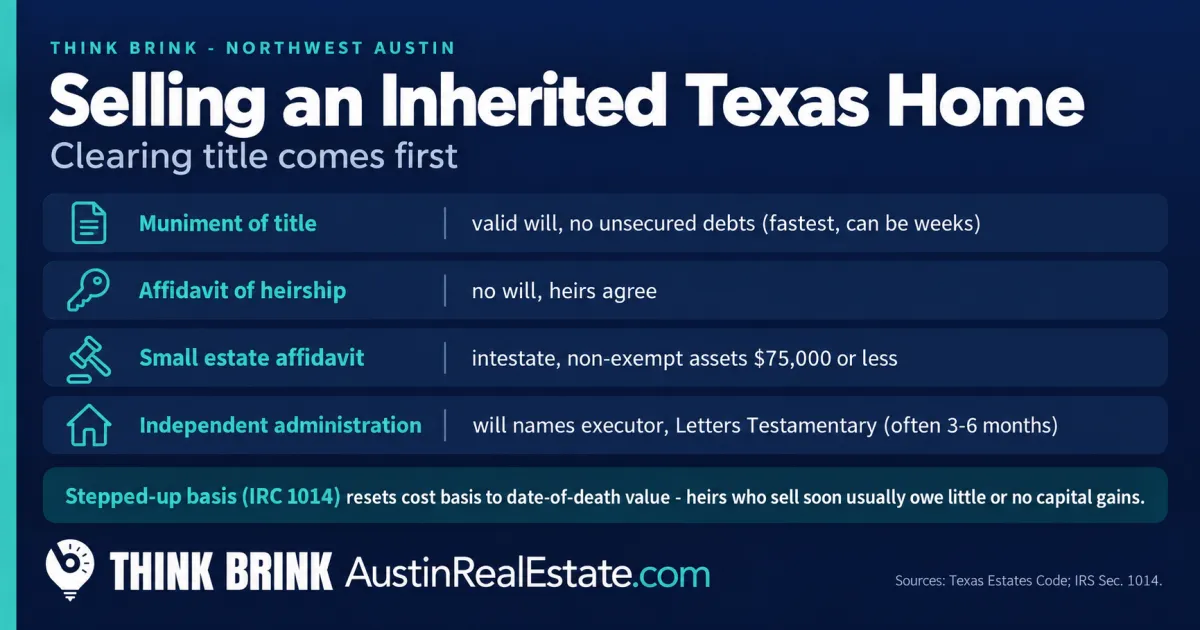
This is the most common formal probate path in Texas and usually the cleanest when there is a valid will. The will typically names an independent executor. The court admits the will to probate and issues Letters Testamentary, which is the document that legally empowers the executor to act, including to list and sell the real estate. The word that matters is "independent." Texas independent administration operates with minimal court supervision after the executor is appointed, which is why it is faster and cheaper than the court-supervised (dependent) administration used in many other states. Once the executor has Letters Testamentary in hand, they can sign the listing agreement and, at closing, sign the deed conveying the property to the buyer.
Timeline is the thing to plan around. From filing to receiving Letters Testamentary commonly runs a few months, often in the three to six month range depending on the county's docket and whether anyone contests. In practice you can often begin preparing the home for market and even list it while administration is underway, but you cannot close until the executor has legal authority. I have seen families lose a strong spring market because they waited to start the probate filing until after they had picked an agent. If a home is coming to you through a will, get the attorney engaged the same month, not after you have interviewed Realtors.
Muniment of title (valid will, no unsecured debts)
This one is close to a Texas superpower and it is worth knowing about, because a lot of paid-off Northwest Austin homes qualify. If the person left a valid will and the estate has no unpaid debts other than debts secured by real estate (a mortgage counts as secured, so a remaining mortgage does not disqualify you), Texas lets you probate the will as a "muniment of title." No executor is appointed and no administration is opened. The court simply admits the will as a link in the chain of title, and the recorded court order becomes the document that moves ownership to the beneficiaries named in the will. In straightforward cases this can sometimes be completed in a matter of weeks rather than months. For a family whose parent owned a Balcones Woods or Great Hills home free and clear, with a clean will and no credit card debt or medical liens hanging over the estate, muniment of title is frequently the fastest, lowest-cost way to get to a sellable title.
Affidavit of heirship (no will, or a will that cannot be probated)
When there is no will, or the four-year window to probate a will has closed (more on that below), and the heirs are known and in agreement, an affidavit of heirship is often used to establish who inherited the property for title purposes. It is a sworn document, ideally supported by disinterested witnesses who knew the family, that lays out the decedent's family history and identifies the legal heirs. It gets recorded in the county real property records. Title companies do not treat every affidavit of heirship identically, and some prefer it to have been on record for a period of time before they will insure over it, so this is a path to walk with both an attorney and the title company you plan to close with, not a form to download and file blind. But for a large share of inherited Texas homes where someone died without a will and the family is not fighting, this is how title actually gets cleared.
Small estate affidavit (small, intestate estates)
Texas has a small estate affidavit for modest estates with no will. As of 2026 the state raised the ceiling, and it now applies when the estate's non-exempt assets total $75,000 or less, up from the old $50,000 limit. Importantly, the homestead and exempt property are excluded from that $75,000 calculation, and a small estate affidavit can transfer the decedent's homestead to the heirs who are entitled to it. It cannot be used to transfer real estate other than the homestead. Other conditions apply: the person died without a will, at least 30 days have passed since death, no administration is pending, and the estate is solvent, meaning assets exceed known debts (setting aside mortgages or liens on exempt property). For a surviving family where the main asset is the home the parent lived in, this can be a viable shortcut, but the rules are specific and worth confirming with counsel before relying on it.
Transfer on death deed (the paperwork was done ahead of time)
This is the one that avoids all of the above, and if you are an owner reading this rather than an heir, pay attention. Since 2015, Texas has allowed a transfer on death deed under Chapter 114 of the Texas Estates Code. It lets an owner name who inherits a specific piece of real estate at death, while keeping full control during life, you can still sell it, mortgage it, or change your mind. It must be signed before a notary and, critically, recorded with the county clerk before the owner dies. An unrecorded transfer on death deed does nothing. When it is done correctly, the property passes to the named beneficiary at death outside of probate entirely, which means the beneficiary can move much more quickly toward a sale. It is not a cure-all. It does not wipe out an existing mortgage or lien, the beneficiary must survive the owner by at least 120 hours, and it does not shield the property from the state's Medicaid estate recovery program. But for an owner who wants to make things simple for the next generation, a properly recorded transfer on death deed is one of the cleaner tools Texas offers. Have an attorney prepare it; a botched TODD creates more problems than it solves.
The four-year rule you do not want to trip over
Texas law generally requires that a will be filed for probate within four years of the date of death, under Estates Code Section 256.003. The clock starts on the date of death, not the date you found the will or the date the family got around to dealing with it. Miss that window and, as a rule, you cannot probate the will and Letters Testamentary will not be issued, unless you can prove you were "not in default," meaning your delay was not intentional or negligent. That is a real hurdle, not a formality. If a will exists, do not sit on it. When the four-year window has genuinely passed, families usually shift to a determination of heirship, a court process that identifies the legal heirs and does not carry the same deadline. The practical lesson is simple: the cheapest, fastest paths (muniment of title, timely independent administration) are available while the four-year window is open, and they get more complicated and more expensive the longer an estate sits untouched.
The tax picture, which is usually better than heirs fear
Most heirs walk in braced for a tax hit and are relieved by what they learn. Here is the general shape of it, and again, confirm the specifics with a CPA.
Texas has no state inheritance tax and no state estate tax, and no state income or capital gains tax. So at the state level, inheriting and selling a Texas home does not generate a tax bill. The federal estate tax does exist, but the 2026 exemption is $15 million per individual, roughly $30 million for a married couple, and the One Big Beautiful Bill Act signed in July 2025 made that level permanent and indexed to inflation. In plain terms, a Northwest Austin home, even a $1 million-plus property in 78731, is nowhere near triggering federal estate tax on its own. For all but the largest estates, federal estate tax is simply not part of the conversation.
The tax that actually matters when you sell an inherited home is capital gains, and this is where the "stepped-up basis" rule does most families an enormous favor. Under Internal Revenue Code Section 1014, when you inherit property, your cost basis is reset ("stepped up") to the fair market value on the date of death, not what the deceased originally paid for it. Consider a couple who bought in Spicewood Estates in 1988 for $120,000, in a home now worth $700,000. If they had sold during their lifetime, they would have been looking at roughly $580,000 of gain against the Section 121 exclusion limits, and a long-held Northwest Austin home can push past those limits, which is exactly the situation I wrote about in the post on the Section 121 capital gains exclusion for long-held homes. But an heir who inherits that same home takes a basis of $700,000 as of the date of death. If they sell within a few months for $705,000, the taxable gain is roughly $5,000, not $580,000. The decades of appreciation are wiped off the tax calculation. Heirs who sell reasonably soon after inheriting frequently owe little or no capital gains tax at all.
Two practical notes flow from that. First, it is worth documenting the fair market value as of the date of death, because that number is your basis and the anchor for any future gain. A broker price opinion or an appraisal keyed to the date of death is cheap insurance; if you want a current read on what these homes are bringing, the post on what a 78750 or 78759 home is worth right now gives the market context, and a CPA can tell you what form of date-of-death valuation they want to see. Second, the longer heirs hold the home after inheriting and the more it appreciates, the more post-death gain can accrue, so the timing of the sale has a tax dimension worth discussing with your CPA before you decide to rent it out for a few years.
The property tax surprise heirs should plan for
Here is a real cost that catches families off guard, and it has nothing to do with the sale itself. If the parent was 65 or older, their school property taxes were very likely frozen under the over-65 tax ceiling, and they may have had additional exemptions that held their tax bill well below what the home would otherwise be assessed. That ceiling and those exemptions belong to the person, not to the house. They do not pass to the heirs. When the home changes hands and the over-65 owner is gone, the taxing units can reassess and the annual property tax bill can jump meaningfully from what the family had been used to seeing. If you are holding an inherited Northwest Austin home rather than selling it right away, budget for a materially higher tax bill than the deceased was paying. I covered how that freeze works, and why it is tied to the person, in the post on the Texas over-65 school tax ceiling. It is one more reason many families decide to sell rather than hold.
When there is more than one heir
Most of the friction I see in inherited sales is not legal, it is human. When several siblings inherit a home together, all of the owners generally have to agree to sell and all of them have to sign the deed at closing. One sibling who wants to keep the house, or who lives out of state and is slow to respond, or who thinks the list price is too low, can stall the whole thing. A few things help. Agree early and in writing on the basics: whether to sell at all, roughly what price, which agent, and how proceeds split. Decide who is the point of contact so the agent and title company are not chasing four people. If one heir wants to keep the home, they can buy out the others, but that is a purchase and it needs to be priced and documented like one. And if the heirs genuinely cannot agree, that is an attorney conversation, because Texas law has mechanisms to resolve co-owned property disputes, and none of them are fast or cheap. The goal is to never get there.
Condition, and the "as-is" reality of inherited homes
Many inherited homes in Northwest Austin are original-condition houses from the 1970s through the 1990s that the parents lived in for decades and did not update. That is not a criticism, it is just the pattern, and it shapes how you should sell. Heirs almost never want to sink $60,000 into a kitchen and bath renovation on a house they are about to sell, and they usually should not. The more common and sensible route is to sell as-is or close to it, price it honestly for its condition, and let the buyer pool that wants a project compete for it. Northwest Austin has strong demand for exactly these homes, buyers who want the school zoning and the established lot and are willing to renovate to taste. What matters is pricing to condition rather than to the updated comps down the street, and being straightforward about what the home needs. Deferred maintenance disclosed up front is a negotiation; deferred maintenance discovered during the option period is a re-trade or a dead deal.
What buyers should know about buying an inherited or probate home
If you are on the buying side and the home you love turns out to be an estate sale, it is very much worth pursuing, but go in with clear eyes. Expect the seller to be an executor, an administrator, or a group of heirs rather than a single owner, and expect the timeline to depend on where the estate is in the process. If probate is not yet complete, the closing may hinge on the court, which is outside everyone's control, so build flexibility into your dates. Confirm early, through your agent and the title company, that the sellers have or will have the legal authority to convey, whether that is Letters Testamentary, a recorded muniment order, or a clean affidavit of heirship, because that is what makes your title insurable. Anticipate an as-is sale with limited or no seller's disclosure, since heirs who never lived in the home genuinely may not know its history, which makes your own inspection and your option period more important than usual. The mechanics of that title review are the same ones I covered in the post on reading the title commitment and survey, and they matter even more on an estate deal. Inherited homes can be some of the best values in an established neighborhood; you are just trading a little certainty on timeline and disclosure for a home that has not been flipped and priced like one.
Frequently asked questions
Can I sell an inherited house in Texas before probate is finished?
Generally no, not to a close. You can prepare the home, hire an agent, and often list it, but you cannot deliver insurable title to a buyer until the ownership has been legally transferred to the sellers and recorded. Depending on the estate, that means completing an independent administration to get Letters Testamentary, a muniment of title order, an affidavit of heirship, or a small estate affidavit. Some cash buyers will contract earlier and wait, but a normal financed sale needs the title cleared first.
How long does it take to be able to sell an inherited Texas home?
It depends on the path. Muniment of title in a clean case can sometimes be done in a few weeks. Independent administration to get Letters Testamentary commonly runs a few months, often three to six, depending on the county and whether anyone contests. Affidavit of heirship timing depends on the title company's comfort level. The single biggest delay is usually waiting to start, so engage a probate attorney as early as possible.
Do I have to pay taxes when I sell an inherited home in Texas?
Texas has no state inheritance, estate, or capital gains tax, so there is no state tax on the sale. Federally, the estate tax only reaches estates above roughly $15 million per person in 2026, so it almost never applies to a single home. The tax to watch is federal capital gains, but because your basis is stepped up to the home's value on the date of death, heirs who sell reasonably soon after inheriting typically owe little or nothing. Confirm your specifics with a CPA.
What is a stepped-up basis and why does it matter?
Under IRC Section 1014, when you inherit a home your cost basis resets to its fair market value on the date of death rather than what the deceased paid. That erases the decades of appreciation from your taxable gain. A home bought for $120,000 and worth $700,000 at death gives the heir a $700,000 basis, so selling near that value produces little or no taxable gain. It is the single biggest reason inherited-home sales are usually far less taxing than families expect.
What happens if there is no will?
The home passes under Texas intestacy law to the legal heirs, and title is typically cleared through an affidavit of heirship or, for small qualifying estates, a small estate affidavit, or through a court determination of heirship. Who inherits and in what shares depends on the family structure, whether the property was community or separate, and whether there are children from prior relationships, which is exactly the kind of question to put to a probate attorney rather than guess at.
We are several siblings who inherited the house. Do we all have to agree to sell?
Generally yes. Co-owners each hold an interest, and a normal sale needs all of them to agree and to sign the deed at closing. One heir can buy out the others, treated as a purchase. If the co-owners cannot agree at all, Texas has legal processes to resolve it, but they are slow and expensive, so aligning early on price, agent, and process is well worth the effort.
Does a transfer on death deed avoid all of this?
If the owner recorded a valid transfer on death deed before passing, the property transfers to the named beneficiary at death outside probate, which lets the beneficiary move toward a sale much faster. It does not erase an existing mortgage or lien, and it does not protect against Medicaid estate recovery. It only works if it was properly signed, notarized, and recorded before death, so it is a planning tool for owners, not something heirs can create after the fact.
Should we update the inherited home before selling it?
Usually not with a major renovation. Most heirs are better served selling as-is or close to it and pricing honestly for the home's condition, because Northwest Austin has real demand for original-condition homes in established neighborhoods from buyers who want to renovate to their own taste. Light cleanup, decluttering, and addressing obvious safety items generally pay off; a full remodel on a home you are about to sell generally does not.
What this means for you
If you have inherited a Northwest Austin home, the sale is very doable, and the tax picture is probably kinder than you fear, but the order of operations matters. Clearing title comes first, and the path depends on whether there was a will and whether the estate carries debt. Get a probate attorney involved the same month, not after you have picked an agent, because the fastest and cheapest options are the ones available early and while the four-year window is open. Document the date-of-death value for your basis, plan for a higher property tax bill if you hold rather than sell, and if there are several heirs, get everyone aligned in writing before the home hits the market. If you are buying an estate home, expect an as-is deal on the estate's timeline and lean hard on your inspection and title review, because the value is often real.
I am a broker, not your attorney or CPA. The value I add on an inherited sale is coordinating the moving parts, pricing the home correctly for its condition and the current market, and keeping the transaction moving while the legal work gets done, and pointing you to the right attorney and tax professional for the parts that are theirs to handle. If you are working through an inherited Northwest Austin home and want a straight read on what it is worth and how to approach the sale, that is a conversation I am glad to have.
This article is general information for Northwest Austin homeowners, heirs, and buyers, and is not legal or tax advice. Probate procedures, estate and capital gains tax treatment, and title requirements depend on your specific situation. Consult a licensed Texas probate attorney and a qualified tax professional before acting.
