What Buyers Should Know About Balcones Hills Before Making an Offer (78759)
Balcones Hills Is Three Streets in 78759 That Almost Nobody Outside It Knows. Here Is What Buyers Should Understand Before Making an Offer.
Some Northwest Austin neighborhoods sell themselves on name recognition. Great Hills has it. Canyon Creek has it. Balcones Woods, even at a lower profile, still shows up when people search 78759. Balcones Hills does not. It is a small, quiet enclave of roughly three streets that most buyers drive past without ever knowing it is there, and the people who live in it tend to like it that way.
That obscurity is worth understanding before you shop here, because it cuts both ways. On one hand, a neighborhood that generates almost no search volume also generates almost no competition from buyers who are shopping by name. On the other hand, a neighborhood this small produces very few sales, which means the data you would normally lean on to understand a market barely exists, and you have to buy with judgment rather than with a spreadsheet.
This guide is for the buyer who has found Balcones Hills, felt the pull of its mature-tree, hill-country character, and wants to understand what they are actually getting into before they write an offer on one of the handful of homes that come available in a given year.
What Balcones Hills Actually Is
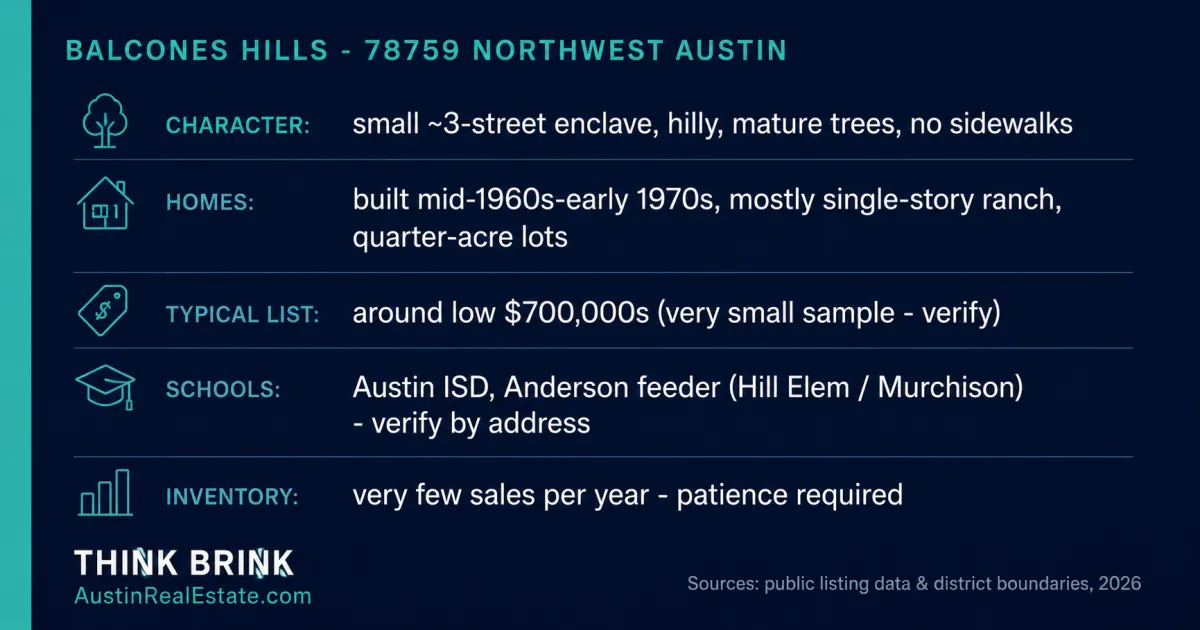
Balcones Hills is a small established neighborhood in the 78759 zip code of Northwest Austin. Its defining characteristics are physical and immediate: hilly topography, mature trees, quiet streets, and a notable absence of sidewalks that gives the whole place a natural, slightly rural feel despite sitting inside one of the most developed parts of Austin. It is compact enough that residents describe it as just a few streets, which fosters the kind of tight, everyone-knows-the-street community feel that larger neighborhoods lose.
The homes were built primarily between the mid-1960s and the early 1970s, which makes this some of the older housing stock in Northwest Austin. The original homes are mostly single-story ranch-style houses on quarter-acre lots, with a mix of traditional two-story residences worked in. Many of these homes have been thoughtfully remodeled over the years, with owners opening up the dated original floor plans and updating finishes, so the neighborhood today is a blend of original mid-century homes and reworked, modernized ones.
What you are buying in Balcones Hills, more than anything, is the setting. The lots, the trees, the topography, and the quiet are the product. The houses sit on top of that, and their value swings enormously based on how much updating has been done to a structure that started life more than half a century ago.
The Small-Neighborhood Data Problem, and Why It Matters
Here is the thing no glossy neighborhood profile will tell you plainly: Balcones Hills is too small to have reliable market statistics, and you need to price your expectations accordingly.
At any given time there may be only a small handful of homes available or recently sold across the entire neighborhood. Public listing data has shown just a few homes on the market with an average list price in the neighborhood of the low $700,000s, around 1,600 square feet, and built around the early 1970s on average. But an average built from three homes is not a market statistic in any meaningful sense. One heavily renovated home or one original fixer can swing that entire average by a wide margin, and there simply are not enough transactions to smooth the noise out.
The practical consequence is that you cannot value a Balcones Hills home the way you would value a home in a large, active neighborhood where dozens of recent comparable sales exist. Instead, valuation here leans on comparable sales from the surrounding established 78759 neighborhoods, adjusted carefully for lot, condition, and the specific character of Balcones Hills. This is exactly the kind of situation where a portal's automated estimate is least reliable and where a real, human comparative market analysis earns its keep. The what is your 78750 or 78759 home worth post walks through how genuine valuations are built in this market, and the logic matters even more in a neighborhood too small to price itself.
Older Homes Mean Condition Is Everything
Because the housing stock dates to the 1960s and 1970s, condition is the single biggest variable in what a Balcones Hills home is worth and what it will cost you to own. This is the same reality that governs any older Northwest Austin neighborhood, but it is amplified here because the homes are older than most and because the neighborhood is small enough that you may not have the luxury of choosing among several homes in your preferred condition tier.
A home that has been fully remodeled, with the original floor plan opened up and the mechanical systems updated, is a very different purchase from one that is charming but essentially original. The renovated home costs more and carries far less near-term risk, because a prior owner already absorbed the cost of the roof, the HVAC, the windows, the plumbing, and the electrical updates that a home of this age eventually demands. The original home costs less up front and hands you that entire list of future projects.
Neither is the wrong choice. But the buyer who anchors to the lower price of an original home without budgeting for the work is setting up a disappointment, and the buyer who assumes a cosmetically pretty home has been fully updated underneath is taking on risk they have not priced. In a neighborhood of homes this old, the inspection is not a box to check. It is the most important research you will do, and you should read it as a budget for the years ahead rather than as a simple pass-or-fail on the purchase.
Schools: Austin ISD, and You Must Confirm the Address
Balcones Hills is served by Austin ISD, which distinguishes it from many of its Northwest Austin neighbors that fall into Round Rock ISD. This is an important distinction, because AISD and RRISD are different districts with different schools, different feeder patterns, and different reputations, and buyers who assume Northwest Austin automatically means Round Rock ISD can be caught off guard.
Within Austin ISD, the relevant pathway for much of this part of Northwest Austin runs through the Anderson High School feeder, with Hill Elementary and Murchison Middle School among the campuses that serve the area. Anderson High School itself sits nearby in 78759 and is a well-regarded AISD campus. Hill Elementary has a strong reputation among AISD elementary schools. These are genuine strengths for a buyer who wants the AISD option in Northwest Austin.
But the rule that applies everywhere applies double in a small neighborhood near district edges: verify the exact address against Austin ISD's current attendance boundaries before you make an offer. Do not rely on the neighborhood name, do not rely on the listing, and do not assume that because a neighbor's kids attend a certain school, yours will too. Attendance zones are drawn at the address level and they change. If schools are a meaningful part of why you are buying, confirming the current assignment for the specific home is the most important due-diligence step you will take. For the wider picture of how school assignment interacts with pricing across these zip codes, the Living in 78750 and 78759 neighborhood guide is a useful companion.
Location and Access
Balcones Hills shares the locational advantages that make 78759 desirable, tucked into Northwest Austin with convenient reach to the major roadways that carry commuters around this part of town. Buyers here are within the established Northwest Austin corridor, with access toward the employment centers that anchor the area, including the Domain and the broader tech corridor along 183 and Parmer.
What sets the neighborhood apart is not raw commute speed, which is comparable to its neighbors, but the contrast between how quiet and tucked-away the neighborhood feels and how connected it actually is. The absence of sidewalks and the hilly, tree-covered streets make it feel removed, almost tucked into the hills, even though the practical access to Northwest Austin's roads and employment is right there. For a buyer who wants the daily experience of a quiet, natural setting without giving up the central Northwest Austin location, that combination is genuinely hard to find, and it is a real part of the neighborhood's appeal.
If you are weighing Balcones Hills against the more established, higher-profile hillside character of Great Hills, the Great Hills buyer guide is worth reading alongside this one, because the two neighborhoods appeal to overlapping buyers for different reasons and at different price points.
The Cost of Owning, and the Small-Neighborhood Wrinkle
The carrying costs of a Balcones Hills home follow the same pattern as the rest of Northwest Austin, with the older housing stock adding its own consideration.
Property taxes in the Austin area run at an effective rate in the neighborhood of roughly two percent of value, varying by the specific taxing jurisdictions and exemptions for a given address and generally landing in the range of about 1.8 to 2.2 percent. Making the home your primary residence and claiming the Texas homestead exemption removes a significant amount of value from the school district portion of your taxable amount, which is the largest single component of most Central Texas tax bills. Because Balcones Hills is in Austin ISD, the specific taxing jurisdictions differ from neighboring RRISD areas, so run the actual numbers for the exact address rather than assuming. This is general information and not tax advice; a CPA can confirm your specific situation.
The older-home consideration is maintenance and reserves. A home built in the 1960s or early 1970s will, over time, need the expensive systems addressed if a prior owner has not already done so. Budget for that honestly. A full breakdown of what ongoing ownership actually costs in these zip codes lives in the real cost of owning a home in 78750 or 78759 post, and the maintenance line matters more here than in a neighborhood of newer homes.
Who Balcones Hills Is Right For
Balcones Hills fits a particular buyer very well and disappoints others, and it is better to know which you are before you fall for a specific house.
It is right for the buyer who values setting above almost everything: the trees, the hills, the quiet, the tucked-away feel, and the small-community intimacy of a neighborhood that is only a few streets. It is right for the buyer who wants the Austin ISD option in Northwest Austin, specifically. It is right for the buyer who is comfortable either buying a fully renovated older home or taking on the updates of an original one. And it is right for the patient buyer, because homes come available here rarely and you may have to wait for the right one rather than choosing from a menu.
It is a weaker fit for the buyer who needs to move quickly and choose from many options, who wants new-construction finishes and layouts, who specifically wants Round Rock ISD, or who is uncomfortable with the maintenance profile of a home built more than half a century ago. It is also a weaker fit for the buyer who leans heavily on data and comparable sales to feel confident, because this neighborhood simply does not produce enough transactions to offer that comfort. Here you buy with judgment, a good agent, and a thorough inspection, not with a deep pool of comps.
How to Buy Well in Balcones Hills
Buying well in a small, older neighborhood is a discipline problem more than a speed problem. A few principles matter most.
Be patient and be ready. These two are in tension, and both are true. Homes come available infrequently, so you may wait. But when the right one appears, you want to already understand the neighborhood, already have your financing in order, and already know your condition-tier preference, so you can act with confidence rather than scrambling. The buyer who understands Balcones Hills before they need to make a decision about it is in a far stronger position than the one who tries to learn the neighborhood after a home hits the market.
Lean hard on the inspection. In homes this old, the inspection is where you learn what you are actually buying and what it will cost you over the next several years. Read it as a budget, not a hurdle. Verify the school assignment for the exact address before you commit. And insist on a condition-adjusted valuation that draws on the surrounding established 78759 neighborhoods, because the neighborhood itself does not generate enough sales to price a home on its own. This is precisely the situation where a knowledgeable local read is worth more than an algorithm.
Frequently Asked Questions About Balcones Hills
Where is Balcones Hills in Austin?
Balcones Hills is a small established neighborhood in the 78759 zip code of Northwest Austin. It is defined by its hilly topography, mature trees, quiet streets, and lack of sidewalks, and it is compact enough to be described as just a few streets. It sits within the established Northwest Austin corridor with convenient access to the area's major roadways and employment centers.
What school district is Balcones Hills in?
Balcones Hills is served by Austin ISD, which sets it apart from many nearby Northwest Austin neighborhoods that fall into Round Rock ISD. The relevant Austin ISD pathway for much of this area runs through the Anderson High School feeder, with campuses such as Hill Elementary and Murchison Middle School serving the area. Because attendance zones are drawn at the address level and can change, verify the exact assignment for a specific home with Austin ISD's current boundaries before making an offer.
How much do homes in Balcones Hills cost?
Public listing data has shown a small number of homes with an average list price in the range of the low $700,000s, around 1,600 square feet, though this is based on very few homes and should be treated as a rough indication rather than a reliable market statistic. Because the neighborhood is so small, prices are best determined through a condition-adjusted analysis using comparable sales from the surrounding established 78759 neighborhoods rather than from Balcones Hills alone.
Why are there so few homes for sale in Balcones Hills?
Balcones Hills is a very small neighborhood of only a few streets, so it naturally produces very few listings in a given year. Residents also tend to stay, with many families remaining after their children have grown, which further limits turnover. The practical effect for buyers is that you may need patience and readiness, because the right home comes available infrequently rather than on demand.
Are Balcones Hills homes old, and does that matter?
Yes. The homes were built primarily between the mid-1960s and early 1970s, making them some of the older housing stock in Northwest Austin. This matters because condition varies widely between original homes and remodeled ones, and older homes eventually require attention to major systems like roofing, HVAC, plumbing, and electrical. A thorough inspection is essential, and you should read it as a budget for the years ahead rather than simply a pass-or-fail on the purchase.
Is Balcones Hills a good neighborhood for families?
It can be a strong fit for families who value a quiet, natural setting and the Austin ISD option, and the neighborhood has a family-oriented, tightly knit character with many long-term residents. The key considerations are confirming the specific school assignment for the address, being comfortable with older homes, and accepting that limited inventory may require patience. Families who want those things and are willing to wait for the right home tend to be very happy here.
What is the difference between Balcones Hills and Balcones Woods?
Despite the similar names, they are distinct neighborhoods. Balcones Woods is a larger, more active 78759 neighborhood known for a fast-moving market, and it generally falls into Round Rock ISD. Balcones Hills is much smaller, quieter, and served by Austin ISD, with a more tucked-away, hill-country character and far fewer sales. Buyers weighing the two are really choosing between a larger, more liquid market and a smaller, more distinctive setting with a different school district. The Balcones Woods buyer guide covers that neighbor in detail.
Should I buy an original or a renovated home in Balcones Hills?
Both can be good choices, and it depends on your appetite for projects. A renovated home costs more but hands you updated systems and layouts with less near-term risk, because a prior owner already paid for the expensive work. An original home costs less and offers the chance to build value over time, but you must budget honestly for the updates a home of this age will need. The inspection is what tells you, for a specific house, which situation you are actually in.
The Honest Summary
Balcones Hills is not a neighborhood you buy for name recognition or for a deep menu of options, because it offers neither. It is a neighborhood you buy for setting: the trees, the hills, the quiet, and the small-community feel of a place that is only a few streets tucked into 78759, paired with the Austin ISD option that its RRISD neighbors do not offer.
The tradeoffs are real and specific. The homes are old, so condition is everything and the inspection is your most important tool. The neighborhood is tiny, so market data is thin and valuation depends on judgment and surrounding comparables rather than on a pool of local sales. And inventory is scarce, so buying here rewards patience and preparation over speed. Understand those three things going in and Balcones Hills can be one of the more distinctive places to own a home in Northwest Austin. If you have found a specific home here and want a grounded read on what it is actually worth and what it will need, that is exactly the kind of situation where a careful local look pays off, and I am glad to give it.
