What Buyers Should Know About Spicewood Estates Before Making an Offer
Spicewood Estates is one of those Northwest Austin neighborhoods that buyers tend to find late in their search rather than early. It doesn't have the name recognition of Canyon Creek or the search volume of Great Hills, and it sits far enough west of 183 that buyers who are anchoring on that corridor sometimes never make it out to look. That's a mistake, and it's the reason homes here sell when they sell - often to buyers who discovered the neighborhood and stopped looking elsewhere.
This guide is for buyers who are starting to take Spicewood Estates seriously and want a complete picture before they make an offer, and for sellers in the neighborhood who want to understand how buyers evaluate what they're buying. It covers the physical reality of the neighborhood, the two-section HOA structure, the school situation, the preserve adjacency and what it means practically, the wildfire context, what homes are trading for, and what to check before you go under contract.
What Buyers Should Know About the Jollyville Corridor in Northwest Austin Before Making an Offer
Where Spicewood Estates Actually Is
Spicewood Estates sits in the 78750 zip code, off Spicewood Springs Road west of Highway 183. The entry into the neighborhood runs off Spicewood Springs Road onto Scotland Well Drive and then Ashton Ridge - an approach that takes buyers through a transition from the commercial corridor on 183 into something that feels genuinely removed from it within a matter of blocks.
The neighborhood sits at the western edge of developed Northwest Austin, with the Balcones Canyonlands Preserve forming its western and southern border. That preserve adjacency is not incidental to what Spicewood Estates is - it's central to it. The terrain, the views, the wildlife, and the sense of space that the neighborhood carries are all direct products of that adjacency, and buyers who understand that context understand why residents tend to stay.
The neighborhood is small. That low turnover is not something that shows up in data tables but it's something you notice when you start researching the market: there are typically only a handful of homes available at any given time, sometimes fewer. When something good comes available here, it doesn't sit long if it's priced correctly.
The Two-Section Structure: What Buyers Need to Know
Spicewood Estates is divided into two sections - Section One and Section Two - each with its own covenants and restrictions governed by the Spicewood Estates Homeowners Association. The SEHA is an active HOA with a board, section representatives, and street captains who maintain neighborhood communication and enforce the covenants. The neighborhood has its own Google Group for resident communications and an active Facebook group for residents.
This is not a nominal HOA that collects dues and sends annual letters. The SEHA is engaged, the Architectural Control Committee reviews projects and improvements, and the covenants carry real teeth. For buyers who are specifically seeking no-HOA situations, Spicewood Estates is not that neighborhood. For buyers who want a neighborhood that maintains its standards and character over time - and have seen what happens to neighborhoods without that structure - the active HOA is part of what protects the investment.
The two sections have separate covenants that vary in specifics, so buyers should request and review the covenants for the specific section of the home they're considering before going under contract. Don't assume the Section One covenants apply to a Section Two address or vice versa. Your agent should provide these as part of the HOA disclosure package.
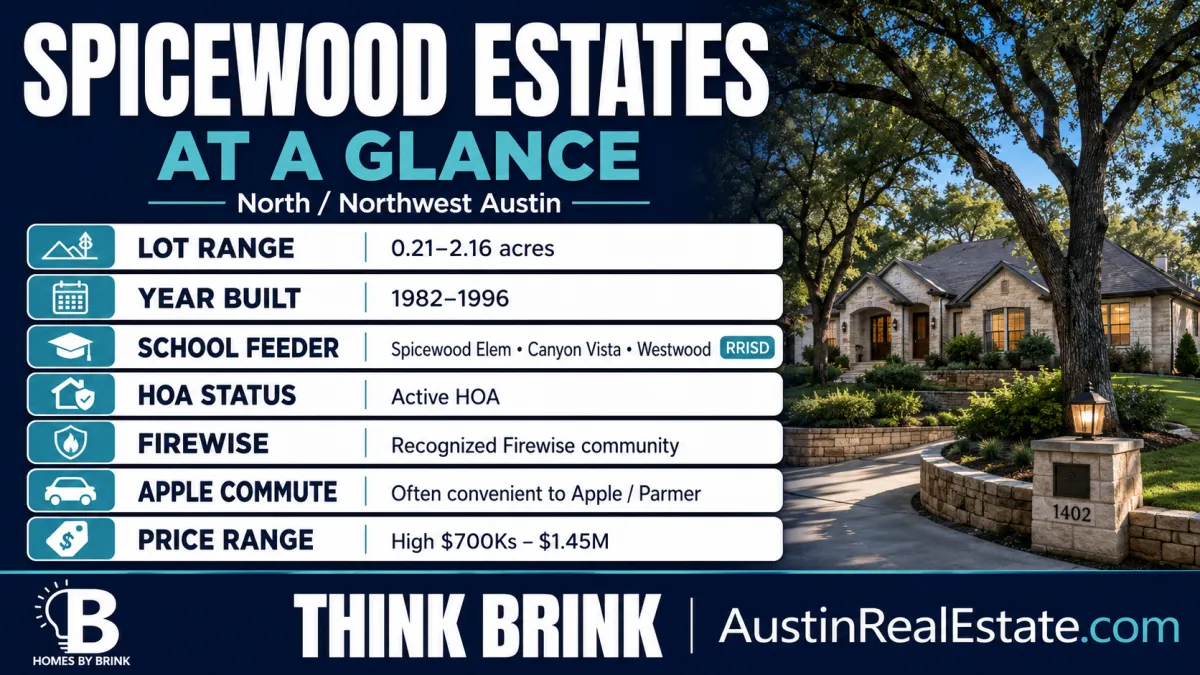
The HOA reached a significant milestone in May 2025 when Spicewood Estates officially became a Firewise Community - a designation that requires organized community participation in wildfire risk mitigation. The SEHA established a wildfire committee, partnered with the Austin Fire Department for home assessments through the AFD Structure Ignition Zone Evaluation program, and is actively coordinating fire mitigation measures across the neighborhood. This is directly relevant to buyers, and is covered in more detail in the wildfire section below.
Living in 78750 and 78759: The Northwest Austin Zip Code Guide Buyers and Sellers Should Bookmark
The Lots: What Makes This Neighborhood Physically Different
The lot situation in Spicewood Estates is one of the most significant things that separates it from the other 78750 neighborhoods buyers are typically comparing it to. Lot sizes range from approximately a fifth of an acre on the smaller end up to a full acre or more on the larger end, with considerable variation within the neighborhood depending on section and street.
That range is meaningful. A fifth-of-an-acre lot in Spicewood Estates feels different from a fifth-of-an-acre lot in a flat suburban neighborhood, because the Hill Country terrain and established tree coverage change the character of even a modest lot. But the larger lots in the neighborhood - particularly those that back to or are positioned near the preserve edge - carry something that simply doesn't exist in most of Northwest Austin: genuine space, views into natural terrain, and a privacy profile that more closely resembles rural Hill Country living than suburban Austin.
The terrain itself creates lot variation that goes beyond square footage. Some lots sit on ridgelines with views. Some are tucked into draws with natural privacy. Some back directly to the Balcones Canyonlands Preserve boundary. Within the same street, two houses can have dramatically different lot characters depending on their position on the slope and their relationship to the surrounding terrain. This is not something that conveys in photos - it requires visiting the specific lot to understand what you're actually buying.
Mature trees are a consistent feature across the neighborhood. Live oaks, cedar, and other native Hill Country species that have been growing for 40-plus years are part of the landscape on most lots. The combination of mature canopy, terrain variation, and preserve adjacency is what the SEHA's own description captures when it says the neighborhood has "homes with individuality and character situated on well-proportioned lots wooded with mature trees." That's an accurate description, not marketing language.
The Homes: What to Expect
Spicewood Estates was built primarily from the mid-1980s through the early 1990s, with some variation across sections. The neighborhood's homes are not cookie-cutter - this is something that comes up in nearly every description of Spicewood Estates and it's accurate. Architectural styles vary across brick, stone, and stucco exteriors. Home sizes range from roughly 1,900 square feet on the smaller end up to over 4,000 square feet on larger custom builds, with the median around 2,700 to 2,800 square feet with four bedrooms and three bathrooms.
The lack of architectural uniformity is a feature for buyers who value character and individuality, and a slight complication for comparable analysis - two homes of similar square footage on the same street can differ meaningfully in layout, finishes, and condition. The neighborhood doesn't lend itself to the kind of simple apples-to-apples comparison that more homogeneous subdivisions allow.
The updates question matters here exactly as it does in every established Northwest Austin neighborhood from this era. Some homes in Spicewood Estates have been fully renovated - updated kitchens, primary bath overhauls, new flooring throughout - and show beautifully against newer construction. Others still carry original 1987 or 1992 finishes. The gap in value between fully updated and original-condition homes in this neighborhood is real and significant, and buyers should go in knowing which they're looking at and what it implies for the price.
Because homes here sell infrequently and the inventory is small, pricing in Spicewood Estates can be inconsistent relative to more actively traded neighborhoods. A seller who hasn't seen a comparable sale in 18 months may be anchoring on an outdated number. A buyer who hasn't done the homework on what actually closed here recently may overpay or walk away from a fair deal. Actual closed comps in the neighborhood are the only reliable guide - not Zestimates, not automated valuations, not what sold in Canyon Creek.
Is Northwest Austin Still Worth the Premium?
The Preserve Adjacency: What It Means Day to Day
The Balcones Canyonlands Preserve forms the western and southern boundary of Spicewood Estates, and buyers who don't understand what that means practically are missing the most important contextual fact about the neighborhood.
The Balcones Canyonlands Preserve is a protected habitat system covering over 30,000 acres in Travis County. It is home to several endangered species including the Golden-cheeked Warbler and Black-capped Vireo, and it is actively managed as a conservation preserve, meaning the land adjacent to Spicewood Estates will not be developed. The views and the sense of space at the preserve edge are permanent, not contingent on what the next developer decides to do with an adjacent tract.
For residents on the preserve edge, the daily experience includes wildlife that many Austin buyers don't expect to encounter in a neighborhood 16 miles from downtown: deer, foxes, wild turkey, a variety of raptors, and during migration season a range of songbirds that serious birders actively seek out. The Balcones Village / Spicewood HOA literature specifically notes the wildlife viewing opportunities as a feature of preserve adjacency for their overlapping area.
The flip side of preserve adjacency is wildfire exposure. Cedar and other native vegetation that covers the preserve is flammable, and properties on or near the preserve edge face a genuine wildfire risk that buyers need to understand and that insurance carriers are increasingly pricing into coverage. This is not a reason to avoid the neighborhood - it's a reason to understand it clearly before you buy.
The Wildfire Reality: What Buyers Must Understand
The Firewise Community designation that Spicewood Estates achieved in May 2025 is significant and deserves direct treatment in any honest buyer's guide for this neighborhood.
The designation means the neighborhood has formally organized around wildfire risk mitigation. The SEHA established a wildfire committee, partnered with the Austin Fire Department for home assessments, and is actively coordinating measures to reduce structural ignition risk across the neighborhood. Individual homeowners can have their homes assessed through the AFD Structure Ignition Zone Evaluation program to receive specific recommendations for their property.
For buyers, this has several practical implications. First, homeowners insurance for properties in or near wildland-urban interface areas has become meaningfully more difficult and expensive to obtain in recent years. Buyers should get insurance quotes on any specific Spicewood Estates property before going under contract - not after. The insurance market for this type of location has tightened, and what the current owner is paying may not reflect what a new buyer will pay with a new policy.
Second, the proximity to the preserve affects how you should think about landscaping and structural fire mitigation. Homes on the preserve edge benefit from the specific defensible space and ember-resistant modifications that the AFD assessment program recommends. These aren't dramatic renovations - they're things like vegetation management within a certain distance of the structure, ember-resistant vents, and similar measures - but they're worth understanding before you buy.
Third, the Firewise designation is an active community commitment, not a one-time certification. Buyers who purchase in Spicewood Estates are buying into a neighborhood that takes this seriously, which is part of what protects values over time but also involves participation in the community effort.
None of this is a reason to avoid Spicewood Estates. It's information that should be part of your evaluation before you make an offer.
Why Some Northwest Austin Homes Sit While Others Still Sell
Schools: Consistent and One of the Neighborhood's Strongest Cards
Spicewood Estates feeds into Round Rock ISD consistently throughout the neighborhood - this is one of the cleaner school situations in all of 78750. The feeder pattern runs Spicewood Elementary, Canyon Vista Middle School, and Westwood High School IB World School. All three campuses are among the strongest in the RRISD system and in the broader Northwest Austin market.
Westwood High School's IB designation in particular is a consistent draw for buyers who specifically target this feeder. The IB diploma program gives qualifying students the opportunity to pursue internationally recognized college-level coursework during high school, and Westwood has maintained a strong program and strong reputation for it for many years.
Spicewood Elementary has historically been a well-regarded campus with strong parent involvement and a school culture that reflects the neighborhood's community character. Canyon Vista Middle School has maintained a strong reputation within RRISD. All three are worth independent research, but the overall feeder pattern is one of the most consistent selling points the neighborhood has and has remained stable over time.
As always, verify current assignments at the specific address with RRISD before making any school-based decisions.
Commute and Access
Spicewood Estates sits west of 183, and that positioning shapes the commute profile.
Apple Campus on Parmer Lane is approximately 15 to 20 minutes from most of Spicewood Estates under normal conditions, routing via 183 north to MoPac or surface streets to Parmer. This is a reasonable daily commute for Apple employees and is one of the reasons the neighborhood consistently shows up in Apple employee home searches.
The Domain is 15 to 25 minutes depending on routing and time of day. Close enough to use regularly without treating it as a destination trip.
Downtown Austin via MoPac runs 25 to 35 minutes in normal peak traffic. The MoPac express toll lanes help during congested periods.
The 183 corridor employers are accessible via a short drive east on Spicewood Springs Road to 183. Buyers commuting to employers along 183 generally find Spicewood Estates sits in a useful location for that routing.
The one direction where Spicewood Estates is less convenient than other 78750 neighborhoods is heading north or east - getting to Round Rock, the 183A toll corridor, or the eastern Parmer corridor adds time compared to neighborhoods that sit closer to those routes.
Getting in and out of the neighborhood during peak hours via Spicewood Springs Road deserves attention. Spicewood Springs is a two-lane road through much of its length, and traffic does back up at the 183 intersection during morning rush. Buyers who do this commute daily should drive the specific route at the time they'll be making it before they commit.
What Homes Are Trading For
Spicewood Estates pricing reflects the neighborhood's lot quality, preserve adjacency, school feeder, and low turnover. Current active listings and recent sold data show a range from the low $700,000s for smaller or original-condition homes up through $1.1 million and above for larger, updated homes on premium lots. The median active list price as of mid-2025 has been running in the high $900,000s to around $1 million range, with price per square foot generally in the $290 to $335 range depending on condition and lot.
That pricing puts Spicewood Estates at the upper end of 78750 single-family inventory and above the typical Canyon Creek range for similar square footage - a premium that reflects the lot character, the preserve adjacency, and the lower inventory. Whether that premium is warranted depends on how much the specific things Spicewood Estates offers matter to the specific buyer.
Days on market in Spicewood Estates have historically been longer than in more actively traded neighborhoods, which reflects both the price point and the fact that the buyer pool for a $900,000 to $1 million home in this specific location is narrower than the buyer pool for a $600,000 home in a higher-volume neighborhood. Well-priced homes that show well do move, but buyers should not be alarmed by days on market figures here - they reflect the market dynamics of a low-inventory, higher-price-point neighborhood more than they reflect any problem with the neighborhood itself.
Should You Buy an Older Home in Northwest Austin or a Newer Home Farther North?
What to Check Before You Make an Offer
Run through this before you go under contract on any Spicewood Estates home:
Which section is this address - Section One or Section Two? Request and review the specific covenants and restrictions for that section before signing. Do not assume they are identical.
What is the lot position relative to terrain and the preserve? Visit the specific lot, walk the backyard, understand what you're looking at from the outdoor spaces. Lot character varies significantly within the neighborhood and doesn't convey in photos.
What is the wildfire risk profile for this specific home? Consider requesting an AFD Structure Ignition Zone Evaluation assessment if the home hasn't been assessed recently. Ask about defensible space measures already in place.
Get insurance quotes before going under contract. The insurance market for preserve-adjacent properties has tightened. Know what coverage will cost before you remove contingencies.
What is the condition of the major systems? Homes from the mid-1980s through early 1990s are 35 to 40 years old. HVAC, roof, water heater, and windows deserve specific attention in any inspection. Know the replacement history.
What is the updates level and how does it affect pricing? Be clear before you make an offer whether you're buying an updated home or an original-condition home, and whether the pricing reflects that distinction honestly.
Drive Spicewood Springs Road at peak hours. If this is your daily commute route to 183, do it at 7:30am before you commit. The road experience at that hour is different from a Saturday afternoon showing.
Are there any drainage or slope considerations on this specific lot? Hill Country terrain creates drainage patterns that vary by lot. An inspector familiar with this terrain type is more valuable here than a generalist.
What Locals Wish They Knew Before Buying in Northwest Austin
The Buyer Fit Check
Spicewood Estates tends to work well for buyers who:
Want a genuinely distinctive home on a lot with character - not a subdivision where every house looks like its neighbors
Value preserve adjacency and the sense of space, wildlife, and permanence it provides
Are specifically targeting the Spicewood Elementary - Canyon Vista - Westwood RRISD feeder
Work at Apple, the western Parmer corridor, the 183 corridor, or from home
Are comfortable at the $700,000 to $1.1 million price range for the right home
Want an active, engaged HOA that maintains neighborhood standards
Are prepared for the insurance and wildfire mitigation realities of preserve-adjacent living
Value a neighborhood with long-term residents and genuine community character over a high-turnover subdivision
Spicewood Estates tends to be a harder fit for buyers who:
Need a price point below the mid-$600,000s - the neighborhood doesn't have much inventory there
Want new construction or fully updated turnkey finishes without a search process
Are commuting daily to Dell in Round Rock or eastern metro employers and want the shortest possible drive
Prefer a neighborhood with consistent architectural character rather than home-by-home variation
Are sensitive to HOA governance and the covenant review process for property improvements
The Honest Summary
Spicewood Estates is not the right neighborhood for every buyer, and it doesn't try to be. The price point is real, the preserve-adjacency considerations are real, and the low inventory means buyers sometimes wait for the right home to come available rather than finding it on demand. What the neighborhood offers in return - lot character, terrain, views, community stability, the RRISD feeder, and the sense of permanence that comes from sitting next to 30,000 acres of protected land - is genuinely unusual this close to the Austin urban core.
Buyers who find it and do their homework tend to feel they found something. The neighborhood's own HOA describes it as "an attractive, well-maintained community in a prime part of Northwest Austin" where residents "take time to be neighbors" and where "acquaintances and friendships among homeowners play a vital part in upholding the appeal and safety of our neighborhood." That's not boilerplate. It reflects what longtime residents consistently say about the place.
Go in understanding the wildfire context, the HOA structure, and the lot variation. Buy in the section that fits your situation. Verify the school assignment. Get insurance quotes early. If those boxes check out, the case for Spicewood Estates as a long-term home tends to be a strong one.
Frequently Asked Questions
What zip code is Spicewood Estates in?
78750. The neighborhood sits off Spicewood Springs Road west of Highway 183 in Northwest Austin.
What schools serve Spicewood Estates?
Spicewood Estates is in Round Rock ISD throughout the neighborhood. The feeder pattern is Spicewood Elementary, Canyon Vista Middle School, and Westwood High School IB World School - one of the most consistent and sought-after RRISD feeder patterns in Northwest Austin. Verify current assignments with RRISD for any specific address.
Does Spicewood Estates have an HOA?
Yes. The Spicewood Estates Homeowners Association is an active HOA with two sections, each with separate covenants and restrictions. The HOA has a board, an Architectural Control Committee, section representatives, and street captains. Buyers should request and review the specific section's covenants before going under contract.
What is the Firewise Community designation?
In May 2025, Spicewood Estates organized as a Firewise Community through the National Fire Protection Association's program. This means the neighborhood has formally committed to wildfire risk mitigation, partnered with the Austin Fire Department for home assessments, and established an active wildfire committee. Buyers should factor wildfire considerations and insurance costs into their evaluation.
What are home prices in Spicewood Estates?
Current active listings and recent sold data show a range from the low $700,000s for smaller or original-condition homes up through $1.1 million and above for larger, updated homes on premium lots. The median has been running in the high $900,000s to around $1 million range as of mid-2025. Price per square foot generally runs $290 to $335 depending on condition and lot.
What is the Balcones Canyonlands Preserve?
A protected habitat of over 30,000 acres in Travis County that forms the western and southern boundary of Spicewood Estates. It is permanently protected and will not be developed. The preserve adjacency is central to the neighborhood's terrain, views, wildlife, and sense of space - and also to its wildfire risk profile.
How far is Spicewood Estates from Apple Campus?
Approximately 15 to 20 minutes under normal traffic conditions, routing via 183 north to MoPac or surface streets to Parmer. This is a workable daily commute for Apple employees and is one of the reasons the neighborhood consistently draws buyers from the Apple corridor.
What is the biggest thing buyers miss about Spicewood Estates?
Lot variation within the neighborhood. Two homes on the same street can have dramatically different lot character based on terrain position, preserve proximity, and tree coverage. Photos don't convey this. Walking the specific lot at different times of day - and understanding its relationship to the surrounding terrain and preserve edge - is essential before making an offer.