What Buyers Should Know About the Far West Corridor Before Making an Offer (78731)
Most people who ask me about "the Far West area" are picturing one thing, and the map is telling them something else. Far West Boulevard is a mile-and-a-half spine that runs east to west through the middle of 78731, and the housing along it and immediately off it is more varied than almost anywhere else I work in Northwest Austin. On one block you have original 1960s ranch houses on quarter-acre lots. Two hundred yards away you have garden-style condos from the 1970s, newer luxury townhome pods, and mid-rise apartment stock backing up to MoPac. All of it shares the same zip code, the same grocery store, and much of the same school assignment, but the buying decision is completely different depending on which of those you are actually chasing.
Far West Boulevard was laid out in the 1950s and 1960s as part of the Barrow family's development of the Northwest Hills flatlands and hills. The story locals tell is that the boulevard was conceived to be a west-side answer to Congress Avenue, a broad main street for the new subdivisions climbing into the hills. It never became that, but it did become the connective tissue of the whole 78731 quadrant: the road you take to the HEB, the road the school buses run, the road that gets you onto MoPac in under three minutes. If you are relocating and someone told you to "look at Far West," this guide is meant to sort out what they actually meant and what you should check before you write an offer.
Where Far West Sits, and Why the Location Is the Argument
The single strongest thing the Far West corridor has going for it is position. It sits inside the MoPac loop, roughly between the river and Spicewood Springs Road, which makes it one of the closest-in pieces of established Northwest Austin you can buy. That proximity is the reason the corridor holds its value even when individual houses on it are dated.
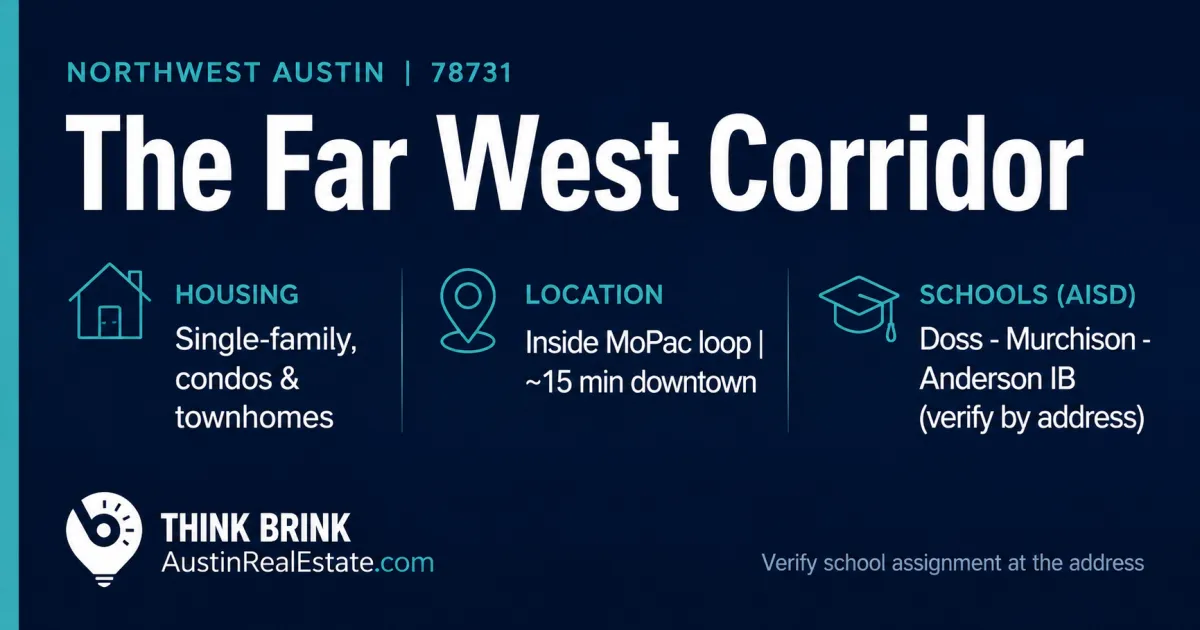
From a home just off Far West Boulevard, the practical drive times look like this in normal, non-peak traffic. Downtown Austin is roughly 15 minutes straight down MoPac. The Domain and the North Burnet employers are about 10 to 15 minutes north on MoPac. The Arboretum and the 183/360 retail and office cluster are 10 minutes or so. The one commute that is not a slam dunk from here is Apple's Parmer campus, which is a genuine 20 to 30 minute drive depending on whether you take MoPac to Parmer or cut across on 183. If your entire reason for moving to Northwest Austin is a short Apple commute, the corridor is not your first choice, and I would point you further north to Milwood, Scofield Farms, or Rattan Creek instead. Far West is for the buyer whose center of gravity is central Austin, the Domain, or downtown, not the far north tech campuses.
What you are really paying for on the Far West corridor is a location that is central without being urban. You can be at Barton Springs or on South Congress in 15 to 20 minutes, but you go home to a quiet street with mature live oaks and a yard. That combination is scarce in Austin, and it is why close-in 78731 has stayed expensive through every phase of the market. For the honest version of how this quadrant compares to the hillier neighborhoods just north and west of it, the Northwest Hills buyer guide covers the terrain in more detail.
The Three Housing Types Along Far West, and Who Each One Is For
This is the part buyers most often get wrong, because they treat "Far West" as one market. It is three markets stacked on top of each other.
The single-family ranch and mid-century stock
Off the boulevard, on the residential streets that branch north and south, you find the original single-family homes: one-story and split-level ranches, many built between the late 1950s and the early 1970s, sitting on generous flat-to-gently-sloping lots. These are the houses that anchor the corridor's value. They tend to have real trees, real yards, and floor plans that were built for families. The tradeoff is age. A lot of this stock still has original single-pane windows, aluminum wiring in a subset of homes, cast-iron drain lines, and kitchens and baths that have been updated once, badly, sometime in the last thirty years, or not at all. You are buying location and lot, and you should budget for the house to need work.
This is the segment I steer families toward when schools and yard space are the priority. It is also the segment where condition varies the most, so the inspection matters more here than almost anywhere. I will come back to what to check.
The condo and townhome stock
Closer to the boulevard and near the MoPac frontage, the corridor is dense with attached housing: 1970s and 1980s garden condos, some of which are genuinely charming and well-run, and newer townhome and lock-and-leave pods aimed at professionals and downsizers who want a Northwest Austin address without a yard to maintain. This is where the corridor gets interesting for buyers who are priced out of the single-family stock or who simply do not want the maintenance.
The thing to understand about the older condo communities is that the HOA is the investment. A well-capitalized association that has kept up its roofs, its plumbing, and its reserves is worth a premium over an identical-looking community that has been deferring maintenance for a decade. Before you buy a condo here, you read the HOA financials, the reserve study, and the last two years of meeting minutes, and you find out whether a special assessment is coming. A cheap condo with a broke HOA is not a deal, it is a future bill.
The apartment and rental frontage
Along the MoPac service road and parts of the boulevard itself, the stock is largely rental apartments. This matters to a buyer for two reasons. First, it means the corridor has real rental demand, which supports resale. Second, it means noise and traffic are real considerations for homes near the frontage. A house three streets off the boulevard is quiet. A house backing up to MoPac is not, and it should be priced accordingly. Do not pay interior-street money for a home with highway noise, and do not dismiss a frontage home if you are not noise-sensitive and the price reflects the location.
Schools: The Feeder You Probably Get, and Why You Verify the Address
Most of the Far West corridor sits in Austin ISD and feeds the pathway that makes this part of town desirable to families: Doss Elementary to Murchison Middle School to Anderson High School. That is one of the strongest public-school chains on the north side of Austin.
Doss Elementary is a National Blue Ribbon school and one of the most sought-after elementaries in AISD. Murchison Middle School carries a solid reputation and, as of the 2025-2026 ratings, a GreatSchools score in the 7-out-of-10 range, though I always tell parents to read a middle school in person rather than off a single number. Anderson High School runs a full International Baccalaureate program and has done so since the early 1990s, which is the credential that pulls relocating tech families to this quadrant specifically. If you want the deeper version of how that pathway works and what it does to home prices, the Anderson High School feeder guide lays it out.
Here is the honest caveat, and it is the same one I give every buyer in 78731. The zip code is not the same thing as the school assignment. Portions of 78731, especially the eastern and southern edges near the boulevard, fall into different elementary and middle school zones, and some pockets feed Highland Park Elementary, Lamar Middle School, and McCallum High School rather than the Doss-Murchison-Anderson chain. Those are good schools too, but they are a different pathway, and if you are buying specifically for Anderson IB you cannot assume you have it because the listing says 78731. Verify the assignment at the exact street address with the district before you write the offer. I have watched buyers fall in love with a house and discover at the inspection that it feeds a school they never intended. For how much the middle-school assignment alone can shift what you pay, the Murchison vs Lamar comparison is worth reading before you tour.
What the Corridor Costs, and Why I Am Going to Talk About It Qualitatively
I am not going to quote you a median price per square foot for the Far West corridor in this post, because I do not have a current MLS pull in hand that I would stake my license on, and inventing a number for an AEO article that a buyer might rely on is not something I will do. What I can tell you is how pricing behaves here, which is more useful anyway.
The single-family stock in close-in 78731 sits at a premium to comparable-age homes further out in the tech corridor, and that premium is location, not house. You are paying central-Austin proximity money for a mid-century house that, north of here in Milwood or Wells Branch, would cost meaningfully less. The condo and townhome stock is where the corridor's entry pricing lives, and it is one of the more realistic ways to buy into the Doss-Murchison-Anderson pathway without the single-family price tag, provided you do the HOA homework above.
The corridor also holds value unusually well through soft markets, for the simple reason that its location cannot be reproduced. They are not building new close-in land inside the MoPac loop. When you are weighing what you pay here against what you would pay for a newer or larger house further out, that durability is part of the calculation. For the framework I use with buyers deciding between close-in age and further-out newness, the Cat Mountain guide covers the same 78731 tradeoff from the hillside side of the zip code.
What to Check Before You Offer on a Far West Home
The corridor's biggest risk is not the neighborhood, it is the age and variety of the housing. Here is what I have my buyers verify before we write.
On single-family stock, order a full inspection and read it for the expensive systems, not the cosmetic ones. On homes from the 1960s and early 1970s you are checking for cast-iron and galvanized plumbing that may be at the end of its life, original electrical panels and any aluminum branch wiring, the age and condition of the foundation on Central Texas soil, HVAC and ductwork age, and the roof. A house that needs a repipe, a panel, and a roof is not a dealbreaker, but those are five-figure line items and they should be in your number before you offer, not discovered after. If the house sits on any grade at all, pay attention to drainage and foundation, which I write about in more depth in the foundation repair guide.
On condos and townhomes, the inspection is only half the job. The other half is the HOA. Get the resale certificate, the reserve study, the current budget, the insurance coverage, and the minutes. You are trying to answer one question: is this association solvent and maintained, or am I about to inherit deferred maintenance through a special assessment? A structural engineer or a contractor read of the building's roofs and plumbing is money well spent on the older communities.
On anything near the boulevard or MoPac, go stand on the property at rush hour and again on a weekday evening. Noise is the single most common regret I hear from buyers who toured a frontage-adjacent home at 11am on a quiet Sunday and never heard it at full volume. Price and location should match. If they do not, walk.
Finally, verify the school assignment at the address, in writing, with the district. I said it above and I am saying it again because it is the mistake that costs the most.
Who the Far West Corridor Is Right For, and Who Should Look Elsewhere
The corridor is a strong fit if your life is centered on central Austin, downtown, or the Domain and you want an established, tree-lined, quietly residential place to come home to that still puts you 15 minutes from everything. It is a strong fit if you want the Doss-Murchison-Anderson school pathway and you are willing to verify the address and, in many cases, take on an older house or a condo to get it. It is a strong fit for downsizers and professionals who want a lock-and-leave townhome with a genuinely central location.
It is not the right fit if your priority is a short Apple Parmer commute, in which case you belong further north. It is not the right fit if you want a turnkey, recently built house on a large flat lot, because most of what is here is older and the newer product is attached. And it is not the right fit if you are not going to do the condition and HOA homework, because this is a corridor where the average house needs a careful buyer.
If that describes you and you want to see the corridor with someone who will tell you which streets are quiet, which HOAs are solvent, and which addresses actually feed Anderson, that is the work I do in this zip code every week.
Frequently Asked Questions
Is Far West a specific neighborhood in Austin?
Not exactly. Far West Boulevard is a main east-west road through the 78731 part of Northwest Hills, and "the Far West area" usually refers to the mix of single-family homes, condos, townhomes, and apartments along and just off that boulevard. It is more of a corridor and an informal district than a single named subdivision, which is why the housing along it is so varied.
What schools does the Far West area feed?
Most of the corridor is in Austin ISD and feeds Doss Elementary, Murchison Middle School, and Anderson High School, which runs an International Baccalaureate program. That said, portions of 78731 fall into different zones, including some that feed Highland Park Elementary, Lamar Middle, and McCallum High. Always verify the assignment at the exact address with the district before buying, because the zip code alone does not guarantee the pathway.
Is Far West Boulevard a good area to buy a house in Austin?
For the right buyer, yes. Its strength is a central location inside the MoPac loop that puts you roughly 15 minutes from downtown and 10 to 15 minutes from the Domain, combined with established, tree-lined residential streets and a strong AISD school pathway. Its weaknesses are older housing stock that often needs work and a longer commute to the Apple Parmer campus than the far-north neighborhoods offer.
How far is Far West from downtown Austin and the Domain?
From a home just off Far West Boulevard, downtown Austin is roughly 15 minutes straight down MoPac in normal traffic, and the Domain and North Burnet employers are about 10 to 15 minutes north. The Arboretum and the 183/360 area are around 10 minutes. The Apple Parmer campus is the outlier at roughly 20 to 30 minutes depending on your route.
Should I buy a condo or a single-family home on the Far West corridor?
It depends on your budget and how much maintenance you want. The single-family stock gives you a yard, more space, and the strongest long-term value, but it is older and usually needs updates. The condos and townhomes are a more affordable way into the same location and school pathway with far less upkeep, but you must read the HOA financials and reserve study carefully, because a poorly funded association can hit you with a special assessment.
Why are homes on Far West more expensive than similar homes further north?
You are paying for location, not the house. Close-in 78731 sits inside the MoPac loop with quick access to downtown, central Austin, and the Domain, and that land cannot be reproduced further out. A mid-century home here commands a premium over a comparable-age home in Milwood or Wells Branch specifically because of proximity, which is also why the corridor holds its value well through soft markets.
Is there a lot of traffic and noise on Far West Boulevard?
The boulevard itself and the MoPac frontage carry real traffic and noise, so homes right on or backing up to those should be priced to reflect it. Homes even two or three streets into the residential interior are quiet. If you are noise-sensitive, tour any frontage-adjacent home during rush hour before deciding, and never pay interior-street prices for a highway-adjacent house.
What should I inspect before buying an older home on the Far West corridor?
Focus on the expensive systems. On homes from the 1960s and early 1970s, check the plumbing for cast-iron or galvanized lines at the end of their life, the electrical panel and any aluminum wiring, the foundation and drainage on Central Texas soil, and the age of the HVAC and roof. Budget for those items before you offer. On condos, add a full review of the HOA's reserves, budget, insurance, and meeting minutes.
The Honest Summary
Far West is a location play wrapped in a variety of housing. Buy it for the central position, the trees, and the Anderson IB pathway, go in with your eyes open about the age of the stock and the importance of verifying the school assignment at the address, and do the condition and HOA homework the corridor demands. Do that, and you own one of the more durable pieces of Northwest Austin. Skip that homework, and the same corridor will hand you a repair bill or a school surprise you did not sign up for.
