What Northwest Austin Buyers Should Know About Foundation Repair on Central Texas Clay
Nothing empties a buyer's confidence faster than the word "foundation" in an inspection report. I have watched people walk away from a genuinely good house in Great Hills over a repair that a structural engineer would have called cosmetic, and I have watched other buyers wave off cracked sheetrock and a sticking door that turned out to be the early signal of real movement. Both mistakes come from the same place: nobody explained what Central Texas soil actually does to a house, so the buyer either panicked or shrugged when they should have done the opposite.
This is a guide to reading foundation issues the way an experienced Northwest Austin broker reads them. Not to talk you out of caring - foundation movement is real here and it is expensive when it is real - but to give you the framework to tell a $1,500 problem from a $30,000 problem, and to understand why the ground under 78750, 78759, and 78726 behaves differently from the ground under a house in East Austin or Pflugerville.
Why Central Texas soil moves houses in the first place
The short version: much of the Austin area sits on expansive clay, and expansive clay is the closest thing residential construction has to a moving target. Austin's eastern half sits on the Blackland Prairie, dominated by what geologists call Taylor and Austin black clay - a montmorillonite clay that swells when it takes on water and shrinks when it dries out. Public soil and foundation sources describe this clay shrinking meaningfully during drought and swelling again after heavy rain, with the active zone of movement extending roughly 10 to 15 feet below the surface across much of Austin, and deeper in the eastern part of the county.
That cycle is the whole story. A slab foundation is essentially a large concrete raft sitting on soil. When the soil under one part of the house swells with moisture and the soil under another part stays dry - say the side under a big live oak that is pulling water out of the ground, versus the side next to a leaking gutter - the raft is no longer supported evenly. Concrete does not bend gracefully. It cracks, and the house above it telegraphs that movement into the drywall, the door frames, and the tile.
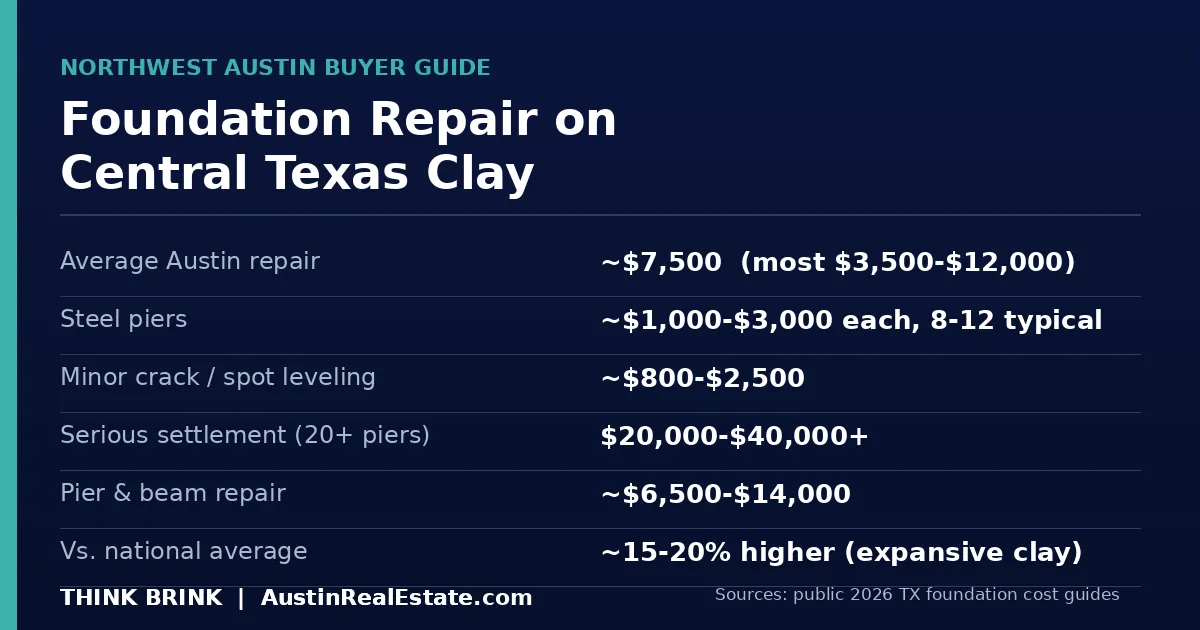
Central Texas makes this worse than average because our weather runs to extremes. We go through multi-year droughts followed by flooding rains. Each swing pushes the soil through another expansion or contraction cycle. That is why several public cost sources put Austin foundation repair pricing 15 to 20 percent above the national average - it is not that our contractors charge more for the fun of it, it is that our soil demands deeper piers to reach stable strata.
The Northwest Austin wrinkle nobody tells relocating buyers
Here is the part that matters specifically for the zip codes I work, and that most generic "Austin foundation" articles miss entirely. Northwest Austin does not sit uniformly on that deep black clay. The Balcones Fault runs through Austin and separates two very different worlds of dirt. East of the fault you get the deep, fertile, aggressively expansive Blackland Prairie clay. West of the fault - which is where a great deal of 78750, 78759, and 78726 lives - you are up on the edge of the Edwards Plateau, and the geology shifts to limestone with thinner, rockier soils over it.
What that means in practice: a house in the hilly western sections of Great Hills, Canyon Creek, or Spicewood Estates may be sitting on relatively shallow soil over limestone bedrock, which is a more stable platform than deep clay. That is genuinely good news, and it is one reason established Northwest Austin holds value the way it does. But it is not a free pass, for three reasons.
First, the fault zone itself is complicated. Right along the transition, limestone units and clay units are faulted together in a jumble, so two houses a few streets apart can sit on completely different soil. Second, even in limestone country you get clay pockets - in creek bottoms, in old drainage channels, in areas where fill dirt was brought in during construction. Third, thin soil over rock creates its own failure mode: if the soil is shallow and the drainage is bad, water moving across rock can undermine a slab edge even when there is not much clay to swell. So "we're on the limestone side" is a reason to be calmer, not a reason to skip the inspection.
The honest summary is this. If you are relocating from California or the Pacific Northwest and someone told you "all of Austin has terrible foundations," that is too broad. If a Texas native told you "you're up in the hills, foundations are fine here," that is too reassuring. The truth is address-specific, and the only way to know your address is to look at the actual house.
How common is foundation movement here, really
More common than buyers want to hear, and less catastrophic than the panic suggests. Public Austin foundation and inspection sources estimate that a large share of Austin homes show some degree of foundation movement over their lifespan, with something on the order of a third of Central Texas homes showing noticeable movement within their first couple of decades. The important word is "some degree." That bucket runs from a hairline crack that has not moved in fifteen years all the way to a corner that has dropped an inch and a half. Lumping those together is how buyers scare themselves out of good houses.
What I tell my buyers is that in this market, seeing a foundation note on an inspection or a disclosed prior repair is normal, not disqualifying. The skill is not avoiding every house that has ever moved. The skill is figuring out which movement is finished and stable, which is active and progressing, and which was already repaired correctly. Those are three different situations and they call for three different responses.
The signs that actually matter when you tour a house
You do not need to be an engineer to walk a Northwest Austin house intelligently. You need to know what to look at and, more importantly, what patterns mean. Here is what I check when I walk a listing with a buyer.
Doors and windows
Interior doors that will not latch, or that swing open or closed on their own, are one of the most reliable everyday tells. When a foundation shifts, it racks the frame out of square and the door stops fitting. One sticking door in a 40-year-old house is normal seasonal movement. Three or four doors that all bind in the same part of the house, in the same direction, is a pattern worth asking about.
Cracks, and which ones are noise
Hairline cracks radiating from the top corners of door and window frames are extremely common and usually cosmetic - drywall is brittle and every house in Texas has some. What I pay more attention to is a crack wider than about a quarter inch, a crack that runs on a diagonal across a wall, cracks that reopen after being patched, and separation where the wall meets the ceiling. Outside, look at the brick: stair-step cracks running through the mortar joints, and gaps opening up around the garage door frame, tell you the exterior wall has moved.
Floors
Sloping or bouncy floors, and tile or grout lines that have cracked in a long straight run, point to slab movement underneath. A marble or a golf ball is the old trick - set it down and watch whether it rolls decisively to one side. It is crude but it tells you something.
The stuff outside that causes the problem
This is the part buyers skip and I never do. Walk the perimeter. Is the soil graded to carry water away from the house, or toward it? Are the gutters actually moving water away, or dumping it at the corner of the slab? Are there large trees within striking distance of the foundation, pulling moisture out of the soil on one side? Most of what damages foundations here is a drainage or watering problem that could have been fixed for a few hundred dollars before it cost tens of thousands. When I see bad drainage on an otherwise sound house, I read it as a warning about the future, not just the past.
What foundation repair actually costs in the Austin area
Let me give you real numbers, with the honest caveat that these are ranges from public Central Texas contractor and cost-guide sources, not a quote on any specific house - every foundation is priced by pier count and depth to stable soil, so your number depends entirely on your house. With that said, here is the landscape as of 2026.
Published Austin cost guides put the average foundation repair somewhere in the mid four figures to around $7,500, with a typical range for most homeowners running roughly $3,500 to $12,000. The method most commonly used on Central Texas clay is steel piers driven down to stable strata, and public pricing runs on the order of $1,000 to $3,000 per pier, with an average slab home needing something like 8 to 12 piers. Do the math and a common full-perimeter or partial job lands in the high four figures to the low five figures.
The tails matter too. On the low end, a hairline crack injection or a small spot-leveling job can run in the hundreds to low thousands - public sources cite roughly $800 to $2,500 for minor work. On the high end, a house that has suffered serious settlement and needs 20 or more piers can climb from $20,000 to north of $40,000 depending on how deep the crews have to go to find stable ground. Pier and beam foundations, which are less common in the newer Northwest Austin housing stock but show up in older pockets, run their own range - public Austin guides put those repairs higher than slab work, often in the $6,500 to $14,000 band, because of the carpentry and access labor involved.
The practical takeaway for a buyer: when you see foundation movement, the question is not "is this bad" in the abstract. The question is "how many piers, how deep, and what does a written engineer's scope say it costs." A cracked wall tells you nothing about the bill. A structural engineer's report and a couple of contractor bids tell you everything.
How to handle a house that already has a disclosed repair
This is where Northwest Austin buyers make the biggest unforced errors, in both directions. A prior foundation repair is not automatically a red flag. In many cases it is the opposite - a house that was repaired correctly, by a reputable company, with an engineer's sign-off and a transferable lifetime warranty, can be a more predictable buy than an identical house next door that has never moved and might. But you have to verify the paperwork, and this is exactly where a lot of deals go sideways.
In Texas, a seller who has had foundation work done is required to disclose it on the Seller's Disclosure Notice, including who did the work and whether a transferable warranty exists. When you see that disclosure, here is your checklist. Get the name of the company that did the work and confirm they are still in business - a warranty from a company that folded is worth nothing. Get the actual warranty document and read whether it is transferable to you as the new owner, and just as important, whether there is a transfer deadline. Some warranties have to be transferred within a set window after closing - a common figure is around 90 days - and buyers who miss that deadline lose a warranty they thought they were inheriting. Get the engineer's report, if there was one, and any post-repair elevation survey showing the house came back within tolerance.
A repaired-and-warrantied foundation with an engineer's certification is, for most traditional buyers, the most reassuring version of a foundation history you can get. It means the movement already happened, a professional already addressed it, and someone stands behind the fix. What you are checking is that the fix was real and that the protection actually follows the house to you.
One note on scope: foundation and warranty questions have legal and financial consequences that go beyond what a broker should opine on. Have your inspector and, where warranted, a licensed structural engineer evaluate the house, and have your title company or a real estate attorney confirm the warranty transfer mechanics before you rely on them. I can quarterback the process and tell you what I have seen, but the certification and the legal language are theirs to give.
Does foundation history hurt resale value in Northwest Austin
Less than buyers fear, if it was handled right. In a market where a meaningful share of homes have some foundation history, a documented, warrantied, engineer-certified repair is not the scarlet letter people imagine. Buyers and their agents in 78750 and 78759 are sophisticated - many are tech relocators who research everything - and a clean repair file with transferable coverage reads as "this was addressed properly," not "this house is broken." What actually damages value is the opposite situation: visible, un-addressed movement with no paperwork, or a cheap patch job with no engineering behind it. That is what makes buyers nervous and drags out days on market.
If you are buying and planning to sell in five or ten years, the smart move is to keep the file. Every document you collect at purchase - the warranty, the transfer confirmation, the engineer's report, the elevation survey - is a document you hand the next buyer to make their decision easy. That is directly connected to how a partially updated or previously repaired home should be positioned when it sells, which I have written about in how to sell a partially updated Northwest Austin home without overpricing it.
New construction is not immune
Buyers shopping the newer product in the Apple corridor sometimes assume a brand-new slab is above all of this. It is not. New homes are built on the same soil, and a slab poured last year can still move if the drainage was done poorly or the lot was not prepped correctly. The difference is that new construction usually carries a builder's structural warranty, which is exactly the kind of protection you want to read carefully rather than assume. If you are weighing a new build, the same verify-the-paperwork discipline applies - I cover what to check in new construction warranties and inspections in the Apple corridor. And if you are comparing older established homes against new builds partly on this durability question, that tradeoff is the subject of mid-century versus 1980s and 1990s homes in North Austin.
What a foundation issue should and should not do to your offer
My rule of thumb: let the engineer's scope, not the drywall crack, drive your negotiation. If an inspection turns up movement, the right sequence is to bring in a structural engineer, get a written scope and a repair estimate, and then negotiate against a real number. Sellers respond to "the engineer's scope is 9 piers at roughly X dollars" in a way they never respond to "we're nervous about the foundation." A concrete figure turns a scary unknown into a line item you can credit, escrow, or split.
And sometimes the right answer is to keep going. A house on a good street, in the right school feeder, with a foundation that moved once, was repaired correctly, and carries a transferable warranty, can be a better buy than a pristine-looking house with terrible drainage that has not moved yet. The ground under both is the same Central Texas ground. The difference is which one has already dealt with it. Understanding the full carrying cost of a home here - taxes, insurance, and maintenance reserves for exactly this kind of thing - is part of buying with your eyes open, which I break down in what it actually costs to own a home in 78750 or 78759.
Frequently Asked Questions
Do all Austin homes have foundation problems?
No, but movement is common enough that it is a normal part of buying here rather than a rare defect. Public Austin sources estimate a large share of homes show some degree of foundation movement over their lifespan, with roughly a third showing noticeable movement within their first couple of decades. Most of that is minor and stable. The job when buying is not to avoid every house that has moved, it is to tell finished, stable movement apart from active movement and from a repair that was done correctly.
Is Northwest Austin better or worse than the rest of Austin for foundations?
Generally more forgiving in the hilly western sections, because a good deal of 78750, 78759, and 78726 sits west of the Balcones Fault on the Edwards Plateau, where soils are thinner and sit over limestone rather than the deep expansive Blackland clay found east of the fault. That is a more stable platform on average. It is not a guarantee, because the fault zone is complicated, clay pockets exist in creek bottoms and fill areas, and thin soil over rock has its own drainage-driven failure mode. Soil is address-specific, so inspect the actual house.
How much does foundation repair cost in the Austin area in 2026?
Public Central Texas cost guides put the average around the mid four figures to roughly $7,500, with most jobs falling between about $3,500 and $12,000. Steel piers, the common method on our clay, run roughly $1,000 to $3,000 each and an average slab home may need 8 to 12 of them. Minor crack or spot-leveling work can be in the hundreds to low thousands, while serious settlement needing 20-plus piers can run $20,000 to over $40,000. These are ranges, not a quote - your number depends on pier count and depth to stable soil on your specific lot.
Should I walk away from a house that has had foundation repair?
Not automatically, and often not at all. A repair done by a reputable company with an engineer's certification and a transferable lifetime warranty can make a house more predictable than one that has never moved. Verify three things: that the company is still in business, that the warranty transfers to you and within any required deadline, and that there is engineering documentation of the repair. A verified, warrantied repair is reassuring. An undocumented patch is the one to worry about.
Does a foundation repair transfer to me when I buy the house?
Only if the warranty is transferable and you complete the transfer correctly. In Texas the seller must disclose prior foundation work and whether a transferable warranty exists. Many warranties can be transferred to a new owner but require action within a set window after closing - a commonly cited figure is around 90 days - and missing that deadline can void coverage you assumed you had. Get the warranty document, confirm the transfer terms, and have your title company or a real estate attorney handle the mechanics. This is a legal and financial matter, so confirm it with the appropriate professional rather than assuming.
What are the first signs of foundation trouble I can see myself?
Multiple interior doors binding or failing to latch in the same area, diagonal cracks wider than about a quarter inch, cracks that reopen after being patched, separation where walls meet ceilings, stair-step cracks in exterior brick mortar, sloping or bouncy floors, and long straight cracks in tile or grout. Just as important, look outside for the cause: poor grading that sends water toward the slab, gutters dumping at the corners, and large trees pulling moisture from one side of the house.
Will trees near the house cause foundation problems?
They can, on expansive soil, because a large tree pulls significant moisture out of the ground on its side of the house, causing that soil to shrink while the other side stays stable - and uneven soil moisture is what moves slabs. This is more of a factor where there is real clay in the soil. It does not mean cut down every oak, but it does mean that a big tree close to the foundation raises the importance of consistent watering and good drainage, especially during our drought cycles.
Can I prevent foundation movement on a home I buy?
You cannot change the soil, but you can control the moisture cycle that drives most movement, and that is most of the battle here. Keep drainage carrying water away from the slab, keep gutters clean and extended away from the corners, water the foundation perimeter consistently during droughts so the soil does not shrink hard on one side, and address plumbing leaks quickly. A lot of Central Texas foundation damage traces back to a drainage or watering problem that would have cost a few hundred dollars to fix before it became a five-figure repair.
The honest bottom line
Foundation movement is a real feature of buying in Central Texas, and Northwest Austin's position on the limestone edge of the Edwards Plateau makes the western hill sections more forgiving than the deep-clay areas east of the fault - but forgiving is not the same as exempt. Do not let a hairline crack scare you off a good house, and do not let "it's on the limestone side" talk you out of a real inspection. Bring in a structural engineer when movement shows up, negotiate against a written scope rather than a feeling, and treat a documented, warrantied prior repair as the reassurance it usually is. The buyers who get hurt here are the ones who either panic or shrug. The ones who do well look at the actual dirt under the actual house, read the paperwork, and price the risk instead of fearing it.
If you are weighing a specific Northwest Austin house and want a read on how its foundation history should factor into your offer, that is exactly the kind of call I am glad to walk through before you write anything.
