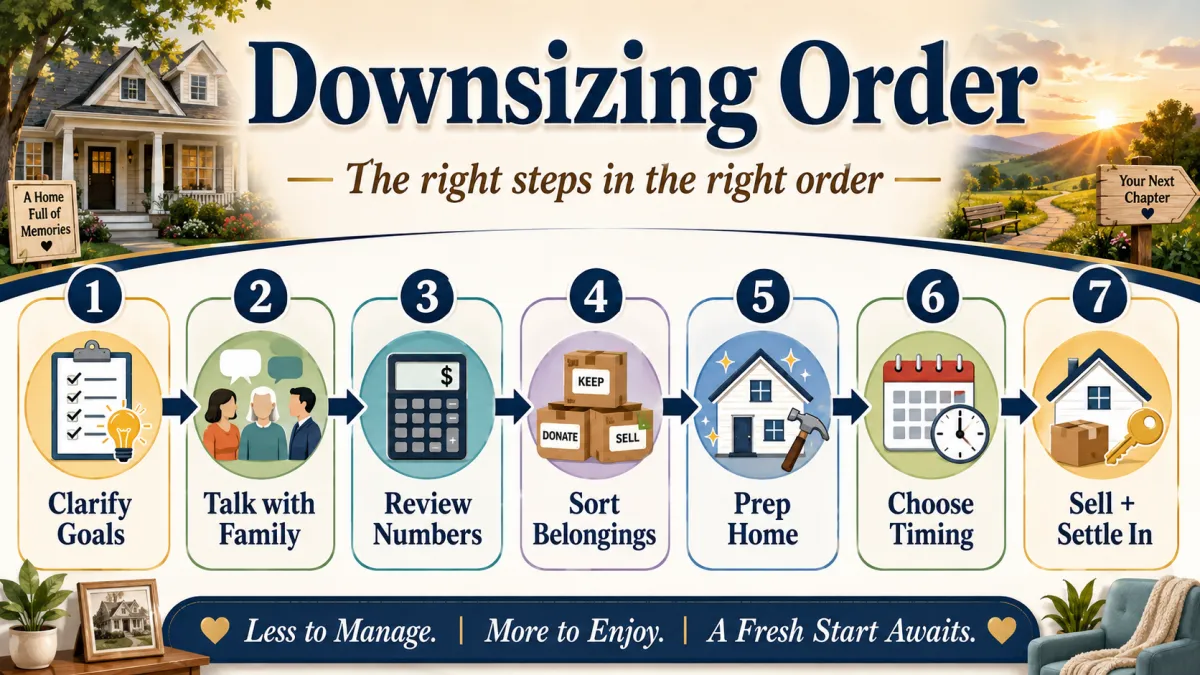
What Is the Best Order of Steps for Downsizing From a Longtime Home?
Downsizing from a longtime home can feel overwhelming because everything seems connected.
You may be trying to figure out where to move, what to do with decades of belongings, whether to fix up the house, how much the home is worth, whether to buy first or sell first, what adult children should be involved in, and how to avoid making a decision you regret.
That is a lot.
And when everything feels equally urgent, it is easy to freeze.
The mistake many people make is trying to solve the whole move at once. They start looking at homes before they know what they actually need. Or they call contractors before deciding whether updates are worth doing. Or they start sorting family photos before they have built any momentum. Or they list the house before knowing where they will go next.
A smoother downsizing move usually comes from doing things in the right order. Not perfectly, just in a sequence that reduces stress instead of creating more of it.
Should You Keep the Family Home as a Rental or Sell It?
Why the order matters
When you have lived in a home for 20, 30, or 40 years, downsizing is not just a move.
It is a project.
It may include:
deciding whether the current home still fits
sorting decades of belongings
talking with adult children
understanding the home’s value
deciding what to fix before selling
evaluating property taxes and next-home costs
choosing where to move
deciding whether to buy first, sell first, or rent temporarily
preparing the home for photos, showings, and inspection
moving into a new place and setting it up for the next chapter
If you do those steps out of order, the process gets harder.
For example, if you start shopping for homes before you know whether you want one-story living, lower maintenance, family proximity, or familiar routines, every listing can feel confusing.
If you start remodeling before you know your likely buyer pool, you may spend money in the wrong places.
If you wait to sort belongings until after the house is under contract, the move can become chaotic.
The right order helps you protect your time, money, energy, and peace of mind.
How to Sell a Parent’s Home in Austin Without Overwhelming the Family
Step 1: Decide what problem downsizing is supposed to solve
Before you look at homes, call movers, or start repairs, get clear on why you are considering downsizing.
Ask yourself:
Is the house too large?
Are stairs becoming an issue?
Is the yard too much?
Are repairs becoming stressful?
Do you want to be closer to adult children or grandkids?
Do you feel isolated?
Are you using only part of the home?
Do you want more freedom to travel?
Do you want a lower-maintenance lifestyle?
Are you thinking ahead before the home becomes truly difficult?
This matters because the next home should solve the actual problem.
If the problem is stairs, a smaller two-story townhome may not help.
If the problem is yard work, a smaller detached house with a demanding lot may not help.
If the problem is family distance, staying in the same exact neighborhood may not help.
If the problem is maintenance, moving into another older home with aging systems may not help.
Downsizing works best when you are clear about what you are trying to make easier.
Step 2: Decide what you want to keep close
Downsizing is not only about what you want to leave behind.
It is also about what you want to protect.
For many longtime Austin homeowners, especially in Northwest Austin, the most important things may include:
family
doctors
grocery stores
church or community
friends
favorite restaurants
familiar roads
mature trees
a neighborhood feel that still feels like home
access to The Domain, Arboretum, Gateway, 183, MoPac, or Parmer
proximity to adult children or grandkids
This is where many people realize they do not necessarily want to leave the area. They want to leave the burden of the current house.
That is a very different goal.
Before deciding where to move, write down what you want to keep close. Then decide which things are truly essential and which are simply preferred.
That list becomes a filter for the next-home search.
What Happens If Your Adult Children Disagree About Selling the Family Home?
Step 3: Have the family conversation early
If adult children are involved, do not wait until the house is already being photographed to tell them you are thinking about selling.
Give the conversation time.
That does not mean adult children get to decide for you. But if the home has been in the family for decades, the decision may affect them emotionally and practically.
Good early questions include:
What items in the home matter to you?
Are there family pieces you truly want?
Can you pick them up by a specific date?
Would being closer to you matter in the next move?
Are there concerns you think we should discuss?
How can you help without taking over?
The goal is to avoid surprises.
A family conversation does not need to become a family vote. But it should create clarity before the process gets too far along.
Step 4: Understand your current home’s likely value
You do not need to be ready to list in order to understand your home’s likely value.
This is an important early step because it affects almost every other decision.
Your home’s value may shape:
where you can move next
whether you buy before selling
whether you need sale proceeds to purchase
how much you should spend on repairs
whether selling as-is makes sense
whether renting first is realistic
what your financial next chapter looks like
For longtime homeowners, this step can also be clarifying emotionally.
Sometimes people assume their home is worth less because it is dated. But in established Northwest Austin neighborhoods, location, lot, trees, and renovation potential may still carry strong value.
Other times, homeowners assume the market will overlook condition more than it actually will. Either way, having a realistic value conversation early helps you plan with facts instead of guesses.
Should You Move Closer to Your Adult Children When You Downsize?
Step 5: Review your financial and property tax picture
Before choosing the next home, understand the financial picture.
This may include:
current mortgage balance, if any
estimated net proceeds after sale
expected selling costs
next-home budget
cash reserves
property taxes
insurance
HOA dues
maintenance costs
moving costs
whether you need financing
whether you need sale proceeds before buying
In Texas, property taxes deserve special attention.
A smaller home does not automatically mean a smaller tax bill. If you have a homestead exemption, over-65 exemption, or school tax ceiling, you should understand how a move may affect your next property tax situation.
This is also where it may make sense to talk with a CPA, financial advisor, estate attorney, or lender, depending on your situation.
The point is not to make the process complicated.
The point is to avoid being surprised later.
Step 6: Start sorting belongings before you are under pressure
This is one of the most important steps.
For many longtime homeowners, belongings take longer than the real estate transaction.
Do not wait until the home is listed.
Start with easy categories:
expired items
duplicate kitchen items
old paperwork
worn linens
broken tools
unused garage items
old electronics
things no one has touched in years
Do not start with:
family photos
heirlooms
sentimental letters
children’s keepsakes
the most emotional rooms
Build momentum first.
Use four categories:
keep
family
donate or sell
discard
That is enough.
The first goal is not to finish the whole house. The first goal is to break the paralysis.
What If Your Northwest Austin Home Needs Too Much Work to Sell?
Step 7: Decide whether you need outside help
Downsizing from a longtime home can be a bigger project than most people expect.
Depending on your situation, you may need:
professional organizer
Senior Move Manager
estate sale company
donation pickup
junk removal
handyman
cleaner
mover
painter
roofer
HVAC technician
financial advisor
attorney
CPA
Not everyone needs all of that.
But if the home is full, the move feels emotionally heavy, adult children are busy or out of town, or there is a firm timeline, professional help can keep the process from becoming overwhelming.
There is no prize for doing a difficult move the hardest possible way.
Step 8: Decide what to fix, what to price in, and what to leave alone
Once the home is decluttered enough to see clearly, then you can make better preparation decisions.
Do not begin with a major remodel just because the home feels dated.
Instead, ask:
What will scare buyers?
What will show poorly in photos?
What will come up during inspection?
What is inexpensive but high-impact?
What would buyers likely update anyway?
What repairs are better handled through pricing or disclosure?
What projects would delay the sale without improving the outcome?
For many longtime homes, the best strategy is selective preparation:
clean deeply
declutter
improve lighting
clean up landscaping
address obvious safety or function issues
fix small items that make the home feel neglected
avoid major renovations unless the numbers clearly support it
The goal is not perfection.
The goal is buyer confidence.
What People Don’t Know About Downsizing in Northwest Austin
Step 9: Choose the next-home strategy before listing
Before the current home goes live, you should have a next-step plan.
You do not need every detail finalized, but you do need to understand the likely path.
Common options include:
Sell first, then buy
This gives you financial clarity but may create pressure to find the next home quickly.
Buy first, then sell
This can reduce pressure on the next-home search, but it requires financial flexibility.
Sell and rent temporarily
This can create breathing room if you are unsure where you want to live next.
Sell with a leaseback
This may give you extra time after closing, depending on the buyer and contract terms.
Stay for now and prepare gradually
This may make sense if the home is still manageable and the right next option is not available yet.
The key is to know which timing risks you are willing to accept.
Some people fear carrying two homes.
Others fear selling and having nowhere to go.
Your strategy should match your financial reality and your personality.
Step 10: Narrow the next-home search by lifestyle, not just price
Now the search becomes much clearer.
Instead of asking, “What can I buy?” ask:
“What kind of home will make daily life easier?”
That may mean:
one-story home
smaller detached house
patio home
townhome
condo
lock-and-leave setup
smaller yard
closer to adult children
closer to doctors
lower-maintenance community
same neighborhood, different house
nearby neighborhood, better layout
Cedar Park, Round Rock, Georgetown, or Avery Ranch if the map fits better
Do not let price be the only filter.
The best downsizing home is not always the cheapest or smallest. It is the home that reduces the right burdens while preserving what still matters.
Should You Downsize to a Condo, Townhome, Patio Home, or Smaller House in Northwest Austin?
Step 11: Prepare the home for listing
Once the plan is clear, prepare the home for the market.
This may include:
final decluttering
cleaning
landscaping
light repairs
staging adjustments
photography
disclosure preparation
gathering repair documentation
pricing strategy
marketing plan
This is where all the early work begins to pay off.
A home that has been thoughtfully prepared is easier to photograph, easier to show, and easier for buyers to understand.
This is especially important if the home is older or dated.
The presentation should help buyers see the value, not just the work.
Step 12: List, negotiate, and protect timing
Once the home is listed, the goal is not only to get an offer.
It is to get an offer that works.
That means paying attention to:
price
financing strength
option period
inspection risk
closing date
leaseback needs
buyer flexibility
repair expectations
your next-home timing
For downsizers, terms can matter almost as much as price.
A slightly higher offer with difficult timing may be less attractive than a strong offer that gives you the transition you need.
The best offer is the one that supports the full move, not just the sale price.
Cedar Park vs Round Rock for Downsizers: Which Fits the Next Chapter Better?
Step 13: Move thoughtfully into the next home
The move is not over when the old home closes.
The next home still needs to work.
That may mean:
unpacking intentionally
setting up the kitchen first
arranging furniture for ease and safety
installing better lighting
adding grab bars or other safety features
choosing storage systems
deciding what not to bring back out of boxes
making the home feel familiar without overcrowding it
This is where many people realize downsizing is not about losing things.
It is about keeping what supports the next chapter.
When Is the Right Time to Downsize Your Northwest Austin Home?
A simple order of steps
Here is the clean version:
1. Clarify why you are downsizing
Know what problem the move is supposed to solve.
2. Decide what you want to keep close
Family, routines, doctors, neighborhood feel, community, familiar roads.
3. Talk with family early
Include adult children without turning the decision into a vote.
4. Understand your home’s value
Use realistic numbers before making big decisions.
5. Review finances and property taxes
Know the likely cost of leaving, landing, and living in the next home.
6. Start sorting belongings
Begin with low-emotion areas and build momentum.
7. Decide whether you need help
Organizer, Senior Move Manager, estate sale, junk removal, handyman, or other support.
8. Choose what to fix or not fix
Focus on buyer confidence, not perfection.
9. Build the buy/sell/rent strategy
Do not list without a next-step plan.
10. Narrow the next-home search
Prioritize lifestyle fit, layout, maintenance, and location.
11. Prepare the current home for listing
Clean, declutter, photograph, price, and market intentionally.
12. Negotiate with timing in mind
The best offer supports the full transition.
13. Settle into the next home
Make the new home easier, safer, and more aligned with your life now.
What happens when people do this out of order?
The process gets harder.
Common examples:
Shopping too soon
You look at homes before knowing what you need. Everything feels confusing.
Repairing too soon
You spend money before knowing whether buyers will value the improvements.
Listing too soon
You get an offer but do not know where you are going.
Sorting too late
You are under contract and suddenly trying to clear 30 years of belongings in three weeks.
Ignoring taxes too long
You buy a smaller home and discover the total cost is not what you expected.
Leaving family out too long
Adult children react emotionally because they feel blindsided.
The right sequence prevents a lot of this.
What if you are not ready to sell yet?
That is okay.
You can still start.
You can:
clarify what you would want next
lightly declutter
learn your home’s value
understand property taxes
talk with adult children
watch homes in the areas you might consider
identify what repairs may matter eventually
think through whether you would buy, sell, or rent first
Starting does not mean selling tomorrow.
It means giving future you more options.
What if the move is urgent?
Sometimes families do not have the luxury of a long timeline.
A health change, loss of a spouse, safety issue, or financial pressure may compress the process.
In that case, the order still matters, but the plan may need to simplify.
You may need to:
sell more as-is
hire more professional help
focus only on essential belongings
rent temporarily
use one family point person
prioritize safety and speed over perfection
make decisions with the best information available
A rushed move can still be handled well, but it usually requires clearer roles and more help.
What Costs Should You Expect When Downsizing in Texas?
The common mistake people make
The biggest mistake is treating downsizing as one giant decision.
It is not.
It is a series of smaller decisions that need to happen in the right order.
When you break it down, the process becomes much less overwhelming.
You do not have to solve everything today.
You just need to know the next right step.
Should You Hire a Senior Move Manager When Downsizing in Austin?
My practical take
If you are downsizing from a longtime home, the best order is:
First, define the life you want next.
Then understand the financial reality.
Then start reducing the belongings burden.
Then decide how much preparation the current home needs.
Then build the timing strategy.
Then sell and move.
That sequence protects the homeowner from the two biggest downsizing mistakes: rushing the move or avoiding it until the move becomes a crisis.
Should You Rent First After Selling a Longtime Home in Northwest Austin?
Final thought
Downsizing from a longtime home is not simple, but it can be manageable.
The key is doing the right things in the right order.
Start with why the move matters. Decide what you want to keep close. Talk with family early. Understand your numbers. Start sorting before pressure builds. Choose repairs strategically. Build a buy/sell/rent plan. Then list the home with a clear path forward.
A good downsizing plan does not just help you sell a house.
It helps you move into the next chapter with more clarity, control, and peace of mind.
How Long Does Downsizing Usually Take in Austin? A Realistic Timeline for Longtime Homeowners
Watch the Downsizing with Dignity Video Series
FAQ
What is the first step in downsizing from a longtime home?
The first step is deciding what problem downsizing is supposed to solve. Before looking at homes or making repairs, clarify whether you are trying to reduce stairs, yard work, maintenance, unused space, isolation, family distance, or overall stress.
When should I start sorting belongings before downsizing?
Start as early as possible, ideally before the home is listed. Begin with low-emotion areas like paperwork, duplicate kitchen items, expired products, garage clutter, and unused household goods.
Should I fix up my home before deciding where to move?
Not necessarily. First understand your home’s value, likely buyer pool, and next-home plan. Then decide which repairs or updates are worth doing before listing.
Should I talk to adult children before selling the family home?
Usually, yes. Adult children do not necessarily get to decide, but early conversations can reduce surprises, clarify family belongings, and create better support during the move.
Should I buy first or sell first when downsizing?
It depends on your finances, risk tolerance, and how specific your next-home needs are. Some people sell first, some buy first, some rent temporarily, and some negotiate a leaseback.
How do I avoid feeling overwhelmed by downsizing?
Break the process into phases: clarify goals, review finances, sort belongings, decide home prep, choose timing strategy, list the home, and settle into the next place. Do not try to solve everything at once.
