What Northwest Austin Buyers Should Know About Wood-Shake and Aging Roofs on the Wildland Edge
If you are shopping for a home on the western and northwestern edges of Austin, the neighborhoods that sit up against the hill country and the Balcones Canyonlands Preserve, you will eventually walk into a beautiful older home with a wood-shake or an aging roof and fall a little in love with it. Then you will call to get an insurance quote and the conversation will get complicated fast. This post is the thing I wish more buyers understood before they wrote an offer on one of these homes, because the roof on a wildland-edge property is not just a maintenance line item. It can be the difference between a home you can insure affordably and a home you cannot insure at all.
I am going to walk through why wood-shake roofs became a problem, how insurers treat them now, what an aging roof of any material does to your coverage and your closing, and exactly what to check and price before you remove your option period. This is a condition-and-cost guide, not a scare piece. Plenty of these homes are worth buying. You just need to buy them with the roof math done in advance.
Why Wood-Shake Roofs Became an Insurance Problem
Wood-shake and wood-shingle roofs were popular in parts of Texas through the 1980s and 1990s. They looked the part on a hill country home, they carried a certain status, and some homeowner associations of that era actually required them. The problem is fire. Wood roofing is a known ignition source, and burning embers from a nearby fire can travel on the wind and land on a wood roof and start a new fire well ahead of the original flames. In its natural state, cedar shake carries a Class C fire rating, the lowest common rating, and while pressure-treated products with fire-resistant underlayment can reach Class B or even Class A, the base material is still combustible.
The insurance industry learned this lesson expensively. After major fire events, insurers across fire-prone regions moved away from writing coverage on wood-shingle roofs, in some markets stopping within a year or two of a bad fire. The trend has only accelerated. Insurers in wildfire-exposed areas are increasingly declining to renew or write policies on homes with real wood-shake roofing, tightening requirements, and pushing homeowners toward Class A non-combustible roof coverings.
For a buyer on Austin's wildland edge, this history matters because a lot of the character homes in these neighborhoods still wear their original or second-generation wood roofs. A roof that was a selling point in 1992 can be an underwriting problem in 2026.
What the Wildland Edge Means for Your Risk Profile
Austin's western and northwestern neighborhoods that back to the Balcones Canyonlands Preserve, the greenbelts, and the undeveloped hill country sit in what is called the wildland-urban interface. It is exactly the setting people move to Austin for, the trees, the canyon views, the sense of being in nature. It is also the setting where wildfire exposure is real, and insurers price that exposure into every policy.
Two homes with identical square footage and identical roofs can get very different insurance treatment based on how close they sit to undeveloped land, how much vegetation touches the structure, and how defensible the lot is. A buyer cannot change the location, but the buyer absolutely can and should understand how the location plus the roof combine, because that combination is what an underwriter is actually pricing. I cover the broader version of this in my post on wildfire risk and insurance on the Northwest Austin wildland edge, and this roof-specific guide is the companion to it.
How Insurers Treat Roofs Today
Roof material and roof age are two of the biggest single factors in whether a home is insurable and at what price. Here is how the pieces fit together.
Material
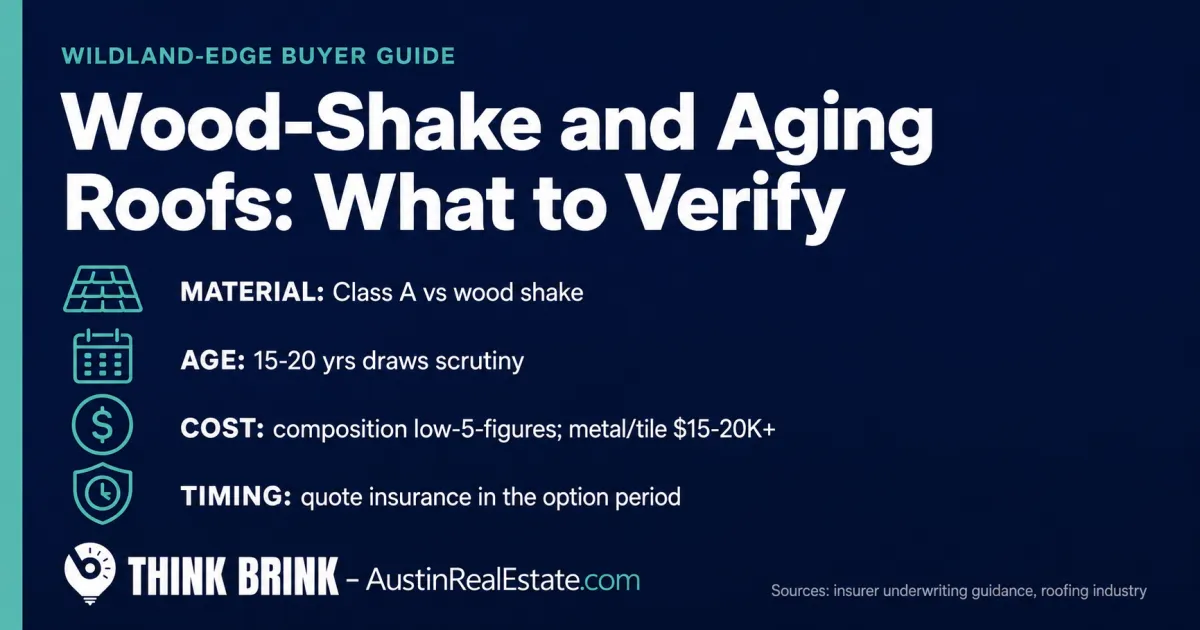
Class A non-combustible roof coverings, standing-seam metal, concrete or clay tile, and Class A rated asphalt-fiberglass composition shingles, are what insurers want to see on a wildland-edge home. Wood shake in its natural, untreated state is the hardest to insure and the most likely to trigger a non-renewal or a decline. A treated wood product with documentation of its fire rating sits in between and may still face resistance depending on the carrier.
Age and Condition
Even a non-combustible roof gets scrutinized on age. Many carriers will not write a policy on a roof past a certain age, often somewhere in the 15-to-20-year range for composition shingle, without an inspection, a reduced settlement basis, or an outright requirement that it be replaced. A roof that is nearing the end of its service life can force a buyer into replacing it as a condition of getting coverage, sometimes before closing.
Settlement Basis
This is the detail that surprises people most. Insurers increasingly cover older roofs on an actual-cash-value basis rather than replacement-cost basis, meaning they depreciate the roof and pay out far less than what a new roof costs if it is damaged. A buyer who assumes a claim will simply "replace the roof" can be badly wrong on an older roof, and that difference should factor into the price you are willing to pay for the home.
What a Replacement Actually Costs
If a home you love has a roof that has to be dealt with, price it honestly before you offer, because the range is wide. A Class A asphalt-fiberglass composition shingle roof on a typical home commonly runs in the range of several thousand to low five figures, while a non-combustible upgrade to standing-seam metal or tile can run from the mid-teens to north of twenty thousand dollars depending on size, pitch, and complexity. These are general ranges, and a hill country home with a steep, cut-up roofline and multiple stories sits at the higher end of any estimate.
The point is not the exact number, which a roofer needs to give you for the specific home. The point is that this is a real, sometimes large, capital cost, and it belongs in your offer math rather than in a surprise conversation after you own the house. When I represent a buyer on one of these homes, we get a roofer out during the option period and we treat the replacement cost as a negotiating item, either a price reduction, a seller-funded replacement, or a credit at closing.
How This Plays Out at Closing
Here is the sequence that catches unprepared buyers. You go under contract on a beautiful older home. You are excited, the inspection looks fine structurally, and then you go to bind insurance a week before closing, and the carrier either declines the roof, quotes a premium far above what you budgeted, or requires the roof be replaced before they will write the policy. Now you are up against your closing date trying to solve a five-figure problem, and your negotiating leverage is gone because you already fell in love and the clock is running.
The fix is simple and it is all about sequence. Get the insurance conversation started at the very beginning of the option period, not the end. On any wildland-edge home, and on any home with a wood-shake or visibly aged roof anywhere in these neighborhoods, treat the insurance quote as a core inspection item with the same weight as the structural inspection. If the roof is going to be a problem, you want to know while you still have an option period and full negotiating leverage, not after.
This is the same discipline I recommend for verifying other big-ticket conditions before closing. My guide to new construction warranties and inspections makes the same sequencing argument for newer homes, and my post on foundation repair on Central Texas clay covers the other condition item that most deserves a pre-offer read out here.
The Case For Buying the Home Anyway
I do not want this to read as "avoid older homes on the edge," because that would be bad advice. Some of the best-located, most characterful homes in Austin sit on the wildland edge with roofs that need attention. A roof is a solvable problem. It has a knowable cost, the fix is a one-time capital expense, and a new Class A roof actually improves your insurability and can lower your premium going forward. If you price the roof correctly and negotiate it into the deal, you can end up owning a wonderful home with a brand-new, fully insurable roof for a total cost that still beats the alternatives.
The buyers who get burned, so to speak, are the ones who ignore the roof, assume insurance is a formality, and discover the problem too late to negotiate. The buyers who do well are the ones who treat the roof as a line item from day one and use it as leverage. Same house, very different outcome, entirely driven by preparation.
There is also a resale angle that is easy to overlook. If you buy a home with a problem roof and do not address it, you inherit the same headache you are learning about now when it is your turn to sell, because the next buyer's insurance quote will run into the same wall. A home with a documented, recent Class A roof is simply easier to sell on the wildland edge than one with an aging wood-shake roof and a stack of coverage caveats. Solving the roof is not only about your own premium and peace of mind; it protects the home's marketability for the day you list it. That is one more reason to treat the fix as an investment in the property rather than a grudging expense, and to keep the paperwork, the installation date, the warranty, and the fire rating, in a place you can hand to the next buyer's agent.
What to Check Before You Offer
- Identify the roof material and its fire rating. Wood shake in its natural state is the hardest to insure. If it is a treated product, ask for documentation of the fire rating.
- Establish the roof age. Ask the seller for the installation date and any warranty. A roof past 15 to 20 years, regardless of material, will draw insurer scrutiny.
- Get a real insurance quote for the specific address during the option period, not a generic estimate, and ask directly how the roof material and age affect coverage, premium, and settlement basis.
- Get a roofer out before the option period ends and get a written replacement estimate for the specific roofline, so you have a real number to negotiate with.
- Ask about defensible space, vegetation clearance, deck screening, and vent construction, since these affect wildfire underwriting alongside the roof.
- Confirm whether coverage is replacement-cost or actual-cash-value on the roof, because on an older roof that distinction can be worth many thousands of dollars in a claim.
Frequently Asked Questions
Can you still get homeowners insurance on a house with a wood-shake roof in Texas?
Sometimes, but it is increasingly difficult, especially on the wildland edge. Many carriers decline natural wood-shake roofs outright or require replacement before they will write a policy, because wood roofing is a known fire risk. Treated products with documented Class A or B ratings fare better but can still face resistance. Get a specific quote for the exact home before you commit.
How old can a roof be before insurance companies refuse to cover it?
It varies by carrier, but many will scrutinize or decline composition-shingle roofs past roughly 15 to 20 years without an inspection or replacement, and some will only cover an older roof on an actual-cash-value basis rather than full replacement cost. Ask the specific carrier for their roof-age rules before you assume coverage.
What is the difference between actual-cash-value and replacement-cost coverage on a roof?
Replacement cost pays to replace the damaged roof with a new one. Actual cash value depreciates the roof for its age and pays out far less. On an older roof, insurers increasingly default to actual cash value, which means a claim may not come close to funding a new roof. This distinction should factor into what you pay for a home with an aging roof.
Should I ask the seller to replace the roof before closing?
It is one of several options, along with a price reduction or a closing credit. If insurance underwriting requires a new roof before the policy will bind, replacement may be necessary to close at all. The key is to surface the issue early in the option period so you have leverage and time to negotiate rather than scrambling against the closing date.
Does a wildland-edge location by itself make a home hard to insure?
Location is one factor, and it interacts with the home's construction. A home close to undeveloped land with heavy vegetation and a combustible roof is much harder to insure than a similarly located home with a Class A roof and good defensible space. You cannot change the location, but you can control the roof and the clearance, which is a large part of what underwriters price.
Is it worth replacing a wood-shake roof with metal or tile?
Often, yes, on a wildland-edge home. A Class A non-combustible roof improves insurability and can lower your premium, and it removes the single biggest fire-related liability on the structure. Metal and tile cost more up front than composition shingle, but they last longer and address the underwriting problem directly. Weigh the up-front cost against years of higher premiums or coverage difficulty.
How much should I budget to replace a roof on a hill country home?
Ranges are wide and roofline-dependent. A Class A composition-shingle roof commonly runs from several thousand to low five figures, while standing-seam metal or tile can run from the mid-teens to north of twenty thousand dollars, with steep, complex, multi-story rooflines at the higher end. Get a written estimate for the specific home rather than relying on a general figure.
When in the buying process should I deal with the roof and insurance?
At the very beginning of your option period. Treat the insurance quote and a roofer's estimate as core inspection items, on par with the structural inspection. Surfacing a roof or coverage problem while you still have your option period preserves your leverage and your ability to walk away, which you lose once the option period ends.
The Honest Summary
A wood-shake or aging roof on a wildland-edge home is not a dealbreaker, but it is a decision you have to make with the numbers in front of you. The roof drives insurability, insurability drives whether you can even close, and the replacement cost is real money that belongs in your offer, not in a post-closing surprise. Buyers who treat the roof as a first-week item, get a real insurance quote and a roofer's estimate during the option period, and negotiate the cost into the deal tend to end up happy, often with a brand-new, fully insurable roof on a home they love. Buyers who assume insurance is a formality are the ones who get caught. Do the roof math early, and most of these homes stay very much worth buying. If you are looking at a specific home on the edge and want a read on the roof and insurance picture before you write, that is exactly the kind of thing I help clients sort out before the option clock starts.
Note: Insurance availability, pricing, and roof-age rules vary by carrier and are property-specific; confirm coverage with a licensed insurance professional and get roof estimates from a licensed roofer during your option period. This is general information, not insurance or tax advice.
