What Project Connect and CapMetro Actually Mean for Northwest Austin Commutes
If you have been reading about Austin's multibillion-dollar transit build-out and wondering what it means for a house in 78750, 78759, or 78726, here is the short version most coverage buries: the light rail everyone is arguing about does not come to Northwest Austin. Not in the first phase, and not in any funded part of the plan. What the established Northwest Austin footprint actually gets from Project Connect is quieter, more modest, and worth understanding before you pay a dime of "transit premium" for a home out here.
I sell in the 78750, 78759, and 78726 corridor, and relocating buyers in particular arrive with a mental map of Austin transit that does not match the ground. Someone moving from Seattle or the Bay Area sees "Austin is building light rail" and assumes it will work the way rail works there. It will not, at least not for this part of town. Let me walk through what is real, what is years away, and what it should and should not change about where you buy.
What Project Connect actually is
Project Connect is the transit expansion program Austin voters approved in 2020. It is not one project. It bundles a light rail line, improvements to the existing commuter rail, new and expanded MetroRapid bus routes, park-and-rides, and supporting infrastructure. When people say "Project Connect" they usually mean the light rail, because that is the expensive, contested piece. But for Northwest Austin, the light rail is the least relevant part of the program, and the bus and commuter-rail pieces are where the actual, if limited, benefit lives.
The program has cleared some real milestones recently. The Federal Transit Administration granted the light rail plan environmental clearance in early 2026, which matters because federal money is expected to cover a large share of the cost. Shortly after, the Austin Transit Partnership awarded a construction contract to begin the early work. Those are genuine steps forward. They also do not change the fact that trains will not be carrying passengers for years, and the projected opening date has already moved once.
Where the light rail actually goes, and where it does not
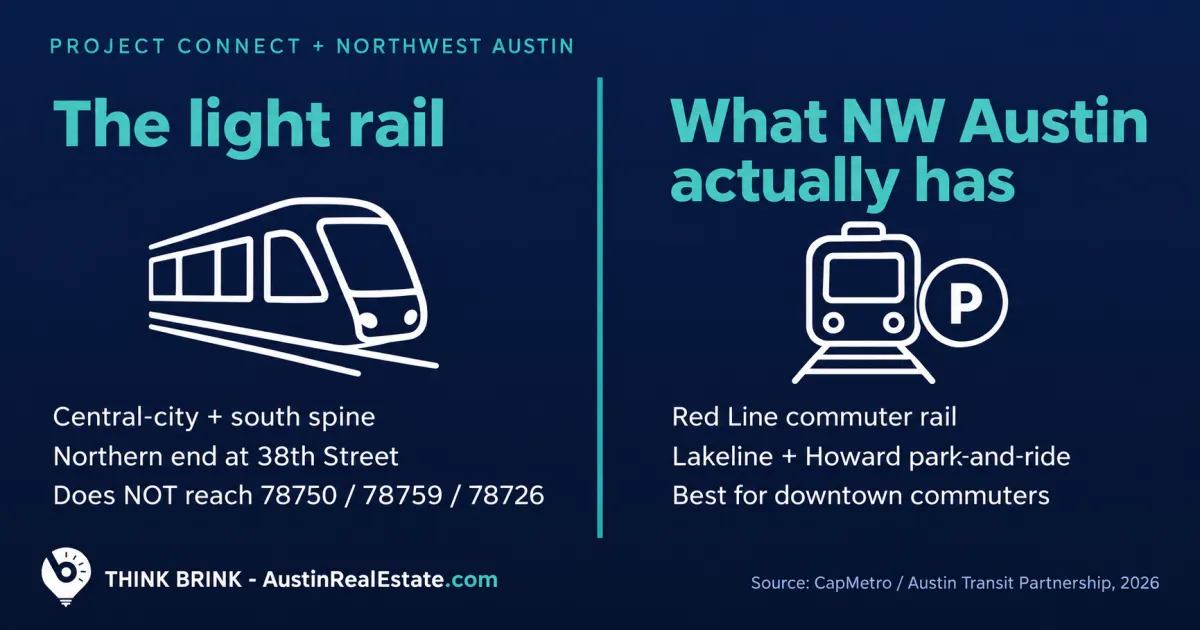
The first phase of the light rail is a roughly 9.8-mile surface line with about 15 stations. It runs from around 38th Street and Guadalupe in central Austin, south through downtown, across Lady Bird Lake on a new bridge, and then splits toward South Congress and toward East Riverside near the airport. Read that route again and notice what is missing: it is a central-city and south/southeast spine. Its northern end is 38th Street.
38th Street is not Northwest Austin. From Spicewood Estates, Great Hills, Canyon Creek, or Balcones Woods, the northern terminus of the first light rail line is a drive down MoPac before you ever reach a platform. The full long-range vision does show an eventual northern anchor at the North Lamar Transit Center, out near US 183 and North Lamar, but that is a future phase that is not funded or under construction, and even that point sits at the southeastern edge of the tech corridor, not in the 78750/78759/78726 core.
So the honest statement for a Northwest Austin buyer is simple. The light rail is not a Northwest Austin amenity. If a listing agent, a builder, or a relocation package implies that buying in this part of town puts you near the new train, that is not accurate, and you should not pay for it.
What Northwest Austin does have: the Red Line
The piece of the rail system that touches Northwest Austin already exists. It is the Red Line, Capital MetroRail's commuter rail running between Leander and downtown Austin. It has about ten stations, and the ones relevant to this side of town are Lakeline and Howard, with Kramer and the newer McKalla station sitting a bit further in toward North Burnet and the Domain area.
Lakeline Station is the one most Northwest Austin buyers can realistically use. It sits near the 183, 620, and Lakeline Boulevard junction on the far northwest edge, and it has a park-and-ride. The model is straightforward: you drive to the station, park, and take the train downtown. For someone who works a fairly standard schedule in the central business district, that can be a real alternative to fighting MoPac or I-35 every day. Howard Station, off Howard Lane, serves the same function a little further south and east.
Be clear-eyed about what commuter rail is, though. The Red Line runs on a commuter schedule, not the every-few-minutes frequency of an urban subway. It is built around peak-hour downtown trips. If your work is at the Apple campus on Parmer, at the Domain, along the 183 tech corridor, or anywhere that is not downtown, the Red Line probably does not serve your commute at all, and you are back in the car. Most Northwest Austin jobs are not downtown jobs, which is a big reason rail has always been a niche option out here.
The Project Connect improvement that actually matters for this area
If you want to track one thing in the whole program as a Northwest Austin resident, track the Red Line improvements, not the light rail. Project Connect funded a new station at McKalla near Q2 Stadium and North Burnet, which opened in 2024, and a second new station near the Domain at the Uptown ATX development that is under construction with an expected opening around late 2027. Those two matter for the tech-corridor and Domain-worker side of the footprint far more than any downtown light rail line does.
The bigger prize is double-tracking. Long stretches of the Red Line are single track, which caps how often trains can run. The Leander-to-Lakeline segment was already double-tracked a few years back. The Howard-to-Lakeline project, which would extend that reliability and eventually allow more frequent service on the northern end, has been working through design, and its construction timeline is still to be determined. More frequent Red Line service is the single change that would make rail genuinely useful to more Northwest Austin households. It is also the change with the least certain date, so I would not buy on the assumption that it arrives soon.
Buses are the quiet workhorse
Project Connect also expands MetroRapid, the limited-stop bus service. Several new Rapid lines have launched, though the most recent additions have served the eastern and southeastern parts of the city rather than Northwest Austin. The Burnet Road corridor has had frequent Rapid service for a while, and that is the bus spine closest to the eastern edge of this footprint. For most buyers in the established 78750/78759/78726 neighborhoods, though, bus transit is not why they are here and not something they will use daily. It is worth knowing the service exists and is growing, without overstating it.
What this should and should not change about where you buy
Here is the practical read after all of that. Do not pay a premium in the Northwest Austin core for transit access, because the marquee transit project is not coming here. The way Northwest Austin gets around is by car, on MoPac, 183, 620, and 360, and that is not changing within the timeframe of a normal home purchase. If commuting is central to your decision, the honest levers are the same ones they have always been: how close you are to your actual employer, and which highways you will be on at rush hour. My separate write-up on what relocating tech workers get wrong about Northwest Austin commutes goes deeper on that, and the I-35 Capital Express breakdown covers the other big infrastructure story affecting how this area drives.
There is one buyer for whom the transit picture genuinely matters: someone who works downtown or near the Domain and wants a rail option. If that is you, proximity to Lakeline or Howard Station, or to the Domain-area Red Line stations, has real value, and it is value that already exists rather than value you are betting on. In that narrow case, weighing a home's drive time to a park-and-ride is a reasonable thing to do. For a buyer targeting the Domain and North Burnet employers specifically, my guide to what Domain-area buyers should know about Northwest Austin neighborhoods and commutes is the better companion piece, and the broader North Austin tech-corridor neighborhood guide maps the employer geography.
For everyone else, treat Project Connect as a citywide story that improves Austin generally over the long run, not as a reason to buy or avoid any particular Northwest Austin street. It is a good thing for the region. It is not a feature of your house.
Frequently asked questions
Will the Austin light rail come to Northwest Austin?
Not in the funded plan. The first phase of the light rail runs from about 38th Street and Guadalupe in central Austin south through downtown to the South Congress and East Riverside areas near the airport. Its northern end is 38th Street, which is a drive south from the 78750, 78759, and 78726 neighborhoods. A long-range vision shows an eventual northern anchor near US 183 and North Lamar, but that is a future, unfunded phase and still sits at the southeastern edge of the tech corridor rather than in the Northwest Austin core.
Is there any train that serves Northwest Austin now?
Yes, the Red Line commuter rail. Capital MetroRail runs between Leander and downtown Austin, and the stations most usable from Northwest Austin are Lakeline and Howard, both with a park-and-ride model where you drive to the station and take the train downtown. Kramer, McKalla, and the coming Domain-area station serve the North Burnet and Domain side of the corridor.
Is the Red Line a good daily commute option?
It depends entirely on where you work. The Red Line is built around peak-hour downtown trips and runs on a commuter schedule, not frequent all-day service. If you work downtown and keep a fairly standard schedule, it can be a genuine alternative to driving. If you work at Apple on Parmer, at the Domain, or along the 183 corridor, it likely does not serve your commute, and you will still be driving.
Which Project Connect project should a Northwest Austin homeowner actually watch?
The Red Line improvements, especially the Howard-to-Lakeline double-tracking. Double-tracking is what allows more frequent trains, and more frequent Red Line service is the single change that would make rail useful to more households on this side of town. That project has been in design with a construction timeline still to be determined, so it is worth watching but not worth banking on.
Should I pay more for a home near a train station in Northwest Austin?
Only if you will actually use it. If you have a downtown or Domain-area job and value a rail option, proximity to Lakeline, Howard, or the Domain stations is real, existing value. If you do not fit that pattern, do not pay a premium for transit you will not ride. The way most of Northwest Austin commutes is by car, and that is not changing on a homebuying timeline.
When will the Austin light rail open?
Not for years, and the date has already slipped. The project cleared federal environmental review in early 2026 and early construction work is being contracted, but passenger service is not expected until well into the next decade at the earliest. Treat any specific opening year as a moving target and confirm the current schedule with the Austin Transit Partnership or CapMetro.
Does Project Connect change property values in 78750, 78759, or 78726?
There is no reason to expect a direct effect in the established Northwest Austin core, because the light rail does not reach it. Regional transit improvements can support Austin values broadly over time, but for a specific home in this footprint, schools, commute to your actual employer, lot, condition, and price still drive value far more than a transit line that stops miles away.
What this means for you
Project Connect is a real, funded, citywide transit program, and it is moving. It is also, for the established Northwest Austin footprint, mostly a headline rather than a feature. The light rail is a central-city and south-side spine that does not reach 78750, 78759, or 78726. What this area has is the Red Line commuter rail at Lakeline and Howard, useful chiefly for downtown commuters, plus a slow, uncertain path toward more frequent trains through Red Line double-tracking, and a growing Domain-area rail presence that matters most to tech-corridor workers.
If you are buying here, make your decision on the things that actually govern life in Northwest Austin: your real commute by car, the schools your address feeds, the lot, and the price. Let Project Connect be a nice regional development you are glad about, not a premium you overpay for or a promise you build your purchase around. If you want to talk through how a specific address lines up with your commute and whether any of the rail options genuinely fit your situation, that is exactly the kind of thing I help buyers sort out before they make an offer.
