Deerpark vs Cedar Valley: Comparing the Two McNeil-Feeder Middle Schools for Buyers
If you are shopping the North Austin tech corridor by school feeder, Deerpark and Cedar Valley are worth understanding together, because they represent the two ends of the same high school. Both are Round Rock ISD middle schools, both funnel into McNeil High School, and both sit inside the MoPac-to-183-to-Parmer employment belt that draws relocating tech families. That is where the similarity ends. On the numbers, and on the neighborhoods that surround them, these are two very different purchases that happen to share a diploma at the end.
This comparison is for buyers who have narrowed to the McNeil pathway and now need to choose between its close-in, older-neighborhood middle school and its farther-out, newer-neighborhood one. I will lay out what actually separates them - the ratings, the feeder elementaries, the neighborhoods and price points, and the honest tradeoffs - so you can match the right one to your situation instead of chasing a rating number in isolation.
The one thing they share: McNeil High School
Start with what does not change between these two. Deerpark and Cedar Valley both feed McNeil High School, one of four Round Rock ISD middle schools that do - the others being Chisholm Trail and Pearson Ranch. McNeil is an International Baccalaureate World School, and that IB designation is the anchor that makes the entire McNeil pathway attractive to relocating families who want a rigorous, internationally recognized high school program without leaving the tech corridor. I cover what the IB track actually means for buyers in the McNeil High School feeder guide.
So whichever middle school your address feeds, if you stay in the McNeil zone your child lands at the same high school. That matters because it reframes the decision. You are not choosing between two different high school outcomes. You are choosing between two different middle school experiences and two different neighborhoods on the way to a shared high school. For a family with a rising sixth-grader, the middle school years are the ones in play. For a family with younger kids, the neighborhood and elementary matter more than the middle school assignment they will not reach for years, during which boundaries can shift.
The ratings gap is real, and it is wide
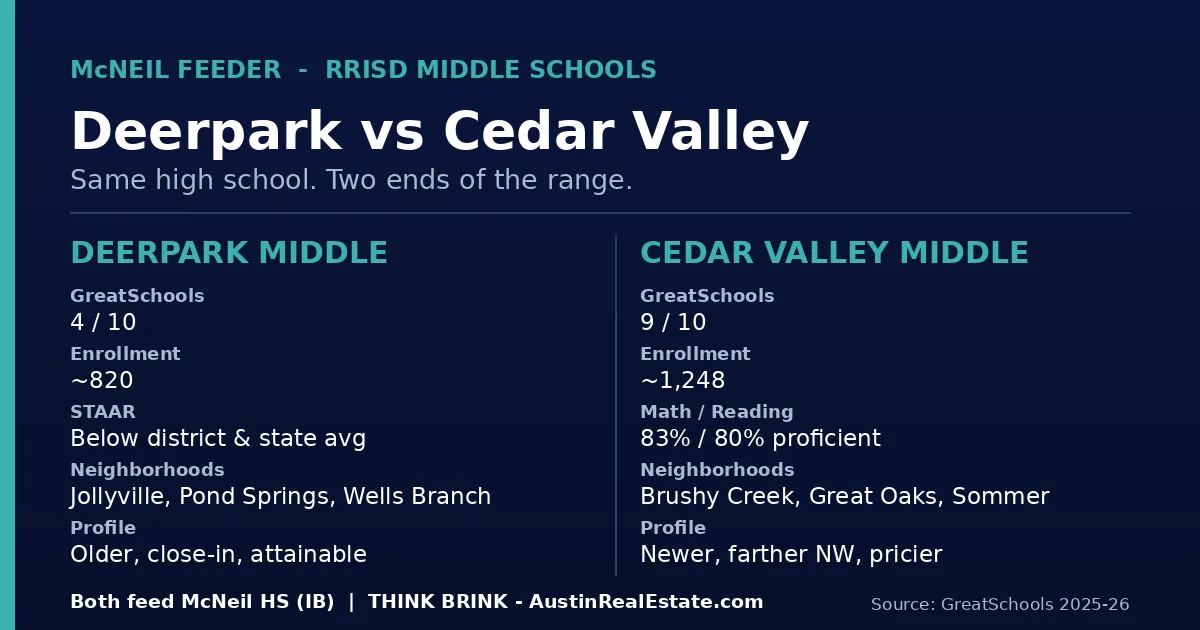
Here is the part buyers most need to hear plainly. On the common third-party rating everyone checks, these two schools are far apart. As of the 2025-2026 data, Cedar Valley Middle School carries a 9 out of 10 on GreatSchools, while Deerpark Middle School carries a 4 out of 10. That is not a rounding difference. It is one of the widest rating gaps between two middle schools feeding the same Round Rock ISD high school.
Cedar Valley's academic profile backs up the rating. Recent data shows roughly 83 percent of students scoring at or above proficient in math and about 80 percent in reading, both above the Texas state average, on an enrollment of around 1,248 students with a student-teacher ratio near 15 to 1. Deerpark, with an enrollment closer to 820, shows STAAR performance that generally runs below the Round Rock ISD and state averages across subjects and grade levels.
Now the necessary caveat, because a rating number is a starting point, not a verdict. GreatSchools ratings lean heavily on standardized test performance, which correlates strongly with the demographics and income of the neighborhoods a school draws from. A 4 does not mean Deerpark is a failing school or that a motivated student cannot thrive there - it means its tested proficiency runs below the district average, which is a meaningfully different statement. Smaller enrollment can also mean a different, sometimes more personal environment. The rating is a real signal that gets capitalized into home prices, and you should know it before you buy. It is not the whole story of what your specific child's experience will be.
Different elementaries, different neighborhoods
The clearest way to understand the difference between these two is to look at where their students come from, because the feeder elementaries tell you exactly which neighborhoods each middle school serves - and those neighborhoods are what you are actually buying.
Deerpark: the close-in, older tech corridor
Deerpark Middle draws from a set of established, close-in elementaries including Joe Lee Johnson, Jollyville, Live Oak, Pond Springs, and Wells Branch. That footprint is the older, more affordable core of the North Austin tech corridor - the neighborhoods along the Jollyville and Pond Springs corridors and out toward Wells Branch. These are 1970s through 1990s neighborhoods, mature trees, established streets, and generally the most attainable price points in the McNeil zone. If your priority is getting into the McNeil pathway at the lowest entry cost and being close-in to the MoPac and 183 employment nodes, this is the side of the zone where that math works. I have written buyer guides for pieces of this area, including Wells Branch and Anderson Mill.
Cedar Valley: the farther-out, newer northwest side
Cedar Valley Middle draws from Brushy Creek, Great Oaks, and Sommer elementaries, which sit farther northwest, out toward the Brushy Creek and Avery Ranch side of the district. These are generally newer neighborhoods with larger homes, more uniform subdivisions, and higher price points than the Deerpark side. The tradeoff is distance - you are farther from the close-in MoPac and 183 nodes and from downtown, and closer to the northwestern edge of the corridor. Buyers who want the newer housing stock, the larger lots, and the top-rated middle school, and who are willing to trade some proximity for it, land here.
So the real decision underneath the school comparison is a neighborhood decision. Deerpark means close-in, older, more affordable. Cedar Valley means farther out, newer, pricier, with the stronger middle school rating. That is the tradeoff in one sentence, and it is why you cannot separate the school choice from the neighborhood choice on this pathway.
What this does to price
The rating gap and the neighborhood-vintage gap point the same direction, so they compound rather than offset. Cedar Valley's combination of a 9-rated middle school and newer, larger homes puts its attendance area at a higher price point than Deerpark's, where an older housing stock and a lower-rated middle school both pull the entry cost down. In a market where families actively shop by feeder pattern, a top-rated middle school assignment is one of the more reliably capitalized features in a home's price, and Cedar Valley has it while Deerpark does not.
I want to be careful here rather than quote a spread I cannot currently verify against fresh MLS data. What I can tell you qualitatively and confidently is the direction and the reason: expect to pay a premium on the Cedar Valley side for the newer homes and the stronger middle school rating, and expect the Deerpark side to be where the more attainable McNeil-zone entry points are. If your budget is the binding constraint and McNeil High is the real goal, the Deerpark side gets you onto the pathway for less. If you want the newer house and the top middle school rating and your budget allows, Cedar Valley is where that combination lives. For a live read on current pricing on either side, that is a conversation worth having with real comparable sales rather than a general figure.
How they fit against the rest of the McNeil middle schools
Deerpark and Cedar Valley are two of four McNeil middle schools, and seeing the full set helps you place them. Pearson Ranch is the newer campus on the Avery Ranch side and tends to be a higher-priced, higher-rated option similar in profile to Cedar Valley. Chisholm Trail sits in between. If you are comparing across the whole set rather than just these two, I have covered the others in Pearson Ranch vs Deerpark and Chisholm Trail vs Cedar Valley, which together with this post cover all four campuses that feed McNeil.
The pattern across the set is consistent: the newer, farther-northwest campuses (Cedar Valley, Pearson Ranch) rate higher and cost more, and the older, closer-in campus (Deerpark) rates lower and costs less, with Chisholm Trail in the middle. That pattern is not unique to Round Rock ISD - it reflects the general relationship between newer neighborhoods, higher household incomes, and test-based ratings across the metro. Understanding it lets you shop deliberately rather than assuming the highest rating is automatically the right buy for your family and budget.
The boundary caveat that matters most
One thing every buyer shopping this pathway needs to hear: attendance boundaries in a growing district like Round Rock ISD get redrawn. New schools open, neighborhoods fill in, and lines move. Pearson Ranch is itself a relatively recent addition to the McNeil set, and its arrival reshaped surrounding boundaries. That means a home you buy today for a specific middle school assignment could be reassigned before your child ages into it, especially if you have young children with years to go before middle school.
The practical move is twofold. First, verify the exact current assignment for the specific address using the Round Rock ISD school-finder and feeder chart, not a listing description or a general neighborhood reputation. Listing agents get feeder patterns wrong constantly, and the checker is authoritative. Second, weight the high school assignment more heavily than the middle school one if your kids are young, because McNeil is the shared, stable outcome across this whole zone while the middle school lines are the more likely to shift. I get into how the broader RRISD high school picture compares in McNeil vs Westwood.
Which one should you choose?
Choose the Deerpark side if your budget is the binding constraint and getting onto the McNeil pathway at the lowest entry cost matters more than the middle school rating, if you want to be close-in to the MoPac and 183 employment nodes and to downtown, and if you are comfortable with an older, established housing stock. The rating gap is real, but a 4-rated middle school in a strong high school pathway, with an involved family and a motivated student, is a very different thing than a struggling school, and the price savings and location can be worth it for the right buyer.
Choose the Cedar Valley side if you want the top middle school rating in the McNeil zone, if you prefer newer and larger homes, and if your budget allows the premium that comes with both. You are trading some proximity to the close-in employment nodes for a newer neighborhood and a stronger middle school profile, and for many relocating tech families that trade is exactly what they are after.
And if the middle school rating is the single thing driving your decision, step back and confirm two things before you commit: that your kids are close enough to middle school age that today's boundary will actually hold for them, and that you have verified the assignment at the specific address. A rating you are buying for a school your child will not attend for six years, on a boundary that may move, is a weaker reason to stretch your budget than it feels like in the moment.
Frequently Asked Questions
Do Deerpark and Cedar Valley both feed McNeil High School?
Yes. Both Deerpark Middle and Cedar Valley Middle feed McNeil High School in Round Rock ISD. They are two of the four middle schools that feed McNeil, along with Chisholm Trail and Pearson Ranch. So the high school outcome is the same from either middle school if you remain in the McNeil zone.
What are the GreatSchools ratings for Deerpark and Cedar Valley?
As of the 2025-2026 data, Cedar Valley Middle carries a 9 out of 10 on GreatSchools and Deerpark Middle carries a 4 out of 10. Cedar Valley shows roughly 83 percent math and 80 percent reading proficiency, above the Texas state average, while Deerpark's tested performance runs below the district and state averages. The rating gap is real and gets reflected in home prices.
Why is there such a big rating difference if they feed the same high school?
Because they draw from very different neighborhoods. Cedar Valley pulls from newer, higher-income neighborhoods on the Brushy Creek and Avery Ranch side, and third-party ratings correlate heavily with the test performance those demographics produce. Deerpark pulls from older, more attainable close-in neighborhoods along the Jollyville, Pond Springs, and Wells Branch corridors. The high school is shared; the middle school neighborhoods are not.
Which neighborhoods feed Deerpark Middle School?
Deerpark draws from elementaries including Joe Lee Johnson, Jollyville, Live Oak, Pond Springs, and Wells Branch - the older, close-in core of the North Austin tech corridor. These are generally the most attainable price points in the McNeil zone.
Which neighborhoods feed Cedar Valley Middle School?
Cedar Valley draws from Brushy Creek, Great Oaks, and Sommer elementaries, on the newer, farther-northwest side of the district toward Brushy Creek and Avery Ranch. Homes there are generally newer and larger, at higher price points than the Deerpark side.
Is the Cedar Valley side worth the higher price?
It depends on what you are optimizing for. You are paying more for newer, larger homes and the top-rated middle school in the zone, and trading away some proximity to the close-in employment nodes and downtown. If the middle school rating and newer housing stock matter to you and your budget allows, it can be worth it. If budget and location matter more, the Deerpark side gets you onto the same McNeil pathway for less.
Can attendance boundaries change before my child reaches middle school?
Yes, and in a growing district like Round Rock ISD they do. New schools open and lines get redrawn - Pearson Ranch is itself a relatively recent addition that reshaped surrounding boundaries. If your children are young, weight the shared McNeil High School assignment more heavily than the middle school line, and always verify the current assignment at the specific address with the RRISD school-finder before you buy.
Should I choose a home based on the middle school rating alone?
No. Use the rating as one input, not the decision. Confirm your kids are close enough to middle school age that the current boundary will hold for them, verify the assignment at the exact address, and weigh the neighborhood, commute, home condition, and budget alongside the rating. A strong rating for a school your child will not attend for years, on a boundary that may move, is a weaker reason to stretch than it feels like.
The honest summary
Deerpark and Cedar Valley are the two ends of the McNeil pathway. They share a strong IB high school and almost nothing else. Cedar Valley pairs a top middle school rating with newer, larger, pricier homes farther northwest. Deerpark pairs a lower rating with older, more attainable, close-in neighborhoods near the employment corridor. The right choice is not the higher number by default - it is the one that matches your budget, your commute, your kids' ages, and how much of your decision you want to hang on a middle school rating versus the high school they will actually spend four years in. Verify the assignment at the specific address, weight McNeil High as the stable outcome, and buy the neighborhood that fits your life, not just the rating that looks best on paper. If you want current comparable sales on either side before you decide, that is exactly the read I do for buyers shopping the McNeil zone.
