Far West vs Northwest Hills: Which 78731 Setting Fits You?
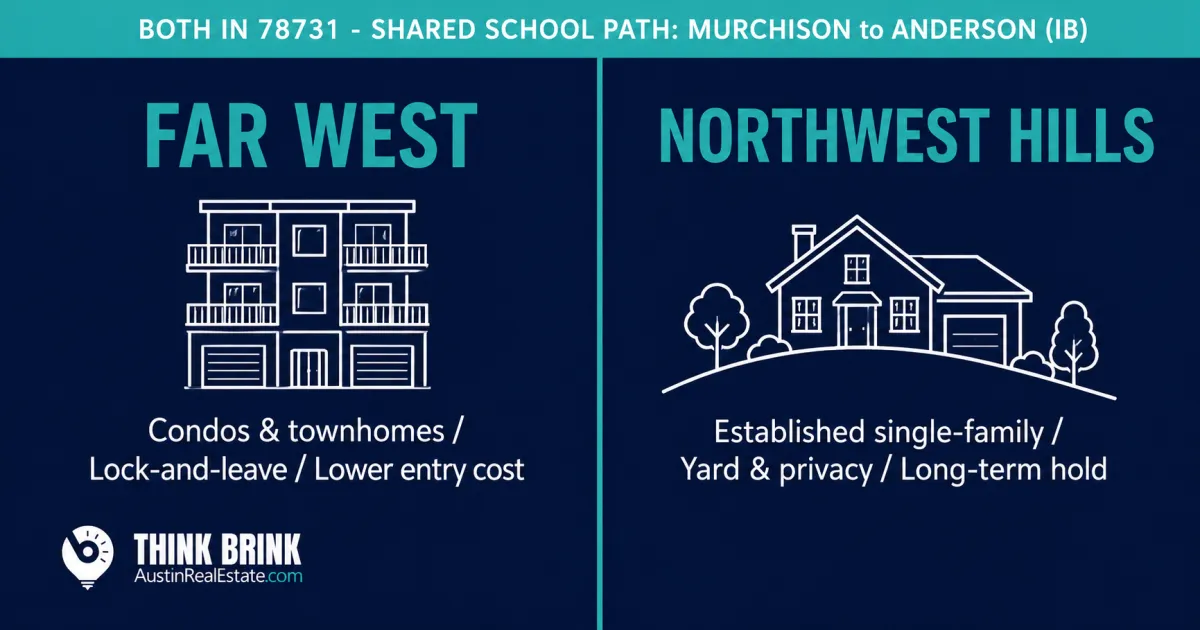
Two of the most searched addresses in the 78731 zip code sit less than a mile apart and share the same school path, but they ask you to live very different lives. The Far West corridor, the stretch of condos, townhomes, and low-rise buildings clustered around Far West Boulevard between MoPac and Mesa, is the most affordable way to plant a flag in one of Austin's most desirable school zones. Northwest Hills, the hillside neighborhood of established single-family homes just above it, is where buyers go when they want the yard, the driveway, and the long-term hold. Same zip code, same buses in many cases, completely different monthly cost and completely different daily routine.
Buyers who tour both usually come in assuming this is a budget decision, and it partly is. But the more useful way to frame it is by what you want your ownership to feel like. One setting is lock-and-leave, low-maintenance, and priced so a single tech salary or a downsizing couple can get into the zip. The other is mow-the-lawn, own-the-roof, and priced for households buying a decade-plus of stability. This guide walks through the real differences so you can tell which 78731 setting actually fits you before you start writing offers.
The quick version
Far West is the close-in, lower-entry-cost side of 78731: mostly condos and townhomes, a lot of it built in the 1970s and 1980s, walkable to Far West Boulevard's restaurants and services, and heavy on lock-and-leave ownership. Northwest Hills is the established, single-family side: larger lots, hillside streets, homes that skew custom and semi-custom, higher prices, and full owner responsibility for everything from the foundation to the trees.
Both sit inside Austin ISD's most sought-after northwest feeder in most sections, Doss or Hill Elementary to Murchison Middle to Anderson High, and Anderson has run an International Baccalaureate program since 1991. That shared school access is the single biggest reason the Far West corridor holds its value the way it does. You are buying into the same zone as the single-family buyers up the hill, at a materially lower price of entry.
If you want the lowest-cost way into this school zone, a simpler monthly life, or a place you can leave for three weeks without arranging lawn care, Far West is built for you. If you want space, privacy, a yard, and an asset that behaves like a long-term family home, Northwest Hills is worth the premium. The rest of this post is about the tradeoffs hiding inside that simple split.
What the Far West corridor actually is
When people say "Far West" as a place rather than a street, they mean the dense band of attached housing that lines Far West Boulevard and the streets feeding it, roughly between MoPac on the east and the Northwest Hills single-family streets above. This is one of the oldest concentrations of condominium and townhome product in northwest Austin, with many buildings dating to the late 1970s and 1980s. You will find garden-style condo communities, two-story townhomes, a handful of mid-rise buildings, and rental apartment complexes mixed in among the owner-occupied product.
The appeal is location and price working together. From the corridor you are minutes from the restaurants, grocery, medical offices, and services along Far West Boulevard and Anderson Lane, you have direct MoPac access for the commute south to downtown or north to the Domain and the Parmer tech corridor, and you are inside the Anderson feeder. For a buyer who wants that access without a single-family price tag, the corridor is often the only realistic door.
Who the corridor fits
The corridor tends to work for four kinds of buyers. First, first-time buyers and single-income professionals who want the school zone and the location but cannot or do not want to stretch to a single-family price. Second, downsizers who are done maintaining a yard and a big house and want to stay in the part of town they already know. Third, investors and parents buying for a student or young professional, because the rental demand here is steady. Fourth, relocating tech workers who want a low-commitment landing spot inside a good zone while they learn the city before buying a house.
What you take on with attached housing
The tradeoffs are real and you should go in with eyes open. Condo and townhome ownership means a homeowners association and monthly dues, and in older 1970s and 1980s communities those dues and the reserve studies behind them matter enormously. Before you write an offer on any attached home in the corridor, read the HOA financials, ask about the reserve balance, and ask what major capital projects, roofs, siding, plumbing risers, parking, are coming. An underfunded older association can hit owners with special assessments, and that risk is the single most important thing to underwrite here. Insurance is another one to check early, because the master policy and your individual walls-in coverage interact in ways that surprise first-time condo buyers.
Construction era also drives condition. A lot of this product is forty to fifty years old. That is not a dealbreaker, but it means you are inspecting for the things that age into problems: cast iron or galvanized plumbing, aluminum wiring in some vintages, single-pane windows, and original HVAC. A well-run association that has kept up with capital work is worth paying more for than a cheaper unit in a community that has deferred everything.
What Northwest Hills actually is
Northwest Hills is the established single-family neighborhood that climbs the hills above the Far West corridor, one of the anchor neighborhoods of 78731 and one of the strongest family neighborhoods in all of Austin ISD. The homes here skew custom and semi-custom, many built from the 1960s through the 1980s, on lots that are generally larger and more private than what you find in the tract subdivisions farther north. Streets wind with the terrain, mature trees canopy the older sections, and a fair number of homes carry hill-country views or greenbelt backing.
This is a buy-and-hold neighborhood. Turnover is relatively low because people who land here tend to stay through the school years and often well past them. That stability is part of what you are paying for. You are also paying for the land, the privacy, and the flexibility that comes with owning the whole property, the ability to add on, landscape, put in a pool, or renovate to your taste without a board's approval.
Who Northwest Hills fits
Northwest Hills fits families who want room to grow inside the Anderson feeder and are planning to stay long enough to make the higher entry cost pay off. It fits move-up buyers coming out of a first home or a condo who want a yard and a garage. It fits buyers who value privacy and mature trees over new construction and want the character of an established neighborhood rather than a brand-new subdivision. And it fits people who are comfortable owning and maintaining an older, larger home, because that is what most of the inventory is.
What you take on with an established single-family home
The flip side of owning everything is maintaining everything. On an older hillside home you are the reserve fund. Foundations on Central Texas clay move, and hillside lots add drainage and retaining considerations that flat lots do not have. Roofs, HVAC, sewer laterals, and original kitchens and baths all come due on their own timeline, and there is no association to spread those costs across. Many of these homes have been updated over the decades, but the degree of updating varies wildly from house to house, so condition, not just location, drives price here more than almost anywhere.
If you want a deeper walkthrough of the neighborhood itself, its sections, lot hierarchy, and what to check before offering, see our Northwest Hills buyer guide. And if you are also weighing the corridor on its own terms, the Far West corridor buyer guide covers the attached-housing side in detail.
Schools: the thing they share, and the caveat that matters
The reason this comparison exists at all is that both settings buy you into the same school access. Most of the Far West corridor and most of Northwest Hills feed the Austin ISD northwest pathway that runs Doss or Hill Elementary to Murchison Middle School to Anderson High School. Murchison hosts Austin ISD's IB Middle Years program, and Anderson has been an IB World School since 1991. This is, by reputation and by demand, the strongest feeder in northwest Austin ISD, and it is a big part of why homes and condos in this zip hold value.
That is the shared upside. Here is the caveat, and it is a real one: the 78731 zip code is not zoned to a single pathway everywhere. Pockets of 78731, particularly toward the southern and eastern edges, are zoned to Highland Park Elementary, Lamar Middle School, and McCallum High School instead of the Doss/Murchison/Anderson path. That is a completely different, and also respected, set of schools, but it is not the Anderson IB pathway. Attendance zones are set at the address level and districts adjust boundaries over time. So if the school assignment is a primary reason you are buying, verify the exact zoning for the specific address with Austin ISD before you write an offer. Do not assume the whole zip feeds Anderson, because it does not.
Between the two elementaries, Doss and Hill both feed Murchison and Anderson but perform and enroll differently, and the choice can matter for your specific street. Our Doss vs Hill comparison breaks that down, and the Anderson High feeder guide covers the full pathway and the IB program.
Cost of entry and cost of ownership
The single biggest practical difference between these two settings is what it costs to get in and what it costs to stay. On price of entry, the Far West corridor is meaningfully lower. A condo or townhome in the corridor is generally the cheapest way to own inside this school zone, which is exactly why the corridor exists as a category. Northwest Hills single-family homes carry a large premium over that, because you are buying land, space, and detached ownership on top of the same school access.
Because fresh neighborhood-level sale prices move month to month, I am not going to put a hard number on either setting in this post. What I will tell you is the shape of it: expect the corridor to open the door at a fraction of what a comparable-square-footage single-family home in Northwest Hills costs, and expect Northwest Hills prices to vary widely based on lot, view, and how thoroughly the home has been updated. If you want current figures for a specific budget, that is a five-minute conversation and I will pull live comparable sales for the exact product you are considering.
The monthly picture is different in kind, not just amount
On the corridor side, your monthly cost is mortgage, taxes, insurance, and HOA dues, and the HOA covers a defined set of exterior and common-area maintenance. The tradeoff is that you do not control those dues, they can rise, and an underfunded association can special-assess you for a big project. But your personal maintenance surface is small: you are generally responsible for the interior and not much else.
On the Northwest Hills side there are usually no mandatory HOA dues, or only nominal voluntary ones, but you are the entire maintenance budget. Roof, foundation, HVAC, trees, drainage, and every system in the house are yours. Over a long hold, a well-bought single-family home in an appreciating neighborhood has historically built more equity than an attached unit, but it also demands more cash and attention along the way and carries more condition risk at purchase. Neither is universally cheaper. They are different financial machines.
Daily life: lock-and-leave versus own-the-hill
Picture your actual week in each place. In the corridor, you park, you walk in, and the exterior is somebody else's job. You can travel for a month and come home to a mowed common area and a building that has been maintained. You are steps from Far West Boulevard's coffee, food, and errands. The tradeoff is shared walls, shared parking in some communities, less private outdoor space, and the reality of living inside an association's rules and budget.
In Northwest Hills, you pull into your own driveway, you have a yard the kids or the dog can use, and you have quiet, established streets with mature trees. The tradeoff is that the yard, the roof, and the hillside drainage are all yours to manage, and hillside lots in particular can mean stairs, slopes, and driveways that are less convenient than a flat corridor unit. This is the classic space-and-privacy versus convenience-and-simplicity tradeoff, and honestly, most buyers know which side of it they are on within one weekend of touring both.
Resale and who buys next
Both settings resell well, but to different buyers, and that is worth thinking about before you buy. Corridor condos and townhomes sell to the same pool that you are in now: first-timers, downsizers, investors, and people who want the zone without the single-family cost. That is a deep, steady pool, but it is also more sensitive to interest rates and to the health of the specific HOA. A community with strong finances and completed capital work resells noticeably better than one with deferred maintenance and rising dues, so the association you buy into is part of your resale story.
Northwest Hills homes sell to move-up families and to buyers relocating into the Anderson zone, and demand for established single-family homes in this feeder has been durable. Condition and lot drive resale here more than anything: an updated home on a good lot moves quickly, while a dated home priced as if it were updated sits. If you buy in Northwest Hills, buying the right lot and either buying updated or budgeting realistically for updates is how you protect your resale.
How to decide
Start with your holding period and your appetite for maintenance, because those two answers usually settle it. If you are planning a shorter hold, want a simple monthly life, or simply cannot get to a single-family price in this zip without stretching uncomfortably, the Far West corridor is the smart, honest choice, and it is a legitimate way to own inside one of Austin's best school zones. If you are planning a long hold, want space and privacy, and can carry both the higher entry price and the full maintenance load, Northwest Hills rewards that patience with land, character, and an asset that behaves like a long-term family home.
Whichever way you lean, do the address-level school check first if schools are driving the decision, and on the corridor side, read the HOA financials before you fall in love with a unit. Those two steps prevent the most common regrets I see in this zip. For a broader look at how Northwest Hills stacks up against another established option, see Northwest Hills vs Great Hills.
Frequently Asked Questions
Are Far West and Northwest Hills in the same school zone?
In most sections, yes. Both generally feed the Austin ISD pathway of Doss or Hill Elementary to Murchison Middle School to Anderson High School, an IB World School since 1991. But 78731 is not zoned to one pathway everywhere, and some pockets feed Highland Park Elementary, Lamar Middle, and McCallum High instead. Always verify the exact address with Austin ISD before buying if schools are the reason you are choosing this area.
Is the Far West corridor a good place to buy or is it mostly rentals?
It is a mix. There are owner-occupied condos and townhomes alongside rental apartment communities. It is a legitimate ownership option, and for many buyers it is the most affordable way into the Anderson school zone. The key is to buy in a well-run association with healthy reserves, because that is what protects both your monthly cost and your resale.
Why is Northwest Hills so much more expensive than the condos below it?
You are paying for land, space, privacy, and detached ownership on top of the same school access. A single-family home on a private hillside lot is a fundamentally different asset than an attached unit, and the established, low-turnover nature of Northwest Hills keeps demand high. The school access is shared, but almost everything else about the two products is different.
Do Northwest Hills homes have an HOA?
Most Northwest Hills single-family homes have either no mandatory HOA or only a nominal voluntary neighborhood association, which means few or no monthly dues but full personal responsibility for all maintenance. Corridor condos and townhomes carry mandatory HOA dues that cover defined exterior and common-area upkeep. Confirm the specifics for any individual property, because arrangements vary street to street and building to building.
Which is the better long-term investment, a corridor condo or a Northwest Hills house?
Over long holds, well-bought single-family homes in appreciating neighborhoods have historically built more equity than attached units, but they also require more cash and carry more condition risk. A condo in a financially healthy association can be an excellent lower-cost hold, especially for shorter timelines. The honest answer depends on your holding period, your budget, and how much maintenance you want to take on, so match the asset to your actual plan rather than to a rule of thumb.
What should I check before buying a condo or townhome in the Far West corridor?
Read the HOA financials and reserve study, ask about upcoming capital projects and any planned special assessments, confirm how the master insurance policy and your individual coverage fit together, and inspect for the systems that age in 1970s and 1980s construction, plumbing, wiring, windows, and HVAC. A cheaper unit in a poorly funded association is often more expensive than a well-priced unit in a healthy one.
Is Northwest Hills good for families or more for empty nesters?
Both. It is one of the strongest family neighborhoods in Austin ISD because of the Anderson feeder, and it also holds a lot of long-term owners who raised families here and stayed. The low turnover reflects both groups. If you have school-age kids and want space inside the Anderson zone, it is a natural fit, and if you are settling in for the long haul, it rewards that too.
Can I get into the Anderson school zone for less money than Northwest Hills?
Yes, and that is precisely what the Far West corridor offers. A corridor condo or townhome is generally the lowest-cost way to own inside the Anderson feeder, assuming the specific address is zoned to that pathway. Verify the zoning at the address level, buy in a sound association, and you can access the same schools as the single-family buyers up the hill for a fraction of the entry price.
The honest bottom line
Far West and Northwest Hills are not really competing for the same buyer. They are two doors into the same school zone at two very different price points and two very different lifestyles. The corridor is for buyers who want in for less, want a simpler life, or are not ready for full single-family ownership, and it is a smart, legitimate choice on those terms. Northwest Hills is for buyers who want space, privacy, and a long-term family asset and can carry both the price and the upkeep. Decide based on your holding period and your appetite for maintenance, verify the school zoning at the address level, and, on the corridor side, underwrite the HOA before anything else. Do that, and either setting can be the right answer.
If you want live comparable sales for a specific budget in either setting, or a read on a particular condo association's health, that is what I do all day in this zip. Reach out and I will pull the current numbers for your exact situation.
This post is general real estate information for Northwest Austin buyers and is not legal, tax, or financial advice. Verify school attendance zones directly with Austin ISD and review HOA and financial documents with the appropriate professionals before making an offer.
