Great Hills vs Spicewood Estates: Which Northwest Austin Neighborhood Fits You?
These two neighborhoods come up together more than almost any other pair in my part of Northwest Austin, and it makes sense that they do. Great Hills and Spicewood Estates are both established, both sit in the 78750/78759 core, both draw the same kind of buyer - a relocating tech household or a move-up family that wants the Round Rock ISD Westwood pathway and a real lot near MoPac and 183. On a map they look almost interchangeable. In practice they are not, and the differences that matter are the ones that do not show up in a listing photo.
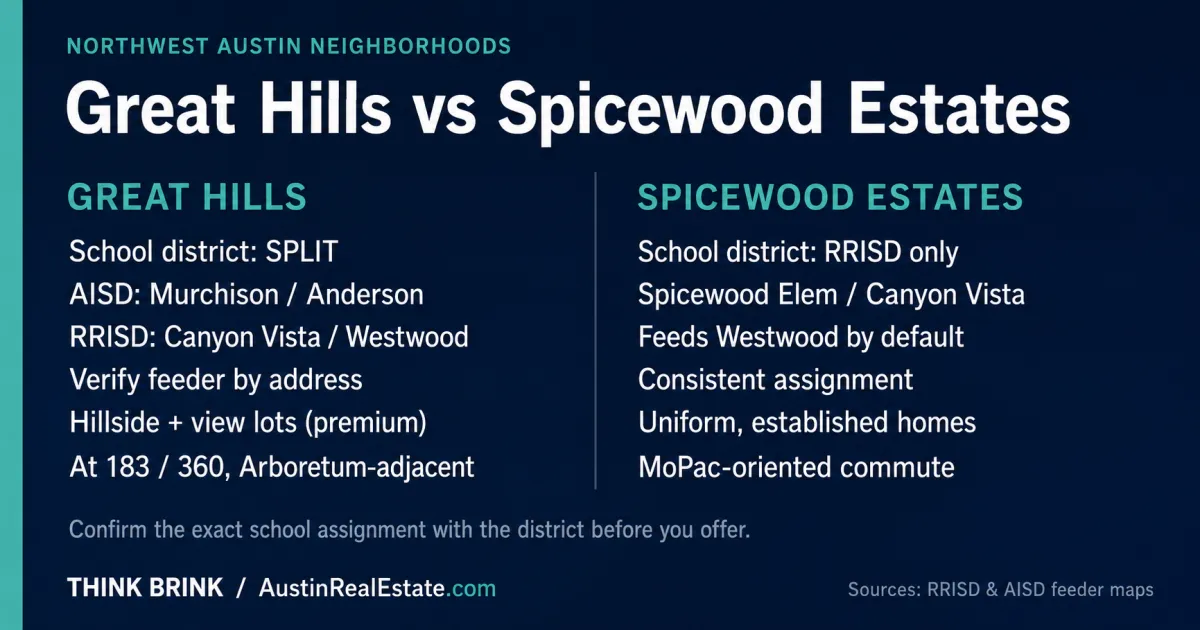
The short version: Spicewood Estates is the more predictable of the two. It is uniformly Round Rock ISD, it feeds the schools most buyers in this area are chasing, and the housing stock is more consistent. Great Hills is larger, more varied, splits across two school districts depending on the exact address, and offers something Spicewood Estates mostly does not - hillside lots with real views, at a real premium. Which one fits you comes down to how much you care about that view, how firm your school requirement is, and how much predictability you want in what you are buying. Let me walk through it the way I would if we were driving between the two.
Where Each One Sits
Spicewood Estates is in 78750, developed off Spicewood Parkway north of Spicewood Springs Road, roughly sixteen miles from downtown Austin. It is a defined, cohesive neighborhood - you know when you are in it - built around a consistent vision. The location puts you close to the Spicewood Springs corridor, with MoPac access that carries you south toward central Austin or north toward the Parmer employment centers.
Great Hills is larger and less contained. It spreads across the area near the 183 and 360 intersection, with the Arboretum and its retail and dining immediately adjacent. That location is one of Great Hills' strongest cards: you are at one of the best-connected road intersections in Northwest Austin, with quick access in multiple directions and the Arboretum's shopping and restaurants essentially in the neighborhood. Great Hills is also more topographically dramatic - it climbs, and that hillside is where its most distinctive homes and lots are.
Both neighborhoods sit in the heart of the geography I cover, and if you want the wider context of how they fit among their neighbors, I lay that out in the Living in 78750 and 78759 neighborhood guide.
Schools: The Single Biggest Practical Difference
This is where the two neighborhoods genuinely diverge, and it is the difference I make sure every buyer understands before they get attached to a house.
Spicewood Estates is uniformly Round Rock ISD. The feeder pattern is Spicewood Elementary to Canyon Vista Middle School to Westwood High School - the pathway that a large share of buyers in this zip code are specifically targeting. Spicewood Elementary, on Olson Drive inside the neighborhood, offers a Gifted and Talented program and International Baccalaureate coursework. Because the whole neighborhood feeds the same schools, you do not have to think hard about which side of a street you buy on. The assignment is consistent, and that predictability is a real feature.
Great Hills is split between two school districts. This is the thing out-of-area buyers most often miss. Because of the neighborhood's size and geography, part of Great Hills is zoned to Austin ISD and part to Round Rock ISD. On the Austin ISD side, the feeder runs through Davis or Hill Elementary to Murchison Middle to Anderson High School. On the Round Rock ISD side, it runs Laurel Mountain Elementary to Canyon Vista Middle to Westwood High School. Both are strong pathways, but they are different pathways, and which one your home feeds depends entirely on the specific address.
What this means in practice: if landing in a particular school - say, Westwood specifically - is a firm requirement for you, Spicewood Estates gets you there by default, while in Great Hills you have to verify the assignment address by address and may be choosing between an AISD Anderson home and an RRISD Westwood home two streets apart. Neither is wrong. But you cannot assume a Great Hills address feeds the school you have in mind. I cannot stress this enough: confirm the assignment for the exact property with the district before you write an offer, because the boundary does not care what the listing says. I break down exactly how this address-level zoning affects price in how school zoning by address changes what you pay in Northwest Austin.
For reference on why buyers chase this pathway at all: Westwood High School carries a GreatSchools rating of 9 out of 10 as of the 2025-2026 year, earned an A accountability rating from the Texas Education Agency for 2024-2025, and ranks in the top ten percent of Texas schools on test scores. That reputation is a meaningful part of what supports values across both neighborhoods on their RRISD sides.
Lots and Homes: Views vs Consistency
The physical product is the second real difference between these two.
Great Hills: the view premium
Great Hills' defining feature is its topography. The neighborhood climbs, and its hillside lots deliver something genuinely scarce in Northwest Austin - real elevation and, on the best lots, long views. That scarcity is priced. A hillside home with a view in Great Hills commands a premium over an interior lot in the same neighborhood, sometimes a substantial one, and understanding what that premium actually buys is its own subject. Not every Great Hills home is a view home; the neighborhood also has plenty of solid interior lots at more accessible prices, which is exactly how a lot of buyers get into Great Hills without paying hillside money. If the view is what draws you, that is a legitimate thing to pay for - just go in understanding that you are paying for the lot as much as the house. I go deep on this in what makes a Great Hills lot worth the premium and on how to buy the neighborhood affordably in the full Great Hills buyer guide.
The tradeoff with Great Hills homes is variability. It is a larger, more varied neighborhood, so the range of home ages, styles, sizes, and conditions is wider. That means more opportunity to find exactly the right house, and more need to evaluate each one carefully, because there is less uniformity to lean on.
Spicewood Estates: the predictable product
Spicewood Estates trades some of that drama for consistency. It is a more cohesive neighborhood with a more uniform housing stock - the homes tend to speak the same architectural language and sit on more comparable lots. You are generally not buying a dramatic view here; you are buying a well-established, consistent neighborhood where it is easier to understand what a home is worth relative to its neighbors because the comparisons are cleaner. For a buyer who values predictability and a settled, coherent neighborhood feel over topographic drama, that consistency is exactly the point. My full write-up on the neighborhood is in the Spicewood Estates buyer guide.
Commute and Location Access
Both neighborhoods serve the same set of employers well, with slightly different strengths.
Great Hills' position at 183 and 360, next to the Arboretum, gives it excellent multi-directional road access. You can get onto major arteries quickly heading toward downtown, toward the Domain and North Burnet tech district, or up toward the Parmer campuses. For a household with two commuters heading in different directions, that central-intersection access is genuinely valuable, and the Arboretum adjacency means a lot of daily errands and dining are minutes away.
Spicewood Estates leans on the Spicewood Springs and MoPac corridors. MoPac carries you south into central Austin or north toward the Parmer and Domain employment centers efficiently. It is a clean commute for someone oriented along that north-south spine. Neither neighborhood is a bad commute to the major Northwest Austin employers; the difference is that Great Hills' intersection gives it a slight edge in sheer directional flexibility, while Spicewood Estates is very well positioned for the MoPac-oriented commuter.
What You Pay - and Why I Am Not Quoting a Single Number
I am deliberately not going to hand you one median price for each neighborhood, and here is why that restraint matters. Both of these are established neighborhoods where the spread within the neighborhood is wide - a renovated view home in Great Hills and an original interior home are very different products at very different prices, and the same range exists in Spicewood Estates between updated and dated homes. A single median flattens all of that into a number that will not describe the house you are actually considering.
What I can tell you qualitatively is the shape of it. Great Hills' pricing is bimodal in a way Spicewood Estates' is not - the view and hillside lots sit well above the interior lots, so the neighborhood spans a wider band. Spicewood Estates tends to price in a tighter, more predictable range because the product is more uniform. In both, the RRISD assignment supports values, and in Great Hills the AISD-versus-RRISD split can itself create price differences between otherwise similar homes. The practical takeaway: get neighborhood-specific, address-specific pricing from someone who can pull the actual comparable sales for the exact home and school assignment you are considering, rather than trusting a headline figure. That is precisely the kind of number I pull for clients on a specific property.
Fit Check: Which One Is Right for You
Choose Spicewood Estates if: the Westwood feeder is a firm, non-negotiable requirement and you want it without having to think about which side of a street you buy on; you value a consistent, cohesive neighborhood with predictable home values; you are commuting along the MoPac spine; and you would rather have a settled, uniform neighborhood than a dramatic lot. It is the lower-variance choice, and for a lot of families that predictability is worth everything.
Choose Great Hills if: a hillside lot or a view is something you genuinely want and are willing to pay a premium for; you value the 183/360 intersection access and Arboretum adjacency; you are comfortable verifying school assignment address by address and are open to either the Anderson or Westwood pathway depending on the home; and you want the widest range of homes to choose from in this part of Northwest Austin. Great Hills rewards buyers who know exactly what lot they want.
The way I usually frame it for clients: Spicewood Estates is the neighborhood you buy for certainty, and Great Hills is the neighborhood you buy for a specific lot. If you are chasing the school pathway above all and want no surprises, Spicewood Estates. If a particular view or the central intersection is what is pulling you, Great Hills - just with your eyes open on the district split. If you want to see how Great Hills stacks up against another established neighbor, I compared it with Balcones Woods in Great Hills vs Balcones Woods.
Frequently Asked Questions
Are Great Hills and Spicewood Estates both in Round Rock ISD?
Spicewood Estates is uniformly Round Rock ISD, feeding Spicewood Elementary, Canyon Vista Middle, and Westwood High School. Great Hills is split: part of it is zoned to Austin ISD (Davis or Hill Elementary, Murchison Middle, Anderson High) and part to Round Rock ISD (Laurel Mountain Elementary, Canyon Vista Middle, Westwood High). In Great Hills you must verify the school assignment for the exact address, because it varies within the neighborhood.
Which neighborhood feeds Westwood High School?
Spicewood Estates feeds Westwood by default across the whole neighborhood. Great Hills feeds Westwood only from its Round Rock ISD portion; its Austin ISD portion feeds Anderson High School instead. If Westwood specifically is your requirement, Spicewood Estates gets you there without address-by-address checking, while in Great Hills you need to confirm the assignment for the specific home.
Why are some Great Hills homes so much more expensive than others?
Great Hills has significant topography, and its hillside lots with views command a premium over interior lots in the same neighborhood. That creates a wider price band than you see in a flatter, more uniform neighborhood. The Austin ISD versus Round Rock ISD split can also contribute to price differences between otherwise similar homes. Spicewood Estates, by contrast, has a more consistent housing stock and tends to price in a tighter range.
Is Spicewood Estates or Great Hills better for commuting to Apple or the Domain?
Both are well positioned. Great Hills' location at the 183 and 360 intersection gives it strong multi-directional access, which helps households commuting to different employers and is convenient for the Domain and central Austin. Spicewood Estates is oriented to the MoPac spine, which carries you efficiently north toward Parmer and the Domain or south toward central Austin. Neither is a bad commute to the major Northwest Austin employment centers; the difference is directional flexibility versus a clean north-south run.
Which neighborhood has better home value predictability?
Spicewood Estates. Its more uniform housing stock and single school district make comparable sales cleaner and values more predictable. Great Hills spans a wider range because of its view premium and district split, which means more opportunity to find exactly the right home but more variability in what any given home is worth. Buyers who want fewer surprises tend to prefer Spicewood Estates; buyers hunting a specific lot prefer Great Hills.
Can I get into Great Hills without paying for a view lot?
Yes. Great Hills has plenty of solid interior lots priced well below its hillside view homes, and buying an interior lot is exactly how many buyers get into the neighborhood at a more accessible price. The location benefits - the 183/360 access, the Arboretum adjacency, and the school assignment for that address - are available on interior lots too. You are only paying the view premium if the view is what you are specifically buying.
Should I verify school zoning myself before making an offer?
Absolutely, especially in Great Hills. School attendance boundaries are set at the address level and have been adjusted over time, so a listing's school section or a neighbor's recollection is not reliable. Confirm the assignment for the exact property with the school district before you write an offer. In Spicewood Estates the assignment is consistent across the neighborhood, but it is still worth a quick confirmation; in Great Hills it is essential.
Which one should I choose if I have no strong school requirement?
Then the decision comes down to lifestyle and lot. If you want a dramatic hillside lot or a view, or you value the Arboretum-adjacent central location, Great Hills is the more compelling choice. If you prefer a settled, cohesive neighborhood with predictable values and a clean MoPac commute, Spicewood Estates fits better. Without a firm school requirement, buyers usually gravitate to whichever neighborhood's physical character and specific available homes speak to them more.
James Brinkman is a licensed Texas real estate broker (TX #0443653) with CRS, ABR, and SRES designations, working Northwest Austin under AustinRealEstate.com. This comparison is educational and not a substitute for advice on a specific property. Verify school assignments with the district for the exact address before you buy.
