What Buyers Should Know About Barrington Oaks Before Making an Offer (78759)
Barrington Oaks is one of those Northwest Austin neighborhoods that buyers stumble into rather than search for by name. They are hunting the Westwood High School feeder, they want to be central to MoPac and 183 without paying Great Hills prices, and they keep landing on listings tucked into a quiet grid of streets off Oak Knoll and Mesa in the 78759 zip code. That is Barrington Oaks. It does not carry the name recognition of Great Hills or Canyon Creek, and that is precisely why it deserves a closer look before you write an offer.
This guide covers what actually matters when you buy here: the school feeder pattern and why it drives the price, the location relative to the employers people are really commuting to, the age and condition of the housing stock, what the lots are like, and the honest tradeoffs you take on when you buy an established home in a neighborhood built decades ago. I am a Northwest Austin broker who works these zip codes every week, and my goal is that you understand Barrington Oaks before you need to make a decision about it, not after.
Where Barrington Oaks Actually Sits
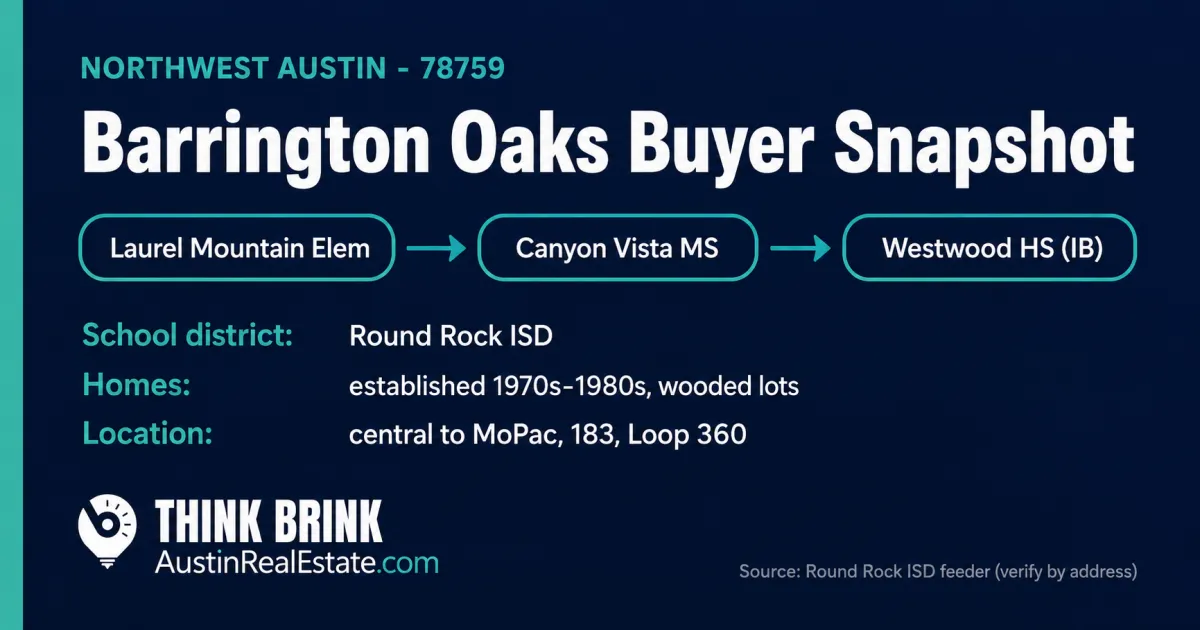
Barrington Oaks is in the 78759 zip code in Northwest Austin, tucked into the area bounded roughly by Spicewood Springs Road, MoPac (Loop 1), and the 183 corridor. It sits inside the broader band of established neighborhoods that fill in the space between MoPac and US 183, which is the part of Northwest Austin buyers keep circling back to because of one thing: it is genuinely central. You are not choosing between a good commute in one direction and a bad one in the other. From Barrington Oaks you can reach MoPac, 183, Loop 360, and Spicewood Springs Road within a few minutes, which means most of the region's job centers are reachable without committing your whole morning to a single highway.
That central position is the neighborhood's core advantage, and it is worth being specific about what it buys you. The Apple campus on Parmer Lane is a straightforward run up MoPac north, generally in the 15 to 25 minute range in normal traffic depending on exactly where in Barrington Oaks you start and how Parmer is moving. The Domain and the North Burnet job cluster, home to Amazon, Indeed, and a growing list of tech employers, is even closer, typically well under 20 minutes. Downtown Austin is a straight shot down MoPac. If your household is splitting commutes between, say, a Domain job and an Apple job, Barrington Oaks is one of the more rational compromises in the whole zip code because it does not force either driver into the worst version of their route.
For a fuller picture of how this neighborhood fits into its surroundings, it is worth reading alongside my guide to living in 78750 and 78759, which lays out the whole cluster of established neighborhoods this one belongs to.
The School Feeder Is the Real Engine Here
If you want to understand why Barrington Oaks holds its value the way it does, start with the schools. Barrington Oaks is served by Round Rock ISD, not Austin ISD, even though it carries an Austin mailing address. That surprises a lot of buyers, and it matters, because the Round Rock ISD assignment here runs through one of the most sought-after high school pathways in the entire region.
The feeder pattern for Barrington Oaks runs through Laurel Mountain Elementary, then Canyon Vista Middle School, then Westwood High School. Westwood is a Round Rock ISD International Baccalaureate World School and consistently ranks among the strongest public high schools in the Austin metro. Canyon Vista Middle School has a long-standing academic reputation of its own and feeds directly into Westwood. This Laurel Mountain to Canyon Vista to Westwood pathway is a significant part of what buyers are actually paying for when they buy in Barrington Oaks, whether they frame it that way or not.
One honest caution: school attendance boundaries are assigned at the address level and Round Rock ISD can and does adjust them over time. Some pockets near the edges of a neighborhood can feed a different elementary than the one most of the subdivision uses, and Caraway Elementary also serves parts of this general area of Northwest Austin. Never assume the feeder from a listing description or from this guide. Before you write an offer on a specific house, confirm the exact elementary, middle, and high school assignment for that precise address directly with Round Rock ISD. It is a five-minute step and it is the single most consequential thing you can verify in this zip code.
If you want to understand how much the school assignment drives price at the address level, I go deep on exactly that in how school zoning by address changes what you pay in Northwest Austin, and I compare the two middle schools that feed Westwood in Canyon Vista vs Grisham.
What the Homes and Lots Are Actually Like
Barrington Oaks is an established neighborhood, and the housing stock reflects that. The bulk of the homes were built from the 1970s into the 1980s, which means you are buying into mature construction on mature lots. This is not a place to look for open-concept new builds with the current finish package. It is a place to look for solid, well-proportioned homes on wooded lots with real trees, in a layout that predates the era of tiny lots and repetitive elevations.
The practical implication is that condition varies enormously from house to house, and that variation is where the opportunity and the risk both live. In a neighborhood built forty-plus years ago, you will see three broad tiers. There are homes that have been fully renovated by an owner who put real money into the kitchen, baths, systems, and windows. There are homes that are partially updated, where someone did the kitchen a decade ago but the primary bath, the roof, and the HVAC are original or aging. And there are original or lightly maintained homes that are effectively priced as the land plus a livable structure, waiting for a buyer with a renovation budget and the stomach for a project.
Your job as a buyer is to know which tier you are looking at and to price accordingly, because the listing photos will not always tell you. A neighborhood like this rewards buyers who inspect carefully and punishes buyers who assume the whole street is equivalent. Pay specific attention to the big-ticket systems on any home of this age: the roof, the HVAC, the water heater, the electrical panel, the plumbing supply lines, and the foundation.
That last item deserves its own attention in Central Texas. Homes across Northwest Austin sit on expansive clay soils that swell and shrink with our wet-then-dry cycle, and forty-year-old slab foundations in this region have had four decades of that movement to work through. It does not mean you should avoid older homes. It means you should read the foundation and drainage carefully and, where warranted, bring in a structural engineer rather than relying on a general impression. I walk through exactly what to look for in what Northwest Austin buyers should know about foundation repair on Central Texas clay.
The Trees Are a Feature and a Responsibility
The wooded, mature-lot character is one of the genuine pleasures of Barrington Oaks. Large canopy trees, established landscaping, and the kind of shade that meaningfully lowers summer cooling bills are all part of the appeal, and they are the sort of thing you cannot replicate in a new subdivision for a generation. But mature trees on an older lot are also a responsibility. Large limbs over a roofline, root systems near foundations and utility lines, and the ongoing cost of proper arborist care are all real. When you tour a home here, look up as well as down. A magnificent oak two feet from the house is an asset and a maintenance line item at the same time.
How the Market Behaves in Barrington Oaks
Barrington Oaks is a small, established neighborhood, and small established neighborhoods in the Westwood feeder tend to behave in a specific way. Inventory is limited because turnover is low. People who buy into a top school feeder with a central location do not move often, so at any given time there may be only a handful of active listings, sometimes fewer. That scarcity is the defining feature of shopping here. When the right home in the right condition comes on the market, the buyers who have done their homework move quickly, and the ones who are still deciding whether they like the neighborhood get left behind.
I am writing this guide without quoting a specific current median price or days-on-market figure, because I will not publish a market statistic I cannot verify against current MLS data, and the honest thing to tell you is that the numbers move month to month. What I can tell you qualitatively is the pattern that holds through cycles: well-priced, well-presented homes in the Westwood feeder move faster than the broader Austin market, and homes that are overpriced for their condition sit, get reductions, and eventually sell for less than a correctly priced home would have. For where the broader Northwest Austin market sits right now and what that means for buyers, see is now a good time to buy in Northwest Austin.
The strategic takeaway is simple. If you are serious about Barrington Oaks, get your financing fully in order, know your condition tiers, and be ready to act on the right home rather than waiting to see what else the neighborhood produces. In a low-inventory pocket, the cost of hesitation is not measured in dollars on that one house. It is measured in the months you spend waiting for the next comparable listing to appear.
What You Give Up By Buying Here
Every neighborhood is a set of tradeoffs, and Barrington Oaks is no exception. Being honest about what you give up is more useful than pretending the place is perfect.
You give up newness. If your heart is set on current finishes, a three-car garage, a media room, and a floor plan designed in the last five years, you will either need to buy a fully renovated home here at the top of the neighborhood's range or accept a renovation project. The land itself is central and desirable, but the structures are of their era.
You give up resort-style amenities. Barrington Oaks is a residential neighborhood, not a master-planned community with a central pool, gym, and amenity center. If having HOA-run amenities within walking distance is a priority, this is a different product than, say, a Balcones Woods or a Wells Branch. What you get instead is a quieter, lower-fee, more traditional neighborhood feel.
And you take on the maintenance profile of older homes and mature lots. That is not a flaw so much as a category. Buyers who thrive here are the ones who understand they are buying location and school assignment first, and a house that will ask for ongoing attention second. If you would rather trade the central location for lower-maintenance newness, the tradeoff is worth naming out loud before you tour, not after you are emotionally attached to a house.
Barrington Oaks Compared to Its Neighbors
Buyers rarely look at Barrington Oaks in isolation. They are usually weighing it against the other established 78759 and 78750 neighborhoods in the same feeder or nearby. A few honest comparisons:
Against Great Hills, Barrington Oaks generally offers a more understated profile and, depending on condition, can present a lower entry point into a comparable location. Great Hills carries more name recognition, more hillside and view lots at the top end, and a country club anchor. If you are weighing the two, my Great Hills buyer guide lays out that neighborhood in the same detail.
Against Balcones Woods, the biggest difference is often the amenity package and the specific feeder. Balcones Woods has an active HOA with a pool and tennis and a reputation for one of the faster-moving markets in the zip code. Barrington Oaks trades some of that community infrastructure for a quieter footprint. My Balcones Woods buyer guide is the companion read there.
The point of these comparisons is not to rank the neighborhoods. It is to help you figure out which set of tradeoffs matches your household. A buyer who wants amenities and quick community will weigh differently than a buyer who wants a quiet street, big trees, and a top feeder at the best available price.
What to Verify Before You Write an Offer
If you are getting close on a specific home in Barrington Oaks, here is the short list I would want a client to confirm before we submit:
- The exact school assignment for that address, confirmed directly with Round Rock ISD, not assumed from the neighborhood or the listing.
- The condition and age of the major systems: roof, HVAC, water heater, electrical panel, and plumbing. In a home of this vintage, replacement timelines on these items are real money.
- The foundation and drainage, with a structural engineer if the inspection or the visible signs warrant it, given Central Texas clay.
- The trees, specifically any large limbs over the structure and any root proximity to the foundation or utility lines, plus a realistic sense of ongoing arborist cost.
- Whether there is an HOA, what it covers, and what the fees and any deed restrictions actually are for that section.
- The specific condition tier you are buying and whether the price reflects it, so you are not paying renovated-home money for a partially updated house.
Frequently Asked Questions
What school district is Barrington Oaks in?
Barrington Oaks is served by Round Rock ISD, not Austin ISD, despite carrying an Austin mailing address in the 78759 zip code. The typical feeder pattern runs Laurel Mountain Elementary to Canyon Vista Middle School to Westwood High School, which is a Round Rock ISD International Baccalaureate World School. Because boundaries are set at the address level and can change, confirm the exact assignment for any specific home directly with Round Rock ISD before you rely on it.
Is Barrington Oaks a good neighborhood for Apple or Domain commuters?
Yes, and that central location is one of its strongest selling points. From Barrington Oaks the Apple campus on Parmer Lane is generally a 15 to 25 minute drive up MoPac in normal traffic, and the Domain and North Burnet job cluster is typically under 20 minutes. Because the neighborhood sits close to MoPac, 183, and Loop 360 at once, it is one of the more balanced choices for households splitting commutes between different employers.
How old are the homes in Barrington Oaks?
Most homes in Barrington Oaks were built from the 1970s into the 1980s. You are buying established construction on mature, wooded lots. Condition varies widely from original homes to fully renovated ones, so the age of the neighborhood matters less than the specific condition and system history of the individual house you are considering.
Does Barrington Oaks have an HOA?
Neighborhoods of this era and type in Northwest Austin vary in whether they have an active HOA and what it covers, and it can differ by section. Rather than assume, verify the HOA status, the fees, and any deed restrictions for the specific property before you make an offer. If HOA-run amenities like a community pool are a priority for you, this is an important thing to confirm early.
Why is Barrington Oaks cheaper than Great Hills or Canyon Creek?
Barrington Oaks does not carry the same name recognition as its better-known neighbors, and depending on the specific home and its condition it can present a lower entry point into a comparable central location and a top school feeder. That relative value is exactly the reason informed buyers target it. The tradeoff is fewer amenities and the maintenance profile of older homes on mature lots.
Is Barrington Oaks a good investment given the older homes?
The combination of a central Northwest Austin location and the Westwood feeder gives Barrington Oaks durable demand, which supports value over time. The key is buying the right condition tier at the right price and budgeting honestly for the maintenance that older homes require. A well-bought home here in the top feeder tends to hold its value well, but this is general market observation, not individualized financial advice. Talk with your own financial advisor about your specific situation.
How fast do homes sell in Barrington Oaks?
Barrington Oaks is a small, low-turnover neighborhood, so inventory is usually limited. Well-priced homes in good condition in the Westwood feeder tend to move faster than the broader Austin market, while overpriced homes for their condition sit and eventually reduce. The practical lesson is to have your financing ready and be prepared to act when the right home appears, because comparable listings do not come along often.
What should I inspect most carefully in a Barrington Oaks home?
Focus on the big-ticket systems that reflect the home's age: roof, HVAC, water heater, electrical panel, and plumbing. Read the foundation and drainage carefully given Central Texas clay soils, bringing in a structural engineer if warranted. And assess the mature trees for any limbs over the roof or roots near the foundation and utilities. These are the items that separate a fairly priced home from an expensive surprise.
The Honest Fit Check
Barrington Oaks is a strong fit if you want a top Round Rock ISD feeder, a genuinely central location that balances commutes to Apple, the Domain, and downtown, and a quiet, established, tree-covered neighborhood, and you are comfortable buying an older home and maintaining it. It is a strong fit if you value getting into the Westwood pathway at a more reasonable entry point than the flashier neighborhoods nearby.
It is a weaker fit if you need current new-construction finishes without a renovation, if HOA-run amenities like a pool and gym are a must-have, or if you want the reassurance of a low-maintenance newer home. None of those are flaws in Barrington Oaks. They are simply a different product than what this neighborhood is.
If the Westwood feeder and a central location are what you are chasing, Barrington Oaks belongs on your list, and because inventory is thin, the right move is to understand it now so you are ready to act when a home comes available. If you want help evaluating a specific property here, or figuring out how Barrington Oaks stacks up against the other established neighborhoods in 78759 for your situation, that is exactly the kind of conversation I have with buyers every week.
