What Buyers Should Know About Golf-Course Lots in Northwest Austin: Great Hills, Balcones, and What the Fairway Premium Really Costs
Golf-course frontage is one of the few lot premiums in Northwest Austin that buyers ask for by name. People who would never think to pay extra for a greenbelt backyard will specifically request a home backing to the fairway at Great Hills or inside the Balcones Country Club footprint. The view sells itself: manicured turf, mature oaks, no neighbor's two-story window looking into your kitchen, and a horizon that stays open because nobody is ever going to build behind you.
That is the appealing half. The other half is that a golf-course lot is a specific kind of property with specific tradeoffs, and the premium you pay does not buy the same thing at every course or on every hole. This is a guide to what golf-course frontage actually costs in the two Northwest Austin communities where it matters most, Great Hills and Balcones, what the premium is really paying for, and the things you want to check before you fall in love with the view and skip the questions.
The two Northwest Austin communities where golf frontage is a real category
Golf-course lots exist in scattered spots around Austin, but in the 78750 and 78759 zip codes there are two established private clubs that anchor actual neighborhoods of golf-frontage homes. If you are shopping for a fairway lot in my geography, you are almost certainly looking at one of these two.
Great Hills Country Club, 78759
Great Hills Country Club opened in 1973 and has been member-owned since the mid-1980s. The course was laid into the hills near the 183 and Loop 360 intersection, which is the same location advantage that makes the broader Great Hills neighborhood worth targeting: fast access to the Arboretum, the 183 tech corridor, and a 15 to 25 minute drive to the Apple campus in normal traffic. It is an eighteen-hole layout, par 71, with tennis, fitness, and aquatics on top of golf.
The homes that front this course are folded into the larger Great Hills area, and the section most associated with golf frontage is the Fairway at Great Hills, where lots back directly onto the course. These tend to be larger 1990s and 2000s homes on bigger lots, priced above the entry tier of Great Hills precisely because of the frontage. If you want a full walkthrough of that specific pocket, I have written a dedicated guide to the Fairway at Great Hills and a broader one on the Great Hills Country Club area as a whole.
Balcones Country Club, 78750
Balcones Country Club sits at the center of Balcones Village, off Spicewood Springs Road in 78750. Unlike Great Hills, Balcones has two eighteen-hole courses: the original Balcones course, which dates to the 1950s and plays as a traditional tree-lined parkland layout, and the newer Spicewood course with a more modern design and more water in play. That matters for a lot shopper, because it means there is simply more golf frontage available inside Balcones Village than at Great Hills, and more variety in what a given lot backs onto.
Balcones Village homes skew a little older on average, with a strong stock of 1970s through 1990s houses on established lots under mature tree canopy. The membership is separate from home ownership, which is a point worth repeating: buying a house on the course does not make you a member of the club. I cover the neighborhood side of this in detail in my guide to the Balcones Village Country Club area.
What the golf-course premium actually buys you
When a listing says golf-course lot and carries a higher price than a comparable interior home in the same neighborhood, you are paying for a bundle of things. It helps to separate them, because some are durable and some are not.
A view that cannot be built out
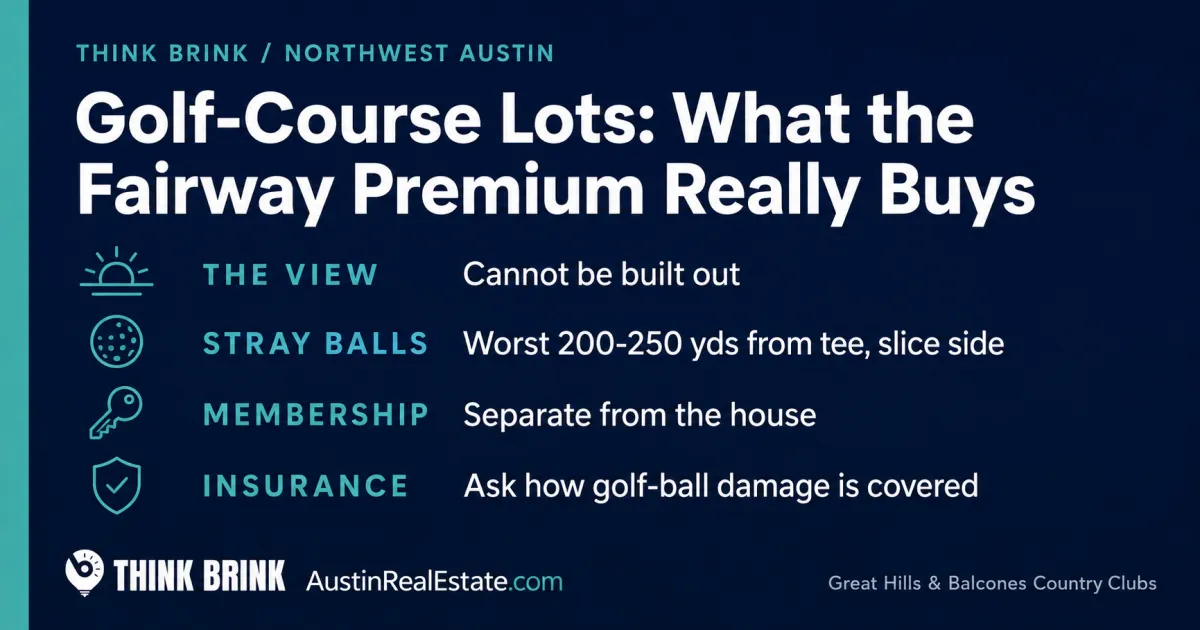
This is the real, permanent part of the premium. On an interior lot, the empty field behind you can become a house, a fence line, or a second story with a window aimed at your patio. On a golf-course lot, the course is a protected land use. Nobody is going to develop the fairway. You are buying a guarantee that your sight line and your back-yard privacy stay open for as long as the club operates the course, which at two established member-owned and member-supported clubs in prime Northwest Austin is a long horizon.
Light, space, and the feel of a bigger property
A home that opens onto a fairway lives larger than its square footage. The borrowed landscape of hundreds of acres of maintained turf and tree canopy makes a standard lot feel like an estate lot, and you get morning light and open sky that an interior lot hemmed in by neighbors never gets. Buyers consistently pay for that feeling, and it holds up at resale because the next buyer feels it too.
Marketing advantage when you sell
Golf-course frontage does part of the listing work for you. The phrase itself pulls a specific buyer, and homes near a private course tend to command a stronger premium than homes near a public or municipal course. In a neighborhood where a lot of homes look similar on paper, the fairway lot is the one that gets remembered.
What the premium does not buy
The premium does not buy club membership, it does not buy a quieter house, and it does not buy immunity from the specific headaches of course-side living. Those are the parts buyers tend to underweight when they are standing on the patio looking at the eighth green, and they are exactly what the rest of this guide is about.
The tradeoffs nobody puts in the listing photos
Stray golf balls are a real, recurring thing
This is the tradeoff that surprises people, and it is not evenly distributed across the course. The lots that take the most ball traffic are the ones in the landing zone, generally on the side where an average right-handed slice ends up, roughly 200 to 250 yards from the tee. If your lot sits in that band, you will get balls in the yard, off the siding, and occasionally through a window. Lots alongside a green, a tee box, or a bend in the fairway see far fewer.
You can figure this out before you buy. Look at where the tee boxes are relative to the lot, which direction play moves, and whether the house sits on the slice side of a longer hole. Ask the listing agent or a neighbor how often balls actually land in that yard. A protective screen, laminated or impact-rated glass on the exposed elevation, and landscaping that catches balls all help, but the smartest move is choosing a lot that is not in the primary landing zone in the first place.
Liability and the assumption of risk
In Texas, as in most of the country, a golfer is generally not liable for an ordinary errant shot that damages your house. The legal reality is that buying a home on a golf course carries an assumption of risk: you accepted the proximity to play when you bought. That means a broken window from a normal slice is usually your problem to fix, not the golfer's and not the club's. It is worth knowing before you buy rather than discovering it after the first pane cracks. This is general information, not legal advice, and a real estate attorney can speak to your specific situation.
Insurance can treat golf-ball damage differently
Homeowner policies vary in how they handle golf-ball damage, and some limit or exclude it on course-side homes. Before you close, ask your insurance agent directly how your policy treats window and exterior damage from stray balls, and whether your carrier prices a golf-frontage home any differently. It is a five-minute conversation that occasionally changes which lot a buyer chooses. I am a broker, not an insurance professional, so confirm the specifics with a licensed agent.
Early mornings belong to the course
Course maintenance starts early. Mowers, blowers, and irrigation run at dawn so the course is ready for play, and that is the hour when a course-side bedroom is loudest. During tournaments or busy weekends you will also have more foot and cart traffic and more eyes on your back yard. For most buyers this fades into background quickly, but if you are a light sleeper with a bedroom on the course side, spend a morning there before you commit.
Privacy runs both directions
The open sight line that gives you a great view also gives players a look at your patio. Golfers walk or ride past your back yard all day during the season. Mature landscaping and thoughtful placement of your outdoor living space solve most of it, but a fully exposed lot with a pool right on the fairway is a different privacy situation than an interior lot, and some buyers care about that more than they expect to.
Membership is separate from the house, and that catches people
Both Great Hills and Balcones are private clubs where membership is separate from home ownership. Buying a house on the course does not enroll you in the club, does not give you golf privileges, and does not obligate you to join. If you want to play the course you back onto, you apply for membership on the club's terms, which at these clubs includes a sponsorship or invitation tradition and monthly dues on top of any initiation cost.
This cuts both ways for buyers. If you are a golfer, budget the membership separately and confirm current dues and any wait or sponsorship requirement directly with the club before you assume you can join. If you are not a golfer, understand that you are paying the frontage premium purely for the view and the lot, not for course access, and that is a legitimate choice as long as you are honest with yourself about what you are buying. Some of the happiest golf-frontage owners I have worked with have never picked up a club. They bought the horizon, not the hobby. For the broader picture on how these communities operate, see my guide to HOA and country club communities in Northwest Austin.
How to read a specific golf-course lot before you offer
The single biggest mistake buyers make is treating golf-course frontage as one thing. It is not. Two lots in the same neighborhood at the same price can be very different properties depending on which hole they sit on and where they sit on it. Here is what to check.
- Where the lot sits on the hole. Alongside a green or tee box is calm. In the fairway landing zone on the slice side is where the balls go. Walk the hole if you can, or at least study the layout.
- The direction of play and the slice side. Most amateur misses go one way. A lot on the wrong side of a long par four or par five takes the most traffic. A lot on the safe side of the same hole is a different property.
- Elevation and drainage. Many of these lots sit on the rolling terrain of the Balcones hills. A course-side lot that collects runoff from higher ground, or that sits below the fairway grade, can have drainage and foundation considerations worth an inspector's eye. My guide to buying a hillside or view lot covers what to check.
- The exposed elevation's glass and screening. Note which windows face play and whether the current owner has done anything to protect them. Retrofitting impact-rated glass later is not cheap.
- Fencing and setback rules. Some course-side lots have restrictions on fence height or type to preserve the course's sight lines. Confirm what you can and cannot build before you plan that back-yard project.
- The HOA and any course-adjacency rules. Read the deed restrictions specifically for anything that applies to lots on the course. These sometimes govern landscaping, structures, and even how far your improvements can extend toward the fairway.
If you want the wider view on lot premiums generally, including greenbelt versus golf frontage and when the premium is and is not worth it, I wrote a companion piece on Northwest Austin greenbelt and golf-course lots and what the premium actually buys you.
Resale: the narrower buyer pool cuts both ways
A golf-course lot is a niche product, and that is worth understanding on the way in. The pool of buyers who specifically want fairway frontage is smaller than the pool for a standard interior home, which can mean a course-side home takes a little longer to find its buyer, or that its value swings more with how much the next buyer personally values the view. In a strong market this barely registers. In a slower market, the niche can matter.
The flip side is that when the right buyer shows up, the frontage is exactly what closes them. A well-chosen lot, one that is not in the primary landing zone, that has a genuine open view and reasonable privacy, tends to hold its premium well because there is no way to manufacture that view anywhere else. A poorly chosen lot, one that takes constant ball traffic or backs onto an unremarkable stretch of rough, carries the premium price without the premium experience, and those are the ones that sit. Which lot you buy matters more here than in almost any other category of Northwest Austin home. Because market pricing shifts, I am not quoting a specific dollar premium here. Ask me for current comparable sales on the exact stretch of course you are considering and I will pull them.
Frequently asked questions
Is it worth buying a house on a golf course in Northwest Austin?
It is worth it if you value a permanent open view and back-yard privacy that cannot be built out, and if you choose a lot that is not sitting in the primary golf-ball landing zone. It is not worth it if you are paying the premium purely on emotion for a lot that takes constant ball traffic or backs onto an unremarkable stretch. The community and the specific lot matter far more than the general idea of golf frontage.
Do I have to join the country club if I buy a home on the course at Great Hills or Balcones?
No. Both Great Hills and Balcones are private clubs where membership is completely separate from home ownership. Buying a course-side home does not enroll you, obligate you, or give you golf privileges. If you want to play, you apply and pay dues separately, and if you never want to golf, you can simply enjoy the view.
How bad is the stray golf ball problem on a fairway lot?
It depends entirely on where the lot sits. A lot in the fairway landing zone on the slice side of a long hole, roughly 200 to 250 yards from the tee, will get regular ball traffic. A lot alongside a green, a tee box, or the safe side of a hole sees very few. This is the most important thing to check before you offer, and it is knowable in advance.
Does homeowners insurance cover golf-ball damage in Texas?
It varies by policy and carrier, and some limit or exclude golf-ball damage on course-side homes. Because golfers are generally not liable for ordinary errant shots and you assume that risk when you buy on a course, the repair is often the homeowner's responsibility. Confirm exactly how your policy treats it with a licensed insurance agent before you close. I am a broker, not an insurance professional.
Which is better for a golf-course home, Great Hills or Balcones?
Great Hills, in 78759, offers newer larger homes with a single eighteen-hole course and strong access to 183, Loop 360, and the Apple corridor. Balcones, in 78750, has two eighteen-hole courses and therefore more frontage and more variety, with a stock of established 1970s through 1990s homes under mature canopy. The right answer depends on the age of home you want, the school feeders you need, and how much frontage variety you want to choose from.
What schools do golf-course homes in these areas feed into?
It depends on the exact address, and the two clubs sit in different districts. Balcones Village homes generally fall in Round Rock ISD, while golf-frontage homes on the 78759 side near Great Hills can fall in Austin ISD, and feeders differ by street. Verify the specific address before you rely on any school assignment, because these boundaries do not follow neighborhood names.
Will a golf-course lot be harder to sell later?
The buyer pool for fairway frontage is narrower than for a standard interior home, so a course-side home can take a little longer in a slow market. But a well-chosen lot with a genuine open view and reasonable privacy holds its premium well, because that view cannot be reproduced anywhere else. A poorly located lot that takes constant ball traffic is the one that struggles, which is why lot selection is everything here.
Can I build a fence or add a pool on a golf-course lot?
Often yes, but course-side lots frequently carry deed restrictions or HOA rules that govern fence height, structures, and how far improvements can extend toward the fairway, all to protect the course's sight lines. Read the specific deed restrictions and HOA documents for course-adjacency rules before you plan any back-yard project.
The honest summary
A golf-course lot in Great Hills or Balcones can be one of the best buys in Northwest Austin or one of the most overpaid, and the difference is almost entirely which lot you pick. The view that cannot be built out is real and durable, and it is the reason the premium holds up at resale. The stray balls, the early-morning maintenance, the two-way privacy, and the insurance and liability questions are also real, and they land very differently depending on where the lot sits on the hole.
Buy the frontage for the permanent open horizon and the borrowed landscape, choose a lot off the primary landing zone, confirm how your insurance treats golf-ball damage, and remember that the house does not come with a club membership. Do that and you own something that genuinely cannot be reproduced across the street. If you want to walk specific golf-frontage lots at Great Hills or Balcones and see which holes and which sides actually make sense, that is exactly the kind of thing I do with buyers. Reach out and I will pull current comparable sales for the exact stretch of course you are considering.
