What Buyers Should Know About the Fairway at Great Hills Before Making an Offer
The Fairway at Great Hills is a specific kind of buy, and the buyers who end up here usually know it when they see it. They want a larger home, they want a lot with something to look at, and they have figured out that inside the broader Great Hills area there is a pocket built later than the rest, with bigger houses on golf-course frontage and a school feeder that runs through Austin ISD rather than Round Rock. That pocket is the Fairway at Great Hills, and it plays by slightly different rules than the neighborhoods around it.
This guide covers what matters before you make an offer here: what the neighborhood actually is and how it differs from the rest of Great Hills, the Austin ISD feeder and why it draws a particular buyer, the reality of buying on a golf course, the age and scale of the homes, the location and commute, and the honest tradeoffs. I work these Northwest Austin zip codes every week, and the Fairway is a neighborhood where the details separate a smart purchase from an expensive mistake.
What the Fairway at Great Hills Actually Is
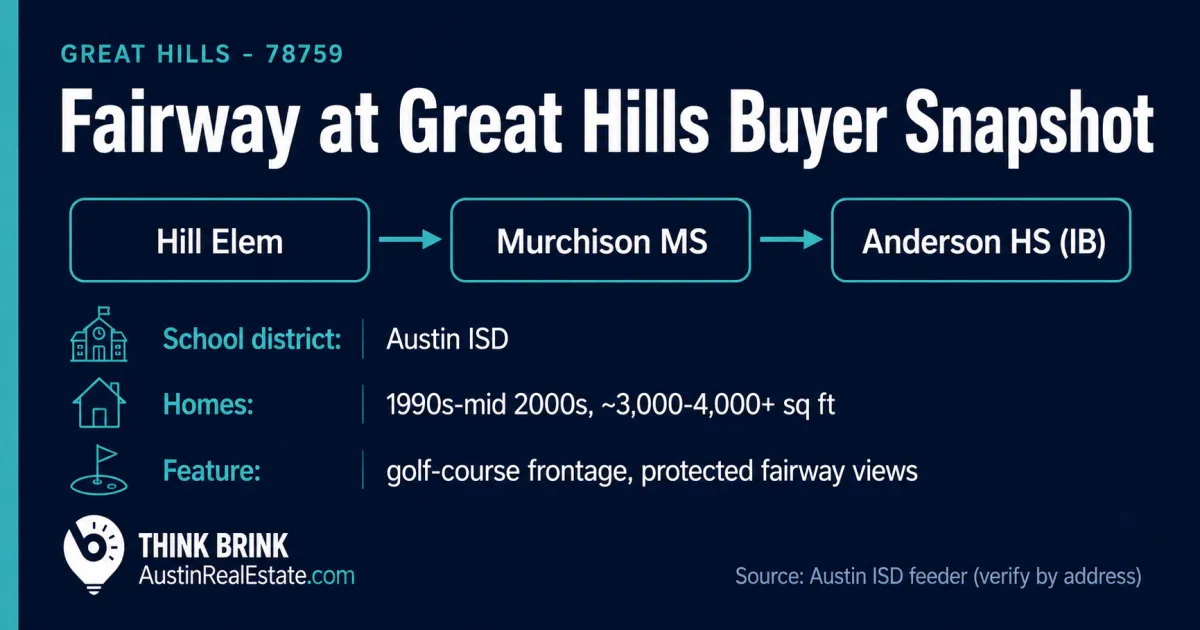
The Fairway at Great Hills is a sub-community within the larger Great Hills area of the 78759 zip code, and it is important to understand it as its own thing rather than as just another Great Hills street. Where much of Great Hills was built out from the late 1970s through the 1980s, the Fairway is a later section, with most homes built from the 1990s into the mid-2000s. The homes here tend to be larger than the older Great Hills stock, frequently in the neighborhood of 3,000 to 4,000 square feet and up, and many of them front directly on the Great Hills golf course with fairway views.
That combination, later construction, larger footprints, and golf frontage, is what defines the Fairway and what sets its price point above much of the surrounding area. If you have read my Great Hills buyer guide, think of the Fairway as the upper, later-built tier of that broader neighborhood, and my guide to the Great Hills Country Club area covers the adjacent golf-and-club side of the same story.
The Austin ISD Feeder Is a Deliberate Choice
Here is where the Fairway at Great Hills genuinely diverges from many of its neighbors. The Fairway is zoned to Austin ISD, and the feeder pattern runs through Hill Elementary, then Murchison Middle School, then Anderson High School. This matters because a lot of Northwest Austin's most-searched neighborhoods feed Round Rock ISD and the Westwood pathway. The Fairway feeds the Austin ISD Anderson pathway instead, and for a meaningful set of buyers that is not a compromise, it is the point.
Anderson High School is one of Austin ISD's flagship high schools, with a long-established International Baccalaureate program, and Hill Elementary and Murchison Middle are well-regarded schools that feed into it. Buyers who specifically want the Austin ISD Anderson experience, whether for the IB pathway, the school culture, or family ties to the district, will find the Fairway is one of the more desirable addresses in that feeder. I lay out the full pathway in my Anderson High School feeder guide.
The same honest caution applies here as anywhere in Northwest Austin: attendance boundaries are assigned at the address level and Austin ISD can adjust them. Do not assume the Hill to Murchison to Anderson feeder from this guide or from a listing. Confirm the exact elementary, middle, and high school assignment for the specific address directly with Austin ISD before you write your offer. It is the single most consequential verification you can do, because the feeder is a large part of what you are paying for.
The Reality of Buying on a Golf Course
Golf-course frontage is the signature feature of the Fairway, and it is worth being clear-eyed about what that actually means, because it is genuinely a mixed bag rather than an unqualified premium. I cover the broader version of this analysis in my guide to what the greenbelt and golf-course premium actually buys you, but here is the Fairway-specific version.
On the plus side, a fairway lot gives you an open, green, protected view that will not be built out, more privacy on the golf-facing side than a standard back-to-back lot, and a sense of space that is hard to find on a conventional interior lot. For a lot of buyers that view is the entire reason they are here, and it holds value because it is genuinely scarce.
On the other side of the ledger, golf-course living comes with real considerations. There is the occasional errant golf ball, which is a genuine thing on fairway-adjacent lots, not a myth. There is course maintenance activity, including early-morning mowing and irrigation. There is foot and cart traffic during play, and the corresponding question of privacy and fencing on the course-facing side. And there is a structural point that many buyers overlook: the long-term health of the golf course itself matters to your view and your value. If a course changes ownership, reduces maintenance, or in a worst case closes, the fairway lot you paid a premium for changes character. That is not a prediction about this specific course, it is a due-diligence item. Ask about the course's ownership and operating status as part of your research, because your premium is partly a bet on the course staying a well-kept course.
Larger Homes, Later Construction, Still Worth Inspecting
Because the Fairway was built later than much of Great Hills, buyers sometimes relax on inspection, figuring a 1990s or 2000s home is new enough to skip the scrutiny. That is a mistake. A home built in 1998 or 2003 is now decades old, and the major systems have aged accordingly. The roof, the HVAC, the water heater, and the finishes all have real lifespans, and a home that has not been updated since it was built may be facing several big-ticket replacements at once.
There is also a condition-tier question here just like anywhere else. Some Fairway homes have been meaningfully updated with current kitchens, baths, and systems, and command a price that reflects it. Others are largely original to their build era and are priced, or should be priced, as homes that will need investment to bring current. Larger homes amplify this: reroofing, re-HVACing, and re-finishing a 4,000-square-foot house costs considerably more than doing the same to a 2,000-square-foot one. Know which tier you are buying and make sure the price matches it. For the broader framework on this, see my guide on partially updated homes, which is written for sellers but is just as useful for buyers reading condition.
And do not skip the foundation. Even later-build homes in Northwest Austin sit on the same expansive Central Texas clay, and larger slabs on sloped, view-oriented lots have their own drainage and movement considerations. Read the foundation and the site drainage carefully, and bring in a structural engineer where the situation warrants it. My guide to foundation repair on Central Texas clay explains what to look for.
Location and Commute
The Fairway at Great Hills sits in the heart of the 78759 Great Hills area, which puts it near the 183 and Loop 360 corridors and within easy reach of the Arboretum and Domain retail and job centers. That location is one of the enduring reasons Great Hills addresses hold value: you are central to Northwest Austin's employment and shopping without being on top of a highway.
For commuters, the Domain and North Burnet job cluster is a short drive, and the Apple campus on Parmer Lane is generally reachable in roughly 15 to 25 minutes in normal traffic via MoPac or 183 depending on your exact starting point and how the corridors are moving. Downtown is a straightforward run down MoPac or Loop 360. As with any Northwest Austin neighborhood, the honest framing is that no single location is equally close to everything, but the Great Hills area is one of the better-balanced central positions in the zip code. For a deeper commute analysis, see my guide on Apple corridor commute versus price tradeoffs.
What You Give Up
The Fairway is a premium pocket, and the honest tradeoffs run in two directions.
Compared to the rest of Great Hills and the surrounding established neighborhoods, you pay more. The larger homes, the later construction, and the golf frontage all sit at the upper end of the local range. If your budget is the priority and the golf view is not essential, you may get more house-for-the-dollar in a standard interior lot in Great Hills or a neighboring 78759 subdivision, and my guide to buying into Great Hills without paying hillside prices is built around exactly that question.
You also take on the specific realities of golf-course living that I described above, plus the maintenance profile of a larger home. Bigger houses cost more to cool, roof, and maintain, full stop. And the Austin ISD feeder, while a genuine draw for many, is a different pathway than the Round Rock ISD Westwood feeder that some buyers are specifically targeting. If Westwood is your goal, the Fairway is not your neighborhood, and that is worth knowing before you tour rather than after.
What to Verify Before You Write an Offer
- The exact school assignment for the specific address, confirmed directly with Austin ISD, since the Hill to Murchison to Anderson feeder should not be assumed from the neighborhood.
- The golf course's ownership and operating status, because your fairway premium depends in part on the course remaining a well-maintained course.
- The condition and age of the major systems on a home that may be 20 to 30 years old: roof, HVAC, water heater, and finishes, priced for the square footage of a larger house.
- The foundation and site drainage, with a structural engineer if warranted, given the clay soils and sloped, view-oriented lots.
- The HOA, its fees, and its rules, including anything specific to golf-course frontage lots such as fencing restrictions.
- The condition tier you are buying and whether the price reflects updated-versus-original, so you are not paying renovated money for an original home.
Frequently Asked Questions
What school district is the Fairway at Great Hills in?
The Fairway at Great Hills is zoned to Austin ISD, with a feeder pattern that runs Hill Elementary to Murchison Middle School to Anderson High School. This is different from many nearby Northwest Austin neighborhoods that feed Round Rock ISD and Westwood. Because boundaries are assigned at the address level and can change, confirm the exact assignment for any specific home directly with Austin ISD before relying on it.
Are the homes in the Fairway at Great Hills newer than the rest of Great Hills?
Yes. While much of Great Hills was built from the late 1970s through the 1980s, the Fairway at Great Hills is a later section, with most homes built from the 1990s into the mid-2000s. The homes here also tend to be larger, frequently in the 3,000 to 4,000 square foot range and up, and many front on the golf course.
Is buying a home on the golf course worth it?
It depends on how much you value the view and the openness. A fairway lot gives you a protected green view that will not be built out and more privacy on the course-facing side, which is genuinely scarce and holds value. The tradeoffs are occasional errant golf balls, course maintenance activity, and the fact that your premium depends on the course staying well-maintained. If the view is the reason you are buying, it can absolutely be worth it, but verify the course's operating status as part of your due diligence.
How much do homes in the Fairway at Great Hills cost?
The Fairway sits at the upper end of the Great Hills range because of its larger homes, later construction, and golf frontage. Rather than quote a specific figure that moves month to month, the honest answer is that it prices above the standard interior-lot homes in the broader Great Hills area. For a current, address-specific number, look at recent comparable sales with an agent, because a general neighborhood average can be misleading given how much the golf frontage and home size vary.
What is the difference between the Fairway at Great Hills and the Great Hills Country Club area?
They are adjacent and related but not identical. The Fairway at Great Hills is a residential sub-community defined by golf-course-fronting homes built largely in the 1990s and 2000s. The Great Hills Country Club area refers to the neighborhoods around the private club and course. There is overlap in feel and location, but they are distinct pockets. My separate guide to the Great Hills Country Club area covers that side in detail.
Does the Fairway at Great Hills feed Anderson High School?
The typical feeder for the Fairway runs through Hill Elementary, Murchison Middle School, and Anderson High School, all in Austin ISD. Anderson is one of Austin ISD's flagship high schools with a long-established International Baccalaureate program, which is a specific draw for buyers targeting this feeder. Always confirm the exact assignment for your address directly with Austin ISD, because boundaries can shift.
Should I worry about errant golf balls on a fairway lot?
It is a real consideration, not a myth, and it varies significantly by lot depending on where the home sits relative to the fairway, the tee boxes, and the direction of play. Some lots see it rarely, others more often. If you are seriously considering a specific fairway home, ask the seller and neighbors directly, and factor it into your view of the lot. It is manageable, but it should inform which lot you choose rather than being discovered after closing.
Is the Fairway at Great Hills a good fit if I want a large home in Northwest Austin?
Yes, this is one of the more consistent places in the 78759 area to find larger homes, frequently in the 3,000 to 4,000 square foot range, on lots with real character. That scale is part of the neighborhood's identity. Just budget honestly for the maintenance and system costs that come with a larger, decades-old home, and confirm the condition tier you are buying.
The Honest Fit Check
The Fairway at Great Hills is a strong fit if you want a larger home on a lot with a real view, you specifically value the Austin ISD Hill to Murchison to Anderson feeder, and you are drawn to golf-course living with your eyes open to what that entails. It is a strong fit for buyers who have decided that a protected green view and more square footage are worth paying up for in a central Great Hills location.
It is a weaker fit if your priority is maximum house-for-the-dollar, if you are specifically targeting the Round Rock ISD Westwood feeder, or if the realities of golf-course living, from errant balls to your dependence on the course staying well-run, do not appeal to you. In those cases a standard interior lot elsewhere in Great Hills or a neighboring 78759 neighborhood will serve you better.
If a larger home, a fairway view, and the Anderson feeder describe what you are after, the Fairway at Great Hills is worth serious attention, and the details, especially the school assignment, the condition tier, and the golf course's health, are where a careful buyer protects themselves. If you want help evaluating a specific home here or weighing it against other Great Hills options for your situation, that is the kind of analysis I do with buyers every week.
