What Northwest Austin Buyers Should Know About Buying a Hillside or View Lot Before Making an Offer
A View Lot Is a Great Buy Right Up Until It Is an Engineering Project
Northwest Austin is built on the edge of the Hill Country, which means a large share of the most desirable lots in Great Hills, Cat Mountain, Jester, Canyon Creek, and the hillier parts of Northwest Hills are not flat. They fall away toward a canyon, a greenbelt, or a downtown skyline view, and buyers pay real money for that drop. I understand the appeal completely. A hillside lot with a view is one of the few things in residential real estate that genuinely cannot be reproduced. Nobody is manufacturing new canyon rims.
What I want to do in this guide is separate the two things that get blurred together when people fall in love with a view. One is the value of the view itself, which is real and durable. The other is the cost and risk of the slope that produces it, which buyers routinely underestimate because the expensive parts are invisible from the driveway. A hillside home can be a fantastic buy. It can also be a house where the view cost you a quarter of what you paid and the hill costs you the rest over the next fifteen years. The difference is entirely in what you check before you offer.
This is a companion to two posts you should read alongside it: the greenbelt and golf-course lot guide, which covers what the view premium actually buys, and the interior-lot guide, which makes the honest case for skipping the premium entirely.
The Ground You Are Actually Building On
Central Austin sits on the Edwards Plateau, which means limestone bedrock under a thin layer of topsoil, frequently mixed with expansive clay. That geology cuts two ways on a hillside. The good news is that a lot with shallow rock can give you a very stable foundation, because you are anchoring to stone rather than floating on soil that moves. The bad news is that the same rock makes excavation, drainage trenching, pool digging, and any below-grade work more expensive and less predictable, and where clay is present instead of rock, that clay swells when it is wet and shrinks when it is dry, which is the single most common source of foundation movement in this region.
On a slope, water is the variable that ties all of this together. Austin averages roughly 35 inches of rain a year, and a meaningful share of it arrives in short, violent bursts rather than steady drizzle. On flat ground that water has time to soak in. On a hillside it does not. It runs, it gains speed, and it goes exactly where the grade sends it, which on an unengineered lot is often straight at the foundation of the house below. Every serious question you should ask about a hillside lot is, underneath, a question about where the water goes. For the deeper version of how Central Texas soil moves and what foundation repair actually costs when it does, the foundation repair guide is the companion piece.
Downhill Versus Uphill: They Are Not the Same Buy
The first thing I want a buyer to understand is that "hillside lot" describes two opposite situations, and they carry opposite risks.
The downslope lot
A downslope lot falls away from the street. The house is often built with the main level at street grade and living space or a walkout basement stepping down the hill behind it. This is the classic Austin view configuration, because the back of the house looks out over the drop. The risk on a downslope lot is structural and financial: the downhill side of the house frequently sits on piers, stem walls, or a stepped foundation, and that engineering is expensive to build and expensive to repair. You are also the low point for nothing above you, which is good for incoming water but means everything your own roof and yard shed has to be carried safely down and away without undermining your own foundation.
The upslope lot
An upslope lot rises from the street, so you are looking up at the house and, often, the neighbor's yard drains toward you. Here the risk is water management and retaining. You may need a retaining wall just to create a usable yard or driveway, and you are catching runoff from everything uphill of you. Upslope lots can be perfectly good buys, and they are often cheaper than the view-facing downslope lots, but you need to know going in that you are the catch basin for the hillside above you and budget the drainage accordingly.
Neither is inherently better. What matters is that the house and the site were engineered for the direction the land actually slopes, and that the drainage was designed on purpose rather than left to gravity and hope.
Retaining Walls: The Line Item Buyers Never See Coming
Retaining walls are the most underestimated cost on hillside property, for a simple reason. From the street they look like landscaping. Structurally they are doing the job of holding a hillside in place, and when they fail they fail expensively.
Here is the part most buyers do not know. A retaining wall is itself an impervious barrier, and the water it holds back has to go somewhere. A properly built wall has drainage behind it: gravel backfill and a perforated pipe, often called a French drain or weep system, that relieves the water pressure before it can build up behind the wall and push it over. A wall built without that drainage will hold for a while and then bulge, crack, and lean as hydrostatic pressure builds against it, especially after our heavy-rain bursts. Adding proper drainage to a wall during construction is a modest cost. Rebuilding a failed wall after it has moved is not.
When you tour a hillside home, walk every retaining wall on the property and look for three things. Look for bulging or lean, which means the wall is losing the fight. Look for cracking, especially stair-step cracking in block or stone. And look for weep holes or a visible drainage outlet at the base, because a wall with no way to shed water behind it is a wall on borrowed time. Tall walls, terraced walls, and walls near property lines or drainage easements often require permits and engineering in Austin, so ask whether the walls on the property were permitted and engineered or thrown up by a landscaper. That answer tells you a lot about the rest of the house.
Drainage Is the Whole Game
If you take one thing from this guide, take this: on a hillside lot, drainage is not a detail, it is the entire risk profile of the property. A well-drained hillside home can outlast a flat one. A poorly drained one will move, crack, and cost you.
Good hillside drainage is a system, not a single feature. It usually combines some mix of graded swales that carry water around the house rather than at it, dry creek beds that route heavy flow across the lot, terracing that breaks a long slope into shorter runs so water never builds up speed, French drains behind retaining walls and along the uphill side of the foundation, and gutters with downspouts that discharge well away from the structure rather than dumping at its base. On the better-engineered hillside homes in Great Hills and Jester you can see this system working. On the problem homes, you see a slope that runs straight at the back door and gutters that empty into a flower bed against the foundation.
When you inspect, go look at the property during or right after a rain if you possibly can, and if you cannot, look for the evidence rain leaves behind: erosion channels cut into the soil, mulch and gravel washed into low spots, water stains on the foundation or the lower walls, and pooling near the house. Those are the fingerprints of a drainage problem, and they are far more honest than a dry-day walkthrough. The lot selection tradeoffs here are the same ones I lay out in the Great Hills hillside lots guide, which is worth a read if you are targeting that neighborhood specifically.
The Foundation Question on a Slope
Hillside homes are usually not on the simple slab-on-grade foundation you find on a flat Austin lot. To build level on a slope, builders use piers and beams, stem walls, stepped foundations, or a combination, and the downhill portion of the house may be supported well above the soil. These systems are perfectly sound when they are engineered and maintained. The reason they matter to you as a buyer is that they are more complex to inspect and more expensive to repair than a slab, and problems in them show up in ways a cosmetic walkthrough will miss.
On any hillside home, I want a buyer to spend the money on a structural engineer's report, not just a general inspection. A general inspector is looking at the whole house on a checklist. A structural engineer is specifically evaluating whether the foundation and the slope are behaving. They will look at the piers and stem walls, at the way the house sits on the grade, at whether there is movement, and at whether the drainage is protecting the structure. On a hillside purchase, that report is the most important few hundred dollars you will spend, and I will tell you plainly that I would rather lose a deal over an engineer's findings than let a buyer close on a moving house.
Read the inside of the house for the same story the outside is telling. Doors and windows that stick, cracks that run diagonally from the corners of door and window frames, sloping or bouncing floors, and separation where walls meet ceilings are all signs of foundation movement. On a hillside, those signs deserve more weight, not less, because the cost to correct movement on a stepped or pier foundation is higher than on a slab.
What the View Premium Actually Buys, and Whether It Holds
Let me be fair to the view, because I have spent this whole guide talking about risk. A genuine, protected view is one of the most durable premiums in Austin real estate. A lot that looks over a greenbelt, a canyon, or a preserve that cannot be built on is holding something scarce, and that scarcity shows up at resale every time. Buyers pay for it, and they keep paying for it, because the supply is fixed.
The word that matters is protected. A view over the Balcones Canyonlands Preserve or a permanent greenbelt is protected, because nothing is going up in front of it. A view over a vacant lot, a low-density parcel, or land that is merely undeveloped for now is a view you are renting until someone builds. Before you pay a premium for a view, find out what you are actually looking at and whether it can change. I have watched buyers pay a canyon-view premium for a sightline that a new house erased three years later. Verify what is protected and what is not before you assign a dollar of your offer to the view.
The honest way to think about a view lot is that you are paying two premiums bundled together: one for the view, which is real and durable if it is protected, and one for the slope that creates it, which is a cost and a risk you are taking on. A well-built, well-drained hillside home with a protected view is worth every dollar. The same view on a house with failing walls and a slope draining at the foundation is a liability wearing a pretty face.
What to Verify Before You Offer on a Hillside or View Lot
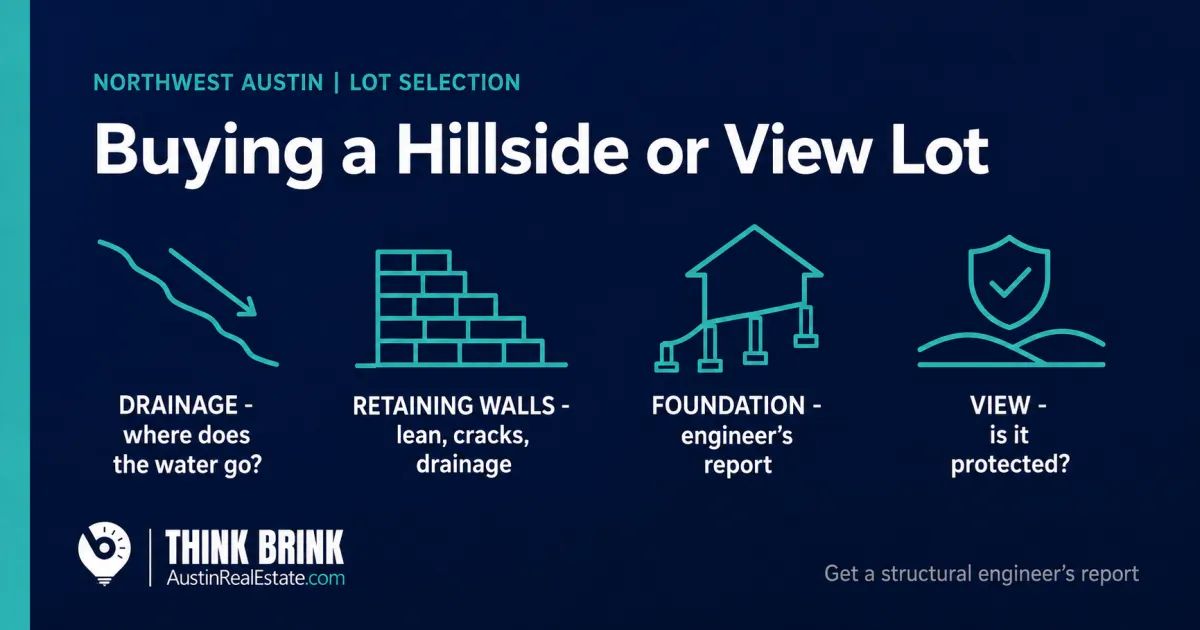
Here is the short list I run with buyers on any sloped property. Get a structural engineer's report, not just a standard inspection, and read it for foundation and slope behavior specifically. Walk every retaining wall and check for lean, cracking, and drainage, and find out whether the walls were permitted and engineered. Trace where the water goes, ideally during a rain, and look for erosion, washouts, pooling, and stains that reveal a drainage problem. Confirm the foundation type and understand what repairs on that type cost, because a stepped or pier system is a different budget than a slab. Verify the view is protected by a preserve, greenbelt, or permanent open space rather than a lot that can be built on. Check for any drainage or creek easements crossing the property and what they restrict. And ask specifically about erosion history, any past wall or foundation repairs, and whether the seller has an engineer's report from when the house was built or last serviced.
None of this is meant to talk you out of a view lot. It is meant to make sure that when you buy one, you are buying the durable premium and not the hidden project. The buyers who do this homework tend to love their hillside homes for decades. The ones who skip it tend to call me two years later asking what a retaining wall costs to rebuild.
Frequently Asked Questions
Are hillside lots in Austin a bad idea to buy?
No, not at all. A well-engineered, well-drained hillside home with a protected view is one of the most durable buys in Northwest Austin, because the view cannot be reproduced. The risk is not the hill itself, it is buying a hillside home where the drainage, retaining walls, or foundation were not built or maintained properly. With a structural engineer's report and honest attention to drainage, a hillside lot is a strong purchase.
What is the biggest risk when buying a home on a slope in Austin?
Water. Austin gets around 35 inches of rain a year, often in sudden heavy bursts, and on a slope that water runs fast and goes wherever the grade sends it. If the drainage was not designed on purpose, that runoff ends up against foundations and behind retaining walls, which causes movement, cracking, and wall failure over time. Nearly every serious hillside problem traces back to drainage.
Do I need a special inspection for a hillside house?
Yes. Beyond the standard general inspection, you should pay for a structural engineer's report on any hillside or view lot. Hillside homes typically use piers, stem walls, or stepped foundations that are more complex to evaluate and more expensive to repair than a flat-lot slab, and a structural engineer is specifically trained to assess whether the foundation and the slope are behaving. It is the most important money you will spend on the purchase.
How much do retaining walls add to the cost of a hillside home?
It varies widely with height, length, material, and whether engineering and permits are required, so I will not quote a single number. What matters is that a properly built wall includes drainage behind it (gravel and a perforated pipe) to relieve water pressure, which is a modest added cost during construction. Rebuilding a wall that has failed because it lacked that drainage is far more expensive, so the walls should be inspected carefully before you buy.
What makes a view lot hold its value?
Protection. A view over a permanent greenbelt, canyon, preserve, or protected open space holds its value because nothing can be built to block it, and that scarcity shows up reliably at resale. A view over a vacant or low-density lot that can still be developed is a view you may lose. Before paying a view premium, confirm exactly what you are looking at and whether it is legally protected from future construction.
What are the signs of a drainage or foundation problem on a hillside home?
Outside, look for erosion channels, washed-out mulch or gravel, pooling near the house, water stains on the foundation, and retaining walls that lean or crack. Inside, look for doors and windows that stick, diagonal cracks from the corners of frames, sloping or bouncing floors, and gaps where walls meet ceilings. On a slope these signs carry more weight, because correcting movement on a pier or stepped foundation costs more than on a slab.
Is a downhill or uphill lot better in Austin?
Neither is automatically better; they carry different risks. Downslope lots give you the classic view but often rely on piers or stepped foundations that are costly to build and repair, and you must shed your own water safely down the hill. Upslope lots are frequently cheaper but catch runoff from everything above them and may need retaining walls to create usable space. What matters is that the house and drainage were engineered for the direction the land actually slopes.
Should I pay a premium for a hillside view or buy a flat interior lot instead?
It depends on how much you value the view and how much risk and maintenance you want to take on. A protected view is a durable, scarce asset that holds at resale, but the slope beneath it is a real cost. If the view is not a priority for you, a flat interior lot in the same neighborhood usually gives you the same schools and access with fewer engineering variables and a lower long-term maintenance burden.
The Honest Summary
A hillside or view lot in Northwest Austin can be one of the best things you ever buy, or one of the most expensive lessons, and the deciding factor is almost never the view. It is the slope underneath it. Buy the protected view, pay for the structural engineer, walk every retaining wall, trace the water, and understand the foundation you are taking on. Do that, and the hill works for you for decades. Skip it, and the same hill quietly bills you for the rest of the time you own the house. When you are ready to look at hillside property with someone who will tell you which slopes were built right and which ones were not, that is the work I do out here.
This article is general real estate guidance, not engineering, legal, or tax advice. Always confirm structural, drainage, and easement questions with a licensed professional engineer for the specific property.
