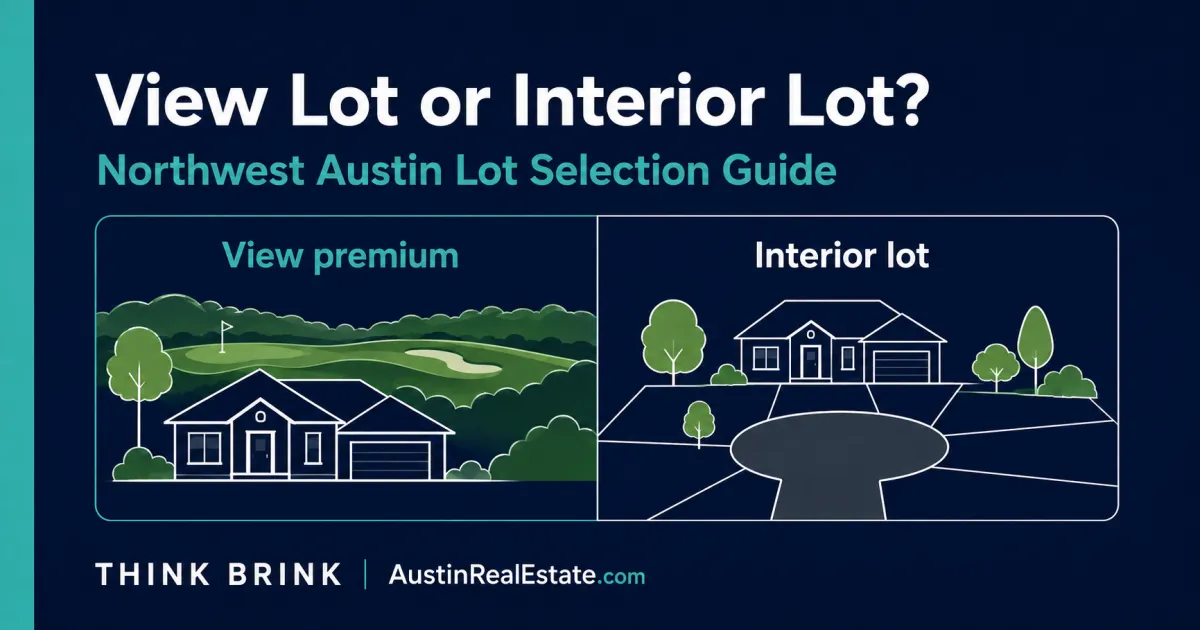
Northwest Austin Cul-de-Sac and Interior Lots: When Skipping the View Premium Makes Sense
In Northwest Austin, two identical floor plans on the same street can be tens of thousands of dollars apart because one backs to a greenbelt or a golf course and the other sits on an interior lot or a cul-de-sac. Buyers see the view lot, fall in love, and stretch for it. Sometimes that is exactly the right call. Just as often, the interior lot is the smarter buy, and the buyer would have been happier keeping that money in the house or in their pocket.
This guide is about how to think clearly about that decision. I sell in the 78750, 78759, and 78726 zip codes, where view premiums are real and sometimes large, and I have watched plenty of buyers overpay for a view they stopped noticing within a year, as well as buyers who would have paid anything for the greenbelt behind them and were right to. There is no universal answer. There is a right answer for your situation, and the point here is to help you find it before you write the offer.
What the view premium actually is
A view premium is the extra amount a lot commands because of what is behind or around it rather than the house itself. In Northwest Austin the common forms are greenbelt frontage, golf-course frontage, hillside or canyon views, and lots backing to permanent open space or a creek. The premium exists because that backdrop is scarce and permanent. Nobody can build behind a greenbelt lot. The fairway will always be a fairway. That scarcity is what you are paying for, and it is genuinely valuable.
The mistake is treating the premium as if it were free, or as if it automatically pays for itself at resale. It is real money, often a five-figure difference, and how much of it you recover later depends on the neighborhood and the market at the time you sell. I break down exactly what these premiums buy in the guide to Northwest Austin greenbelt and golf-course lots, and the same logic applies to the hillside view lots in Great Hills. This post is the other side of that coin: the case for the lot that does not carry the premium.
The case for the interior lot
An interior lot is simply a lot that does not back to a view feature. It faces and backs onto other homes or standard neighborhood space. For a large share of buyers, the interior lot is the better financial decision, and here is why.
You spend more time in the house than looking out the back
Be honest about how you actually live. If your evenings are spent cooking, working, watching television, and sleeping, the greenbelt behind the house is a backdrop you glance at, not a room you use. Buyers routinely pay a large premium for a view they experience for a few minutes a day, then wonder why the renovation budget is tight. If the money that would go to the view lot instead buys you an updated kitchen, a finished-out primary suite, or simply a lower monthly payment, that is real, daily value against an occasional glance.
The same house and schools cost less on the interior lot
This is the part buyers underweight. School zoning in Northwest Austin is set at the address level, and the top feeders do not care where in the neighborhood you buy. An interior lot in a Westwood-feeder neighborhood zones to the exact same schools as the fairway lot six houses away. You are not buying a lesser education by skipping the view. You are buying the same schools, often the same floor plan, for less. If schools are the reason you are in the neighborhood, the interior lot delivers the entire school benefit at a discount. I cover how much address-level zoning drives price in how school zoning by address changes what you pay.
The same principle is why the smartest entry into a premium neighborhood is frequently the interior or non-view lot. It is the strategy behind buying into Great Hills without paying hillside prices: you get the address, the schools, and the neighborhood, and you skip the frontage premium.
Privacy can be better, not worse, on an interior lot
There is a quiet benefit people miss. A greenbelt or golf-course lot has a beautiful open backyard, but it is open, which sometimes means less enclosure and, on a golf course, the occasional errant ball and foot traffic. A well-placed interior lot with mature trees and a fenced yard can actually feel more private and enclosed than a view lot. If what you want is a secluded backyard for kids, dogs, and evenings outside, a wooded interior lot can beat a fairway lot on the exact quality you care about.
What a cul-de-sac actually gives you, and what it does not
Cul-de-sac lots get grouped with view lots as premium lots, but they are a different thing entirely, and the tradeoffs are worth separating.
The real benefits of a cul-de-sac
The genuine advantages are low traffic and the safety and community that come with it. A cul-de-sac has no through traffic, so cars slow down and there is far less of them. Families with young kids value the reduced traffic for exactly the reason you would expect. The bulb also tends to create a tighter social pocket, since everyone shares the same little street. For buyers with small children or who simply want a quiet street, these are real and worth something.
The tradeoffs people forget
Cul-de-sac lots are often pie-shaped, which means a narrow frontage that widens toward the back. That can give you a large backyard, but it can also mean an awkward driveway, tight parking near the bulb, and less usable street parking when you host. Homes right on the bulb sometimes deal with headlights and turnaround traffic in the front. And a true flag lot, with a long skinny driveway leading back to a hidden building envelope, is a different animal again, with its own privacy upside and access and resale quirks. None of these are dealbreakers, but a cul-de-sac is not automatically superior. It is a specific set of tradeoffs that fit some buyers and not others.
When skipping the view premium makes sense
Here is where I tell a buyer the interior or cul-de-sac lot is the smart move.
- You are buying primarily for schools or location. The interior lot delivers the identical address-level school assignment and neighborhood access for less. Put the savings into the house.
- Your budget is tight and the premium competes with condition. If choosing the view lot means an original kitchen and deferred maintenance, while the interior lot means an updated home, the updated home you use every day usually wins.
- You spend your time inside or in an enclosed yard. If you are not someone who will sit and take in the view daily, you are paying for something you will not use.
- You want maximum privacy and enclosure. A wooded, fenced interior lot can out-private an open view lot.
- You are stretching to the top of your budget. The view premium is often the difference between a comfortable payment and a stressful one. The lot will not make the payment easier.
When the premium is worth paying
I am not anti-view. There are clear cases where the premium is money well spent, and I will tell a buyer so.
- You will genuinely use and value it every day. Some people live on their back porch, work from a room facing the greenbelt, or simply draw real daily happiness from the view. For them it is not a splurge, it is the point of the house.
- The permanence protects you. A lot backing to protected greenbelt or a golf course will never have a house built behind it. In a dense, growing area, that guaranteed open space and privacy has lasting value.
- You are in a neighborhood where view lots hold their premium. In established neighborhoods with limited view inventory, the premium tends to be durable, which makes it more defensible as an investment.
- The view lot is also the better lot in other ways. Sometimes the greenbelt lot is also the flattest, most usable, best-oriented lot on the street. When the premium buys a genuinely better lot and not just a view, it is easier to justify.
How to evaluate a specific lot before you offer
Whether you are leaning view or interior, the evaluation is the same. Walk the lot, do not just look at photos, and check these things.
- Usable yard versus total lot size. A big lot on a slope or in a floodplain may have far less usable flat yard than a smaller level lot. Measure what you can actually use.
- Orientation and sun. Which way does the backyard face, and where does the afternoon Texas sun land. West-facing outdoor space bakes in summer regardless of the view.
- Drainage and grading. Where does water go in a hard rain. Low spots, uphill neighbors draining toward you, and creek-adjacent lots all deserve a close look.
- Trees and what protects them. Mature canopy is one of the most valuable things a lot can have and cannot be bought new. Understand which trees are protected and healthy.
- What is actually behind and beside you. A greenbelt can be a manicured buffer or a scrubby drainage easement. A golf-course lot may face a tee box with foot traffic. Confirm the reality, not the label.
- Privacy at eye level. Stand in the backyard. Can you see into neighbors and can they see into you. Fencing and trees change this more than lot type does.
For how lot type fits into the bigger neighborhood decision across this part of town, the Living in 78750 and 78759 guide puts it in context.
Resale: does the discount follow you out?
The honest answer is that it depends, and this is where buyers most want a guarantee I cannot give. In general, view and greenbelt premiums that you pay going in are at least partially recoverable going out, because the next buyer values the same scarcity you did. But the amount you recover depends on the neighborhood, the specific lot, and market conditions when you sell. In a strong market with limited view inventory, the premium tends to hold well. In a softer market, view lots and interior lots can compress closer together.
The interior-lot buyer has a quieter advantage here: you paid less going in, so you have less premium to lose and more room to price competitively when you sell. Neither position is strictly better. A view lot can be a fine store of value if you buy the premium at a reasonable level in a neighborhood that supports it. The trap is overpaying for the view at the top of the market and expecting to recover all of it in a softer one. I would rather help you buy the right lot for how you live than talk you into or out of a premium on principle.
Fit check: which lot is right for you
Choose the view or greenbelt premium if you will use it daily, you value permanent open space and privacy behind you, the premium is reasonable for the neighborhood, and paying it does not force you to compromise on the house or stretch your budget uncomfortably. For you, the view is not a splurge, it is the reason you are buying that house.
Choose the interior or cul-de-sac lot if you are buying mainly for schools and location, you spend your time inside or in an enclosed yard, your budget is better spent on the home itself, or you want to enter a premium neighborhood without paying the frontage premium. You get the same address, the same schools, and often the same house for less, and you can put the difference where you will actually feel it.
My honest summary: the view lot is worth it for the people who truly live toward the view and value the permanence, and it is a costly habit for the people who buy it on emotion and then live entirely indoors. Be honest about which one you are. The best lot is the one that matches how you actually spend your days, not the one that photographs best on a listing.
Frequently asked questions
Is a greenbelt or golf-course lot worth the extra money in Northwest Austin?
It is worth it if you will genuinely use and value the view daily and you want the permanent open space and privacy that a protected greenbelt or fairway provides. It is not worth it if you are paying on emotion and spend your time indoors, or if the premium forces you to compromise on the house or stretch your budget. The premium is real money, often five figures, so decide deliberately.
Do interior lots zone to the same schools as view lots in the same neighborhood?
Yes. School zoning in Northwest Austin is set at the address level within a neighborhood, so an interior lot generally feeds the exact same schools as a view lot on the same streets. You do not give up the school assignment by skipping the view premium. Always confirm the specific address against current district boundaries.
What are the downsides of a cul-de-sac lot?
Cul-de-sac lots offer low traffic and a safer, quieter street, which many families love. The tradeoffs are that they are often pie-shaped with narrow frontage, can have awkward driveways and limited street parking near the bulb, and homes right on the bulb may deal with turnaround traffic and headlights. They are a specific set of tradeoffs, not automatically a premium.
Will I get the view premium back when I sell?
Usually you recover at least part of it, because the next buyer values the same scarcity, but how much depends on the neighborhood, the lot, and the market when you sell. Premiums tend to hold in strong markets with limited view inventory and compress in softer ones. The risk is overpaying at the top of the market and expecting full recovery later.
Is an interior lot harder to sell later?
Not inherently. Interior lots make up the majority of most neighborhoods and sell steadily. Because you paid less going in, you often have more pricing flexibility when you sell. The view lot may command more, but it also has more premium to defend in a soft market.
How do I decide between a bigger interior lot and a smaller view lot?
Look at usable space, not just total size and the view. A large lot on a slope may have less flat, usable yard than a smaller level one, and a view you glance at matters less than a yard you use. Weigh orientation, drainage, trees, and privacy, then match the lot to how you actually spend time at home.
What should I physically check when walking a lot?
Check usable versus total yard, backyard orientation and afternoon sun, drainage and grading in a hard rain, the health and protection of mature trees, what is actually behind and beside the lot rather than the label, and privacy at eye level from the backyard. Fencing and trees affect privacy more than lot type does.
If you are weighing a specific view lot against an interior or cul-de-sac option in Northwest Austin, that is exactly the kind of tradeoff I help buyers price out house by house. Reach out and we will look at the two lots side by side against your budget and how you actually live.
