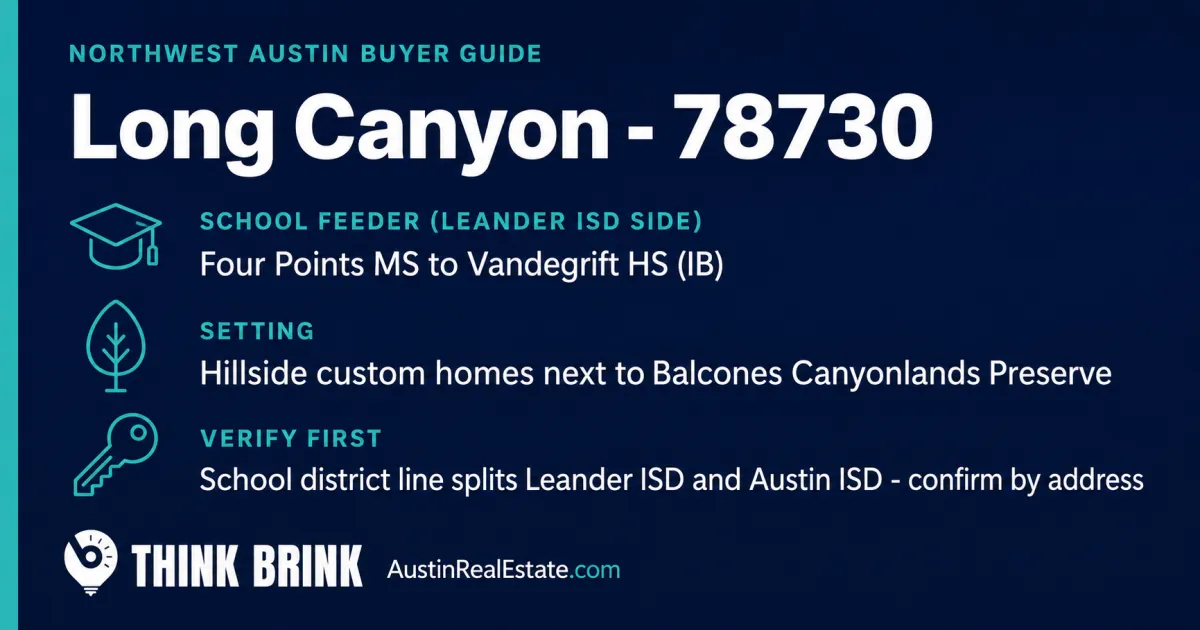
What Buyers Should Know About Long Canyon Before Making an Offer (78730)
Long Canyon is one of those Northwest Austin pockets that most buyers never put on their list until an agent shows them a house there, and then they spend the drive home trying to figure out why they had not heard of it. It sits in 78730, tucked into the hills off RM 2222 between River Place and the edge of Steiner Ranch, wrapped on multiple sides by the Balcones Canyonlands Preserve. It is not a master-planned community with an amenity center and a monument sign. It is an established hillside neighborhood of custom and semi-custom homes on real lots, and buying well here has less to do with the finishes inside the house and more to do with the land it sits on, the school district line running through the area, and the commute math from a location that is genuinely beautiful and genuinely farther out than the core 78750 and 78759 neighborhoods.
This guide covers what actually matters when you are deciding whether to make an offer in Long Canyon: the school district split that changes depending on which side of the neighborhood you are on, the lot and terrain issues that come with hill country living, the commute tradeoffs to the major employers, and the specific things to verify during your option period. I am going to be honest about the tradeoffs, because Long Canyon is not the right fit for every buyer, and the ones who are happiest here are the ones who understood what they were choosing before they closed.
Where Long Canyon Is and What Kind of Neighborhood It Actually Is
Long Canyon runs off RM 2222 in far West Austin, in the 78730 zip code, in the band of hill country that sits between the 360 corridor and Lake Travis. Your nearest neighbors as far as neighborhoods go are River Place to the northwest, Steiner Ranch farther west across the preserve land, and the Comanche Trail and Courtyard areas back toward 360. This is not North Austin flatland. This is limestone, elevation change, oak and cedar cover, and lots that were platted to follow the terrain rather than fight it.
The housing stock is custom and semi-custom, and it varies more than you would find in a production neighborhood. You will see classic Texas hill country ranch styles alongside contemporary designs, homes built to capture canyon and hill views, and properties with substantial outdoor space. The variety is part of the appeal and part of the homework: two houses on the same street can be very different in age, construction quality, and how well they have been maintained, so you cannot assume a neighborhood-wide baseline the way you can in a more uniform subdivision.
The defining physical feature is the preserve. Long Canyon is adjacent to the Balcones Canyonlands Preserve, the roughly 30,000-plus-acre system of protected tracts that Travis County and the City of Austin manage to protect endangered species habitat. Living next to it is a real amenity - the views, the quiet, the wildlife, and the certainty that the green space next to you is not going to be bulldozed for another 200 homes. It also comes with rules and realities that buyers here need to understand, which I cover below and in more depth in my guide to living near the Balcones Canyonlands Preserve.
The School District Split Is the First Thing to Understand
This is the single most important thing to get right in Long Canyon, and it is the thing buyers most often get wrong, because Long Canyon does not sit cleanly inside one school district. The western portion of the neighborhood is zoned to Leander Independent School District, and the eastern portion falls into Austin Independent School District. That line matters enormously, because it changes the schools your children attend and it changes what a lot of buyers are willing to pay.
The reason most buyers who target Long Canyon are after the Leander ISD side is the high school. The Leander ISD portion feeds into Four Points Middle School and then Vandegrift High School, and Vandegrift is one of the most sought-after high schools in the entire Austin metro. It is an International Baccalaureate World School, it offers Advanced Placement, IB, and dual enrollment through Austin Community College and UT OnRamps, and it consistently earns top ratings. For a lot of families relocating into West Austin, the Vandegrift feeder is the reason they are looking here at all.
On the elementary level, the Leander ISD assignment for the Long Canyon area has been cited as both River Place Elementary and Grandview Hills Elementary depending on the section and the source, with both feeding up through Four Points Middle School. Because the sources are not perfectly consistent and elementary boundaries can be adjusted, do not take a listing agent's word or a neighborhood blog's word for the specific elementary assignment. Confirm the exact campus for the specific address with Leander ISD directly before you write the offer. This is a five-minute phone call that protects a decision you will live with for a decade.
The eastern, Austin ISD portion of Long Canyon is zoned toward a different pathway - options in that direction have included Highland Park Elementary, Lamar Middle School, and McCallum High School. Those are solid AISD schools, and McCallum in particular has a well-known fine arts program, but they are a different pathway than Vandegrift, and they generally require driving farther east. If the Vandegrift feeder is your reason for buying in Long Canyon, you need to verify that the specific house you are considering is on the Leander ISD side of the line, not the Austin ISD side. Two houses a few streets apart can land in different districts. Verify the district and the exact campus by address, every time. For a broader look at how this plays out across the area, see my Grandview Hills buyer guide, which covers the same Four Points and Vandegrift feeder from the 78726 side.
Why the District Line Shows Up in Price
In West Austin, school zoning is priced into the market. Homes on the Vandegrift-feeding side of a boundary tend to command a premium over otherwise comparable homes that feed elsewhere, because the buyer pool chasing that feeder is deep and motivated. That is not a Long Canyon quirk; it is how the whole metro works, and I have written about it in detail in the context of the core neighborhoods. The practical takeaway is that when you compare two Long Canyon listings, you are not necessarily comparing apples to apples if one is Leander ISD and one is Austin ISD. Confirm which district each one is in before you decide one is overpriced or underpriced relative to the other.
The Lots Are the Real Product Here
In a production neighborhood, the house is the product and the lot is a rectangle. In Long Canyon, the lot is a large part of what you are paying for, and it deserves as much of your attention as the kitchen. Hill country lots come with upside and with specific risks, and the buyers who get burned are usually the ones who fell in love with a view and skipped the diligence on the land underneath it.
The upside is obvious: elevation, privacy, mature tree cover, and in many cases genuine long views over canyon and preserve land that cannot be built out. Those are the features that make Long Canyon feel like a retreat rather than a subdivision, and they are the reason values here hold up. But a sloped, wooded, limestone lot is a more complicated thing to own than a flat quarter-acre, and here is what to look at.
Drainage and grading are the first concern. On a hillside, water moves, and it moves toward the lowest point, which is sometimes your foundation, your driveway, or your neighbor's yard. You want to understand where water goes during a hard Central Texas rain, whether the lot has retaining walls, and what condition those walls are in. Retaining walls are expensive to replace and can require permits and engineering, so a failing wall is not a cosmetic issue - it is a five-figure line item waiting to happen.
Foundations on hill country lots deserve extra scrutiny. Central Texas sits on expansive clay and limestone, and homes on slopes can experience differential movement over time. A standard inspection is a starting point, not the finish line. On any hillside home, and especially an older one, budget for a structural or foundation evaluation, and read the drainage and grading around the house as part of the foundation picture. I go deeper on all of this in my guide to buying a hillside or view lot, and it is worth reading before you tour homes here.
Access and driveways are the third item. Steep driveways are common in Long Canyon, and they affect daily livability more than buyers expect - think about backing out in the rain, guests parking, and how a low-clearance car handles the grade. None of this is a dealbreaker, but it is the kind of thing you want to notice on the tour rather than the first week after closing.
Living Next to the Preserve: What It Buys and What It Requires
The Balcones Canyonlands Preserve adjacency is a genuine feature, and it comes with responsibilities. The preserve exists to protect endangered species habitat, including the golden-cheeked warbler, and that protection carries real regulatory weight. There are seasonal restrictions on clearing certain vegetation, and there are limits on what you can do with land that falls under preserve protection. If a lot backs to or includes preserve-associated land, you need to understand exactly where those lines fall and what they permit before you assume you can clear brush, add a structure, or extend into the green space behind you.
The flip side of the wildland edge is that you are living in wildland. That means wildlife is a normal part of life here, and it means fire risk deserves a thought that flatland buyers never have to give it. Homes on the wildland-urban interface benefit from defensible space and fire-aware landscaping, and insurance carriers increasingly pay attention to this. Ask about insurability early, because on the outer hillside edges it is not automatic, and premiums can vary more than buyers expect.
The Commute Math Is the Honest Tradeoff
Here is where I have to be direct, because this is the tradeoff that Long Canyon's beauty can distract you from. Long Canyon is farther from the major employment centers than the core Northwest Austin neighborhoods in 78750 and 78759, and the road network out here funnels through a small number of routes. That has consequences you should price in before you fall for the views.
RM 2222 is the primary artery, and it connects Long Canyon to the 360 and MoPac corridors to the east and toward the 620 and Lake Travis area to the west. It is a scenic road and, in the stretches through the hills, a winding two-lane in places, which means it does not behave like a wide arterial when traffic builds. During peak commute windows, the drive east toward the tech corridors and downtown takes real time, and there is not a lot of redundancy in the network if 2222 backs up.
For someone commuting to the Apple campus on Parmer, the Domain, or the North Austin tech corridor, Long Canyon is a longer daily drive than what a buyer in Great Hills, Balcones Woods, or Spicewood Estates deals with. That does not make it wrong. Plenty of buyers happily trade a longer commute for a hill country lot next to a preserve, and the rise of hybrid and remote schedules has made that trade far easier to justify than it was a decade ago. But if you are in the office four or five days a week and your patience for a commute is thin, drive the route at the actual time you would be driving it, on a weekday, before you decide Long Canyon works for your life. The neighborhood shows beautifully on a Sunday afternoon. Test it on a Tuesday at 8 a.m.
What you get in exchange for the distance is a genuinely different lifestyle. You are minutes from the trailheads and the lake, close to Steiner Ranch and River Place amenities and dining, and a reasonable drive from the Hill Country Galleria and The Domain for shopping. For buyers whose priority is space, nature, and a quiet setting rather than a short commute, that tradeoff is exactly the point.
What Kind of Buyer Long Canyon Actually Fits
Long Canyon fits the buyer who wants land, privacy, and views, who values the Vandegrift feeder or is comfortable with the Austin ISD pathway, and who either has a flexible commute or has genuinely made peace with a longer one. It fits people who want a custom home with character over a production home with a warranty, and who are willing to do the extra diligence that a hillside custom home requires. It fits families who want their kids growing up with trailheads and preserve land out the back door rather than a community pool and a sidewalk grid.
It does not fit the buyer who needs a short, predictable commute to a North Austin office five days a week. It does not fit the buyer who wants a low-maintenance, uniform, HOA-managed environment where every house is a known quantity. And it does not fit the buyer who is going to skip the foundation and drainage diligence because the view sold them in the first ten minutes. If that is you, be honest about it, because a hillside custom home is an unforgiving place to cut corners on inspection.
What to Verify Before You Make an Offer
If you are moving toward an offer in Long Canyon, here is the diligence list I would want a buyer of mine to work through. Some of it is standard, and some of it is specific to this terrain and location.
- Confirm the school district and the exact campus assignments by the specific property address, with the district, not the listing. The Leander ISD versus Austin ISD line is the difference between the Vandegrift pathway and a different one.
- Order a foundation or structural evaluation on any hillside home, and read it alongside the drainage and grading around the house. Do not treat a clean general inspection as the end of the foundation question.
- Inspect any retaining walls and understand who is responsible for them, what condition they are in, and what replacement would cost. Failing walls are expensive and can require engineering and permits.
- Understand exactly where any preserve-associated land falls relative to the lot lines, and what you are and are not allowed to do near it, including seasonal clearing restrictions.
- Get insurance quotes early, specifically asking about wildfire exposure on the wildland edge. Do not assume a standard policy at a standard price.
- Check for a septic system and a private well. Some homes on the outer edges of this area are not on city sewer or city water, and those systems change your inspection scope and your ongoing costs. If a home has either, treat it as a separate diligence track.
- Drive the actual commute at the actual time on a weekday, both directions, before you decide the location works.
- Verify HOA status and any dues or deed restrictions. Long Canyon is not a heavily amenitized master-planned community, so confirm exactly what governance, if any, applies to the specific property.
None of this is meant to scare you off. It is meant to make sure that if you buy in Long Canyon, you buy the right house on the right lot with your eyes open. The buyers who do that diligence tend to be very happy here for a very long time. For the broader context on how the core Northwest Austin neighborhoods compare, my Living in 78750 and 78759 neighborhood guide is a useful companion read.
Frequently Asked Questions About Long Canyon
What school district is Long Canyon in?
It depends on where in the neighborhood you are. The western portion of Long Canyon is zoned to Leander ISD and the eastern portion is zoned to Austin ISD. The Leander ISD side feeds Four Points Middle School and Vandegrift High School, which is the pathway most buyers here are after. Because the district line runs through the area, you have to confirm the district and exact campus by the specific property address before you rely on it.
Does Long Canyon feed into Vandegrift High School?
The Leander ISD portion of Long Canyon feeds Four Points Middle School and then Vandegrift High School, an International Baccalaureate World School that consistently earns top ratings. The Austin ISD portion does not; it follows a different pathway that has included McCallum High School. Confirm which side of the district line a specific home falls on before assuming it feeds Vandegrift.
Is Long Canyon a good place to buy if I commute to Apple or the Domain?
Long Canyon is a longer commute to the Apple Parmer campus, the Domain, and the North Austin tech corridor than the core 78750 and 78759 neighborhoods, because it sits farther west off RM 2222 with a limited road network. If you have a hybrid or remote schedule, that tradeoff is easy to justify for the lots and setting you get. If you are in a North Austin office five days a week, drive the route at rush hour before you commit.
What are the downsides of buying a hillside home in Long Canyon?
The main ones are drainage and grading on a slope, foundation movement risk on Central Texas clay and limestone, retaining wall maintenance and replacement costs, and steep driveways that affect daily livability. None are dealbreakers, but they mean a hillside home requires more diligence than a flat lot, including a foundation evaluation beyond the standard inspection.
What does living next to the Balcones Canyonlands Preserve mean for a homeowner?
It means permanent protected green space next to you, real views, quiet, and wildlife, plus responsibilities. The preserve protects endangered species habitat, so there can be seasonal vegetation clearing restrictions and limits on what you can do with preserve-associated land. It also means you are on the wildland edge, so defensible space and fire-aware insurance planning matter.
Do homes in Long Canyon have septic systems and private wells?
Some do. On the outer hillside edges of West Austin, not every home is on city sewer or city water, so you may encounter septic systems and private wells. If a home has either, it changes your inspection scope and your ongoing maintenance costs, and you should treat each as a separate diligence item during your option period rather than assuming standard city utilities.
Is Long Canyon expensive compared to other Northwest Austin neighborhoods?
Long Canyon is a custom-home, larger-lot, view-oriented neighborhood, and pricing reflects the land and the setting more than a uniform per-square-foot number. Homes on the Leander ISD, Vandegrift-feeding side generally command a premium tied to that feeder. Because the housing stock varies so much in age, size, and condition, ask your agent for recent comparable sales on the same side of the district line rather than relying on a neighborhood average.
Is there an HOA in Long Canyon?
Long Canyon is an established neighborhood rather than a heavily amenitized master-planned community, so HOA structure and deed restrictions can vary by section. Confirm the specific HOA status, dues, and any restrictions for the exact property you are considering rather than assuming the neighborhood as a whole works one way.
The Honest Summary
Long Canyon is a beautiful, hill country neighborhood with real lots, a preserve at its back, and access to one of the metro's most desirable school feeders on its Leander ISD side. The reasons to buy here are genuine, and so are the tradeoffs: a longer commute than the core neighborhoods, the extra diligence a hillside custom home demands, and a school district line that runs right through the area and determines whether you get the Vandegrift pathway or a different one. If you want land and views and quiet, and you are willing to do the homework on the lot, the district, and the commute, Long Canyon rewards you. If you want a short commute and a low-diligence purchase, it probably is not your neighborhood. Either way, verify the district by address, evaluate the lot as carefully as the house, and drive the commute before you decide. If you want help working through whether a specific Long Canyon home is the right one, that is exactly the kind of decision I help buyers make.
