What Northwest Austin Buyers Should Know About Living Near the Balcones Canyonlands Preserve
Some of the most appealing lots in Northwest Austin back up to something that looks like permanent wilderness: rugged, wooded canyon land that will never be developed, with hawks overhead and no rooftops in the view. A lot of that land is the Balcones Canyonlands Preserve, and if you are shopping in parts of 78750 and 78726, there is a real chance a home you love sits next to it or near it. That adjacency is a genuine amenity, and it comes with a set of rules and realities that most buyers have never heard of until they are already under contract.
This guide explains what the Balcones Canyonlands Preserve actually is, why it exists, what living next to it gives you, and what it asks of you, so you can evaluate a preserve-adjacent home with your eyes open. This covers habitat protection and land-clearing rules that touch legal and regulatory territory, so treat the specifics here as a starting point and confirm anything that affects a particular property with Travis County, the City of Austin, and where appropriate a qualified environmental or land-use professional before you rely on it.
What the Balcones Canyonlands Preserve Actually Is
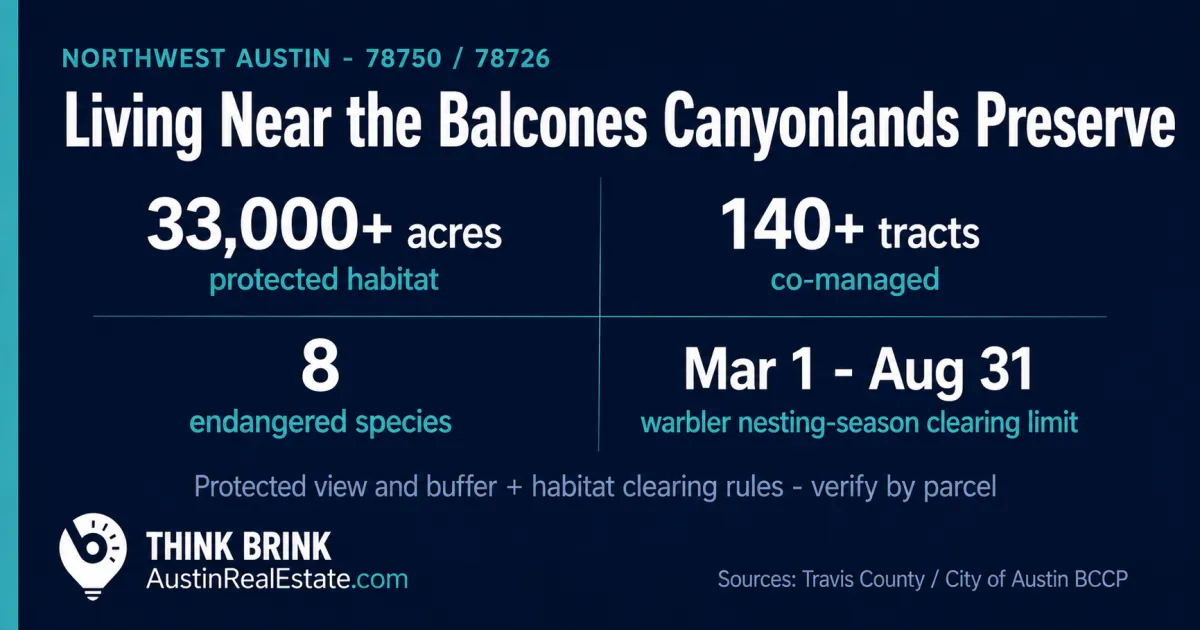
The Balcones Canyonlands Preserve, usually shortened to the BCP, is one of the largest urban preserves in the United States. It protects more than 33,000 acres, roughly 50 square miles, of Hill Country habitat across western Travis County. It is not a single park. It is a network of more than 140 individual tracts, co-managed by Travis County, the City of Austin, and a number of public and private partners, stitched together to protect habitat for eight endangered species that were listed when the plan was created.
The preserve exists because of the Balcones Canyonlands Conservation Plan, or BCCP, a regional agreement signed in the mid-1990s. The idea was elegant for its time: rather than fight parcel-by-parcel battles over endangered species habitat every time someone wanted to build, the region would assemble and permanently protect a large, connected preserve, and in exchange provide a streamlined, predictable path for development to proceed elsewhere. That plan is the reason so much of the rugged land in Northwest Austin is green on the map and will stay that way, and it was extended to continue well into the future.
Why It Exists: The Golden-Cheeked Warbler
The species most associated with the preserve is the golden-cheeked warbler, a small songbird that nests only in central Texas and nowhere else on earth. It depends on mature Ashe juniper, what locals call cedar, mixed with oaks in the canyon woodlands that define this part of the Hill Country. The black-capped vireo and a set of cave-dwelling invertebrates are also part of the protected group. When the conservation plan was negotiated, the science pointed to the need to preserve a large, connected block of this specific habitat for the warbler population to have a chance to recover.
For a buyer, the practical meaning is this: the land next to a preserve tract is not vacant land waiting for a builder. It is protected warbler and endangered-species habitat, and that protection is exactly what guarantees your view stays wild. The bird you may never see is the reason the canyon behind your house will look the same in thirty years as it does today.
What Living Next to the Preserve Gives You
The upside is real and it is the reason preserve-adjacent lots command attention. The single biggest benefit is a permanently protected view and buffer. On a standard lot, the wooded space behind you can be cleared and built the moment someone buys it. On a preserve-adjacent lot, that land is protected habitat, which means no new rooftops, no new construction, and no future neighbor appearing in your backyard sightline. That kind of permanence is genuinely scarce, and it is why buyers pay up for it.
You also get the daily experience of the land itself: canyon topography, mature trees, birdsong, deer, and the quiet that comes from having wild land rather than a subdivision on one side of you. Neighborhoods that touch the preserve, including parts of Canyon Creek and Grandview Hills in 78726 and the Jester and Balcones Village areas in 78750, draw buyers specifically for that edge-of-wilderness feel while still being fifteen to twenty-five minutes from major job centers. My guides to Canyon Creek and Grandview Hills cover two of the 78726 neighborhoods where this adjacency shows up most.
Some sections of the preserve are open to the public with trails and guided hikes. Only a portion of the total acreage, on the order of a few thousand acres, is regularly open to public access, with much of the rest kept closed to protect sensitive habitat. So depending on where you buy, the preserve near you may be a place you can walk in, or it may be protected land you enjoy as a view and a buffer rather than a trail system. That is worth checking for the specific tract near a home you are considering.
What Living Next to the Preserve Asks of You
This is the part most buyers have never heard, and it is the reason this guide exists. Protected habitat comes with land-management rules that can reach onto or near private property, and you want to understand them before, not after, you close.
The most important one concerns clearing land. Removing or disturbing endangered species habitat, which includes the mature juniper-oak woodland the warbler depends on, generally requires a permit, and it cannot be done casually. On properties that contain golden-cheeked warbler habitat, clearing is restricted during the nesting season, generally from March 1 through August 31, and a permit is required to disturb or remove that habitat at any time of year. Travis County administers a permitting process that, for many landowners in western Travis County, allows habitat removal to be mitigated through a one-time fee that funds preserve land, but the point stands: if part of your prospective lot is habitat, you cannot simply clear it to expand a yard, add a structure, or open up a view. This is where a consult-your-professional caveat genuinely matters. Do not assume what you can and cannot do with vegetation on a preserve-adjacent lot. Confirm it with Travis County and, if it is material to your plans, a qualified land-use or environmental professional.
There are also practical realities of living at the wildland edge. Wildfire risk is higher where homes meet dense natural vegetation, which affects defensible-space practices and can affect insurance. Wildlife is closer, which most buyers consider a feature but which means deer, and occasionally less welcome visitors, are part of life. And access to the preserve land itself is controlled, so you should not assume you can create your own trail or entry point onto a protected tract from your property.
How the Preserve Affects Your Lot Specifically
The single most important thing to understand is that being near the preserve is not one situation, it is several, and they carry very different implications. Walk through these distinctions with your agent for any specific home:
First, is the preserve tract adjacent to the property, or merely nearby? An adjacent tract gives you the protected-view benefit directly. A nearby tract may give you the neighborhood character without the backyard buffer.
Second, does the lot itself contain protected habitat, or does it simply border it? A lot that borders the preserve but is itself already-developed yard is very different, from a clearing-and-permitting standpoint, than a larger lot that includes a swath of untouched canyon woodland. The latter can carry real restrictions on what you may do with that portion of your own land.
Third, is the adjacent preserve section publicly accessible or closed? This determines whether you gain a trailhead-in-your-backyard lifestyle or a look-but-do-not-enter buffer, and it also affects foot traffic near your property line.
These are not questions you can answer from a listing photo. They require checking the specific parcel against preserve boundaries and the applicable rules, which is exactly the kind of due diligence that protects a buyer on a preserve-adjacent purchase. It connects closely to the broader lot-selection thinking in my guide on buying a hillside or view lot, since many preserve-adjacent homes are also on canyon and hillside terrain.
The Neighborhoods Where This Comes Up
Preserve adjacency shows up most in the western and northwestern edges of the area I cover. In 78726, neighborhoods like Canyon Creek and Grandview Hills sit against protected canyon land, which is a meaningful part of their appeal and their pricing. In 78750, the Jester area, Balcones Village, and the hillside neighborhoods along the western edge touch or come close to protected tracts. Further west and northwest, closer to the more rugged Hill Country, preserve land becomes an even more dominant feature of the landscape.
If you are relocating and drawn to the idea of a home against wild, protected land while staying within a reasonable commute of the Apple corridor and the Domain, these are the neighborhoods to focus on. My 78726 neighborhood guide is the best starting point for the cluster where preserve adjacency is most common, and the 78750 and 78759 guide covers the eastern side of the same story.
What to Verify Before You Buy a Preserve-Adjacent Home
- Whether the preserve tract is actually adjacent to the property or simply nearby, and how that affects the protected-view benefit you are paying for.
- Whether the lot itself contains protected habitat, which can restrict clearing and construction on part of your own land, versus merely bordering the preserve.
- The clearing and permitting rules that apply to the specific parcel, confirmed with Travis County, including the nesting-season restriction and the permit requirement for habitat removal.
- Whether the adjacent preserve section is open to public access with trails or is a closed, protected tract, and what that means for both your recreation and nearby foot traffic.
- Wildfire risk and defensible-space expectations at the wildland edge, and how they affect insurance for the specific home.
- Any HOA or deed provisions related to preserve-adjacent lots, vegetation, or fencing.
Frequently Asked Questions
What is the Balcones Canyonlands Preserve?
The Balcones Canyonlands Preserve is one of the largest urban preserves in the United States, protecting more than 33,000 acres, roughly 50 square miles, of Hill Country habitat across western Travis County. It is a network of more than 140 tracts co-managed by Travis County, the City of Austin, and other partners, created under the Balcones Canyonlands Conservation Plan to protect habitat for eight endangered species, most notably the golden-cheeked warbler.
Is it good to buy a house next to the Balcones Canyonlands Preserve?
For many buyers, yes. The biggest benefit is a permanently protected view and buffer: the preserve land next to you cannot be developed, so no new rooftops or neighbors will appear in your backyard sightline, which is genuinely scarce and holds value. The tradeoffs are the land-management rules that come with protected habitat, higher wildfire considerations at the wildland edge, and closer wildlife. Whether it is right for you depends on how much you value the permanent natural buffer versus those responsibilities.
Can I clear trees or brush on my property if it borders the preserve?
Not necessarily, and this is the most important thing to verify. If part of your lot contains protected endangered-species habitat, removing or disturbing it generally requires a permit, and clearing is restricted during the golden-cheeked warbler nesting season, generally March 1 through August 31. Travis County administers a permitting and mitigation process. Never assume you can clear vegetation on a preserve-adjacent lot. Confirm the specific rules for your parcel with Travis County and a qualified professional before making plans.
Can I hike or use the preserve behind my house?
Only where the preserve is designated for public access. Just a portion of the total acreage, on the order of a few thousand acres, is regularly open to the public with trails and guided hikes, while much of the rest is kept closed to protect sensitive habitat. So a preserve tract near your home may be a place you can walk in, or it may be a protected buffer you enjoy as a view. Check the access status of the specific tract near any home you are considering.
Which Northwest Austin neighborhoods are near the Balcones Canyonlands Preserve?
Preserve adjacency shows up most in the western and northwestern edges of Northwest Austin. In 78726, neighborhoods like Canyon Creek and Grandview Hills border protected canyon land. In 78750, the Jester area, Balcones Village, and the western hillside neighborhoods touch or come close to preserve tracts. The land becomes an even larger feature further west toward the more rugged Hill Country.
Does living near the preserve increase wildfire risk?
Homes at the wildland-urban interface, where development meets dense natural vegetation, generally carry higher wildfire considerations than homes in the middle of a subdivision. That affects defensible-space practices and can affect insurance availability and cost. It is a manageable reality rather than a reason to avoid these homes, but you should factor it into your budget and confirm insurance specifics for the particular property.
Why does the preserve exist?
It was created under the Balcones Canyonlands Conservation Plan, a regional agreement from the mid-1990s, to protect habitat for endangered species, most notably the golden-cheeked warbler, which nests only in central Texas. Rather than fighting habitat battles parcel by parcel, the region assembled a large, permanently protected preserve while providing a streamlined path for development elsewhere. That plan is why so much rugged Northwest Austin land is protected and will stay wild.
Does preserve adjacency add to a home's value?
A permanently protected natural buffer and view is a scarce, durable amenity, and it tends to support value for the homes that have it, which is why these lots draw specific demand. That said, value depends on the specific lot, the home, and the market, and the same adjacency brings responsibilities that some buyers weigh differently. This is a general market observation, not individualized financial advice; talk with your own advisor about a specific purchase.
The Honest Bottom Line
Living near the Balcones Canyonlands Preserve is one of the more distinctive things you can do in Northwest Austin real estate. You get a permanently protected wild buffer, a view that will not change, and the daily experience of canyon woodland at your doorstep, all within a reasonable commute of the region's job centers. That is a rare combination, and it is the reason preserve-adjacent lots hold their appeal through market cycles.
The responsibilities are equally real: land-clearing and habitat rules that can reach onto your own property, higher wildfire considerations, and controlled access to the protected land itself. None of these should scare a well-informed buyer away. They should simply be understood and verified for the specific property before you commit, because the difference between a lot that borders the preserve and a lot that contains protected habitat is the difference between a straightforward purchase and one with real restrictions attached.
If the idea of a home against permanently protected Hill Country land appeals to you, it is worth doing this homework carefully, and it is exactly the kind of due diligence I walk buyers through on preserve-adjacent properties in 78726 and 78750. Confirm the regulatory specifics with Travis County and the City of Austin, and let a knowledgeable local agent help you read what a particular lot's preserve adjacency really means for you.
