What Buyers Should Know About Mesa Park Before Making an Offer (78759)
Mesa Park Is the Cheapest Way Into 78759. That Is the Whole Story, and Also the Catch.
If you have spent any time shopping Northwest Austin, you already know the pattern. You find a zip code you like, you fall for the location, and then you look at the prices and start doing math you did not want to do. In 78759 that math gets steep fast. Great Hills, Balcones Woods, the established sections near the Arboretum and the Domain all carry a location premium that reflects exactly how central they are to everything a Northwest Austin buyer is targeting.
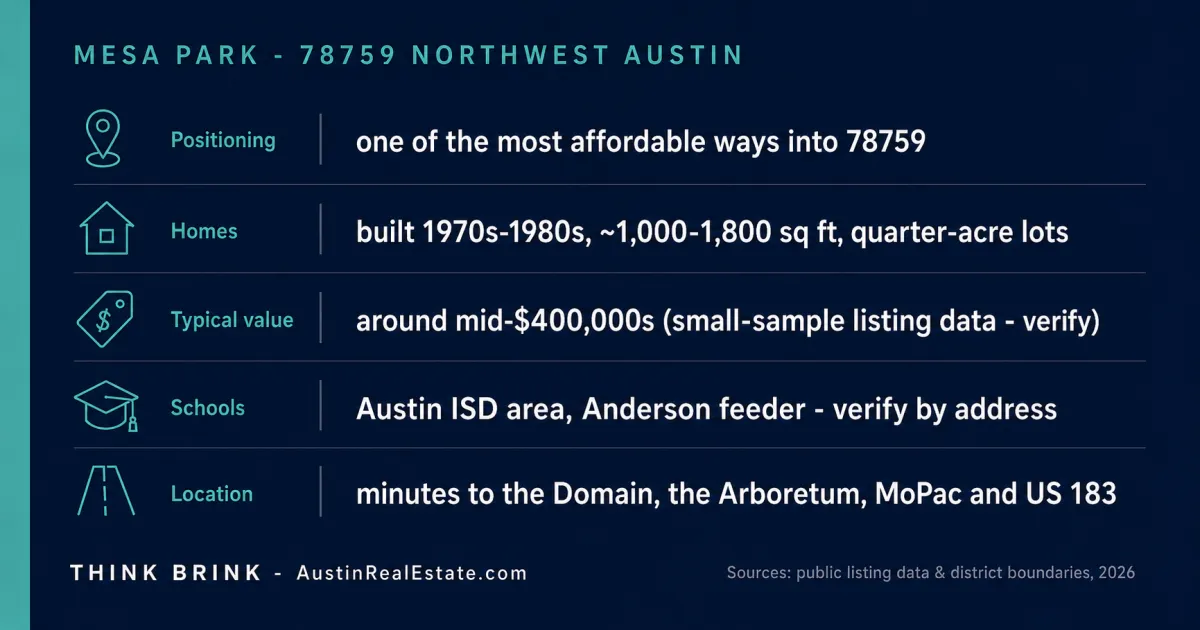
Mesa Park is where that math gets easier. It is a small, unassuming pocket of 1970s and 1980s homes sitting just north of Balcones Woods, and it is consistently one of the more affordable entries into the 78759 zip code. Buyers who find it are almost always people who wanted a different, pricier neighborhood first and then discovered they could get most of the same location for meaningfully less money.
That is the appeal, and it is a real one. But cheaper always comes from somewhere, and the honest version of this guide is about understanding exactly what you are trading to get that lower entry price. This is not a neighborhood where you overpay for a name. It is a neighborhood where you have to know what you are buying, because the homes are older, smaller, and more variable in condition than the guides that just quote an average price will tell you.
Where Mesa Park Actually Sits
Mesa Park is tucked into the 78759 zip code in Northwest Austin, immediately north of Balcones Woods and within the broader cluster of established neighborhoods that sit between MoPac and US 183. Its defining feature is not any single landmark inside the neighborhood. It is what surrounds it. From Mesa Park you are minutes from the Arboretum, minutes from the Domain, and directly plugged into the MoPac and 183 corridors that carry Northwest Austin commuters to the major employment centers.
This is the same locational DNA that makes Balcones Woods move so quickly, which is why the two neighborhoods are worth understanding together. If you want the fuller picture of the pricier neighbor next door, the Balcones Woods buyer guide covers that market in detail, and reading both side by side is the fastest way to understand what the Mesa Park discount is actually buying and giving up.
The neighborhood itself is compact. It was built out primarily in the 1970s and into the 1980s, and the housing stock reflects that era: single-story and modest two-story homes, generally in the 1,000 to 1,800 square foot range, sitting on quarter-acre lots. These are not sprawling floor plans. They are the sensible, well-proportioned family homes of their time, and the lots are often the most valuable thing you are buying.
What You Are Actually Buying: Older Homes, Real Lots, Variable Condition
The single most important thing to understand about Mesa Park is that the homes are old enough that condition, not square footage, is what separates one listing from another. When housing stock is fifty years old, two homes with identical floor plans on identical lots can be a hundred thousand dollars apart in value, and the entire difference is what has happened inside them since 1978.
One home may have original single-pane windows, an aging HVAC system, a roof approaching the end of its life, cast iron or galvanized plumbing, and a kitchen that has never been touched. The house next door may have been taken down to the studs, reworked into an open floor plan, and updated with new mechanical systems throughout. Both are Mesa Park homes. Both will show up in the same price averages. They are not remotely the same purchase.
This is why the price figures you will see quoted for Mesa Park are best treated as a starting point rather than gospel. Public listing sources have shown the neighborhood's typical home value in the range around the mid-$400,000s, with price per square foot in the low $300s and homes sitting on the market on the order of a couple of months. But Mesa Park is a small neighborhood, which means a handful of sales in either direction moves those averages a lot, and the spread between an original home and a renovated one is wide enough that the average tells you very little about the specific house in front of you. Treat any single number as a conversation starter, not a valuation.
The condition tiers, concretely
When you shop Mesa Park, you will encounter roughly three kinds of homes, and knowing which one you are standing in matters more than any listing description:
Original or lightly touched. These are the lowest entry prices in the neighborhood, and for good reason. You are buying the lot and the bones. Budget realistically for windows, HVAC, roof, and a kitchen and bathroom that will need work. The low sticker price is not a bargain if you have not priced the deferred maintenance.
Partially updated. This is the trickiest tier, because a fresh coat of paint and a new quartz countertop can hide the fact that the expensive systems underneath are still original. A partially updated home can be a genuine value or a cosmetic dress-up over deferred maintenance. The inspection is where you find out which.
Fully renovated. These sell at the top of the Mesa Park range and, honestly, they are often the smart buy despite the higher price, because the previous owner absorbed the cost and hassle of the mechanical updates. You pay more up front and inherit far less risk.
The mistake buyers make in a neighborhood like this is anchoring to the lowest number they saw and then being disappointed that the move-in-ready home costs more. In an older neighborhood, the move-in-ready home should cost more, because someone already paid for the work.
Schools: Verify by Address, Because This Is a RRISD Edge
School zoning is where Mesa Park buyers most often make an assumption that costs them. The neighborhood sits in the part of Northwest Austin served by Round Rock ISD, which is a genuine advantage, because RRISD's Westwood feeder is the most sought-after pathway in this whole geography. But Mesa Park sits close enough to district and attendance-zone boundaries that you cannot assume any particular school assignment based on the neighborhood name alone.
Elementary attendance zones in RRISD have shifted with boundary adjustments over the years, and the difference between one campus and the next can be the difference between the school you moved here for and one you did not research. The nearby RRISD elementary campuses in this pocket of 78759 include Caraway Elementary, and the broader area sits within the family of schools that flow toward Westwood High School through Canyon Vista and Grisham middle schools. But "nearby" and "assigned to" are not the same thing.
The rule is simple and it is non-negotiable: verify the specific address with Round Rock ISD's current attendance boundaries before you write an offer, not after. Do not rely on the listing, do not rely on a neighborhood-level generalization, and do not rely on what a home's previous owner told a neighbor five years ago. Pull the current assignment for the exact address. If schools are a primary reason you are buying here, this is the single most important piece of due diligence you will do.
For a broader look at how school zoning interacts with pricing across the core Northwest Austin zip codes, the Living in 78750 and 78759 neighborhood guide lays out the feeder patterns and why address-level assignment matters so much in this part of town.
Commute and Access: The Real Reason to Buy Here
The case for Mesa Park is almost entirely a location case. The homes are fine. The lots are good. But what you are really paying for is the address, and the address is excellent for a Northwest Austin commuter.
From Mesa Park you have quick access to both MoPac and US 183, the two corridors that define how people get around this part of Austin. The Domain, which has become a major employment center in its own right with Amazon, Indeed, and a growing roster of tech and corporate tenants, is a short drive. The Arboretum, with its concentration of offices, shopping, and dining, is right there. And for buyers working the larger tech corridor, the 183 and Parmer routes to the northern employment centers, including the Apple campus, are accessible without the longer approach that buyers in neighborhoods farther out have to absorb every day.
This is the honest tradeoff in reverse: in a lot of Austin real estate, you trade commute for price, moving farther out to afford more house. Mesa Park lets you do the opposite. You accept a smaller, older home in exchange for keeping the central location that costs a premium almost everywhere else in 78759. For a dual-income household where both people commute, or for anyone who has already decided that time in the car is the thing they least want to spend, that is a trade worth taking seriously.
The HOA, the Lots, and the Feel of the Place
Mesa Park is an established, low-key residential neighborhood rather than an amenity-driven master-planned community. Do not come here expecting a resort-style pool complex and a manned gate. Come here expecting mature trees, quarter-acre lots, quiet streets, and the settled feel of a neighborhood that has been lived in for decades. Buyers who value that kind of established character over new-build polish tend to be the ones who are happiest here.
The quarter-acre lots are a real part of the value. In a market where new construction increasingly puts larger homes on smaller lots, an established neighborhood with genuine yard space and mature canopy offers something you cannot get from new inventory at this price point. If outdoor space, room for a garden, or simply not being able to reach out and touch your neighbor's wall matters to you, the lots here are a meaningful part of what you are buying.
As with any neighborhood, confirm the specifics of any homeowners association, its dues, and what it does and does not cover as part of your due diligence. Ask for the current dues and the governing documents before you are emotionally committed to a house, not after.
What It Costs to Own Here, Beyond the Purchase Price
The lower purchase price in Mesa Park is real, but the carrying costs of owning a Northwest Austin home apply here just like everywhere else, and the older housing stock adds a wrinkle you should plan for.
Property taxes in the Austin area run at an effective rate in the neighborhood of roughly two percent of value, varying by the specific taxing jurisdictions and exemptions that apply to a given address, generally landing somewhere in the range of about 1.8 to 2.2 percent. If you make the home your primary residence, the Texas homestead exemption removes a meaningful chunk of value from your school district taxable amount, which is the largest line on most Central Texas tax bills. Run the actual numbers for the specific address rather than assuming, because the exemptions materially change the annual figure. This is general information, not tax advice; confirm your situation with a CPA.
The older-home wrinkle is maintenance. A fifty-year-old house does not maintain itself, and the buyer who wins on purchase price and then ignores the roof, the HVAC, and the plumbing has not actually saved money. Build a realistic maintenance and reserve budget into your decision. For a full breakdown of what ongoing ownership actually costs in these zip codes, the real cost of owning a home in 78750 or 78759 post walks through the numbers that a purchase price alone will never show you.
Who Mesa Park Is Right For
Mesa Park is a strong fit for a specific kind of buyer, and a poor fit for others. It is worth being honest about both.
It is right for the buyer who wants the 78759 location above all else and is willing to accept an older, smaller home to get it. It is right for the buyer who is genuinely comfortable with a renovation, either buying an updated home at the top of the range or buying an original one and doing the work over time. It is right for the commuter who prizes the central access to the Domain, the Arboretum, and the MoPac and 183 corridors, and who would rather spend their money on location than on square footage. And it is right for the buyer who values quarter-acre lots and mature trees over new-build finishes.
It is a weaker fit for the buyer who needs a large floor plan, who wants a move-in-ready home with no compromises at the lowest possible price, or who is uncomfortable managing the maintenance realities of a home built in the 1970s or 1980s. Those buyers are not wrong to want what they want. They just may be better served in a different neighborhood or price tier, and there is no shame in figuring that out before you make an offer rather than after you close.
How to Buy Well in Mesa Park
Because the homes vary so much in condition, buying well here is more about discipline than about speed. A few things separate the buyers who are happy a year later from the ones who are not.
First, get a thorough inspection and read it as a budget, not a hurdle. In a neighborhood of older homes, the inspection is not a formality to survive. It is your single best tool for understanding what you are actually buying and what you will need to spend after closing. A home that inspects with an aging roof, original HVAC, and dated plumbing is not disqualified. It is simply a different price than the same home fully updated, and the inspection is how you price it correctly.
Second, verify the school assignment for the exact address before you commit, as covered above. Third, confirm the HOA specifics and dues. Fourth, understand that the average price figures for a neighborhood this small are noisy, and lean on your agent to pull genuine comparable sales adjusted for condition rather than trusting a portal estimate. If you want to understand how home values are actually determined in this market rather than guessed at, the what is your 78750 or 78759 home worth post explains the comparable-sales logic that a real valuation rests on.
And finally, decide honestly which condition tier you actually want before you start touring. Buyers who know whether they are shopping for a renovation project or a move-in-ready home waste far less time and make far better decisions than buyers who tour everything and try to figure it out on the fly.
Frequently Asked Questions About Mesa Park
Is Mesa Park a good neighborhood in Northwest Austin?
Mesa Park is a solid choice for buyers who prioritize the 78759 location and are comfortable with older, smaller homes. Its main strength is being one of the more affordable ways into a zip code known for premium pricing, with quick access to the Domain, the Arboretum, and the MoPac and 183 corridors. Its main tradeoff is that the homes date to the 1970s and 1980s and vary widely in condition, so the neighborhood rewards buyers who do their homework and is less ideal for those who need a large, move-in-ready home at the lowest price.
How much do homes cost in Mesa Park Austin?
Public listing sources have placed the typical Mesa Park home value in the range around the mid-$400,000s, with price per square foot in the low $300s, though these figures move a lot because it is a small neighborhood and the gap between an original home and a fully renovated one is wide. Treat any single quoted number as a starting point and rely on condition-adjusted comparable sales for the specific home you are considering rather than a neighborhood average.
What school district is Mesa Park in?
Mesa Park sits in the part of Northwest Austin served by Round Rock ISD, which is a real advantage given how strong the Westwood feeder is in this area. However, the neighborhood is close enough to attendance boundaries that you should verify the specific school assignment for the exact address with the district's current boundaries before making an offer. Do not assume a particular campus based on the neighborhood name.
Why is Mesa Park cheaper than Balcones Woods and other 78759 neighborhoods?
The lower prices reflect the housing stock, not the location. Mesa Park homes are generally older and smaller, in the 1,000 to 1,800 square foot range and built in the 1970s and 1980s, which is what allows the entry price to sit below neighboring communities that offer larger or more updated homes. You are essentially trading square footage and, often, updated condition for the same central 78759 location that costs a premium next door.
Are Mesa Park homes a good renovation opportunity?
They can be, for the right buyer. Because the neighborhood has a mix of original, partially updated, and fully renovated homes, there is genuine opportunity to buy an original home and build value through updates over time. The key is pricing the deferred maintenance honestly up front, using the inspection as your budget, so that the low purchase price actually reflects the work the home needs rather than hiding it.
How is the commute from Mesa Park to the Domain and the Apple area?
Mesa Park's central location is its strongest selling point. The Domain and the Arboretum are a short drive, and access to both MoPac and US 183 makes the broader Northwest Austin employment corridor, including routes toward the Apple campus via 183 and Parmer, more reachable than from neighborhoods farther out. Exact commute times depend on your specific destination and the time of day, but the central positioning is a real, everyday advantage.
Does Mesa Park have an HOA?
Mesa Park is an established residential neighborhood rather than an amenity-heavy master-planned community, so you should confirm the specifics of any homeowners association, its dues, and what it covers as part of your due diligence on a particular home. Ask for the current dues and governing documents before you are committed to a house.
Is now a good time to buy in Mesa Park?
Timing in Mesa Park follows the broader Northwest Austin market rather than moving on its own, so the question is really about the overall market and your personal situation. For a fuller discussion of market timing across Northwest Austin, see the is now a good time to buy in Northwest Austin guide, which covers the conditions buyers are weighing right now.
The Honest Summary
Mesa Park is the value play in 78759, and value plays always come with a story about where the discount comes from. Here the discount comes from age and size. You are buying older, smaller homes on good lots in an excellent location, and your job as a buyer is to make sure you are pricing the condition of the specific home correctly rather than anchoring to the lowest number on a portal.
Do that well and Mesa Park is one of the smarter ways to get a genuinely central Northwest Austin address without paying the premium the pricier neighborhoods next door command. Do it carelessly and you can end up with a bargain that quietly costs more than the move-in-ready home you passed on. The neighborhood is not complicated. It just rewards buyers who know exactly what they are buying, and if you want a second set of eyes on a specific Mesa Park home before you write an offer, that is exactly the kind of read I am glad to give.
