What the 78726 Northwest Austin Housing Market Means for Buyers and Sellers (2026 Update)
Of the three zip codes I work most closely in Northwest Austin, 78726 is the one where a single month of data can lie to you the loudest. It covers Canyon Creek, Grandview Hills, and Estates of Brentwood, tucked along the western edge of the metro near RM 620, 2222, and the Balcones Canyonlands Preserve. It is also the lowest-volume of my three core zips, and that changes how you should read the numbers. In July 2026, only 11 homes closed here. When a zip turns over that few properties in a month, the median sale price is not a trend. It is a coin flip that happened to land on eleven specific houses.
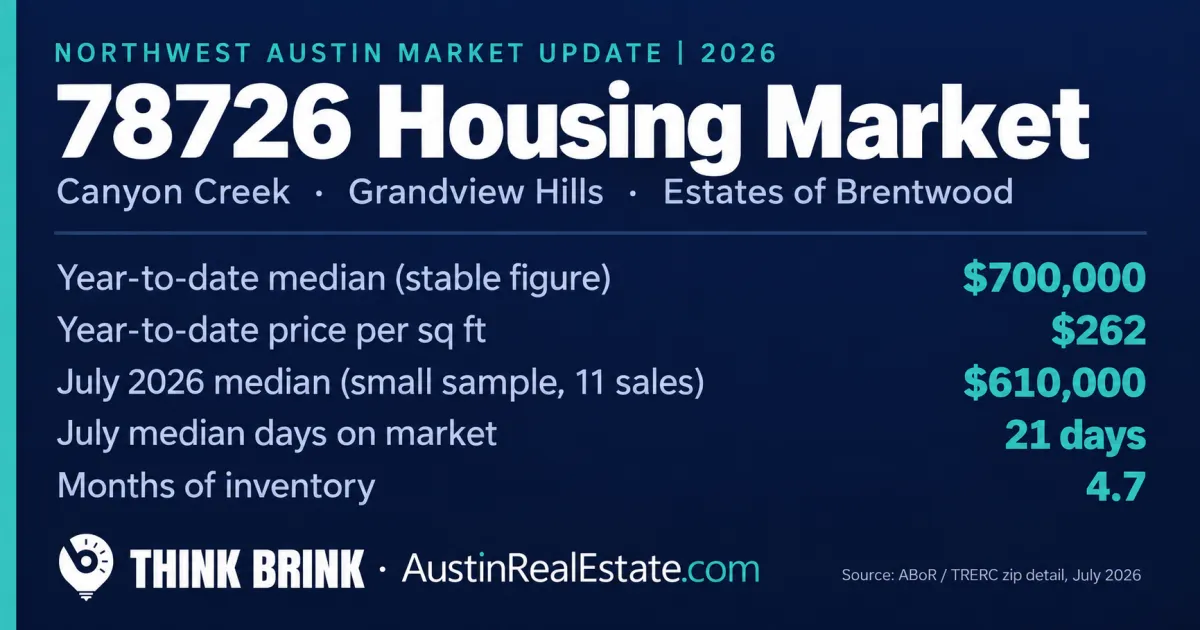
So this update leads with the figure that actually holds still: the year-to-date median. Through the reporting in the most recent ABoR and Texas Real Estate Research Center zip detail, the 78726 year-to-date median sale price is roughly $700,000, at about $262 per square foot. That is the number to anchor on. The July single-month median of $610,000 at $286 per square foot is real data, but on 11 sales it tells you almost nothing about where prices are heading. Below I will walk through what the stable figures say, why 78726 behaves differently from its neighbors, and what all of it means if you are buying, selling, or just deciding whether to stay put.
What the 78726 numbers actually say in 2026
Here is the current read, with the caveats that this zip demands:
- Year-to-date median sale price: about $700,000 (roughly $262 per square foot year-to-date). This is the stable headline number for 78726. Use it, not the single month.
- July 2026 median: $610,000 at $286 per square foot, on just 11 closed sales. Treat this as directional at best. The per-square-foot figure is often more trustworthy than the raw median in a thin month, and $286 is broadly consistent with the neighborhood.
- July median days on market: 21. Fast on paper, but again, that is 21 days across a very small handful of homes. It tells you that well-prepared, correctly priced homes still move here, not that the whole zip is red-hot.
- Months of inventory: 4.7. This is the most interesting number in the set, and I will come back to it. It is higher than what 78750 and 78759 are showing, and it points to a market with more breathing room for buyers than the sister zips.
Put those together and 78726 looks like what it is: a normalized, roughly balanced market with a low transaction count. Not a crash, not a frenzy. The kind of market where the specific house, the specific street, and the specific price matter far more than any headline about "the zip."
Why one month of 78726 data is not a trend
This is worth being blunt about, because it is where buyers and sellers most often get misled. When 38 homes close in a zip, as they did in 78759 in July, the median has enough underlying sales to mean something. When 11 homes close, the median can swing $80,000 or $100,000 from one month to the next purely on the mix of what happened to sell. A couple of larger homes on greenbelt lots in Canyon Creek close, and the median jumps. A run of smaller or dated homes closes, and it drops. Neither move is a market signal.
That is why the year-to-date median exists, and why I lead with it. It pools the whole year of closings into one figure that does not lurch around on sample size. For 78726, the honest sentence is: the year-to-date median is about $700,000, the market is balanced-leaning, and the single-month numbers are noise until proven otherwise over several months. Anyone quoting you July's $610,000 as evidence that 78726 is "dropping" is reading eleven houses as if they were a forecast.
The wrinkle that makes 78726 different: the county line
Here is the thing about 78726 that does not apply to 78750 or 78759. This zip straddles the Travis County and Williamson County line. That is not a trivia point. It affects your tax bill, your school district, and in some cases your day-to-day services, and it varies address by address.
Most of the established 78726 core sits in Travis County, but parts of the zip reach into Williamson County, and the two counties tax and assess independently. The combined property tax rate you actually pay depends on which taxing units your specific address falls into, the county, the school district, any municipal utility district, and the city or ESD. Two homes a few streets apart in the same zip can carry meaningfully different tax rates. I go deeper on this in my write-up on Travis County versus Williamson County property taxes in Northwest Austin, and if you are buying in 78726, that piece is worth ten minutes before you fall in love with a house.
The school picture splits the same way. Canyon Creek feeds the Round Rock ISD pathway, Canyon Creek Elementary to Grisham Middle to Westwood High, which carries the IB designation that pulls a lot of families into this part of the market. Grandview Hills and the far-western pockets feed Leander ISD instead, along the Grandview Hills Elementary to Four Points Middle to Vandegrift High track. Both are strong, but they are different districts with different boundaries, and the line does not follow the zip. The single most important thing a 78726 buyer can do is verify the school assignment at the exact address, not the neighborhood name and never the zip. I say the same thing in the 78726 neighborhood guide, because it is the mistake I see relocating buyers make most often out here.
What this market means if you are buying in 78726
The 4.7 months of inventory figure is your friend, within reason. Compared to the roughly three months of supply in 78750 and 78759, 78726 is carrying more standing inventory relative to its sales pace. In plain terms, buyers here generally have a little more selection and a little more negotiating room than they do in the tighter core zips. That does not mean lowball offers work. It means that a home that has sat for a few weeks, or one that is priced ahead of the market, is a real opportunity to negotiate on price, on closing costs, or on a rate buydown rather than waving concessions off to win a bidding war.
At the same time, the July days-on-market figure of 21 is a reminder that the good ones still go quickly. In a balanced market, the split widens between well-prepared, correctly priced homes and everything else. The updated house on a desirable Canyon Creek greenbelt lot, priced right, may still see competition. The dated house priced as if it were updated will sit. Your job as a buyer is to know the difference, which means touring enough inventory to calibrate, and using your option period to actually investigate the house rather than treating it as a formality.
On financing, be realistic about the backdrop. As of mid-September 2026, the 30-year fixed has been running in the high-6 percent range, roughly 6.9 to 7.0 percent by Freddie Mac and Bankrate's surveys, its highest level in about a year after the Federal Reserve raised rates in mid-September against inflation that was still running above target. That matters for 78726 buyers in a specific way: at a $700,000 price point, every quarter-point on the rate is real money each month. This is exactly the kind of market where a seller-paid rate buydown, which is more attainable in a zip with 4.7 months of inventory, can do more for your monthly payment than shaving a few thousand off the price. Talk to your lender about the actual tradeoff on your numbers. General guidance only here, not personalized financial advice.
What this market means if you are selling in 78726
If you are selling here, the honest framing is this: you are in a normalized market that rewards preparation and punishes wishful pricing. The metro backdrop supports that read. Across the Austin-Round Rock-San Marcos area in the second quarter of 2026, homes sold at roughly 94 percent of their original list price after about two months, with prices essentially flat to slightly down year over year and sales volume up. Travis County, where most of 78726 sits, ran a second-quarter median around $515,000, down less than one percent year over year, with sales up nearly ten percent. That is a functioning market with real buyers in it, not a stalled one. But it is a market where the first list price has to be right, because the days of naming a number and letting a bidding war fix your mistakes are over.
In a zip carrying 4.7 months of inventory, you are competing against more standing supply than a seller in 78750 or 78759 would be. That raises the bar on two things. First, condition and presentation, because a buyer with more to choose from will pass on the house that needs work when a comparable turnkey home is a few streets away. Second, pricing discipline, because an overpriced 78726 listing does not just sit, it accumulates days on market that later become a negotiating weapon for buyers. The homes selling in three weeks are the ones that came out priced to the market on day one. The homes still sitting after two months are almost always the ones that opened high and are now chasing the market down.
The good news for sellers is that the underlying demand for this part of Northwest Austin is durable. The Westwood IB pathway, the Vandegrift pathway, the proximity to the preserve and to the 620 and 2222 corridors, and the relative value compared to the pricier zips to the south all keep buyers coming. Price it to that demand honestly and it will sell. Price it to what you wish the market were and it will teach you the lesson the hard way.
What if you are staying put
Not everyone reading a market update is transacting. If you own in 78726 and plan to stay, the useful takeaways are quieter. Your equity is not evaporating. Prices are flat to slightly down year over year across the footprint, which after the run-up of recent years is a soft landing, not a decline that should worry a long-term owner. The place to spend your attention is your tax assessment. Because 78726 straddles two counties and multiple taxing units, and because appraised values do not always track a normalizing market on their own, it is worth reviewing your assessment each year and protesting it when the number looks out of step with what comparable homes are actually selling for. That is one of the few levers a stay-put owner controls, and in a flat-price year it is where the money is. Consult your CPA or a property tax professional for your specific situation.
How the three 78726 neighborhoods differ inside one zip
One reason the zip-level median is a blunt instrument here is that 78726 contains genuinely different submarkets. Canyon Creek is the largest and best-known, a Round Rock ISD neighborhood off 620 with the Westwood IB feeder and a mix of established homes on wooded and greenbelt lots. It tends to anchor the middle-to-upper part of the zip's price range and draws school-motivated buyers. Grandview Hills sits on the Leander ISD side with the Vandegrift pathway and generally newer construction, which changes both the price per square foot and the buyer profile. Estates of Brentwood is smaller and more of a value pocket within the zip. A buyer weighing these against each other should read my full comparison of Canyon Creek versus Grandview Hills, because the choice usually comes down to district, home vintage, and lot type rather than the headline price.
The practical point for reading this market update: when you see "78726 median $700,000 year to date," understand that it is an average across a Round Rock ISD neighborhood, a Leander ISD neighborhood, newer construction, and older established homes. Your actual target price depends heavily on which of those you are shopping. The zip number is a starting orientation, not a comp.
How 78726 stacks up against its neighbors right now
For context, 78726's roughly $700,000 year-to-date median sits below 78759's year-to-date figure in the low-to-mid $700,000s and below 78750's more volatile numbers, while carrying more months of inventory than either. If you are cross-shopping the core Northwest Austin zips, the rough shape is this: 78726 tends to offer a little more space and a little more negotiating room per dollar, especially on the newer Leander ISD side, while 78750 and 78759 carry the tighter supply and the established-neighborhood premium closer to MoPac and the Arboretum. None of the three is cheap, and all three are normalized rather than frothy. My companion update on the 78759 market covers that sister zip in the same detail if you are deciding between them.
Frequently asked questions about the 78726 housing market
What is the median home price in 78726 in 2026?
The most reliable figure is the year-to-date median of roughly $700,000, at about $262 per square foot. A single month, like July 2026's $610,000 on only 11 closed sales, is too small a sample to treat as a trend. Lean on the year-to-date number when you are trying to understand the market.
Is 78726 a buyer's market or a seller's market right now?
It is close to balanced, and leaning slightly more buyer-friendly than the neighboring core zips. With about 4.7 months of inventory, buyers here generally have more selection and more negotiating room than in 78750 or 78759, which are running closer to three months. That said, well-prepared homes priced correctly still sell quickly, so it is not a market where sellers have lost leverage entirely.
Why did the July 78726 median drop compared to the year-to-date figure?
Because only 11 homes closed in July, the median reflects whichever specific homes happened to sell that month, not a broad price move. In low-volume zips like 78726, single-month medians swing hard on sample size. The year-to-date median of about $700,000 is the figure that actually holds still.
What school districts serve 78726?
Both Round Rock ISD and Leander ISD serve parts of 78726, and the boundary does not follow the zip. Canyon Creek generally feeds the Round Rock ISD pathway of Canyon Creek Elementary, Grisham Middle, and Westwood High, which carries the IB designation. Grandview Hills and the western pockets generally feed Leander ISD along the Grandview Hills Elementary, Four Points Middle, and Vandegrift High track. Always verify the assignment at the specific address, never by neighborhood name or zip.
Why are property taxes different across 78726?
78726 straddles the Travis County and Williamson County line, and the two counties, along with different school districts and utility districts, tax independently. The combined rate you pay depends on which taxing units your exact address falls into, so two nearby homes in the same zip can carry different tax bills. Verify the specific rate for any address before you budget, and consult a tax professional for your situation.
How long are homes taking to sell in 78726?
July 2026 showed a median of 21 days on market, but on a very small number of sales. In practice, correctly priced and well-prepared homes still sell quickly, while overpriced or dated listings can sit for a couple of months. Days on market vary more by the individual home's price and condition than by the zip as a whole right now.
Is now a good time to buy in 78726?
If the home and the payment work for you, the current market is more forgiving to buyers than it has been in several years, thanks to more inventory and real negotiating room. The offsetting factor is financing: 30-year fixed rates have been in the high-6 percent range as of mid-September 2026. Many buyers find that negotiating a seller-paid rate buydown, which is more achievable in a balanced zip like this, helps the monthly payment more than a small price cut. Run the actual numbers with your lender.
Are home prices in 78726 going to drop further?
Nobody can promise a direction, and I will not. What the data shows is prices essentially flat to slightly down year over year across the footprint, with steady demand from school-motivated and relocating buyers. That looks like normalization after a big run-up, not the start of a decline. For a long-term owner, it is a soft landing. For a buyer, it is a window with more choice than the recent past offered.
What this means for you
78726 in 2026 is a balanced, low-volume market where the year-to-date median of about $700,000 tells the truth and the single-month numbers mostly tell noise. Buyers have more room to negotiate here than in the tighter core zips, especially on the newer Leander ISD side, but the well-prepared homes still move fast, so preparation and calibration matter. Sellers are in a functioning market that rewards honest, correct pricing and punishes the wishful kind. And everyone, buyer, seller, and stay-put owner alike, needs to remember that in this particular zip the county line and the school boundaries cut across the map in ways that change the tax bill and the district, address by address.
If you want to know what your specific home is worth in this market, or what your real buying power looks like at today's rates in a particular Canyon Creek, Grandview Hills, or Estates of Brentwood pocket, that is a conversation worth having with actual numbers rather than a zip-level median. I am glad to run it for you street by street. That is where the useful answers live.
Market figures are from the ABoR and Texas Real Estate Research Center monthly local market report, zip detail, reflecting July 2026 data, and the Unlock MLS quarterly report for county and metro context. Mortgage rate figures reflect Freddie Mac and Bankrate surveys as of mid-September 2026. Nothing here is personalized financial, tax, or legal advice; consult your lender, CPA, or attorney for your situation.
