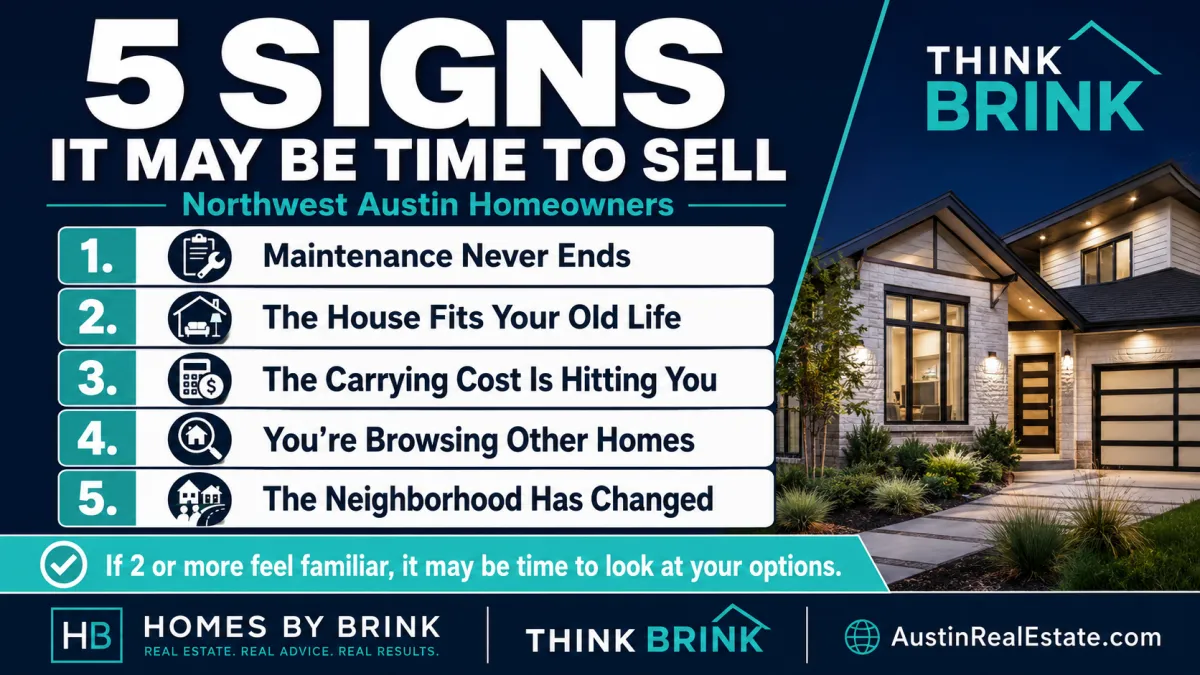
Five Signs It May Be Time to Sell Your Northwest Austin Home
Most people who eventually sell their home in 78750 or 78759 don't start with a decision. They start with a feeling. Something shifts - the house feels too big, or the maintenance is piling up faster than they want to deal with it, or they do the math on what they're spending every year to stay in a home that no longer quite fits - and a vague awareness starts to form that the situation may have changed even if the plan hasn't caught up yet.
This post is for homeowners who are somewhere in that space. Not actively listing, not certain about anything, but quietly wondering whether the home they've owned for ten or fifteen or twenty years is still the right place to be.
None of the five signs below are a verdict. Any one of them might have an explanation that makes staying the right call. But if you're reading this and finding yourself nodding at more than two or three of them, that's information worth paying attention to rather than filing away.
What Is Your 78750 or 78759 Home Worth Right Now?
Sign One: The Maintenance List Has Become a Permanent Fixture in Your Life
Every home requires maintenance. The question is whether the maintenance has shifted from something you manage to something that manages you.
Homes in 78750 and 78759 were built primarily in the 1970s through the 1990s. That means your HVAC, your roof, your water heater, your windows, your foundation, and your plumbing are all somewhere between 25 and 50 years old. Some of those systems have been replaced. Some haven't. And the ones that haven't are running on borrowed time that is getting shorter every year.
The sign to pay attention to is not any single repair - it's the accumulation. When you find yourself saying "we just did the HVAC, now the roof needs attention, and the pool equipment has been running rough" - when the list never fully clears before the next thing appears - that's a meaningful signal. Not because the house is falling apart, but because the maintenance burden has become a permanent ongoing commitment that costs real money, takes real time and mental energy, and will not get smaller as the home gets older.
The math on maintenance for a well-maintained 30-to-40-year-old home in these zip codes averages roughly 2% of home value per year when you account for routine upkeep and eventual system replacements. On a $700,000 home that's approximately $14,000 annually - not in a single check, but in an accumulation of HVAC service calls, roof work, pool chemicals and eventual replastering, irrigation repairs, foundation monitoring, and the steady drumbeat of things that older homes require.
If you have been telling yourself "we'll deal with X after we take care of Y" for the past few years, and the list hasn't materially shortened, that pattern tends to continue rather than resolve on its own. The question worth asking is not whether you can keep managing it - you clearly can - but whether you want to keep managing it for the next five to ten years, and whether the home you're maintaining is actually serving your life at the level that effort deserves.
What It Actually Costs to Own a Home in 78750 or 78759 Right Now
Sign Two: The House Fits the Life You Used to Have, Not the One You're Actually Living
Homes are purchased at a specific moment in life for a specific set of circumstances. The three-bedroom, two-story home made complete sense when the kids were in middle school and you needed space for their friends, a dedicated homework room, a garage full of sports equipment, and room for holiday gatherings that filled the house.
That moment passes. The kids graduate. They go to college. They build their own lives. And the house that was perfectly calibrated for a specific phase stays the same while the daily reality of how you're using it changes completely.
The sign here is not emptiness as an emotion - it's emptiness as a practical fact. If you're maintaining, heating and cooling, insuring, and paying property taxes on 2,800 square feet and actively using about 1,100 of them on a typical day, that's a measurable mismatch between the home and the life. The guest bedrooms that see guests twice a year. The formal dining room that functions as a storage surface. The yard that gets mowed every two weeks and genuinely enjoyed on maybe fifteen Saturday mornings a year.
This is not a value judgment about how people should live. Some homeowners in 78750 and 78759 choose to stay in their larger homes specifically because they value the space, the guest capacity, and the familiar setting - and that's a legitimate choice. The sign to watch for is whether the home is serving the life you're actually living, or whether you are serving the home.
If the honest answer is closer to the second one - if the home requires more from you in money, time, and maintenance energy than it is giving back in how you actually experience daily life - that's worth sitting with rather than just being busy around.
Should You Sell Your 78750 or 78759 Home Before You Downsize?
Sign Three: You've Done the Math on What Staying Actually Costs
Most longtime homeowners in 78750 and 78759 have never added up the full annual cost of ownership. Property taxes, homeowner's insurance, maintenance, and in some cases HOA dues combine to a number that surprises people when they actually calculate it.
The sign here is not the number itself - it's the moment of clarity that happens when you run the math and see it clearly for the first time.
On a representative $700,000 home in 78750 or 78759 right now, the annual carrying cost before any mortgage payment looks something like this: property taxes in the $11,000 to $13,000 range depending on specific assessment and exemptions, homeowner's insurance in the $3,500 to $5,500 range given the Texas insurance market's recent trajectory, maintenance averaging $12,000 to $14,000 per year over time on a home this age, and HOA dues if applicable. Total: somewhere between $26,000 and $32,000 per year - roughly $2,200 to $2,700 per month - just to stay in the home.
If you have a remaining mortgage, add that too.
Now consider what you're sitting on in equity. Longtime owners in these zip codes who purchased in the late 1990s or early 2000s often have $400,000 to $600,000 or more in net equity sitting in the walls of a home that costs $26,000-plus per year to maintain. That equity is illiquid. It's not diversified. It's not generating income. And it's growing at whatever the Austin real estate market decides to do - not at a rate you control.
The sign to watch for is the moment when that math produces a feeling of discomfort rather than satisfaction. When the number you're spending to stay starts to feel like more than the experience of staying is worth. When you find yourself calculating what that equity could do if it were deployed differently. When you realize that a smaller, lower-maintenance home would cost $8,000 to $15,000 less per year to carry - and that difference is real money going somewhere more useful than maintaining space you're not fully using.
That moment of math-driven clarity is one of the most common precursors to a seller deciding it's time.
What Sellers in 78750 and 78759 Should Know About the Market Right Now
Sign Four: You've Started Looking at What Else Is Out There
There is a specific behavior pattern that tends to precede a selling decision by 6 to 18 months, and most people doing it don't consciously recognize it as a selling signal.
They start casually browsing real estate listings. Not actively searching - they're not ready for that - but occasionally checking what's on the market in a neighborhood they've always liked, or looking at what condos are going for near the Domain, or clicking through a one-story patio home community in Cedar Park or Round Rock because the listing appeared in their feed and they were curious.
Sometimes it's more specific. They tour a friend's new home after a downsize and find themselves more impressed than they expected. They visit a neighbor who moved to a townhome two years ago and notice how different the maintenance conversation sounds. They do a search for "one-story homes in Northwest Austin under $600,000" and spend more time than they planned looking at what came up.
This behavior - the casual, low-commitment browsing that isn't quite a search but isn't quite nothing either - is the mind's way of beginning to evaluate options without the emotional commitment of admitting you're considering selling. It's exploring the possibility before you're ready to call it a possibility.
If you've been doing this, even occasionally, it's worth acknowledging what it means. You're not browsing because you're entirely satisfied with your current situation. You're browsing because some part of you is starting to wonder what the alternative looks like. That's not a problem - it's useful information about where your thinking actually is.
Living in 78750 and 78759: The Northwest Austin Zip Code Guide Buyers and Sellers Should Bookmark
Sign Five: The Neighborhood Has Changed Around You Without You Changing With It
This one is the most personal and the hardest to articulate, but longtime residents of 78750 and 78759 often describe it clearly once they give themselves permission to think about it honestly.
Neighborhoods evolve. The friends you had on the street when you moved in - the ones with kids the same age, the ones who came to your Fourth of July parties and borrowed your ladder - have largely moved on. The neighborhood association meetings that used to feel like a gathering of people you knew have slowly become a room with more unfamiliar faces. The sense of being rooted to a specific place and specific people has gradually thinned.
This doesn't happen dramatically or all at once. It happens in the accumulation of slow changes: neighbors who moved when their kids graduated, friends who downsized to easier living, families who relocated for work. The neighborhood is still a good neighborhood - the schools are still strong, the streets are still well-maintained, the location is still excellent. But the specific community that made you want to be in this particular house on this particular street has evolved into something different from what it was.
The sign here is a subtle but persistent feeling that the rootedness you once felt in this specific home has become more about habit and familiarity than about active belonging. When you think about what you'd miss most about leaving, and the honest answer is increasingly "the house" rather than "the people," that's a shift worth acknowledging.
This doesn't mean the neighborhood is bad or that leaving is obviously right. It means the specific factors that most strongly tied you to this location may have changed, and the decision about whether to stay deserves to be made based on what the situation actually is now - not on what it was ten years ago when those ties were at their strongest.
How Much Are Homes Selling for in 78750?
What to Do If Two or More of These Landed
Reading a list like this is easy. Doing something with it is harder.
If you found yourself recognizing your situation in two or three of these signs, the most useful next step is not to make a decision - it's to get better information. Specifically:
Find out what your home is actually worth in the current market. Not your TCAD value, not your Zestimate, not what the neighbor got in 2022. What a buyer would pay for your specific home in its current condition based on what comparable homes have actually closed for in the past 90 days. That number is the foundation of any financial decision about selling, and most longtime homeowners in 78750 and 78759 are working with a much foggier version of it than they realize.
Run the full annual carrying cost for your specific home. Property taxes, insurance, maintenance averaged over time, HOA if applicable. Put it on paper in a single number. Then look at what a realistic next home situation would cost to carry, and calculate the annual difference. That gap is the financial argument for or against staying, stated plainly.
Have a honest conversation with someone who knows the market about what the transition would actually look like. Not a sales conversation - a planning conversation. What would selling realistically net you after transaction costs? What does that buy in the next home category you'd be targeting? What's the sequencing? What are the timing considerations?
None of those steps commit you to anything. They just replace the vague awareness that something might need to change with actual information you can make a real decision from.
The Thing Most People Wait Too Long to Do
The homeowners in 78750 and 78759 who are most satisfied with their selling decisions are consistently the ones who made the decision from a position of choice rather than from a position of necessity. They sold when the house still showed well, when the equity was at a level that gave them flexibility, when their physical energy to manage a move and set up a new place was fully available, and when the market conditions - while not perfect - were functional.
The homeowners who are less satisfied tend to be the ones who waited. Who let the maintenance pile grow larger than it should have before dealing with it. Who stayed past the point where the house genuinely fit their life because the idea of leaving was uncomfortable. Who eventually sold under circumstances that gave them less control over the process and the outcome than they would have had if they'd moved earlier.
Waiting is not free. Waiting has a real annual cost in maintenance and carrying expenses, an opportunity cost in equity sitting illiquid, and a personal cost in continuing to manage a property that may have passed its usefulness for your specific situation.
None of that means you should sell. It means the decision is worth making consciously rather than by default. And the five signs above are a starting point for making it consciously.
Frequently Asked Questions
How do I know if it's the right time to sell my home in 78750 or 78759?
The right time is more about your specific circumstances than about market conditions. The five signs in this post - maintenance accumulation, lifestyle mismatch, carrying cost awareness, casual browsing, and shifted community connection - are more reliable signals than any market timing consideration. Most longtime owners in these zip codes have enough equity that the current market is functional for a sale regardless of where it sits relative to the 2022 peak.
What is my home actually worth right now?
The only reliable answer to that question is a comparative market analysis built from actual recent closed sales of genuinely comparable homes - similar size, condition, school assignment, and lot character - in the past 60 to 90 days. TCAD values, Zestimates, and what a neighbor got in 2022 are all unreliable guides to current value. A conversation with an agent who actively works these zip codes and will give you a straight answer rather than a flattering one is the right starting point.
What does it cost to sell a home in 78750 or 78759?
Total transaction costs typically run 8% to 10% of the gross sale price, including broker commissions, title insurance, escrow fees, any seller concessions or repairs negotiated during the transaction, and pre-listing preparation costs. On a $700,000 home that's approximately $56,000 to $70,000. Factor this into your net proceeds calculation before you make decisions about what the next home can cost.
Is the current market good enough to sell in?
For longtime owners in 78750 and 78759 with substantial equity, yes. The market is not at its 2022 peak, but it is functional. Homes priced correctly for their specific condition and location are selling. The underlying demand drivers for these zip codes - employer proximity, school feeders, established neighborhood character - remain intact. The carrying cost of waiting for a market that may or may not materially improve on a useful timeline is real.
What are the first steps if I'm considering selling?
Get a current market value estimate from an agent who knows these zip codes specifically. Run your full annual carrying cost and compare it to what a next home would cost to carry. Have a planning conversation about what the transition would realistically look like. None of those steps commit you to anything - they just replace uncertainty with information you can make a real decision from.
