How to Choose the Right Listing Agent for Your 78750 or 78759 Home
There are approximately 17,000 licensed real estate agents in Austin. Most of them can put a sign in your yard, enter your home into the MLS, and get you to the closing table. The question of which one to hire is not really about whether they can execute a transaction - it's about whether they understand your specific market well enough to price accurately, position strategically, and negotiate effectively for your specific home in your specific zip code.
That distinction matters more in 78750 and 78759 than in most parts of the Austin metro. The internal variation in these zip codes - the school district split between RRISD and AISD that runs through both zips, the lot premium hierarchy that drives $75,000 to $150,000 in value differences between otherwise similar homes, the condition gap between updated and original-condition inventory, the seasonal dynamics specific to this buyer pool - requires someone who works this market daily, not someone who sells three or four homes a year across a wide geography and treats 78750 and 78759 as two of many zip codes they cover.
This post covers how to evaluate potential listing agents for a 78750 or 78759 home - what actually matters, what the standard questions miss, and what the right answers look like when you hear them.
What Northwest Austin Sellers Get Wrong About Timing the Market
The Default Approach Most Sellers Take - and Why It Falls Short
Most sellers in these zip codes hire their listing agent based on one of four factors: a referral from a friend or family member, name recognition from signs or advertising they've seen in the neighborhood, whoever they bought with years ago, or the agent who called or knocked first when the word got out they were thinking about selling.
None of those are inherently wrong. A trusted referral is worth pursuing. An agent who bought you into the neighborhood knows your home's history. But none of those factors answer the question that actually matters most: does this agent know 78750 and 78759 specifically, and can they price, position, and market your home accurately within those zip codes right now?
The National Association of Realtors reports that sellers interview an average of just two agents before signing a listing agreement. In a zip code with the complexity of 78750 or 78759, going with the first agent who seems competent rather than the one who actually knows the market best is an expensive shortcut.
Five Signs It May Be Time to Sell Your Northwest Austin Home
The Pricing Conversation: The Most Important Interview in the Process
The single most consequential thing your listing agent does is set the initial list price. Everything flows from that number - the buyer pool you attract, the offers you receive, the negotiation leverage you have, and ultimately what you net.
In the current 78750 and 78759 market, correct initial pricing is more important than at any point in the past five years. Homes that start at the right price in week one generate showings that convert to offers. Homes that start too high generate showings that don't convert, sit, accumulate days on market, develop a perception problem, and eventually need a price reduction that lands them at or below where they should have started - with less negotiating leverage than they would have had on day one.
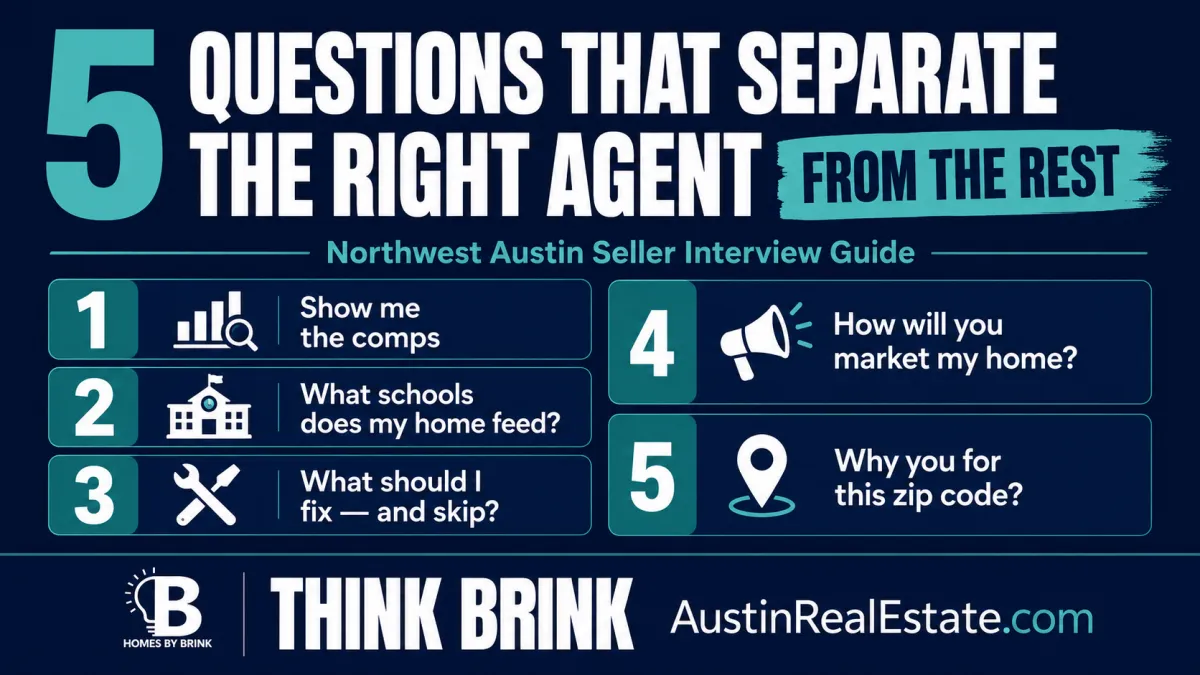
The interview question that reveals the most about an agent's pricing discipline is this: "Show me the comparable sales you would use to price my home, and walk me through how you got to the number."
A strong answer looks like: a set of three to six genuinely comparable closed sales from the past 60 to 90 days in your specific neighborhood, filtered by size, school assignment, condition, and lot position - with specific adjustments made between your home and each comparable that reflect what buyers actually pay for those differences in this market. The agent should be able to tell you specifically why one comparable sold for $50,000 more than another, what condition or lot difference produced that gap, and where your home sits in that range.
A weak answer looks like: a number derived from what the seller told them they want, or from a Zestimate with modest adjustment, or from comparable sales that include homes in different school districts, different condition categories, or from more than six months ago. Or a CMA that produces an unusually high number relative to what has actually closed - which is the classic "buying the listing" move where an agent flatters a seller with an aspirational price to win the listing, then reduces it after the home fails to sell.
Ask specifically: "Have you priced any homes in 78750 or 78759 in the past six months that had to reduce price, and what happened?" A good agent will have a specific and honest answer. Overpricing is often a market condition, not just an agent failure - but the agent should be able to articulate what they learned from it and how they'd approach it differently.
What Is Your 78750 or 78759 Home Worth Right Now?
The School District Question: A Differentiating Test
In 78750 and 78759, school district and feeder assignment are among the most powerful value drivers in the market. An agent who doesn't understand this deeply cannot position your home effectively.
Ask them: "What school district is my home in, and which specific campuses does it feed, and how does that affect how you'd price and market it?"
The right answer is specific. They should know not just the district but the exact feeder - whether your address feeds Westwood via Spicewood Elementary and Canyon Vista, or feeds Anderson via a different chain. They should be able to tell you the premium that confirmed RRISD assignment with Westwood feeder access commands over comparable homes without that assignment in your specific section. They should know which buyers are specifically targeting that feeder and how to reach them.
If the agent's answer is vague - "this area has great schools" - that tells you they don't know the market at the level that serves your interests. A vague school district answer from a listing agent means they will market your home to a general audience rather than targeting the specific motivated buyer pool that pays a premium for your specific school assignment.
The Condition and Preparation Conversation
Before you list, you will be making decisions about what to update, what to repair, what to stage, and how much to invest in pre-listing preparation. Your listing agent's guidance on those decisions directly affects your net proceeds.
Ask them: "What specifically should I do before listing, and what shouldn't I bother with? And how did you arrive at those recommendations?"
A strong answer is specific to your home and supported by data. Something like: "The kitchen is the most visible thing buyers will react to - given that comparable updated kitchens in your neighborhood have sold for $X more than original-condition ones, the investment in your specific situation would return $Y. The secondary bathrooms are not worth touching because buyers at this price point in 78750 are expecting to update them on their own and pricing reflects that. The exterior and landscaping are the highest-return pre-listing investment here because the online first impression is where buyers decide whether to schedule a showing."
A weak answer is generic: "You should declutter and deep clean and maybe paint." That advice applies to every home in America regardless of zip code, price point, or buyer profile. It tells you nothing about what will actually move the needle for your specific home in your specific market.
Also ask: "What do buyers in this price range in 78750 or 78759 react most negatively to, and how does that affect how we position the home?" An agent who works these zip codes daily will have a specific answer based on showing feedback they've actually received. An agent who doesn't will give you something generic.
What It Actually Costs to Own a Home in 78750 or 78759 Right Now
The Marketing Conversation
In 78750 and 78759, the buyer profile is heavily weighted toward tech professionals and dual-income households who are frequently relocating from out of state and doing extensive online research before they arrive to tour. That buyer profile has specific implications for how your home should be marketed.
Ask: "Walk me through exactly how you would market my home and what your marketing produces that a standard MLS listing doesn't."
You're looking for specific answers about professional photography - whether they use a dedicated real estate photographer, not just a good camera, and whether the photography package includes video walkthrough or 3D tour capability for out-of-state buyers who make initial decisions remotely. You're looking for answers about how they specifically target buyers relocating to Austin for Apple, IBM, and the broader tech corridor - because those buyers are a meaningful segment of the 78750 and 78759 buyer pool. You're looking for answers about how they handle digital marketing beyond the MLS - social targeting, email lists of active buyers in the price range, agent-to-agent marketing to buyer's agents who are working active searches in these zips.
Also ask about their open house strategy - not whether they hold open houses, but whether they think open houses serve your specific home in your specific price range. In 78750 and 78759 at the current price points, open houses serve a different function than they do in lower price ranges, and an agent with genuine market knowledge will have an informed opinion rather than a default "yes we do open houses" answer.
The Communication and Process Questions
These matter less than pricing and preparation but are worth covering because the transaction process in the current market requires an agent who communicates clearly and proactively rather than reactively.
Ask: "How will you communicate with me during the listing, and what does a typical week of feedback look like after the home goes live?"
The right answer describes a proactive process: weekly showing summaries that include not just how many showings occurred but what the feedback was and what patterns are emerging, a clear plan for what happens if the home isn't generating offers after two or three weeks, and direct communication about price adjustments rather than waiting for the seller to ask.
Ask: "What happens if my home isn't selling as expected after 30 days? What specific steps would you recommend and in what order?"
A strong answer describes a specific decision tree: first, evaluate whether the showing volume is appropriate for the price and whether feedback is pointing to a specific issue - condition, pricing, or presentation. Then determine whether the issue is correctable without a price reduction - presentation changes, staging additions, or a targeted outreach to buyer's agents actively working the zip. Then, if necessary, a specific price reduction recommendation based on where the comparable data actually points. Vague answers about "adjusting strategy" without specifics are a red flag.
What Sellers in 78750 and 78759 Should Know About the Market Right Now
The Listing Agreement: What to Read Before You Sign
The listing agreement is a contract, and the terms matter. Before you sign with any agent, understand these specific provisions:
The listing term. Most listing agreements run 90 to 180 days. In the current 78750 and 78759 market with an 86-day average days on market, a 90-day agreement is tight - if the home takes the full average to sell, you're at the end of the term when you finally go under contract. A 120 to 150-day term gives appropriate runway. But make sure the agreement includes a cancellation provision if you're not satisfied with the agent's performance - some strong agents offer no-penalty cancellation clauses that reflect their confidence in their own work.
The commission structure. Broker compensation in Texas has always been negotiable. The NAR settlement changes that took effect in 2024 mean that buyer's agent compensation is no longer required to be offered in the MLS and is now explicitly negotiated separately. Understand what your listing agent's fee is for their services and what, if any, buyer's agent compensation you are offering and how that decision affects your buyer pool. An agent who can explain this clearly and help you think through the tradeoffs is more valuable than one who gives you a rote answer about "industry standard."
The exclusions. If there is anyone you might sell the home to without an agent - a neighbor who has expressed interest, a family member, someone who has approached you directly - those exclusions need to be in the listing agreement before you sign, not after.
The Question That Cuts Through Everything
After the formal interview is done - the pricing conversation, the marketing strategy, the comparable analysis, the communication plan - there is one question worth asking every candidate before you make your decision.
"Why should I hire you specifically for this home in this zip code, and what would you do differently from the other agents I'm interviewing?"
Listen carefully to the answer. An agent who knows 78750 and 78759 specifically will give you a specific answer that references their transaction history in these zips, their knowledge of the school district nuances that drive value, their relationships with buyers' agents who are actively working searches in this market, and their track record with homes in comparable condition and price range to yours.
An agent who doesn't know these zip codes specifically will give you a generic answer about their team, their marketing platform, their years of experience in Austin broadly, or their brokerage's market share. Those things are not irrelevant - but they're not the answer to the question you asked.
The agent who can tell you specifically why your home's RRISD Westwood feeder commands a premium over comparable homes on the AISD side of the boundary, what buyers in your price range are reacting to in terms of condition right now, and what the realistic days-on-market expectation is for a home like yours in the current 78750 or 78759 market - that's the agent who will serve your interests.
Frequently Asked Questions
How many agents should I interview before hiring a listing agent?
Interview at least three. The NAR reports that sellers interview an average of two - which is not enough to meaningfully differentiate. Three interviews give you a reference point for comparing pricing approaches, marketing strategies, and market knowledge. If you hear significantly different price recommendations from three agents, the spread is telling you something important about how each one is analyzing your specific market.
Should I hire the agent who gives me the highest price estimate?
No - and this is one of the most common mistakes sellers make. Agents sometimes inflate their price estimates to win listings, knowing they can reduce after the home fails to sell. This is called "buying the listing" and it is more common than sellers realize. Ask every agent to show you the specific comparable sales that support their price recommendation. If an agent can't support their number with data, the number isn't a market estimate - it's a flattery strategy.
Does it matter if my listing agent has the CRS or ABR designation?
Professional designations like CRS (Certified Residential Specialist) and ABR (Accredited Buyer's Representative) indicate advanced training and a minimum transaction threshold. They're a meaningful signal of commitment to the profession, but they don't substitute for demonstrated transaction history specifically in 78750 and 78759. Use designations as one positive data point among several rather than as a primary selection criterion.
Should I use the same agent I bought with years ago?
Only if they still actively work 78750 and 78759 and have a current transaction record in these zip codes. An agent who bought you into the neighborhood ten years ago and has since shifted their focus to a different geography or price tier may not have the current market knowledge your sale requires. Check their recent transaction history before assuming loyalty is the right basis for the decision.
What commission should I expect to pay a listing agent in 78750 or 78759?
Listing agent commissions in Texas are negotiable and have no legal standard rate. Following the 2024 NAR settlement, buyer's agent compensation is also separately negotiated and no longer automatically offered through the MLS. Total transaction costs including both sides of commission, title insurance, and other seller closing costs typically run 8% to 10% of sale price. An agent who can clearly explain how their compensation is structured and what it covers is more valuable than one who gives you a vague answer and moves on.
How do I verify an agent's transaction history in 78750 or 78759?
Ask the agent directly for a list of their closed transactions in these zip codes over the past 12 months - addresses, sale prices, and days on market. You can cross-reference through public TCAD records or through Austin Board of Realtors data. Any agent who is reluctant to provide this specific information when asked is telling you something important.
