What Northwest Austin Sellers Get Wrong About Timing the Market
There is a version of the timing conversation that sellers in 78750 and 78759 have been having with themselves for the past two or three years, and it goes something like this: rates are still too high, the market hasn't fully recovered from 2022, spring might be better, fall might be better, maybe next year will look different. And so the decision gets deferred another season.
Some of those deferrals have been reasonable. Some have been expensive. And almost all of them have been based on a version of market timing that doesn't hold up when you look at what the data actually shows for these specific zip codes.
This post is about what the seasonal patterns in 78750 and 78759 actually look like, what market timing can and cannot realistically do for a seller, what the cost of waiting is in concrete terms, and what the decision should actually be based on.
Five Signs It May Be Time to Sell Your Northwest Austin Home
The Myth of the Perfect Market
The sellers who have been waiting for 2022 prices to return before listing have now been waiting for approximately four years. In that time, they have paid property taxes, homeowner's insurance, and maintenance on a home they were planning to sell. On a $700,000 home in these zip codes, that carrying cost has run approximately $26,000 to $32,000 per year - meaning four years of waiting has cost somewhere between $104,000 and $128,000 in cash that went out the door while they were waiting for the market to improve.
Meanwhile, the market has not materially recovered toward 2022 peak values. Austin's overall market is down approximately 2% to 3% year over year as of mid-2026 and remains meaningfully below the spring 2022 peak. Most forecasts call for modest appreciation of 1% to 3% annually through the near term - not the kind of recovery that would justify absorbing $26,000 to $32,000 per year in carrying costs while waiting for it.
The math works against waiting in most scenarios. For the wait to pay off financially, prices would need to appreciate faster than the annual carrying cost - which, for a home in these zip codes, means prices would need to rise 4% to 5% per year just to break even with the cost of staying. Current forecasts are not calling for that.
The perfect market - the one where rates are back at 3%, buyers are competing aggressively, and multiple offer situations are routine - is not on a near-term horizon that most analysts are identifying with confidence. Waiting for conditions that may not materialize on a useful timeline is a decision with a real price tag attached.
What Buyers Should Know About Great Hills Before Making an Offer
What Seasonal Timing Actually Delivers in 78750 and 78759
Here is what is genuinely true about seasonal timing in these zip codes, stated as specifically as the data supports.
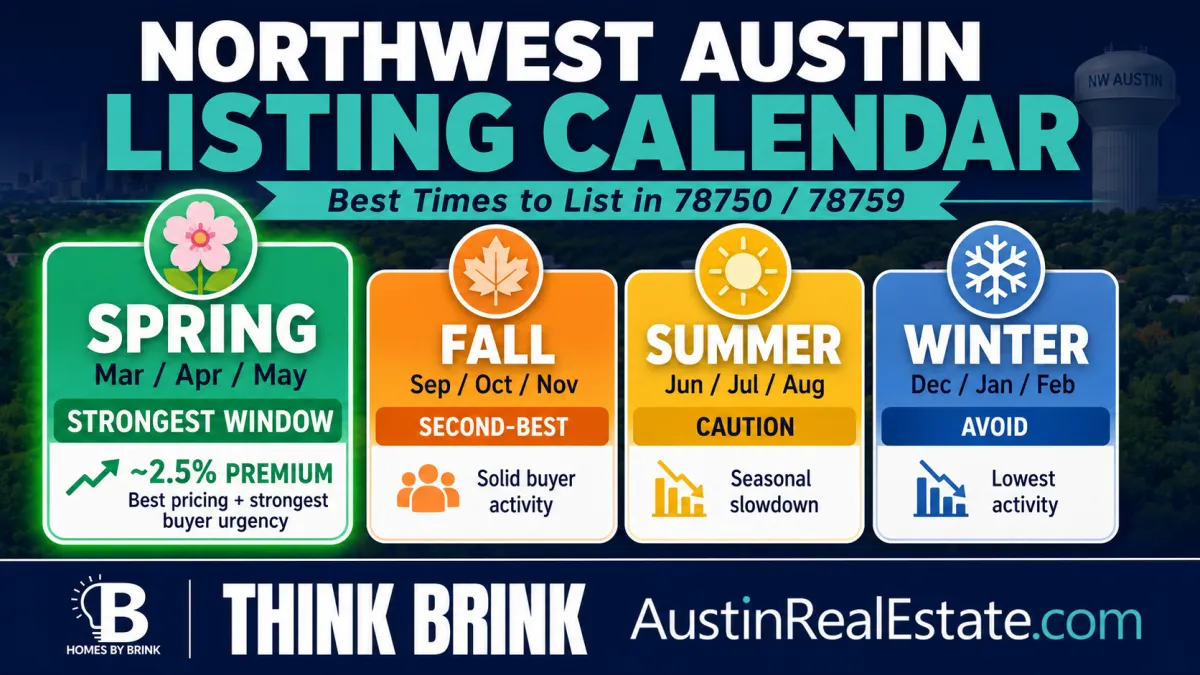
The strongest listing window in the Austin market - and in Northwest Austin specifically - is the second half of March through late April. Zillow's 2026 analysis puts Austin's best listing window in the second half of March, with homes selling for an estimated premium of approximately 2.5% compared to other periods. On a $700,000 home, that's roughly $17,500 in additional proceeds. That's a real number and worth planning around.
The reason spring works is specific and school-driven. The buyer pool in 78750 and 78759 is heavily weighted toward families with school-age children who are specifically targeting RRISD and the Westwood feeder, or AISD and the Anderson feeder. Those families are trying to close, move, and get settled before the school year starts. The AISD school year ends May 28 in 2026. That means families who want to be in the new home before fall need to be under contract by April or May at the latest, which drives buyer urgency and activity during the February through May window. That urgency is genuinely useful for sellers - it narrows the decision timeline for buyers in ways that benefit sellers.
The second-best window is September through early November. After the summer slowdown, buyer activity picks back up as families who didn't find what they needed in spring return to the market, corporate relocations for the fall semester land, and the remaining inventory from summer gets evaluated with fresh eyes. This window doesn't produce the same premium as spring but is meaningfully more active than summer or deep winter.
Summer - June through August - is the seasonal trough for buyer activity in 78750 and 78759. Families who needed to be settled before school have already bought or given up for the year. New buyer activity is at its lowest. Days on market extend. A home that doesn't sell in spring is not automatically better positioned by staying active through July and August - in many cases, extended days on market during the summer trough creates a perception problem that follows the listing into the fall.
December and January are the slowest months for showings and buyer activity. However, they serve a specific function for motivated sellers: the buyers who are active in December and January are almost universally highly motivated - corporate relocations, lease expirations, life events that created a must-buy situation. A home that is priced correctly and presented well can sell efficiently in December specifically because the competition from other listings is at its annual low. This is not a conventional wisdom tip - it's a real dynamic that correctly priced sellers have used effectively.
The School Calendar Is the Real Driver - Not the Season
Most timing advice for real estate is season-based because nationally, buyer activity broadly follows a spring-summer pattern. In 78750 and 78759 specifically, the more accurate frame is school-calendar-based.
The Westwood feeder and Anderson feeder are not abstract selling points. They are the specific reason a large and highly motivated segment of the buyer pool for these zip codes is buying on a specific timeline. A family relocating from California for an Apple role who has specifically identified RRISD and Westwood High School as their school requirement is not going to wait for fall if they can help it - they want to be settled before their kids start at Westwood or Canyon Vista in August. That timeline-driven buyer is disproportionately concentrated in the late February through May window.
What this means practically: if your home is in RRISD with confirmed Westwood feeder access, the spring window captures a buyer pool with genuine urgency that no other window replicates. A listing that goes live in late February or early March in a confirmed RRISD-Westwood address is stepping into the market at the moment that specific buyer type is most active and most motivated.
Conversely, a listing that goes live in September for the fall window captures a different but still meaningful buyer pool - corporate relocations with January start dates, buyers who are mid-search and ready to pull the trigger, and families who are planning ahead for the following school year. The fall window doesn't have the same urgency premium as spring but has less competition from other listings.
What Buyers Should Know About Spicewood Estates Before Making an Offer
The Preparation Timeline Most Sellers Get Wrong
Understanding when to list and understanding when to start preparing to list are different conversations. Most sellers who target the late February or March spring window don't start preparing early enough to actually be ready for it.
A home in 78750 or 78759 that is going to be listed in late February or March needs to be effectively ready by mid-to-late January to allow time for professional photography, staging, any pre-listing repairs, and the administrative work of the listing agreement and MLS preparation. That means the decisions about what to fix, what to update, and what to stage need to be made by December at the latest. And the agent relationship and pricing strategy conversation needs to happen in November or December.
Sellers who start that conversation in February are not listing in February or March - they're listing in April at the earliest, which puts them in the middle of the spring window rather than the beginning of it. The beginning of the spring window is where the best-condition buyers are actively searching and where the urgency is highest.
The same logic applies to the fall window. A seller targeting a September listing needs to be having the preparation conversation in July. A seller who starts thinking about it in September is listing in October or November, which compresses the fall window significantly.
The practical calendar for a seller targeting spring 2027 - the next full spring window - looks like this:
October and November 2026: Agent conversation, comparable market analysis, decisions about what updates or repairs to make before listing.
November through January: Pre-listing preparation - any targeted updates, professional staging consultation, photography planning.
Late January: Professional photography and final staging.
Late February: Listing goes live.
That timeline sounds long for what it produces, but it reflects the reality of how well-prepared spring listings are built. The homes that go live in late February having started preparation in November are competing differently from the homes that went live in April because the seller wasn't ready until then.
What Timing Cannot Fix
This is the part of the timing conversation most sellers need to hear.
Timing cannot fix overpricing. A home that goes live in the second half of March at a price that doesn't reflect current comparable sales will sit in the best seasonal window just as surely as it would in November. The spring window expands your buyer pool - it does not make buyers pay prices they wouldn't otherwise pay. Buyers in 78750 and 78759 are analytical, comparison-shopping, and informed. They know what comparable homes have closed for. A first week in March is not sufficient cover for a price that is 8% above what the data supports.
Timing cannot fix presentation problems. A home that photographs poorly, shows with clutter, has a tired exterior, or hasn't been properly staged will underperform in any season. In a spring market with more inventory competition than in off-peak periods, presentation problems are more costly, not less - because buyers have more options to move on to.
Timing cannot substitute for accurate school information. A listing that incorrectly identifies the school district in the MLS - or that leaves it ambiguous - is failing to serve the buyer segment that is most motivated in the spring window in these zip codes. Confirmed RRISD with Westwood feeder clearly communicated in the listing is a competitive advantage. Ambiguity is a missed opportunity.
What timing does is create conditions where good preparation and correct pricing perform better. It amplifies the results of everything else you're doing right. It doesn't rescue things that aren't being done right.
Living in 78750 and 78759: The Northwest Austin Zip Code Guide Buyers and Sellers Should Bookmark
The Real Variable: Your Situation, Not the Market
The most consistently successful sellers in 78750 and 78759 are not the ones who timed the market perfectly. They're the ones who made a decision based on their specific situation, prepared well, priced correctly, and listed in a seasonally reasonable window.
The questions that should drive your timing decision are not primarily market questions. They're personal questions.
What is your carrying cost right now, and how much more of it do you want to absorb? For every month you delay listing, you are spending roughly $2,200 to $2,700 in taxes, insurance, and maintenance on a $700,000 home. If waiting three more months for a better window adds $6,000 to $8,000 in carrying costs, the premium that the better window might deliver needs to exceed that cost to make the wait financially rational.
What is your next move, and what does its timing require? If you need to sell before you can buy the next home, or if you're coordinating with a lease expiration, a job start date, or a family transition, those real-life constraints should drive your timing more than seasonal patterns. A correctly priced, well-prepared home can sell in any season. The question is whether the seasonal premium is worth the personal cost of waiting for it.
Are you actually ready to list, or is "waiting for the right time" covering for not yet being prepared? This is the most honest version of the timing question for many sellers. If the home needs work before it can be listed, or if the preparation conversation hasn't happened yet, the timing question is academic. The right time to list is when you are actually ready - and getting ready takes longer than most sellers anticipate.
Is Northwest Austin Still Worth the Premium?
The Honest Summary on Timing in 78750 and 78759
The spring window - late February through late April - is real and meaningfully better than any other period for seller outcomes in these zip codes. The school-calendar-driven urgency in the buyer pool during this window is genuine and produces real results for well-prepared, correctly priced listings.
The fall window - September through early November - is the second-best option and works well for sellers who miss spring or who are specifically targeting the corporate relocation and plan-ahead buyer.
Summer and deep winter are the weakest windows and should be avoided if the seller has any flexibility.
The carrying cost of waiting for a future window is $2,200 to $2,700 per month. The premium of the best window over an average window is roughly 2% to 3% of sale price. For a $700,000 home, that's $14,000 to $21,000 in premium - roughly equivalent to 6 to 10 months of carrying costs. Waiting more than 6 to 10 months for a better window erodes the benefit of the window itself.
The decision to sell should be made primarily based on your circumstances, your carrying cost, your next move, and whether you're ready. Once that decision is made, timing the listing to the best available seasonal window is a legitimate optimization. Waiting indefinitely for the perfect seasonal moment while carrying a home that has outlived its usefulness for your life is not optimization - it's deferred decision-making at real cost.
What North Austin Growth Means for Homeowners Near The Domain, Apple, and Parme
Frequently Asked Questions
When is the best time to list a home in 78750 or 78759?
The second half of March through late April is consistently the strongest window, driven by school-calendar urgency in the buyer pool for these zip codes. Zillow's 2026 analysis identifies the second half of March as Austin's peak listing window, with an estimated 2.5% premium over other periods. The fall window - September through early November - is the second-best option. Summer and December through January are the weakest periods for buyer activity.
How much does seasonal timing actually affect sale price in Northwest Austin?
The premium for the strongest spring window versus the weakest summer or winter period is approximately 2% to 3% of sale price in current market data. On a $700,000 home that's $14,000 to $21,000. That's a real number worth planning around - but it needs to be weighed against the monthly carrying cost of waiting for a better window, which runs $2,200 to $2,700 per month for a home in this price range.
Does it make sense to wait for mortgage rates to drop before listing?
Current forecasts from major lending institutions put 30-year fixed rates in the 6% to 6.4% range through most of 2026 and into 2027. Rates are not expected to return to 2020 and 2021 levels in any near-term forecast. The buyer pool at 6.4% is smaller than at 3%, but buyers are still transacting - particularly the tech-professional dual-income households that dominate the 78750 and 78759 buyer pool and frequently have the income to absorb current rates. Waiting for rates to drop to 5% or below before listing is waiting for a condition that may not arrive on a useful timeline.
If I miss the spring window, should I list in summer or wait for fall?
Wait for fall if you can. Summer - June through August - is the weakest seasonal window in these zip codes, with reduced buyer activity and extended days on market. A home that didn't sell in spring and stays active through July and August can develop a days-on-market perception problem that follows it into the fall. Pulling the listing in June and relaunching in September with fresh positioning and accurate pricing typically produces better outcomes than sitting through summer.
When should I start preparing to list if I want to be on market in late February or March?
The agent conversation and pricing strategy discussion should happen in October or November. Pre-listing repairs and updates should be completed by January. Professional photography and final staging should happen in late January. That timeline puts you in a position to go live in late February - the beginning of the spring window - rather than scrambling to get ready in April when the window is already partially closed.
Is December or January ever a good time to list in 78750 or 78759?
For a motivated seller who has flexibility on price, yes. The buyers who are active in December and January are almost universally highly motivated - corporate relocations, lease expirations, and life events that created a must-buy situation. Competition from other listings is at its annual low. A correctly priced home can move efficiently in December for a seller who is ready and wants to avoid waiting another full season for spring.
